
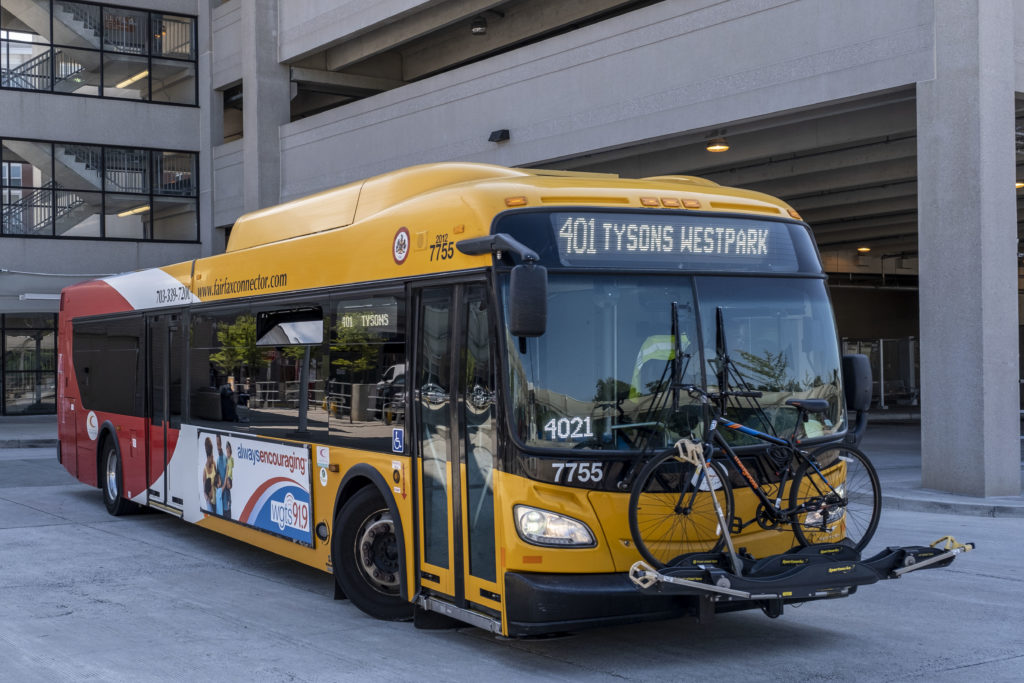
Fairfax Connector suspended fare collections last year as a temporary health measure in response to the COVID-19 pandemic, but the public bus system is considering longer-term adjustments to its fare policies with support from a new state grant program.
The Fairfax County Department of Transportation is one of 12 transit agencies in Virginia that have expressed interest in the Department of Rail and Public Transportation’s new Transit Ridership Incentive Program (TRIP), which will fund projects that increase connectivity in highly populated areas or remove barriers for low-income individuals by reducing or eliminating fares.
While fare collection resumed on Jan. 4, county leaders see reducing or subsidizing trip costs as one way to encourage more people to ride the Connector, which is the largest local bus system in Northern Virginia, transporting approximately 30,000 passengers on 91 routes in ordinary times.
“Access to transit is crucial in promoting equity county-wide and for many a barrier is cost,” Fairfax County Board of Supervisors Jeff McKay said. “Our Department of Transportation is committed to looking into how we can provide aid to those experiencing economic hardship.”
Created by the General Assembly during its 2020 session, TRIP was conceived before the novel coronavirus arrived in the U.S., but Virginia Transportation Secretary Shannon Valentine told the Commonwealth Transportation Board during a May 18 workshop that the pandemic illustrated how vital public transportation is for essential workers, DCist reported.
“Fares turned out to be an obstacle. So we are really trying to use this as an opportunity,” Valentine said, according to DCist.
DRPT has split TRIP into two programs: one focused on regional connectivity, which could include everything from integrated fare collection systems to the creation of bus-only lanes on significant routes, and one focused on reducing the impact of fares on low-income users, which could involve eliminating fares, creating zero-fare zones, or providing subsidized or free passes.
Virginia has allocated a total of $129 million to the TRIP initiative through fiscal year 2027, including $88.4 million for the connectivity program and $39.6 million for the fare program, according to a presentation that DRPT delivered to the Commonwealth Transportation Board.
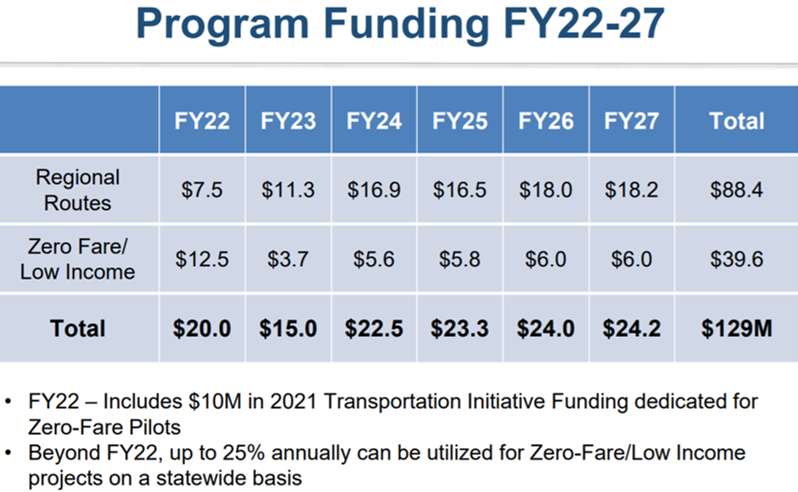
Legislators limited the fare reduction program to 25% of the initiative’s annual funding, but the General Assembly gave the program an additional $10 million in the state’s fiscal year 2022 budget, raising its total to $12.5 million for the upcoming fiscal year, which begins on July 1.
DRPT released a draft policy last week outlining how TRIP will be implemented, including how projects will be evaluated for grant funds. The resolution is open for public input through June 18, and the CTB is scheduled to vote on it on June 23.
The department has also made a draft of the program’s application guidelines available for public comment until July 7. Read More
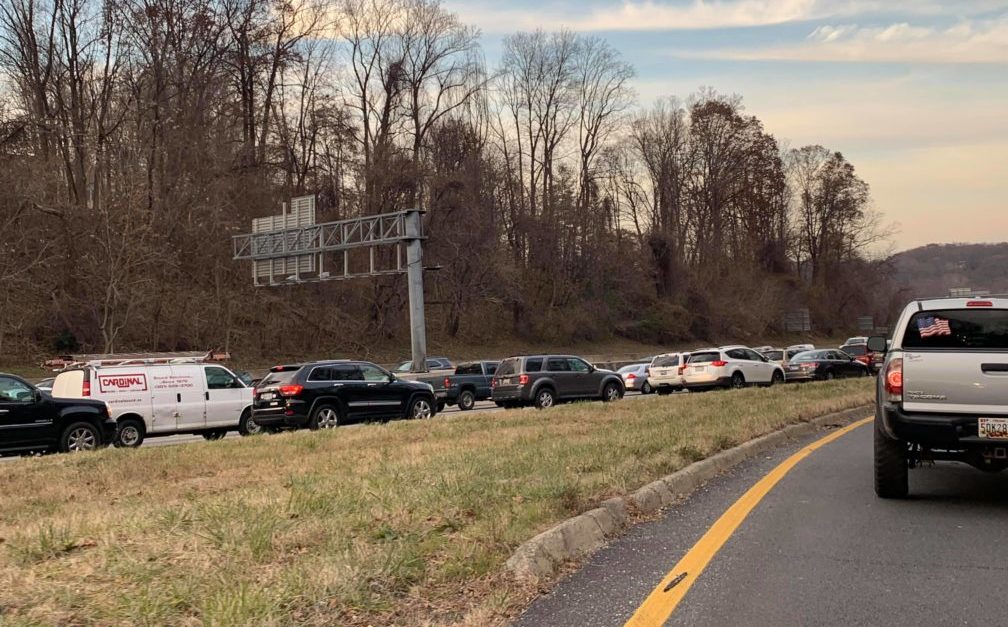
In its current state, the American Legion Bridge doesn’t work. Anyone who has driven across the bridge during rush hour knows the pain of being stuck in hours of back up as traffic bottlenecks, but a new study aims to relieve some congestion with proposed bus routes between Maryland and Virginia.
Conducted by the Maryland Department of Transportation and the Virginia Department of Rail and Public Transportation, the transit and transportation demand management study examined the existing traffic congestion on the bridge and finalizes recommendations for future bus routes with dedicated transit lanes in the I-495 corridor.
According to the study, traffic on the American Legion Bridge has continued to increase over the past two decades:
Between 2002 and 2017, the traffic volumes on the Bridge increased by 18 percent. Population and employment growth is projected to continue in the region, specifically in Tysons and the surrounding area, putting further strain on the existing infrastructure. The Traffic and Transportation Technical Report for the I-495 Express Lanes Northern Extension also found that trips travelling across the Bridge have a wide-range of origins and destinations, with many existing and projected future trips originating and ending in locations outside of Fairfax County and Montgomery County — the two jurisdictions connected by the Bridge.
And it’s likely to get worse. Based on projected population growth in areas like Tysons, the study says traffic on the bridge is expected to increase by 31% over the next two decades, with 1,833 additional trips per year, primarily from Maryland residents coming to attractions or workplaces in Virginia.
“The majority of existing trips are generated in Maryland, clustered along the MD 355 corridor, along with smaller clusters around Frederick and the US 29 corridor,” the study said. “In Virginia, trip generation is concentrated in the activity centers of Tysons, Dunn Loring, Alexandria, and Arlington.”
The study noted that aside from Metro, no existing transit options offer any inter-state connections, and the Metro routes circuitously travel through Rosslyn.
“Commuter bus routes running on managed lanes could be more efficient to commuters travelling between these key activity centers rather than a circuitous transit trip on Metrorail,” the study said. “In addition to local and commuter bus service, access to managed lanes can drastically improve travel times for carpool and vanpool users.”
The Fairfax County Board of Supervisors recently endorsed plans to extend the I-495 Express Lanes to the American Legion Bridge, but the viability of the 495 NEXT project depends on Maryland widening its portion of the highway, a proposition that remains tentative at best.
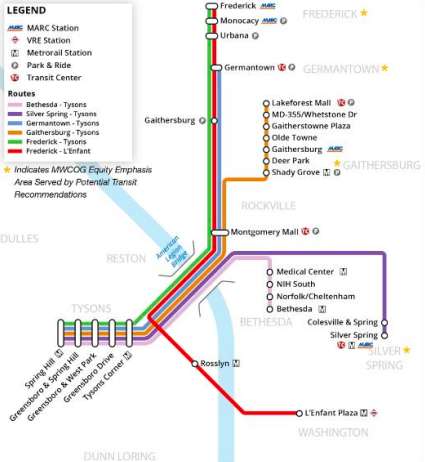
If the planned dedicated transit lanes on the American Legion Bridge do come to fruition, the study looked at several potential bus routes that could run between Tysons and Maryland, including lines to Bethesda, Germantown, Silver Spring, Frederick and Gaithersburg.
The study found that the routes to Bethesda, Silver Spring and Gaithersburg all scored fairly highly when it came to factors like connections to low-income areas and potential ridership.
The study included a range of options based on different levels of investment in transit infrastructure.
The baseline transit expansion was for $2.2 million to $3.5 million in annual operating costs. This would offer a pair of routes that run from Spring Hill to Lakeforest Mall in Germantown and Bethesda.
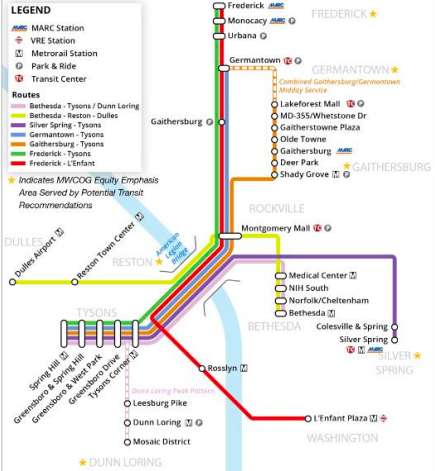
A medium-cost expansion would run from Spring Hill up to Frederick and to Bethesda as well as Silver Spring, with another line connecting Frederick down to Rosslyn and L’Enfant Plaza. This package has estimated annual operating costs of $6.8 million to $11.6 million.
The highest investment package would include all the above, plus a line out to Reston Town Center and Dulles Airport and another to the Mosaic District. The annual operating cost would be between $11.4 million and $19.8 million.
People who live and work in Tysons are one step closer to getting a bus rapid transit route through the area.
Fairfax County began studying options for bus rapid transit in Tysons two-and-a-half years ago as part of the larger Envision Route 7 BRT project from the Northern Virginia Transportation Commission, which would establish bus service between Tysons and the Mark Center in Alexandria.
Now, the Fairfax County Department of Transportation has settled on a preferred route within Tysons, which it will recommend to the NVTC as the organization embarks on the fourth phase of study for the Envision project.
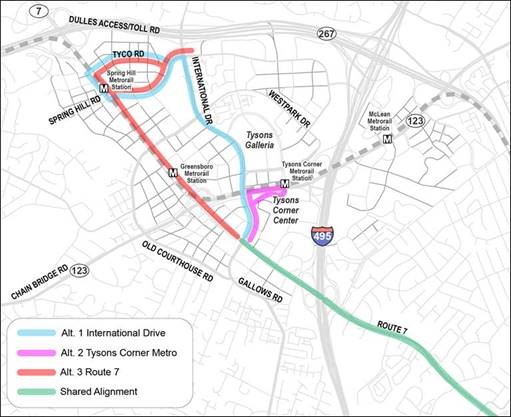
The county’s preferred route goes up Route 7 and takes International Drive up to Spring Hill Road, where it loops onto Tyco Road to rejoin International Drive. It will make six stops, FCDOT BRT Route 7 Project Manager Sean Schweitzer said during an informational meeting Wednesday night (March 24).
FCDOT chose the route out of three proposed alternatives because it would serve the most households, the greatest population — about 6,700 people — and the largest employment area in Tysons, according to Schweitzer.
Staff had narrowed nine options down to three after considering cost, sustainability, and accessibility, among other factors, he said. The second option, which is much shorter, branches off Route 7 to loop past Tysons Corner Center and the Tysons Metro station.
Schweitzer said the third alternative most closely resembles the NVTC’s vision for a route through Tysons, circling around Tyco and Spring Hill roads but remaining aligned with Route 7 by passing through the Greensboro Metro station.
FCDOT staff will accept comments on the proposed paths through April 14 via the Route 7 BRT Survey. The NVTC will incorporate the selected route into the final phase of its Envision Route 7 BRT study this summer and fall, Schweitzer said.
“BRT is a more efficient form of local bus, which typically operates in zone-exclusive lanes,” he said. “BRT usually has enhanced stations with raised platforms for level boarding, smart digital fare, and real-time passenger information and bus times. Stops are more limited than local bus and are more distanced.”
BRT is comparable to light rail but at a lower capital cost, he said.
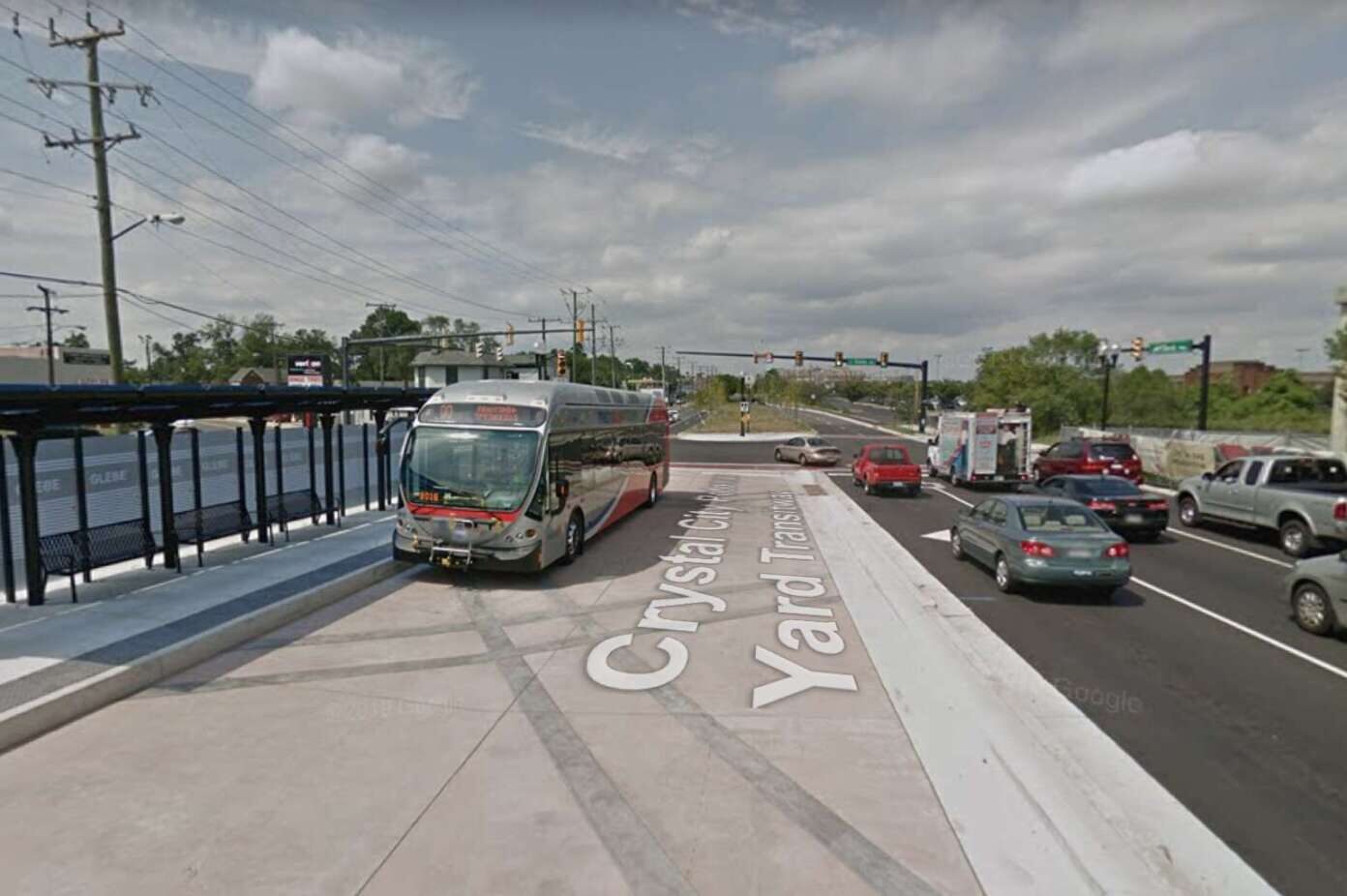
Like the BRT service operated by the Washington Metropolitan Area Transit Authority in Alexandria, pictured above, a service in Tysons could run along the median for part of the route. To further reduce conflicts with cars and bicycles, buses would get transit signal priority, and bicycle lanes would run behind the stations.
The buses would drive in mixed traffic, turning left onto Spring Hill and transitioning into a bus-and-turn lane before returning to the median lane, according to Schweitzer.
The service would run from 5 a.m. to 1 a.m. on weekdays and 6 a.m. to 12 a.m. on weekends, seating 110 passengers, he said.
After the meeting, FCDOT planner Mike Garcia told Tysons Reporter that the county obtained input from residential and commercial management groups, homeowners and civic associations, faith communities, libraries, recreational centers, schools, and other stakeholders, including the Tysons Partnership, in coordination with district supervisor offices.
“The pandemic did limit our outreach efforts to physically reach out to communities,” he said.
Map via FCDOT, photo via Google Maps

Wind Advisory in Effect Today — A wind advisory will be in effect today for the D.C. area, including Fairfax County, from 11 a.m. to 7 p.m. Winds could reach speeds of 20 to 30 miles per hour with gusts up to 50 miles per hour. Gusts could blow around unsecured objects and result in fallen tree limbs or power disruptions. [National Weather Service, Fairfax County Office of Emergency Management/Twitter]
Northam Plans to Speed Up Marijuana Legalization — “Virginia Gov. Ralph Northam is expected to ask the legislature to legalize the adult possession of an ounce or less of marijuana beginning on July 1, according to several sources with knowledge of the administration’s ongoing discussions with lawmakers. Lawmakers passed legislation last month that wouldn’t take effect until Jan. 1, 2024.” [VPM]
Falls Church Narrows Down Possible New School Names — Committees tasked with selecting new names for the city’s elementary and high schools will present five recommendations each to the Falls Church City School Board by April 9. The groups have whittled hundreds of suggestions down to 18 options for the high school and 53 for the middle school. The school board will make the final decisions on May 13. [Falls Church News-Press]
Greater Washington Partnership Envisions Regional Train System — “An alliance of the Washington area’s top chief executives is pushing for Maryland and Virginia commuter trains to cross jurisdictions to provide service that would be more frequent and more interconnected…It could be achieved within a quarter-century, said the group, which has rallied support from transit advocates, the region’s passenger railroads and public- and private-sector groups.” [The Washington Post]
Satellite Telecommunications Company Moves Into Tysons — SpaceLink announced earlier this week that it has established a headquarters office in Tysons. The company, which also operates in Silicon Valley and Huntsville, Alabama, is developing a “network of satellites in medium Earth orbit that will provide secure, continuous, high-bandwidth communications between its clients’ low Earth orbit spacecraft and the ground.” [Virginia Business]
Fairfax County Sees Dip in Unemployment Rate — Fairfax County’s jobless rate dropped almost half a percent between December 2020 and January 2021, according to data from the Virginia Employment Commission. However, unemployment rates throughout Northern Virginia are still more than double pre-pandemic numbers. [Sun Gazette]
Fairfax Connector will make a few service changes this summer.
The Fairfax County Board of Supervisors unanimously approved several proposed service changes during its meeting yesterday (Tuesday). The changes will be implemented starting July 10.
Service on Routes 462 and 467 will be enhanced “to improve connectivity between the Dunn Loring and Tysons Corner Metrorail Stations, as well as provide access to employment centers and activity centers along Maple Avenue,” according to the proposal made to the Board of Supervisors.
Route 462 will operate with 30-minute frequency while providing weekday peak-period service between the Dunn Loring and Tysons Corner Metrorail stations.
The realignment of Route 467 comes in response to the opening of a new Cedar Lane Bridge in Vienna.
The route will add Sunday service and provide weekday, midday and evening service as well as weekend service between the Dunn Loring and Tysons Corner Metrorail stations. The new realigned route will service Maple Avenue, and Old Courthouse Road to Gallows Road. It will operate with 40-minute frequency.
Route 422 will be discontinued due to low ridership, and because it duplicates service on other routes, including Routes 462 and 467. It currently operates as a circulator between Boone Boulevard and the Tysons Corner Metrorail station.
The proposal to the board says that eliminating Route 422 would offset the service adjustments to Routes 462 and 467.
Fairfax Connector will also assume operations of five Metrobus routes — Routes 703, 715, 803, 834, and 835 — that link communities to the McLean, East Falls Church, West Falls Church, and Pentagon Metrorail stations.
Route 703 replaces the existing Metrobus Route 3T, which is not currently operating and had been scheduled to be eliminated by the Washington Metropolitan Area Transit Authority this year. The new route will provide weekday and Saturday service, linking Pimmit Hills and Tysons to the McLean and West Falls Church Metrorail stations.
Route 803 replaces existing Metrobus Route 3A, which is operating with reduced levels of service. The route will provide weekday and Saturday service to connect Lake Barcroft, Annandale and North Springfield to the East Falls Church Metrorail station.
Both 703 and 803 will operate with 30-minute frequency during weekday peak periods, 40- to 60-minute frequency during weekday off-peak periods and 45-minute frequency on weekends.
Routes 715, 834, and 835 will all provide peak-period service to replace existing Metrobus routes that are not operating currently. They will operate with a frequency of 30 minutes.
Route 715 replaces Route 15K, which links McLean, Salona Village and Chesterbrook Gardens to the East Falls Church Metrorail station.
Route 834 replaces Route 29C, which connects Northern Virginia Community College, Annandale, and Lincolnia to the Pentagon Metrorail station.
Route 835 replaces Route 29W, which links the Northern Virginia Community College and Willow Woods communities in Annandale to the Pentagon Metrorail Station.
The Fairfax County Department of Transportation announced plans to pursue the service changes in December. The changes carry an estimated capital cost of up to $650,000 to purchase 12 buses from Metro and an additional $400,000 to convert them to the Fairfax Connector fleet, according to county staff.

Car Crash Shuts Down Eastbound Leesburg Pike — A car crash around 6:48 a.m. on Leesburg Pike near Colvin Run Road forced the eastbound lanes to close. First responder crews extricated a person who was trapped in a car and transported them to a hospital with non-life-threatening injuries. The crash has now been cleared, and the road is back open. [Fairfax County Fire and Rescue Department/Twitter]
Madison Girls’ Basketball Team Wins State Championship — The Warhawks beat Osbourn Park 54-48 on Saturday (Feb. 20) to earn James Madison High School’s first girls basketball state title since 1993. The team was within a game of the championship last year, but the final contest was canceled due to the COVID-19 pandemic. [The Washington Post]
Leesburg Pike Bus Stop to Be Skipped Due to Construction — “Effective February 24, 2021: Until further notice stop #2674 (Leesburg Pike and Lyons St) will be skipped due to ongoing construction on Leesburg Pike. We encourage you to use alternatives a thank you for your patience.” [Fairfax Connector/Twitter]

All Town of Vienna government offices and facilities will be closed tomorrow (Thursday) as the D.C. region braces for a winter storm that could deliver up to six inches of snow and a quarter inch of ice.
The town-wide closure extends to the Vienna Community Center, and all parks and recreation classes and programs have been canceled, along with Thursday trash pick-up services.
A Board of Architectural Review meeting that was scheduled to take place at 7:30 p.m. tomorrow has been postponed.
“This decision was necessary to ensure the safety of Town employees and because it is anticipated that all staff hands will be needed for snow removal,” the Town said in a statement.
This decision was necessary to ensure the safety of Town employees and because it is anticipated that all staff hands will be needed for snow removal. (Trash will be collected next Thursday, February 25, as regularly scheduled). 2/3
— Town of Vienna, VA (@TownofViennaVA) February 17, 2021
The National Weather Service has issued a Winter Storm Warning for Fairfax County and the rest of the D.C. area starting at 3 a.m. tomorrow and lasting until 6 a.m. Friday.
Residents are being advised not to travel, and Dominion Energy says it is preparing for potential multiple-day power outages throughout the state, including in Northern Virginia.
Metro will operate buses on a moderate snow service plan, while maintaining regular weekday rail operations, though de-icer trains and heaters will be utilized.
Fairfax Connector will offer full service tomorrow, but some routes will be detoured and could be further modified or suspended based on road conditions. A full list of missed stops can be found on the transit service’s website.
Prepare now! Approaching ice storm could be worse than Saturday’s which caused 290,000 outages! @DominionEnergy is preparing for MULTI-DAY outages across Va.
📌Stock extra batteries, medicine, food etc. Report outages to https://t.co/VN1BaqzNtd or our DE app.@WTOP @fox5dc https://t.co/agYVXOAtEF— Peggy Fox (@PeggyDomEnergy) February 17, 2021

Metrorail is now operating at the same frequency during peak and off-peak hours on weekdays after budget changes prompted by the impact of the COVID-19 pandemic took effect yesterday (Monday).
Under the revised Fiscal Year 2021 budget, trains are running every 12 minutes on the Orange, Silver, Blue, Green, and Yellow lines, while Red line trains operate every six minutes. Service after 7 p.m. and on weekends has not been altered.
The reduction of rail service during weekday rush hours was recommended as part of a revised FY 2021 budget that the Washington Metropolitan Area Transit Authority Board of Directors approved when it met on Nov. 19.
“The changes bring rail service in line with ridership demand while managing costs amid pandemic-related budget constraints,” WMATA said in a news release. “Rail ridership remains down nearly 90 percent from pre-pandemic levels.”
In contrast, WMATA says Metrobus ridership is only down 55% on weekdays and less on weekends compared to pre-pandemic levels, so service will expand to accommodate additional capacity starting on Mar. 14.
“Customers will see more buses, more often on the 125 lines of service currently operating, and more routes will be added to expand bus service on weekends,” WMATA said.
More details about the March Metrobus service changes will be provided at a later date, the transit agency says.
Staff photo by Jay Westcott

Virginia Detects First Case of COVID-19 Variant — “The first case of the SARS-CoV-2 variant B.1.1.7 has been identified in a sample from an adult resident of Northern Virginia with no reported recent travel history. The B.1.1.7 variant, which first emerged in the United Kingdom in late 2020, is associated with increased person-to-person transmission of COVID-19.” [Virginia Department of Health]
Additional Ice Accumulation Possible This Morning — “Icy roads and trees can be expected in many areas this morning, but the majority of wintry weather is now behind us. However, hazards may linger into this afternoon as temperatures will only rise slowly this morning.” [National Weather Service/Twitter]
Fairfax Supervisors Prepare to Endorse American Legion Bridge Transit Study — The Fairfax County Board of Supervisors is scheduled to vote on whether to support the Virginia Department of Rail and Public Transportation’s I-495/American Legion Bridge transit demand study. Recommendations include several proposed routes to and from Tysons. [Sun Gazette/InsideNoVA]
Judge Allows Thomas Jefferson High School Admissions Lawsuit to Move Forward — “The ruling issued Thursday by Fairfax County Circuit Judge John Tran tosses out some aspects of the lawsuit but allows the core allegations to go forward. The lawsuit contends that state regulations require TJHSST to operate as a school for the gifted, as measured by scores on standardized tests.” [WTOP]
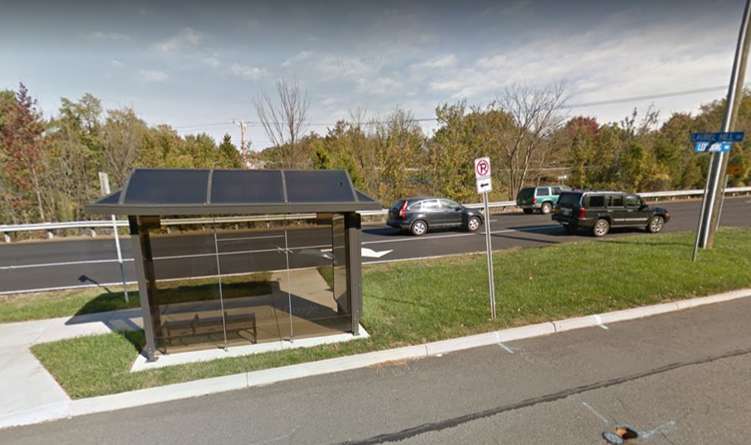
Fairfax Connector has suspended service to bus stop 2605 on Leesburg Pike and Laurel Hill Road until December to accommodate construction on Route 7.
The temporary bus stop closure took immediate effect around noon today, and it is expected to last until approximately the end of 2021, the Fairfax County transit system says.
According to Fairfax Connector, the suspension of service was necessitated by a traffic switch that began this week on Leesburg Pike between Lewinsville Road and Jarrett Valley Drive in the McLean area.
The Virginia Department of Transportation initiated a lane shift and closed direct access to Route 7 from Laurel Hill and Old Ash Grove as part of its Route 7 corridor improvement project, which is widening the highway between Tysons and Reston. The traffic changes will be in effect until late 2021.
Fairfax Connector advises passengers to use stop 2673 as an alternative to the closed stop. Stop 2673 is located near the intersection of Leesburg Pike and Lewinsville Road across from the McLean Bible Church.
⚠️ Effective immediately until December 2021, stop 2605 (Leesburg Pk/Laurel Hill Rd) will be suspended due to road construction. Use stop 2673 (Leesburg Pk/Lewinsville Rd) as an alternate. Thank you for your patience.
— Fairfax Connector (@ffxconnector) January 21, 2021
Photo via Google Maps