
At tonight’s Vienna Town Council meeting, a planned overview of the town’s budget process lays out local budget priorities so far and offers a look at what’s coming next.
In previous meetings, the town manager presented his proposed budget and 10 budget priorities:
- Real estate tax rate remains at $0.225 per $100 of assessed value. This is the seventh year of decrease or no change.
- Three percent compensation increase for eligible employees
- Water and Sewer rates rising 10 percent in total to cover operating costs, maintain positive cash flow and meet industry standards for billing the fixed cost portion of the bill.
- Parks and Recreation revenue increasing $280,000 due to strong attendance and programming
- Minimal personnel changes
- Stormwater engineer salary increase to handle sustainability coordinator duties
- Shift $200,000 from operating budget to capital budget for asphalt costs
- Two vehicles added using unspent capital lease proceeds, water and sewer funds and stormwater funds
- Three percent decrease in health insurance for Anthem, 9 percent increase for Kaiser health insurance, generating an additional $125,000 in savings
- $400,000 available for unfunded priorities allocated to an economic development manager, updated zoning code and other priorities
The economic development manager position was one discussed by the Town Council as part of the strategic plan. The consultant would assist the town in trying to stem the tide of businesses vacating the town.
Town Council work sessions for the budget are planned for March 16 and 18, with a third on April 22 if needed.
A public hearing on the budget, water and sewer rates is scheduled for April 8 and for the proposed tax rate on April 29.
Final budget adoption is scheduled for May 13.
File Photo
An effort to prohibit Vienna Town Council members from taking private meetings with developers was brought to a screeching halt this week.
Town Attorney Steven Briglia said such an ordinance would likely violate a number of laws, from First Amendment rights protecting free speech, including that of developers, to the Citizens United case and Virginia’s Dillon Rule, which only allows localities to pass ordinances where granted clear authority from the General Assembly.
According to Briglia at a Vienna Town Council and Planning Commission work session on March 4:
“The question came up about a month ago about possibly limiting discussion with developers and passing an ordinance requiring any meetings by members of a public body be public. I started with that mandate to see if there was any authority that could restrict a local ordinance… To get right to the end, not only could I not find any authority in Virginia that would enable the town or any locality to pass an ordinance restricting individual contact by representatives of a developer with a member of the council, but… under Virginia law the general assembly says you can do what we say you can do and no more.”
Briglia also said the proposed ordinance could be seen as a violation of free speech.
“I think there would be First Amendment [issues] and I ran it by other attorneys and they had the same concerns I did,” said Briglia. “Citizens United was an expansion of basically corporate rights under First Amendment. Years ago, the Supreme Court said corporations are people for purposes of certain activity under government [so] corporations have the same rights as an individual.”
The effort had been spearheaded by Councilmembers Pasha Majdi and Howard Springsteen, two of the leading opponents to the controversial Maple Avenue Commercial (MAC) developments last year. Majdi asked if the proposal could be pursued as a town policy and a resolution rather than codified law, but ultimately the Council agreed not move forward with any plans for limiting developer-council member discussions.
The discussion also opened old wounds about developer pressures on Town Council members, with Springsteen saying developers frequently used overbearing or even threatening tactics to try to intimidate the town into getting their way. But during a heated exchange, one Planning Commission member said the proposal was but another attempt to stall new development.
“This is another effort to make the MAC even more difficult,” said Planning Commission member Sarah Couchman. “I don’t think this is a widespread problem. It’s like electoral fraud. People hype it up. To use a policy of fear that Council members and Commissioners are going behind people’s backs and having meetings with developers is not right. I’m sorry you feel you need a policy to cite, but the fact of the matter is you can always say ‘I am not comfortable with this.'”
File photo

The Vienna Town Council will review two projects along Maple Avenue in a work session tonight (Monday), after indicating concerns that developers are trying to skirt zoning regulations by pushing their proposed heights a bit higher than current limits might allow.
The 380 Maple development is a proposed mixed-use building with 7,500 square feet of ground floor retail and 40 residential condominiums on three floors. The building includes one floor of underground parking and two floors of structure above-ground parking, but staff noted that the applications calls for an extra half-floor added to the mix, beyond current limits in the area.
“Staff notes that the applicant is proposing a half-floor of parking between the first story and second story of the building, beyond the four stories allowed per code,” staff said in a project overview. “The applicant is applying for a modification of requirement for the additional half-story.”
While approving of greater levels of parking available at the site, Councilmember Douglas Noble said at a meeting last week that he was concerned the additional half-story would still be contrary to the Maple Avenue zoning code’s five-story limit.
Meanwhile, the Sunrise Assisted Living project, a four-story building with 85 assisted living units and 7,700 square feet of first-floor commercial space, is also requesting a “half-story” space.
“Staff notes that the applicant is proposing a half-story space to include additional lobby and common spaces for the assisted living facility between the first story and second story of the building, beyond the four stories allowed per Code,” staff said in the project overview. “The applicant is applying for a modification of requirement for the additional half-story.”
An additional item listed as “limiting discussion with developers” was also added to the agenda at the request of Councilmembers Pasha Majdi and Howard Springsteen, two of the leading opponents to the controversial Maple Avenue Commercial developments last year.
Image via Town of Vienna Planning and Zoning
New Falls Church Development — “Founders Row, a future mixed-use development set to bring a major transformation to Falls Church, has broken ground. Mill Creek Residential’s 4.5-acre development will include luxury apartments and retail space at West Broad Street and North West Street. A formal groundbreaking ceremony will happen Monday, March 4.” [Patch]
Vienna Posting More Meetings Online — “The town of Vienna long has posted video recordings of Town Council and Planning Commission meetings, but those who wished to review less-formal work sessions of those bodies were out of luck. That has changed recently, as the town has begun posting on the Web audio recordings of meetings and work sessions of those bodies within 48 hours, said town spokesman Lynne Coan.” [InsideNova]
Vehicle Slams into Vienna ABC Store — “A driver pulled into a parking spot at the Virginia ABC store, 436 Maple Ave., E., on Feb. 12 at 5:30 p.m. and accidentally left his vehicle’s transmission in drive, Vienna police said.” [InsideNova]
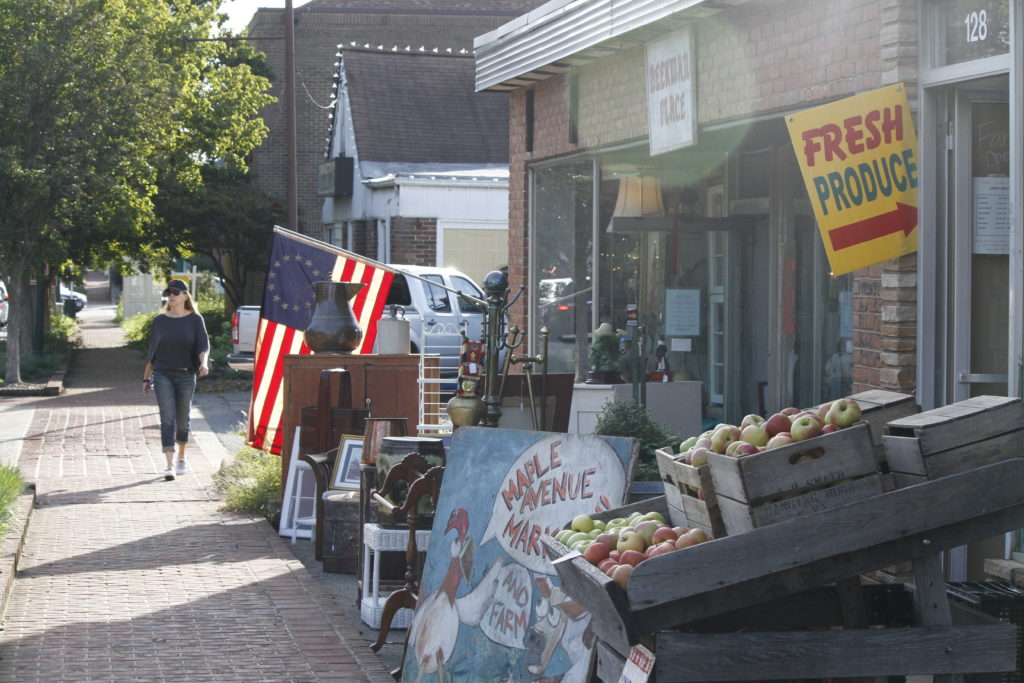
Business is hurting in Vienna. The Maple Avenue Market closed last week, as did the GameStop, with an employee there citing increasing rents as the leading cause.
As store after store shuts its doors, there are questions swirling around town about whether local businesses can stay competitive with new developments surrounding Vienna — and if so, how?
At a town council meeting in January, town business liaison Friderike Butler said businesses on side streets were being hit particularly hard.
“If they’re not on the main street, they’re struggling a lot more,” said Butler. “Even on Church Street, it’s not easy. The economy is doing well overall, and if we have small businesses struggling as the economy is doing well, what is going to happen if there is a recession? It’s something to really think about and make sure our business community is strengthened and supported.”
Peggy James, executive director of the Vienna Business Association, told Tysons Reporter that two big challenges are facing local stores.
“It’s very expensive and we’re pretty tight on parking,” said James.
What’s driving up the rent? It’s an old maxim anyone in real estate will be familiar with.
“Location, location, location,” said James. “It’s always been an expensive place. With Mosaic District just two miles away and Tysons building up like crazy, the competition for brick and mortar is tough.”
Over the years, James said the Saturday morning shopping at mom-and-pop stores that had turned Vienna into a local destination disappeared as sales went to big box stores and Amazon.
“The challenge in this age of Amazon is double,” Frank Shafroth, director of the Center for State and Local Leadership at George Mason University, wrote in an email. “You don’t even have to leave your home or apartment to purchase, and Amazon has such size and distribution that it can undercut in price on almost anything one would purchase at a small business.”
But all three experts noted that there are ways to help local businesses survive.
From a policy standpoint, Butler said the Town of Vienna can help make parking more accessible.
“We need a comprehensive parking map,” said Butler. “Culpepper has a beautiful parking map distributed everywhere in stores and people know where to park. For visitors who have never been in Vienna, it’s very confusing where to park. A comprehensive map would be helpful.”
Town Councilmember Howard Springsteen also recommended the Town Council consider hiring a full-time economic development specialist, an idea that’s been tossed around the council for two years.
“There’s a limit to how much we can rely on volunteers,” said Springsteen. “We just really need to bite the bullet and do it.”
For businesses, Shafroth said survival hinges on finding a niche that can’t be as easily replicated by bigger stores or by Amazon.
“Retailers have to carve out a niche that makes them indispensable: whether shopping for a stroller, car seat, crib or mattress,” said Shafroth. “For instance, new parents want to walk into a physical store and speak with a retailer who can field multiple questions and direct them to the products that best suit their needs — even if those products are available through a different vendor.”
As part of that, Shafroth also said smaller stores should capitalize on the advantages physically touching merchandise offers.
“It’s hard to be certain–especially if you are shopping for a small child, for instance — what will work,” said Shafroth. “A parent wants to feel and touch something: is it baby soft? If it’s a toy, is the mechanism simple enough and safe enough for a tot?”
He continued: “According to Forrester, 43 percent of millennials respond they would rather shop at small local stores, as opposed to big national chains. According to Cassandra, a trend forecasting, research and brand strategy firm, 78 percent of parents in the U.S. would rather shop in stores than online. And, according to the National Retail Federation, today’s young parents spend as much as $1 trillion on items for kids — and this generation values good service more than convenience: they want to be certain that what they purchase will be appropriate — and safe.”
And at the individual level, there’s an obvious answer for how locals can help small stores survive.
“The best thing people can do is give local businesses the first shot at a sale,” said James. “I had a lot of loyal customers at Artful Gift Shop. They’d come to us first. You don’t have to find what you want, but give us a shot.”
James also noted that it can be too easy for locals to blame new developments, like those coming in with the Maple Avenue Commercial zoning changes, for the hardships local stores are facing.
“We can’t stay small and survive,” said James. “We can’t stay as small shops if we can’t keep customers. New spaces [are being developed] on Maple Avenue. Citizens don’t like it and I can understand it, but it kind of has to happen.”
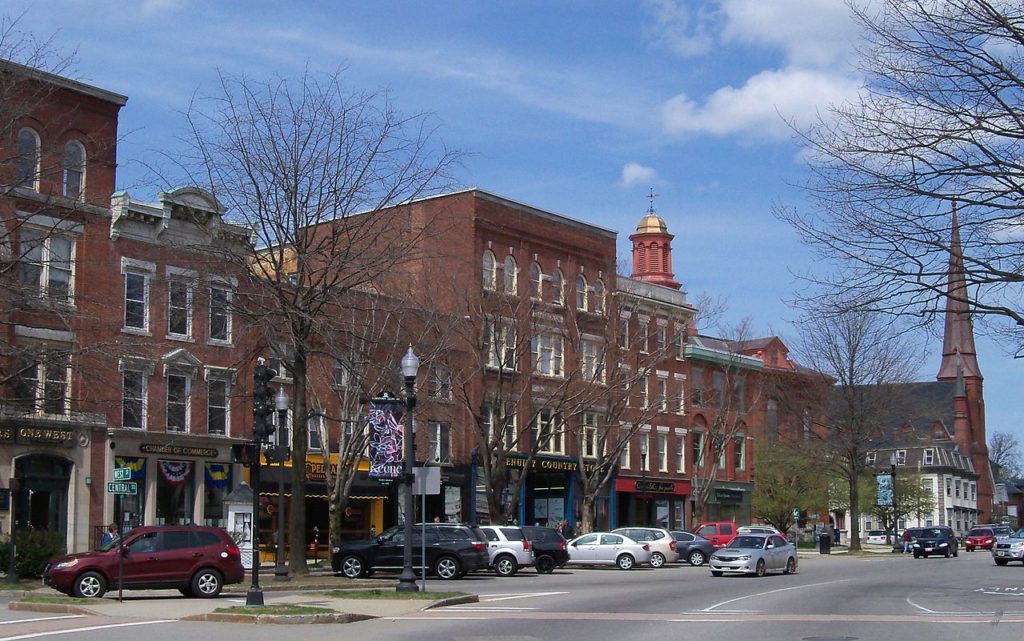
A new survey shows Vienna residents prefer their downtown with classic, small-town brick frontages, rather than the more popular modern designs populating the rest of the area.
The popular sentiment is that the design of new projects on Maple Avenue doesn’t fit with what many people envision for Vienna, so much so that the town is in the middle of overhauling its zoning code following last year’s controversial development discussions.
At tonight’s meeting, the Vienna Town Council will review a visual preference survey for the Maple Avenue Commercial Design Guidelines. The survey collected feedback on what, from a variety of architectural options, best reflected what local residents wanted their town to look like.
With 16 total options, differences in opinion between them was largely marginal, with most ranked around two or three stars out of five.
The most popular facade, with an average rating of 3.28, is based on Keene, New Hampshire. The downtown area depicted shows a series of square, brick buildings more reminiscent of Old Town Alexandria than Tysons. All of the buildings that scored above an average of three stars were the square, red-brick buildings commonly associated with older downtowns.
The least popular of the choices, ranked at an average of 1.6 stars, was a modern-styled brick and glass warehouse design. In general, the buildings reminiscent of trendy redevelopment styles in places like McLean and Merrifield fared poorly in the rankings.
In a ranking of streetscape preferences, the top contender with an average ranking of 3.6 stars showed very wide sidewalks with trees separating pedestrians from the street. All of the top three ranked streetscape designs had similar components.
Streetscapes also had a clear loser, with an average ranking of 1.8 stars. The picture of Fort Industry Square in Toledo, Ohio, had a comparatively narrow sidewalk littered haphazardly with empty pots for plants and old plastic newspaper bins.
There was less variation in what Viennans thought of key intersections and gateways into the town, most of them averaging around two stars. The highest ranked was Merchant Street in Decatur, Illinois, with a metal sign hanging over an entrance. Least popular was a foreboding curved brick building separated from the street by thick foliage.
Photo of Keene, New Hampshire via Wikipedia
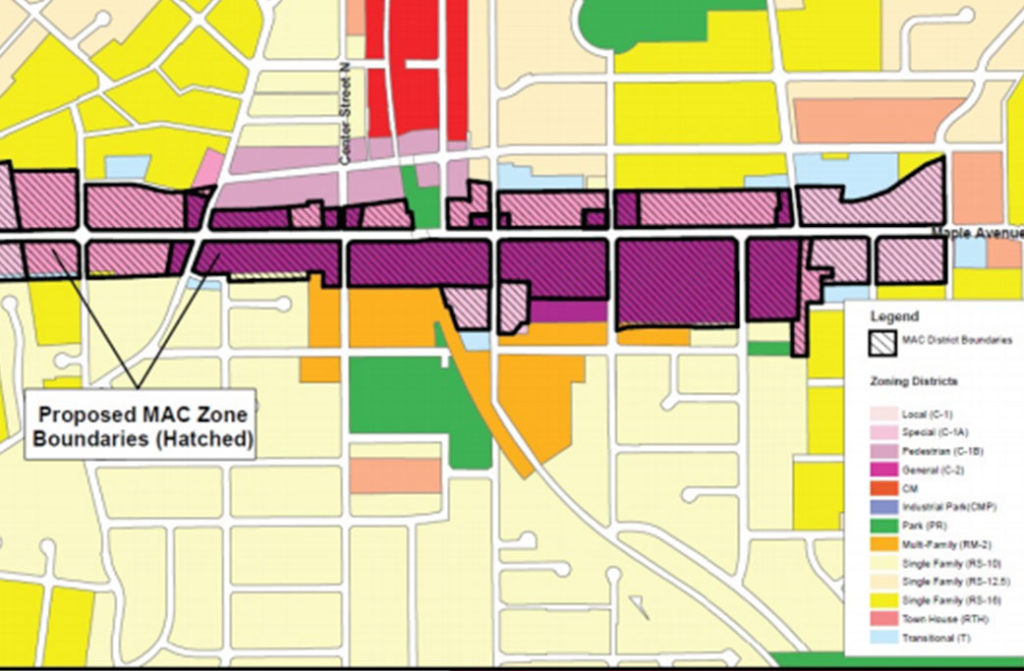
Criticism over massing and scale of new buildings has prompted the Town of Vienna to revisit its Maple Avenue Commercial (MAC) zoning requirements.
While the four-story height limit remains intact, new regulations will push buildings further away from the street.
Setbacks — or the required distance of a new development from the street — played a major role in discussions last year regarding the redevelopment of the Vienna Wolf Trap Hotel. Critics and a few members of the Town Council argued the size of the building overshadowed nearby developments and asked that the building be reduced in size and built further away from Maple Avenue.
The minimum distance from the front of the building to the curb was 20 feet on Maple Avenue, but the new amendments increase that set back to 28 feet. On side streets, the setback requirement is increased from 15 feet to 20 feet.
A maximum height of four stories or 54 feet was included in the original zoning regulations, but the new regulations include a note that all buildings “shall have the appearance of, at most, four stories when viewed from every cardinal direction.”
New proposals will also require applicants to include an analysis of the long-term fiscal benefits and costs to Vienna under the revisions the commission will examine. Projects will also be required to include how the development fits into the current school zone boundary map.
As part of an effort to ensure that the new developments boost local retail, the regulations include a requirement that new developments or redevelopments include ground floor commercial square footage equal to or greater than what currently exists, including commercial square footage currently occupied, vacant or previously demolished.
Density caps had been discussed for multi-family dwelling units, but a comment on the proposed amendments notes that the idea was eventually dismissed.
The new regulations also slightly increase the amount of transparency on the ground floor facade from 50 percent to 60 percent.
The building also includes extensive revisions impervious surfaces of new developments. MAC-zoned developments have an 80 percent maximum impervious surface, meaning surfaces that rainwater can’t pass through. The idea is to prevent runoff that can quickly flood Maple Avenue.
But the zoning regulations also offer incentives allowing an increase in the impervious surface if other requirements are met. This includes a 5 or 10 percent increase if the applicant constructs and maintains a vegetated roof system covering at least half, or 2,000 square feet, of continuous roof area.
The Planning Commission is scheduled to discuss the changes at a work session tomorrow (Wednesday) at 6:30 p.m.
A joint work session is scheduled for March 6, followed by community workshops later in March to discuss the proposed changes.
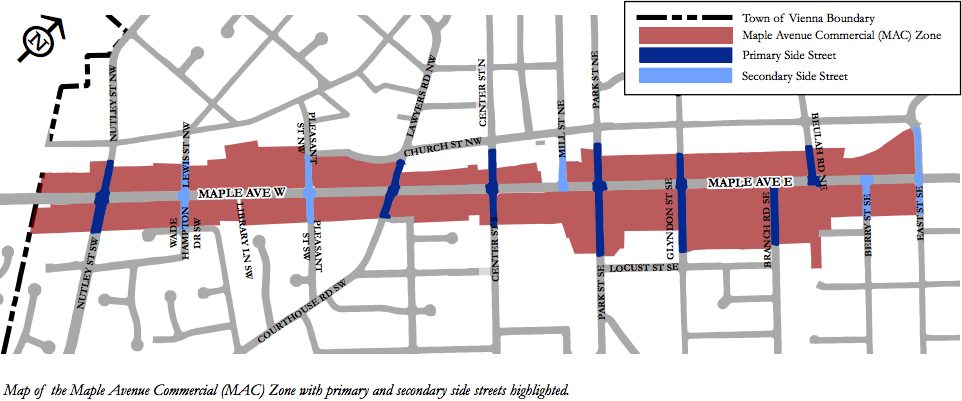
After a fall and winter spent reviewing public feedback on the Maple Avenue Commercial (MAC) zone regulations, Town of Vienna staff think the controversial regulations are ready for the limelight once again.
At tonight’s (Feb. 11) Vienna Town Council work session, the council is scheduled to review the updated design guidelines and amendments to the plan. A moratorium on new proposed developments was imposed last year after new developments sparked extensive controversy.
According to a staff memo, staff looked at the proportion and scale of Church Street, which runs parallel to Maple Avenue, to see how guidelines there could be applied to Maple Avenue. How the new guidelines differ from the existing ones is not immediately obvious reading through the presentation, but the changes will likely be the topic of discussion at tonight’s work session and several meetings planned over the next month.
Andrea West, a planner for the Town of Vienna, said in an email that tonight’s meeting will focus on the process of approving the regulation changes, while the changes themselves will be the subject of a Planning Commission meeting next week.
The new guidelines will be scrutinized at a Planning Commission work session on Feb. 13 and the Board of Architectural Review on Feb. 15. After review at the individual boards, a joint work session is scheduled for March 6, followed by community workshops later in March.
The planned workshop will include a mock-up of a sidewalk section with moveable parts and building blocks showing proposed setbacks and roof lines.
Image via Town of Vienna

At a work session this Friday (Feb. 8), Vienna’s Board of Architectural Review (BAR) is going to take another crack at the Maple Avenue Commercial (MAC) zone design guidelines.
The exact nature of the BAR’s review is a bit unclear. Details are scarce in the agenda, but the BAR is the second stage of a six-step process for new developments along Vienna’s main boulevard, following a staff review.
In September, the Town Council voted to impose a moratorium on new developments filed under the MAC ordinance. The moratorium took effect on Sept. 30 and is scheduled to last until June 17. As part of the moratorium, the BAR was tasked with drawing up new guidelines for public review of projects.
Scale and massing for new Maple Avenue developments has been the largest topic of debate in Vienna over the last year. The MAC ordinance, originally approved in 2014, was aimed at providing a new mechanism for developers to convert outdated and often vacant properties along Maple Avenue into mixed-use developments.
But to make these projects cost-effective for developers, many are significantly larger in scale than the buildings they’re replacing.
The tensions between developers, the Town Council and local residents came to a head last fall over the redevelopment of the Vienna Wolf Trap Hotel. During heated arguments on the Town Council over the four-story development in October, Councilmember Howard Springsteen called the projects that would ultimately be approved the “most divisive project to hit the town in 20 years.”
Photo via Vienna Vienna Development Associates LLC
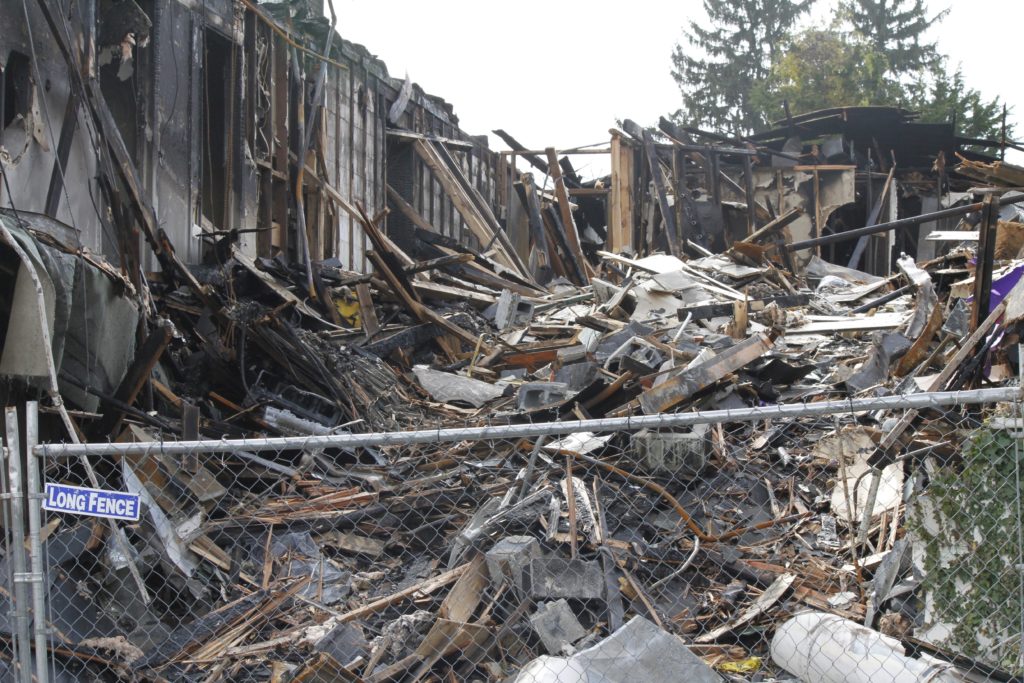
Months after a fire destroyed the Marco Polo restaurant in Vienna, town officials hope they could soon tear the building down.
A fire at the restaurant in October left the building completely destroyed. Two teens were ultimately charged with arson.
Today, the restaurant remains a burned husk and the Vienna Town Council has initiated “blight proceedings” to try and have the building destroyed, an effort that seems to be bearing fruit.
“We are making progress,” said Town Manager Mercury Payton at a Town Council meeting on Monday (Jan. 28). “We are rather close to having what we need for the demolition permit. We don’t have the demolition permit authorized at this point.”
According to Cindy Petkac, director of planning and zoning for the Town of Vienna, discussion on the demolition of the burned building has been proceeding quickly over the last few weeks.
Petkac said staff met with the building’s owner and staff is currently reviewing a demolition permit with revised erosion and sediment control. Water and sewer access to the building has been capped.
“It was well over a month ago that we started blight proceedings,” said Vienna Town Council Member Howard Springsteen. “I’m getting a lot of complaints that this is an eyesore.”
Petkac said demolition at the building is expected within a month.
“The sooner that building gets cleared, the safer it will be,” said Mayor Laurie DiRocco.
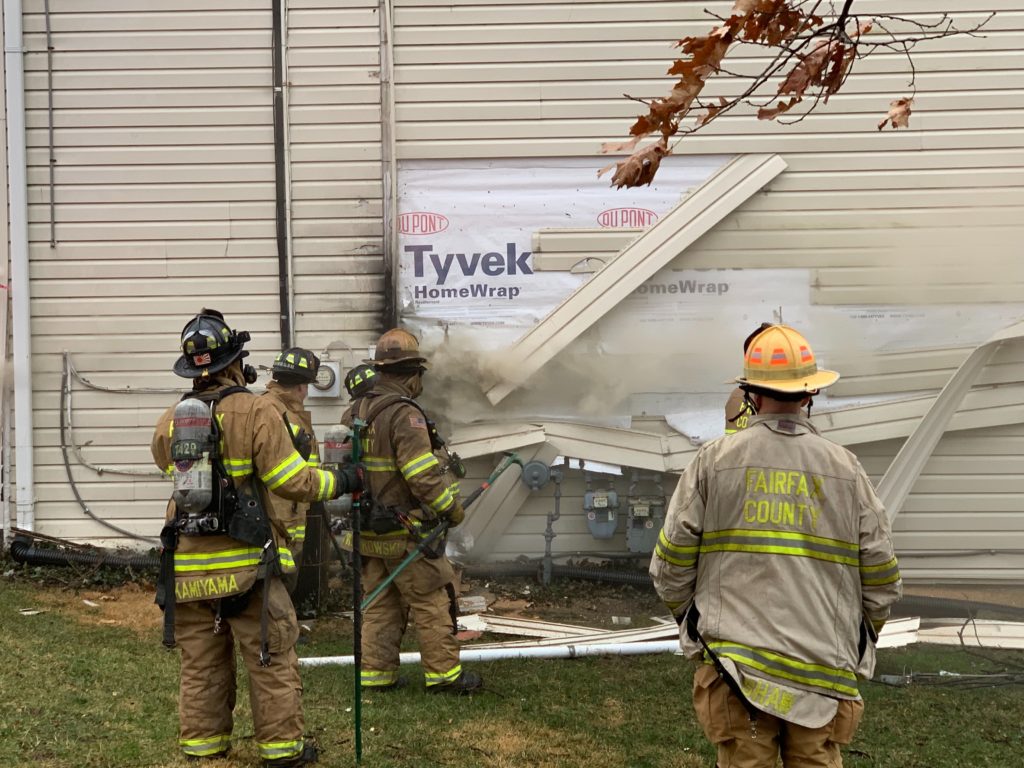
Another fire occurred last week, when a large tree fell onto power lines behind the 123-year-old Bouton Hall at the corner of Church and Mill Streets. The building is owned by the Masonic organization, Concord Lodge 307, and contains the Pennywise Thrift Shop.
According to town staff, the damage from the fire is still being assessed. Payton said how the damage will affect planned renovations to the building is too premature to say.