
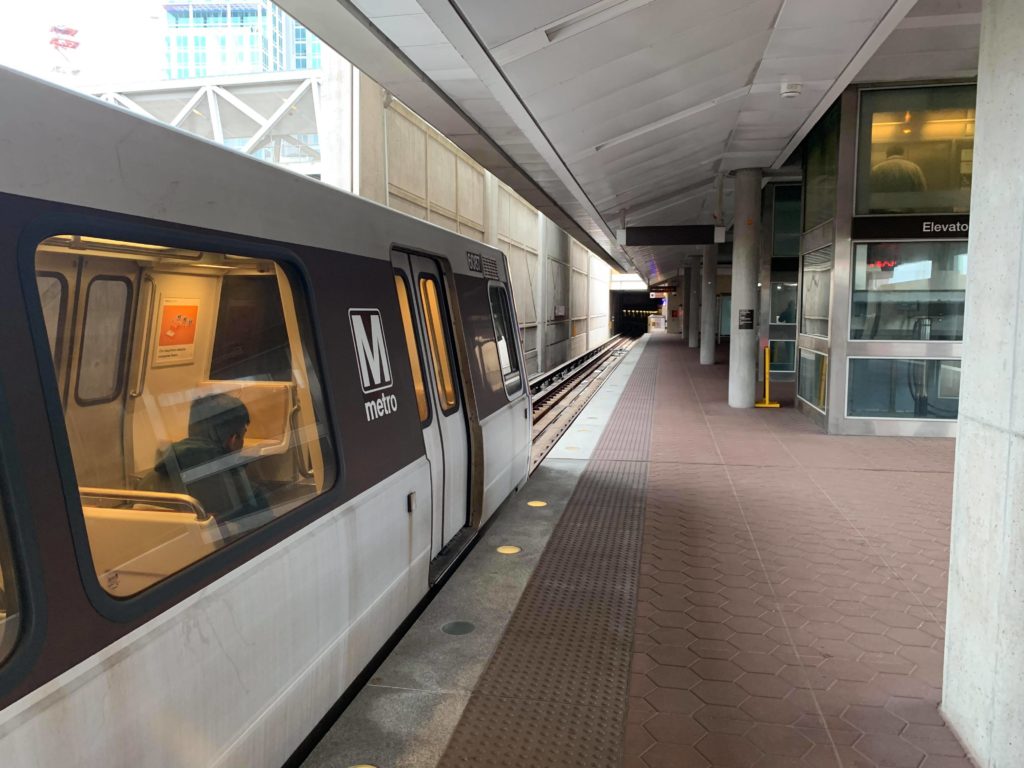
The short Metro tunnel in Tysons is now the only one in Virginia without cell coverage, but Washington Metropolitan Area Transit Authority (WMATA) said that should be remedied by next summer.
Calls inside the tunnel connecting the Tysons Corner and Greensboro Metro stations on the Silver Line are dropped regardless of cellular provider — interrupting 25 minutes of otherwise continuous cell coverage from the Wiehle-Reston to Ballston Metro stations.
The lack of cell service is more than a convenience issue. Experts have called it a glaring safety problem for the system — particularly in the wake of a death in a smoke-clogged tunnel in 2015.
On and off for 10 years, WMATA has been working with cell carriers to wire tunnels to provide continuous service, though the plan has hit several stumbling blocks along the way. The press release said the plan is to have all of the tunnels completed by June 2020:
The $120 million capital project to install dual radio and cellular cables within Metro’s tunnels began in February 2016 and is scheduled to be completed by June 2020. The labor-intensive process involves installing special trays on the tunnel walls to support the heavy cables and requires the track be taken out of service for the work to be done.
WMATA said 67 miles of the 100 total miles of track are now cell-accessible, including all of the Orange and Blue lines.
A small parcel of forest along Prosperity Avenue leading into the Dunn Loring Metro parking garage is likely going to be replaced by a new substation to power the Metro.
The green space is a casualty of plans to expand I-66, which would displace an existing substation along the route.
The Washington Metropolitan Area Transit Authority (WMATA) is currently seeking permission to relocate the substation.
“The relocation will affect the existing open space for the entire 15.383 acres of the WMATA Property and will diminish it approximately 5,778 square feet,” WMATA said in the application.
But the substation isn’t the only thing that could be relocated. Last fall, the Virginia Department of Transportation announced plans that some residents along I-66 could be relocated to make way for the construction.
A Fairfax County Planning Commission hearing scheduled for June 26 will consider the plan.
Photo via Google Maps

Moments of cross-aisle praise are rare, but there was one in Tysons today (Friday).
Amid criticism of the state of national politics, in a speech at Fleming’s Steakhouse (1960 Chain Bridge Road), Sen. Mark Warner (D) took a moment to praise President Donald Trump for retaining funding for the Metro in his federal budget proposal.
“I was not pleased with President’s budget on a variety of items, but I was pleased — even though discretionary spending was cut — that it included $150 million for the Metro,” Warner said. “It’s very important that we retain that.”
Warner was in Tysons for the spring chairman’s luncheon with the Greater McLean Chamber of Commerce to oversee the installation of the new board for the organization.
In some remarks after the installation, Warner spoke on a range of topics, from Facebook to the potential decline and fall of American capitalism.
Warner said regulation has been slow to keep up with companies like Facebook and Google, saying that in the face of the Russian interference through social media in the American elections it was time to take a look at more regulation.
“Today, 60 percent of Americans get all their news from Facebook and Google,” said Warner. “I wonder whether we need to start thinking about these platform companies as media. The content that comes to us across these platforms can be used to spread an enormous amount of lies. Facebook and Google have as much power as Standard Oil did at the beginning of the [20th century].”
Warner also noted that the way the military funded will have to evolve to face 21st century threats. Warner, the ranking member of the Committee on Intelligence, said that China and Russia spend less on their militaries than the United States but are investing more heavily in hacking.
“I worry we’re buying too much 20th century stuff when most of the conflict in the 21st century will be in cybersecurity, disinformation, and space,” said Warner. “Our peers are equal in those domains.”
More broadly, Warner reiterated earlier comments that American capitalism would have to evolve or face extinction.
“I don’t think modern American capitalism is working for our people,” Warner said. “It doesn’t mean you throw out the system, but it means we have to have an honest debate over what the economy that works for everyone looks like… If we don’t find an economy that gives people a fair shot, we’re going to end up with unease and people who will give up on the system.”
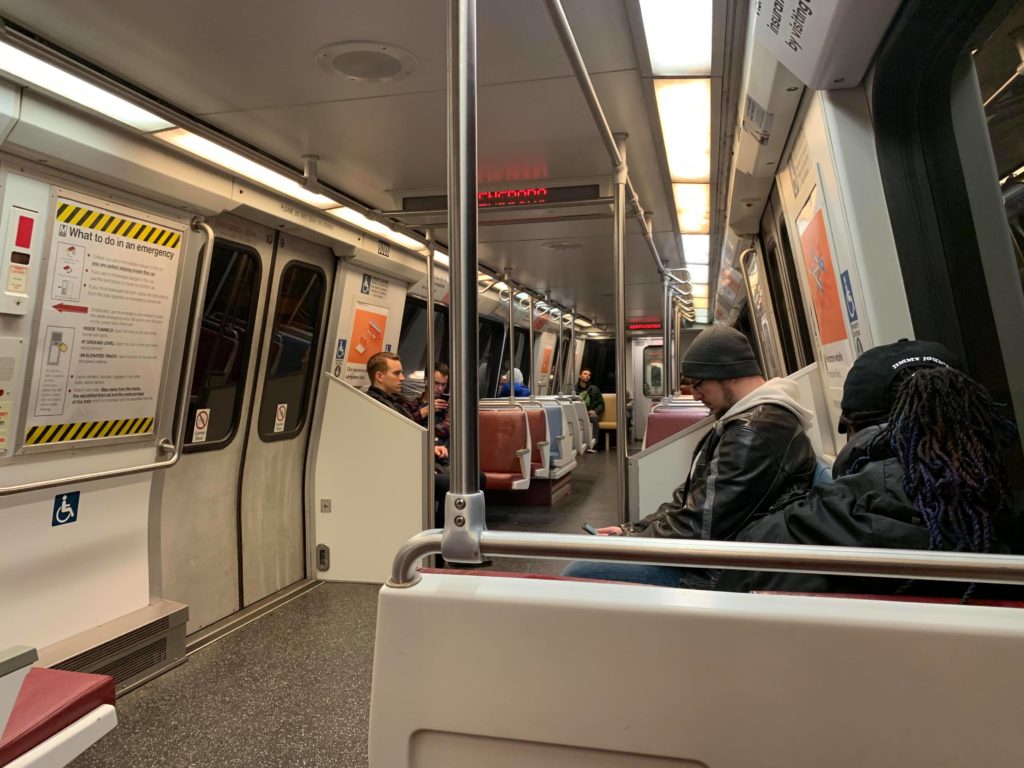
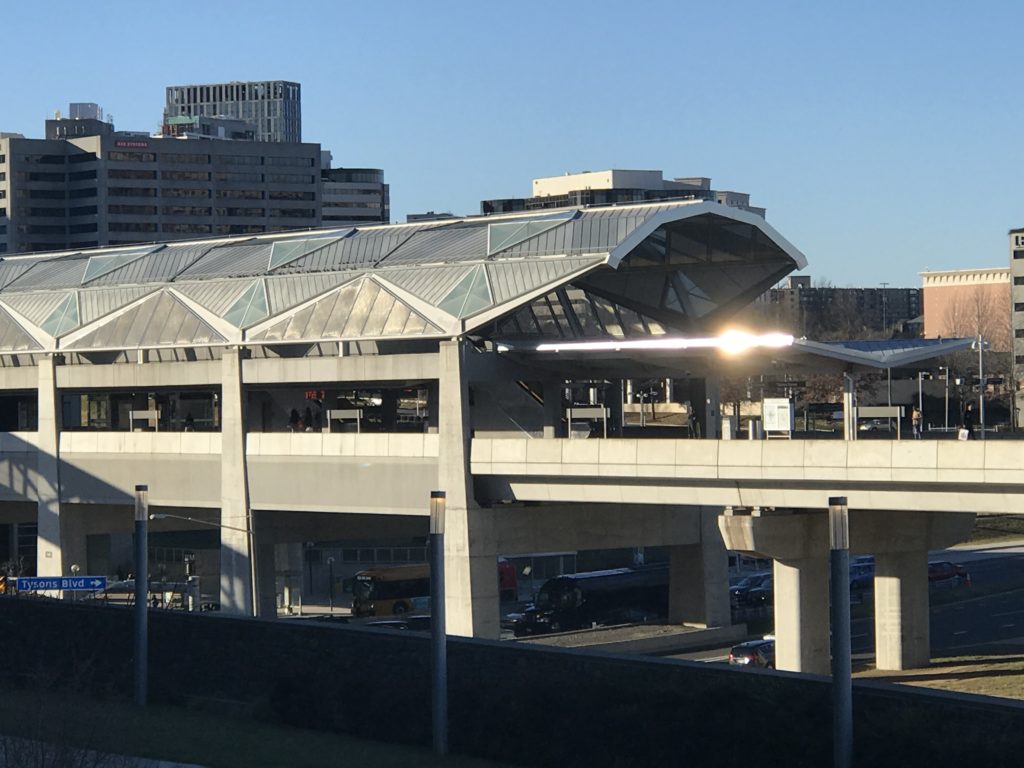
Metro has an ongoing project to provide mobile phone and data service inside its train tunnels, but you wouldn’t know it in the tunnel between Tysons Corner Center Metro station and the Greensboro Metro station.
Tysons Reporter tested cell service multiple times in the tunnel and every time, service was lost. For transit riders, it can be a frustrating coverage gap on the mostly above-ground Silver Line through Tysons.
“This is not good for those on business and personal calls traveling around and through the Tysons area using the Metrorail,” one anonymous tipster wrote to Tysons Reporter. “If fixed, you could have 25 minutes of seamless cell coverage from Wiehle-Reston almost to Ballston.”
The call drops remain more than ten years after Metro signed a contract for cell carriers to wire tunnels to provide continuing coverage. A series of problems delayed the implementation of the plan, however.
The tunnel frustrations haven’t been enough yet to deter local ridership; Tysons stations have had increasing ridership despite declines in other parts of the region.
There is cell coverage elsewhere on the Silver Line, with connectivity available between the Potomac Avenue and Stadium Armory Metro stations, for instance. Additional cell coverage is planned for several stretches of tunnels on the Red, Green and Yellow lines, with the current goal being wireless coverage system-wide by 2021.
But given the plan’s history of delays, riders might be better off just waiting until they’re on the other side of the tunnel to make that phone call.
(Updated 9 a.m.) — Metro ridership may be in free fall overall, but at least in the Tysons area ridership is continuing to climb.
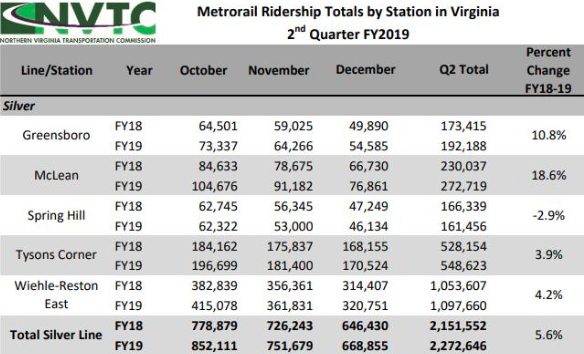
Three of the four stations in the Tysons area saw increased ridership in the last few months of 2018 as compared to the year before.
The McLean Metro station saw the largest increase in ridership, rising 18.6 percent over the last year. The station is located close to the Capital One headquarters, which opened late last year.
The Greensboro Metro station, meanwhile, saw an increase of 10.8 percent, while ridership at the Tysons Corner station increased 3.9 percent. The stats, compiled by the Northern Virginia Transportation Commission, compare ridership in October, November and December of 2018 with the same period in 2017.
The Wiehle-Reston East Metro station saw the highest overall ridership among Silver Line-only stations, with over 1 million rides during the three-month period. The station is the furthest point west on the Silver Line.
The only Tysons stop with a decline in ridership was the Spring Hill station, which declined 2.9 percent. There is very little in walkable proximity to the Spring Hill station, though plans are in the works for several new developments east of the site and a few to the west.
Stations on the Orange Line did not fare as well. While the West Falls Church Metro station saw a 4.1 percent increase in late 2018 as compared to late 2017, Dunn Loring and the Vienna Metro stations saw a 1.1 and 1.4 percent respective decrease in ridership.
Professor Frank Shafroth, director of the Center for State and Local Leadership at George Mason University, told Tysons Reporter earlier that the high Metro ridership in Tysons is likely a result of the area’s notorious traffic, though car remains the more popular for commutes than Metro.
Photo via Twitter
Traffic is not inevitable, and new development does not have to bring new cars.
Arlington County saw an astounding decline of 20 percent in average weekday traffic in just 15 years from 2000 to 2015. That same period saw a growth of nearly 20 percent in population. Certainly, many of Arlington’s new residents drove cars — but not all, and some of its long-time residents must have found new ways to get around.
There are several ways to fight congestion. Most people’s first thought is simply to widen the road. More road, more space for cars, less traffic — right? The problem is that it won’t work for long.
For economists, mobility can be a commodity like any other. And when the government gives something away for free — in this case, it’s giving away the use of asphalt — of course people will clog the system. When something is available for free people will wait in line, paying with time instead of money. So, if highway engineers widen the roadway, it’s only a matter of years until more cars come along and the traffic is as bad as it ever was.
Another idea might be to slow down new development — but it would be difficult to persuade Fairfax County to forgo all the additional tax revenue.
Third, the county could turn to public transit. The Metro arrived in Tysons in 2014 and, while ridership is increasing, it still lingers below expectations. It was certainly a step in the right direction, but Metrorail was a major investment, and it will take decades of development and improvements to local bus service and sidewalks before it sees full results.
Wider roads, slowing development, and railways are 20th-century solutions. The 21st century brings a more subtle, smarter approach — an approach that professionals call “transportation demand management.”
Transportation demand management is not a single technique, but a set of approaches that nudge people out of their cars and towards buses, bikes, walking and working remotely. It’s practiced cooperatively by Fairfax County, the Tysons Partnership and private developers. It often relies heavily on data-driven, highly connected approaches rather than on large infrastructure investments.
One example of a transportation demand management program is the “Guaranteed Ride Home” offered by Fairfax County. This program offers commuters a free trip home up to four times every year. It’s intended for those who would consider a new kind of commute, but who the fear of unplanned overtime or family emergency keeps tethered to their cars.
What Developers Are Doing
For a clearer understanding of what individual developers are doing to cut congestion, Tysons Reporter spoke with Caroline Flax of The Meridian Group, the master developer of The Boro.
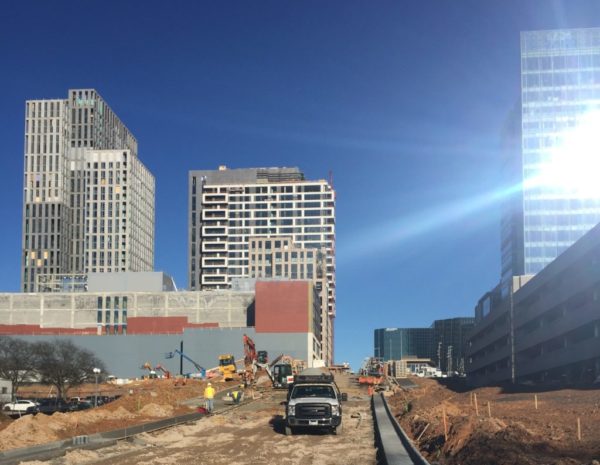
Flax described the “pedestrian experience” at The Boro, and the options that will be available to people on foot. By locating residences close to offices, retail, restaurants and Metro stations, Meridian hopes to “create a bite-sized pedestrian experience.”
“We will have a pedestrian-only promenade that connects to Boro Park, and for the other streets we have created wide sidewalks with activated outdoor seating that will create a really inviting pedestrian experience,” she said.
According to the EPA, concerned with carbon emissions from cars, “Research consistently shows that neighborhoods that mix land uses, make walking safe and convenient, and are near other development allow residents and workers to drive significantly less.”
“[Transportation demand management] is about promoting the other transit options available to residents, visitors, and tenants — aside from driving,” she said. Those options include bicycles, buses, and trains.
Caroline emphasized “making [The Boro] accessible in general” — including shared office/commercial parking to efficiently accommodate drivers, wide sidewalks for pedestrians, designated bike parking, Capital Bikeshare, and creating options for easy pick up and drop off by ride-hailing companies like Uber and Lyft. Flax said that she hopes visitors and tenants at The Boro embrace all modes of travel.
Meridian will strengthen its five-minute walking connection to the Metro by supplying new residents with complementary SmarTrip cards, helping them see how easily they can “hop on the Metro and get downtown, or elsewhere in Tysons, really quickly.”
Flax also emphasized the new streets that will help make traffic smoother by creating more options and connections from the main thoroughfares in Tysons: Route 7, Westpark Drive and Greensboro Drive.
Silver Hill Road, connecting from Greensboro Drive to Route 7, is expected to alleviate traffic on Westpark Drive. Another connection, called Broad Street, currently links drivers and pedestrians from Solutions Drive to another new street that connects to Route 7. Once the second phase of the project begins, Broad Street will connect Westpark Drive to Spring Hill Road.
Smaller blocks make a neighborhood more walkable.
Transportation demand management is a field still in its infancy, as planners and developers find new ways to work toward a more balanced transportation network. People across the country are searching for new tools, and Tysons, frequently dubbed “America’s Next Great City,” will have to work hard to be on the cutting edge.
With the Boro opening soon, Flax concluded by saying, “We’re really excited for everything to come alive… and to show everyone the pedestrian experience we will bring.”
Last week, Tysons Reporter examined the importance of sidewalk design as Tysons expands its pedestrian infrastructure network.
But no matter how well-designed a sidewalk might be, what matters most is that it’s in the right place.
There are three guidelines that Tysons can follow to make its pedestrian infrastructure more complete. The first is simply to find where people are already walking. The second is to connect sidewalks to public transit. The third is to provide cut-throughs in large blocks, connecting up the network.
Find the demand
An old architecture-school anecdote mentions a designer who was hired to lay out paths across a new college campus.
For the first months of the year, she left the entire campus unpaved, and students walked across the grass to their classes.
After the first snowfall, she took pictures of the quad from the bell tower, and then laid out the paths wherever she saw footprints in the snow.
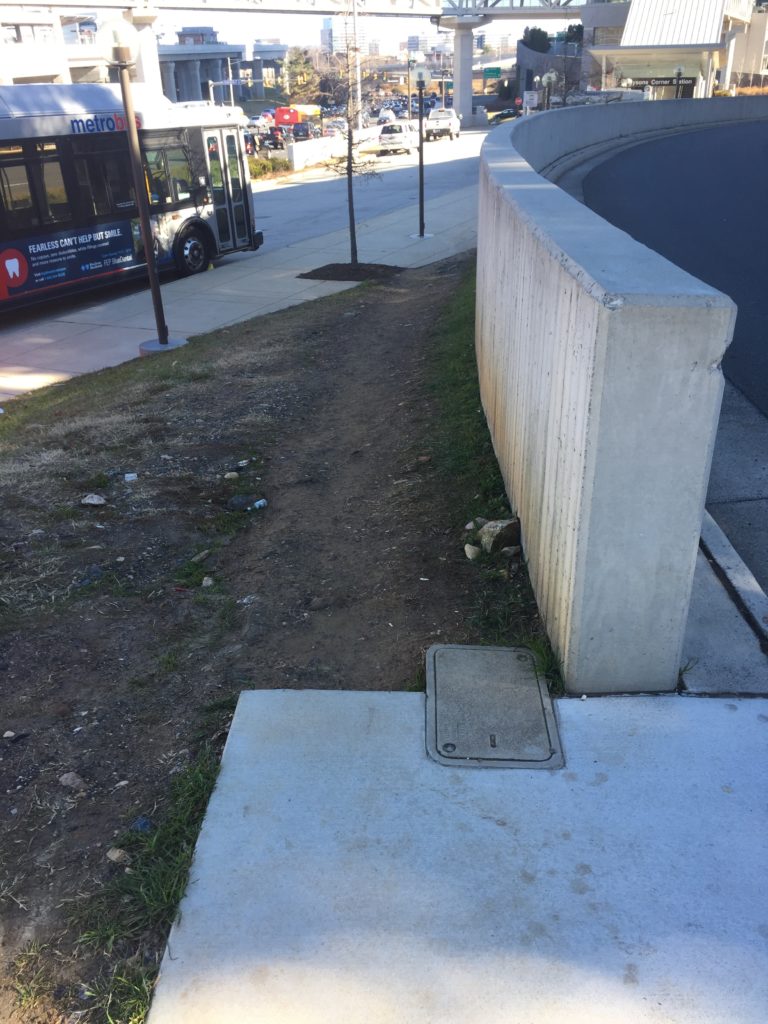
In just the same way, dead grass and bootprints in Tysons reveals pedestrian activity. These are called “desire paths.”
They’re useful for transportation planners because they can prove, no speculation needed, that there really is demand for a sidewalk in a particular place. Even Tysons Plaza, connecting the mall to the Metro station, shows desire paths.
Desire paths can easily be paved over by the owner of the land, whether that is Fairfax County, the Virginia Department of Transportation, or a private interest. According to VDOT’s Project Cost Estimating System, a sidewalk costs only $25.15 per linear foot to install in Northern Virginia — it’s hard to think of a more affordable investment in transportation.
You can find desire paths all over Tysons at the ground level, especially near transit stations — which leads us to the next guideline.
Follow the transit
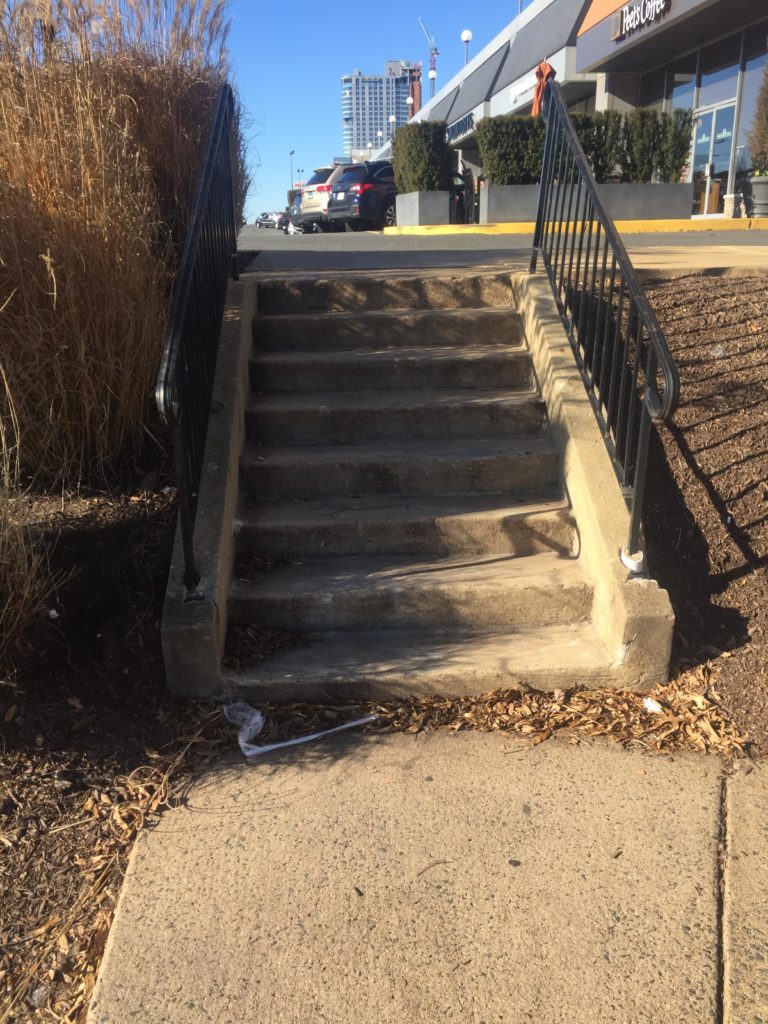
Public transportation and walkability have a symbiotic relationship. Unlike cars, buses and trains rarely drop passengers off right at their destination, meaning that they generally have to walk the final fraction of a mile. But in Tysons, that final stroll can be made circuitous, dangerous or uncomfortable by poor or disconnected pedestrian infrastructure.
As Jeff Speck, author of Walkable City, puts it: “while walkability benefits from good transit, good transit relies absolutely on walkability.” Since its opening in 2014, Silver Line ridership has been less than half of what was anticipated — perhaps because of Tysons’ slower-than-expected transformation into the kind of walkable area promised by ongoing development.
Pedestrian infrastructure is just as important to buses as it is to trains, particularly when a large number of bus stops in Tysons — like one pictured above — are located at neither crosswalks nor sidewalks. Crosswalks, including those in the middle of blocks, are essential to safety; according to VDOT, 51 percent of pedestrian injury crashes occurred at mid-block crossing locations and 86 percent of pedestrian fatal crashes occurred at locations without a marked crosswalk.
Mid-block crossings aren’t new to Fairfax, and they’re approved by VDOT and encouraged by the National Association of City Transportation Officials.
Connect the network
There are two main things that can get in the way of someone walking in Tysons, and they both tend to be larger here than in America’s older cities: streets and buildings.
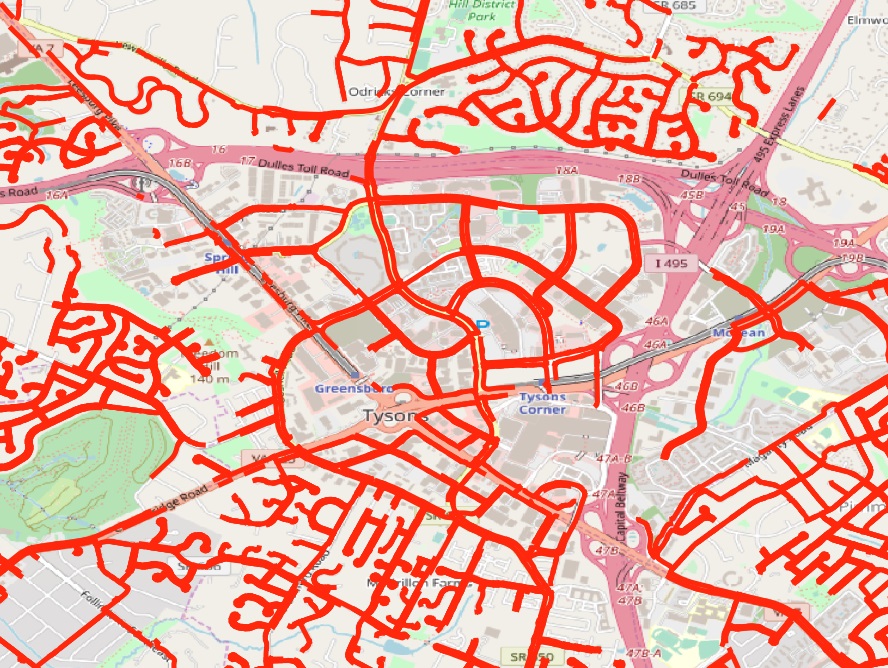
The single block containing Tysons Corner Center measures almost half a mile, equivalent to about half a dozen blocks of downtown D.C. To walk around Tysons’ ‘superblocks’ is a long journey, but if paths are carved through them, these paths multiply the number of five- or ten-minute trips available to pedestrians.
Similarly, bridges and crosswalks also function as multipliers by connecting sidewalk networks. When a pedestrian bridge connected the Towers Crescent office building to Tysons Corner Center, it not only meant that 3,000 employees could walk to a variety of food options for their lunch hour, taking their cars off the road, it connected them to an expanding network of comfortable pedestrian infrastructure reaching beyond the Metro station.
A successful project
When sidewalks opened last month along Leesburg Pike under the Chain Bridge Road overpass, the project was successful because it observed all three of these guidelines.
First, there was demand. As one reader, Ryan, observed in the comments section, “Commuters were walking in the street for a few years, before we had this new sidewalk.”
Second, it was near transit, adjacent to the Greensboro Metro station.
Third, it provided a link between two previously-disconnected sidewalks, meaning that it didn’t only add pedestrian potential but multiplied it.
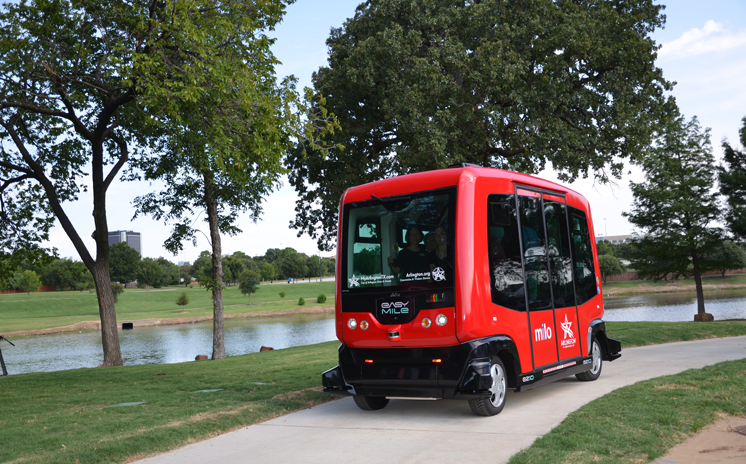
An autonomous shuttle bus between Merrifield’s Mosaic District and the Dunn Loring Metro Station could become a reality, as part of a pilot program pursued by Fairfax County.
Providence District Supervisor Linda Smyth said state officials were in discussions with county economic officials about applying for a grant to bring the project to Fairfax, InsideNoVA reported. But so far, little about the potential project seems set in stone.
A report to the Board of Supervisors on Feb. 12 said Fairfax County was looking at partnering with Dominion Energy and the Virginia Transportation Research Council to introduce a route for a connected and autonomous vehicle (CAV) program.
The project aims to be a “first-mile, last-mile mobility solution” to connect Metro stations with emerging activity centers. As anyone who has walked from the Dunn Loring-Merrifield Metro station to the Mosaic District knows, it’s just far enough to be a pain.
According to the report:
The CAV pilot is intended, in part, to be an important component of VDOT’s broader vision and policies regarding the development and deployment of CAV technology and related demonstration projects throughout the Commonwealth.
The new shuttle would be implemented alongside other public transportation services in the area to assess the viability of CAV shuttles. The report notes Arlington, Texas, as an example of another location to use CAV programs to operate a shuttle service.
The grant money for the program would flow through the state’s Department of Public Rail and Transportation, and be included as part of the Fiscal Year 2020 grant cycle.
Meanwhile, in Reston, self-driving cars could be hitting the street by June.
Photo via City of Arlington, Texas
Firefighter Training in McLean Home — “[Fairfax County Fire and Rescue] units have been conducting ladder truck training exercises at a donated home, in the McLean area, that is slated for demolition.” [Twitter]
New Store Opening in Tysons Galleria — “Lafayette 148 New York has ventured into the nation’s capital, opening its first Greater Washington location this week in the Tysons Galleria shopping center. Its first freestanding boutique in the Mid-Atlantic region, the new Lafayette 148 shop measures 2,500 square feet.” [Washington Business Journal]
Silver Line Test Train Doesn’t Get Far — “The first test train on Metro’s Silver Line extension to Dulles Airport made it only 1,000 feet out of the Wiehle-Reston East station before running into trouble, sources told News4.” [NBC Washington]
Falls Church Development Includes Micro Units — “If approved by the F.C. City Council going forward [the new West End development will] include an extra 150,000 square feet in residential density, including 50,000 square feet for senior housing and 100,000 square feet for 40 or so of the first new condominiums built in the City in over a decade, and even more notable, some 150-175 ‘micro unit’ rentals.” [Falls Church News-Press]
Turmoil in Richmond, Leaders’ Future Uncertain — Under fire for each of their own controversies, resignations by Virginia’s Democratic governor, lieutenant governor and attorney general could end up triggering a special election or even elevating a Republican state lawmaker into one of the top jobs. Meanwhile, the chaos in Richmond was the lead story on the national evening news this week — twice — and made the cover of this morning’s New York Post, with the headline “Virginia is for Losers.” [Politico, Twitter]
FCPS on Two-Hour Delay — Fairfax County Public Schools are opening today on a two-hour delay due to dangerous cold and potentially hazardous travel on local roads. [Reston Now]
Metro Delays This Morning — Expect some delays if riding Metrorail this morning, in part due to fewer trains running amid the bitter cold. [Twitter]
Vienna Businesses Want More Economic Development — “Vienna’s business environment flourished in 2017 but weakened noticeably last year, highlighting the town’s need to hire a specialist to improve its commercial prospects, according to the 2018 annual report submitted by the Town/Business Liaison Committee (TBLC).” [InsideNova]