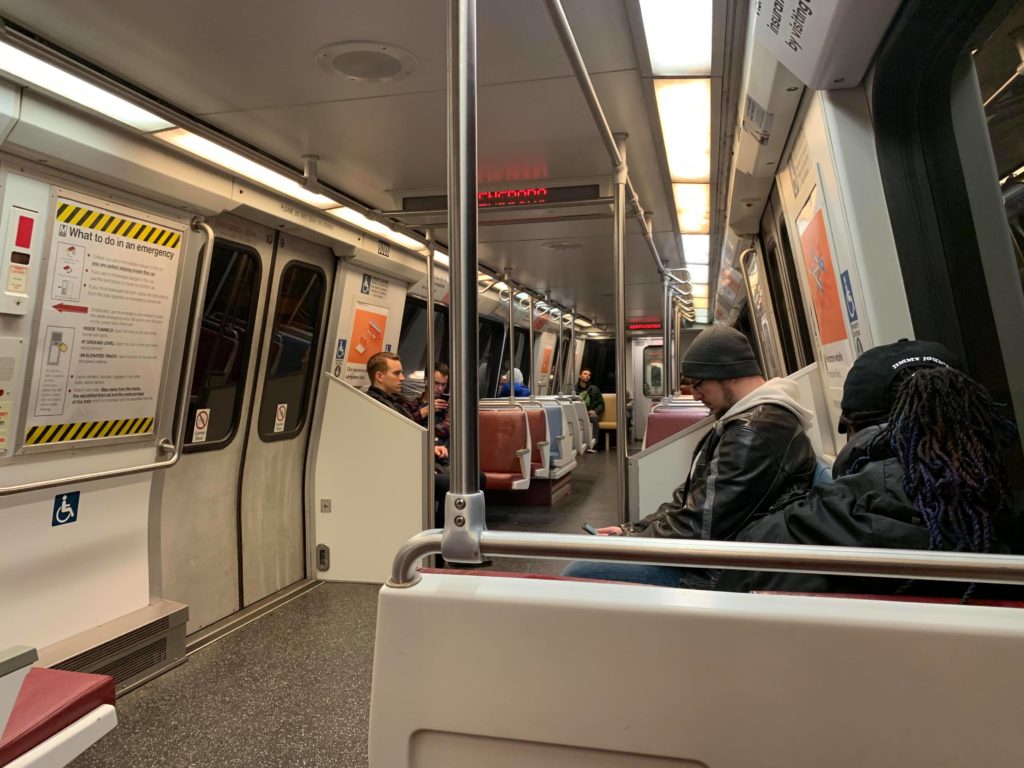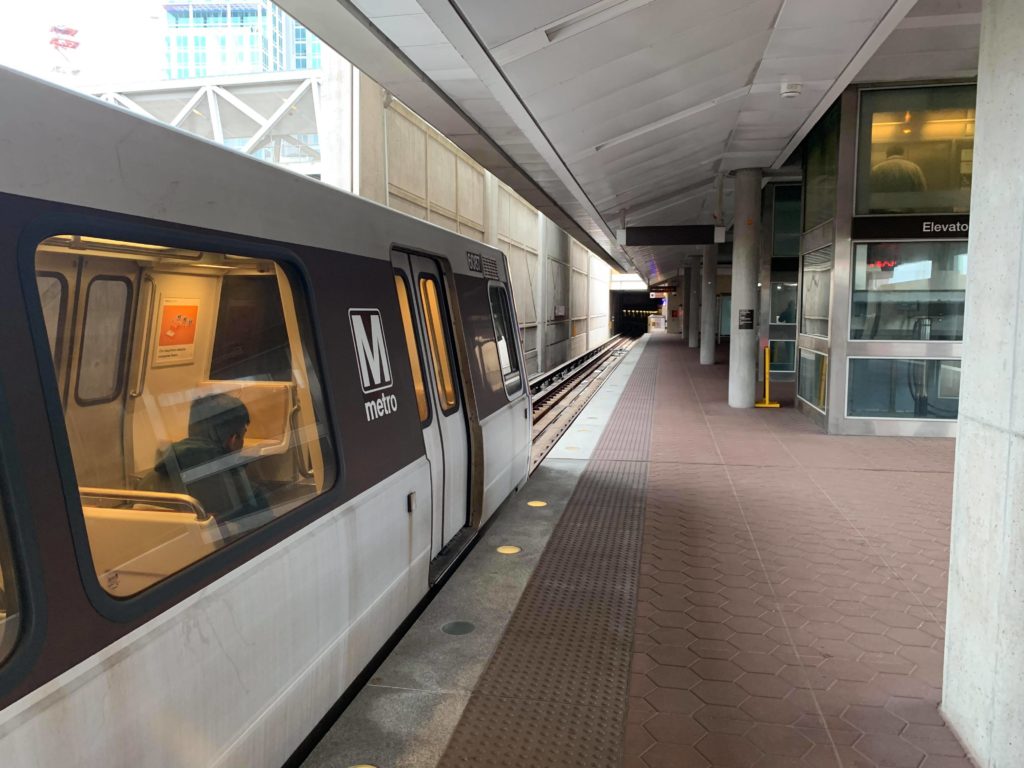

Metro has an ongoing project to provide mobile phone and data service inside its train tunnels, but you wouldn’t know it in the tunnel between Tysons Corner Center Metro station and the Greensboro Metro station.
Tysons Reporter tested cell service multiple times in the tunnel and every time, service was lost. For transit riders, it can be a frustrating coverage gap on the mostly above-ground Silver Line through Tysons.
“This is not good for those on business and personal calls traveling around and through the Tysons area using the Metrorail,” one anonymous tipster wrote to Tysons Reporter. “If fixed, you could have 25 minutes of seamless cell coverage from Wiehle-Reston almost to Ballston.”
The call drops remain more than ten years after Metro signed a contract for cell carriers to wire tunnels to provide continuing coverage. A series of problems delayed the implementation of the plan, however.
The tunnel frustrations haven’t been enough yet to deter local ridership; Tysons stations have had increasing ridership despite declines in other parts of the region.
There is cell coverage elsewhere on the Silver Line, with connectivity available between the Potomac Avenue and Stadium Armory Metro stations, for instance. Additional cell coverage is planned for several stretches of tunnels on the Red, Green and Yellow lines, with the current goal being wireless coverage system-wide by 2021.
But given the plan’s history of delays, riders might be better off just waiting until they’re on the other side of the tunnel to make that phone call.
(Updated 9 a.m.) — Metro ridership may be in free fall overall, but at least in the Tysons area ridership is continuing to climb.
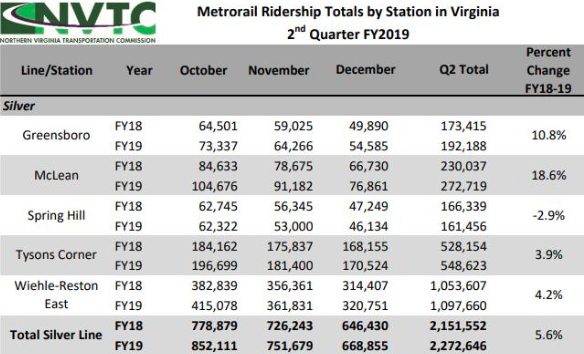
Three of the four stations in the Tysons area saw increased ridership in the last few months of 2018 as compared to the year before.
The McLean Metro station saw the largest increase in ridership, rising 18.6 percent over the last year. The station is located close to the Capital One headquarters, which opened late last year.
The Greensboro Metro station, meanwhile, saw an increase of 10.8 percent, while ridership at the Tysons Corner station increased 3.9 percent. The stats, compiled by the Northern Virginia Transportation Commission, compare ridership in October, November and December of 2018 with the same period in 2017.
The Wiehle-Reston East Metro station saw the highest overall ridership among Silver Line-only stations, with over 1 million rides during the three-month period. The station is the furthest point west on the Silver Line.
The only Tysons stop with a decline in ridership was the Spring Hill station, which declined 2.9 percent. There is very little in walkable proximity to the Spring Hill station, though plans are in the works for several new developments east of the site and a few to the west.
Stations on the Orange Line did not fare as well. While the West Falls Church Metro station saw a 4.1 percent increase in late 2018 as compared to late 2017, Dunn Loring and the Vienna Metro stations saw a 1.1 and 1.4 percent respective decrease in ridership.
Professor Frank Shafroth, director of the Center for State and Local Leadership at George Mason University, told Tysons Reporter earlier that the high Metro ridership in Tysons is likely a result of the area’s notorious traffic, though car remains the more popular for commutes than Metro.
Photo via Twitter
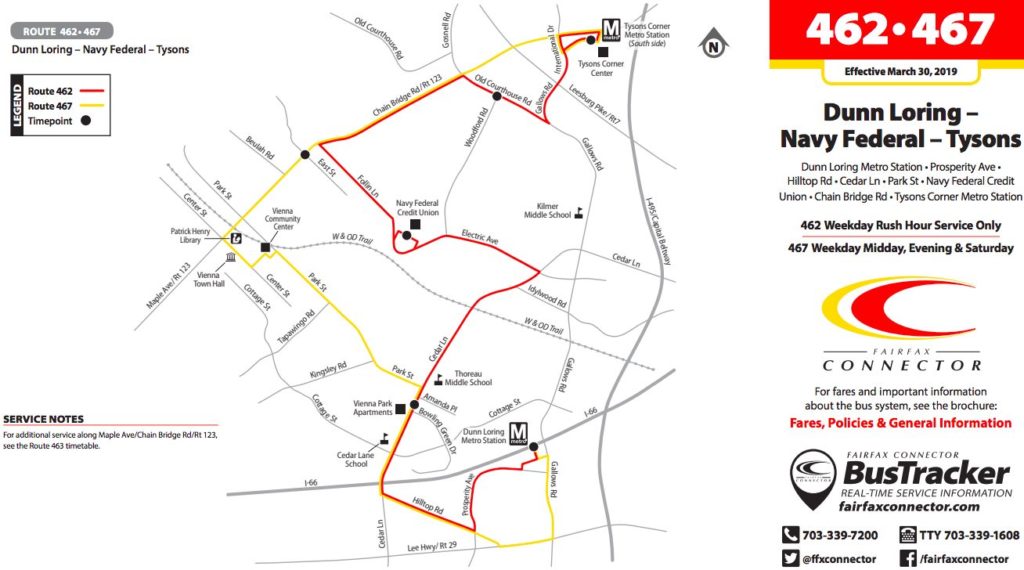
A new Fairfax Connector bus line is scheduled to start later this month, adding another set of connections from Tysons to Vienna and Dunn Loring.
The new bus line bridges the north-south gap between the Tysons Corner Metro station on the Silver Line and the Dunn Loring Metro station on the Orange Line.
Route 467 starts and ends in the same spots as Route 462, but takes a more circuitous route through Vienna, turning at the corner, running from Dunn Loring to the corner of Center Street and Maple Avenue before turning to travel along the western side of Maple Avenue up to Tysons.
Route 467 is scheduled to be active midday and evenings on weekdays and Saturday, starting Saturday, March 30.
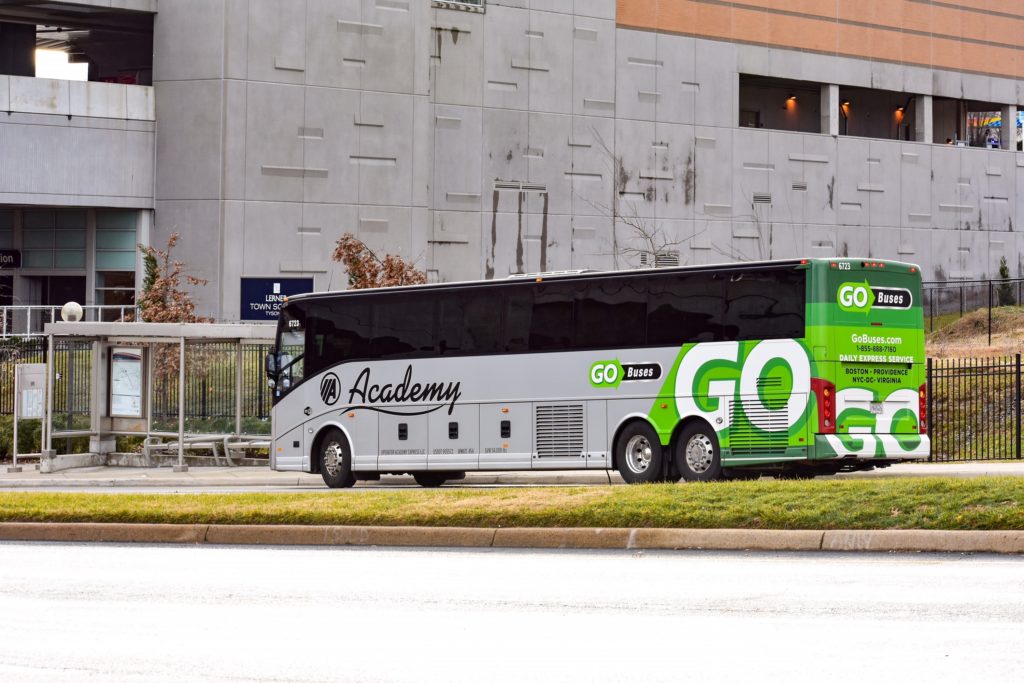
GO Bus, a bus line that operates throughout the northeast, has added an additional stop in Tysons.
According to a press release, the new stop will be at the Tysons Corner Metro station.
From the press release:
For the D.C. and Virginia service to/from New York City, this new stop joins five other stops in the D.C./Virginia metro area, and is the 13th stop overall in the GO Buses network. Other existing stops in the region include L’Enfant Plaza (C Street SW in D.C.), Eastern Market (Pennsylvania Avenue SE in D.C.), the Eisenhower Avenue Metro Station in Alexandria, the Fairfax/GMU Metro station in Vienna, and the Manassas commuter lot on Cushing Road in Manassas. The New York City stop is in Midtown Manhattan (30th Street between 9th and 10th Avenues).
While the press release boasts fares as low as $18, the lowest Tysons to New York City tickets available over the next month are $22.
This isn’t the first new affordable Tysons-New York line to open up. Last November, OurBus opened a new line to New York for around the same price.
Photo courtesy Go Bus
A D.C. man was arrested Wednesday morning after an altercation at the Tysons Corner Metro station and a brief police chase.
Fairfax County Police say 31-year-old Jaron Ulmer was getting off a train at the station just before 7 a.m. when he turned around and accused a man of following him. Ulmer then punched the man several times, according to police.
“Ulmer ran away but was arrested after a short foot pursuit by responding police officers,” said an FCPD crime report. “Ulmer was charged with malicious wounding, public intoxication and obstruction of justice.”
A malicious wounding charge suggests the victim’s injuries were serious enough to make the crime a felony, as opposed to a less severe assault charge.
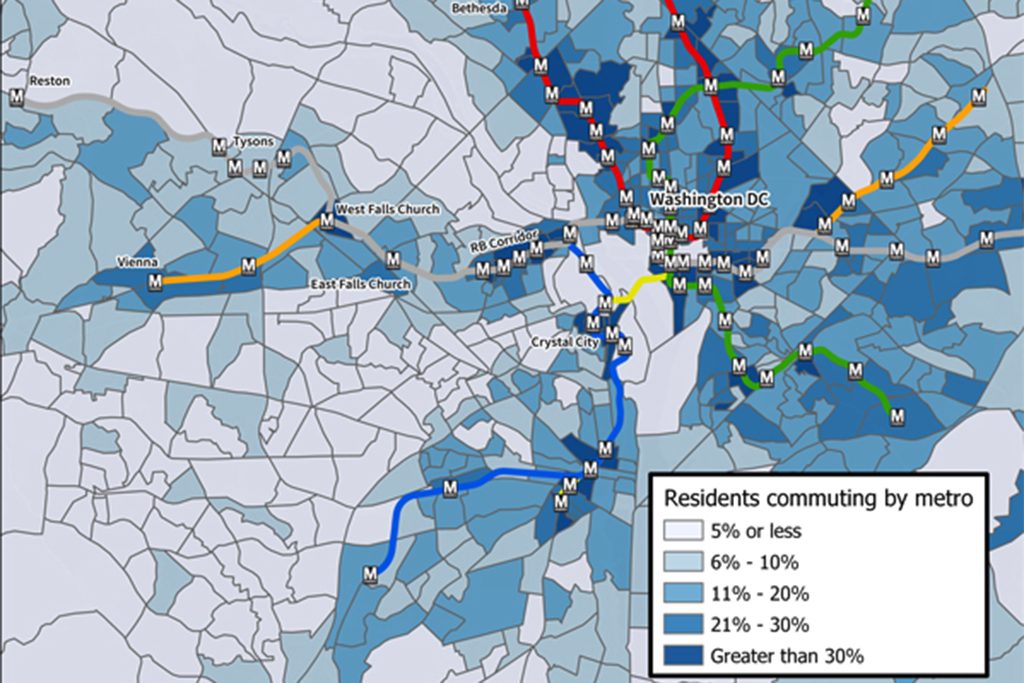
While the Silver Line may be bringing new market tenants to Reston and Tysons, so far it’s had little impact on changing commutes.
According to a new study by JLL, an investment management company, 1.1 million square feet of new office space has emerged in Tysons within a half-mile of a Metrorail station. Rents for higher-end office space on-Metro in Tysons also comes at a 16% premium compared to off-Metro locations.
But while Metro ridership has continued to increase in Tysons, the study notes that nearby residents using the Metro to commute has increased less than 10 percent since the Metro opened. Some of this can likely be attributed to a lack of parking at the stations, which Fairfax County Supervisor John Foust, who represents McLean, said keeps many residents in his districts from using the Metro to commute.
Further west, Reston has seen a similar impact on office markets. According to the study:
“In the Wiehle micromarket, average Class A rents have increased 30% since 2012, and Reston also saw the delivery of its first Trophy building on-Metro — 1900 Reston Metro Plaza — with asking rents in the $50 p.s.f. range, a rate not seen before in the Toll Road market outside Reston Town Center.”
Like their neighbors in Tysons, Reston residents have been slow to give up their cars. Of commuters, less than 10 percent coming from Reston use the Metro.
More residential developments planned over the next few years near the Metro in both Reston and Tysons which will likely result in a gradually increasing amount of Metro ridership in both locations.
The study also notes that companies moving to and growing in the area, particularly in the tech sector, could also bring more Metro ridership to the area by reverse commuters: people living in Washington, D.C. or Arlington and traveling out to Tysons.
Image via JLL
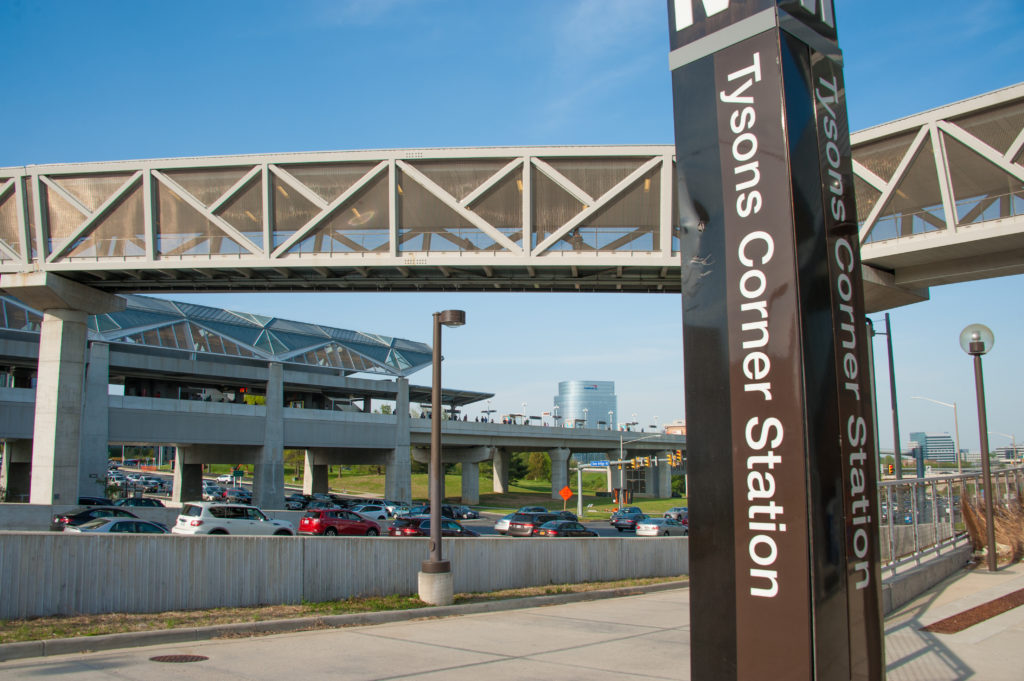
Metro ridership in Tysons has been increasing, bucking the transit system’s overall downward trend.
According to a recent county report, from April 2017-2018 ridership increased across Tysons stations by eight percent, from 7,142 to 7,723 riders per weekday.
According to the report, the most active Metrorail station within Tysons is Tysons Corner, which averages over 3,400 passengers per day (total entries) on weekdays and over 2,500 for Saturdays, exceeding the ridership at the other three stations.
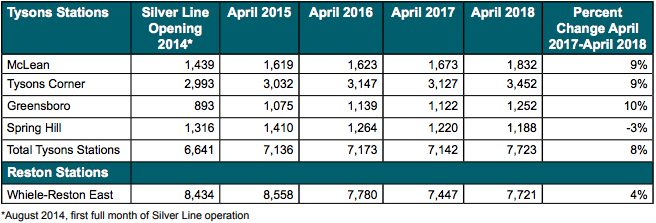
The only station to show a decrease in ridership has been the Spring Hill station, which declined from 1,220 riders to 1,188, a three percent decrease.
The same report also showed that morning and evening peak period traffic to and from Tysons in single-occupancy vehicles had decreased after years of mostly trending upward. Morning trips for single-occupancy vehicles decreased over the last year from 106,389 to 99,472, while evening trips decreased from 108,604 to 104,596.
Professor Frank Shafroth, director of the Center for State and Local Leadership at George Mason University, said the two numbers are likely rooted in traffic and tolling along I-66.
“I think the uptick reflects how terrible I-66 traffic is — and, increasingly, how expensive it is,” said Shafroth. “I know when I go out to Tysons, I do not even think of driving, even though it is almost a straight shot, when I can, instead, relax, read, and prep for whatever meeting I am headed to.”
Graph via Fairfax County
In-Person Absentee Voting Underway — Fairfax residents can now vote absentee in person at 10 locations throughout the county until Nov. 3. Among the locations is the McLean Governmental Center at 1437 Balls Hill Road. [Fairfax County, Twitter]
Thieves Steal ATM Machine from Vienna Metro — “Police are searching for the people they say stole an ATM from a Metro station and then packed it into the bed of a stolen pickup truck. Five suspects in a heavy-duty pickup rammed into the machine at the Vienna station and dislodged it about 1:30 a.m. Monday, a Metro spokesman said. The thieves then lifted the machine onto the truck bed and drove off.” [NBC Washington]
Public Safety Agencies Holding Job Fair — “The public safety agencies of Fairfax County invite residents to learn more about career opportunities available at the Fairfax County Public Safety Career Fair on Saturday, Oct. 20.” [McLean Connection]