
Virginia Gov. Ralph Northam announced a series of new guidelines today (Thursday) aimed at getting the COVID-19 pandemic under control as case numbers soar in Fairfax County and throughout the state.
Starting at 12:01 a.m. on Dec. 14, all Virginians will be expected to stay at home between 12 and 5 a.m. unless they are traveling to and from work, obtaining food and goods, or seeking medical attention.
While the modified stay-at-home order only applies to those early morning hours, Northam urged people to stay home whenever possible during other hours of the day as well, stating that he “strongly” encourages people to telework if they can.
“We already have strong public health measures in place, and with these additional steps, we can turn this around,” Northam said. “Virginians, if you don’t have to be out, stay at home. Whenever we are around other people, we all need to wear a mask, indoors and out.”
The new COVID-19 mitigation measures that take effect on Monday also include an expansion of the state’s existing requirement that all Virginians 5 and older wear a mask in indoor public settings.
Now, all individuals 5 and older will be required to wear face coverings in all indoor settings other than their own home and in all outdoor public settings when within six feet of another person.
The limit on indoor and outdoor social gatherings has been reduced from 25 to 10 individuals. Like before, this rule applies primarily to parties, celebrations, and other social events, but not religious services, workplaces, and schools.
The prohibition on alcohol service in dining establishments after 10 p.m. remains in place, and all restaurant workers are required to wear a mask, even if they don’t interact with customers face-to-face.
Northam said that state agencies will step up their enforcement of social distancing, cleaning, and mask-wearing requirements for businesses. Virginia has issued 181 letters for COVID-19 rule violations so far.
However, the governor declined to follow the lead of some neighboring jurisdictions in shutting down indoor dining, stating that social distancing requirements already significantly reduce the capacity of restaurants.
Despite calls for a statewide return to virtual learning from teachers’ unions in Northern Virginia, Northam also did not introduce any new guidelines for educational institutions, leaving decisions regarding school operations up to the discretion of local officials.
“Local leaders know what’s right for their community,” Northam said. “We’re going to keep working with local leaders to make sure they have the information they need to make the right decisions.”
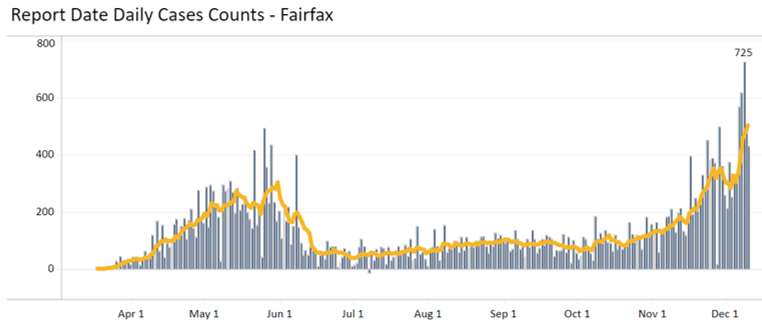
Virginia is now averaging 3,700 new COVID-19 cases per day, three times higher than the peak of 1,200 daily cases in May. The statewide testing positivity rate is 11%, and more than 2,000 Virginians are currently hospitalized, an 80% increase over the last four weeks.
The Fairfax Health District recorded 440 new cases today, and its seven-day average hit a new high of 501.9 cases after reporting a single-day record of 725 new cases on Dec. 8.
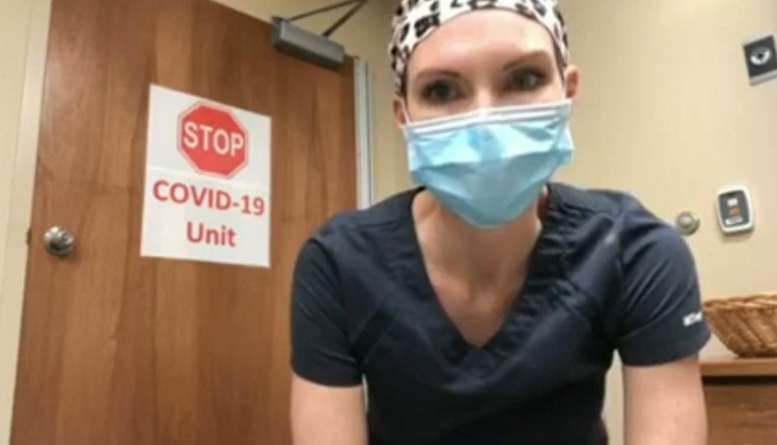
During his announcement, Northam played a video from a healthcare worker named Emily who has been working in a COVID-19 intensive care unit over the past month. She described holding patients’ hands as they died and putting an “ungodly” number of people in body bags.
“I cry a lot. This is real,” Emily said. “…If you could stop just one case by wearing a mask or staying home when you didn’t have to go out, it would help us so much.”
Images via Governor of Virginia/Facebook, Virginia Department of Health
The Fairfax County Board of Supervisors gave the county’s transportation department permission this week to start work on plans for managed curbside parking in Tysons and Reston.
Whether the plan includes paid parking, time-limited parking, designated commercial vehicle parking, or some combination, the Fairfax County Department of Transportation will need at least a year to draw one up for the Board of Supervisors to review, staff said during a board transportation committee meeting on Tuesday.
The incremental step forward comes after professional traffic engineers released their findings from a two-year study that analyzed current parking habits in Tysons’ urban center and Reston’s transit station areas as well as potential options to manage parking.
“Currently in the county, we have a very limited toolbox of parking restrictions that can be implemented by either the Board or VDOT,” FCDOT Section Chief Neil Freschman said. “Generally, most on-street parking on public roadways is uncontrolled.”
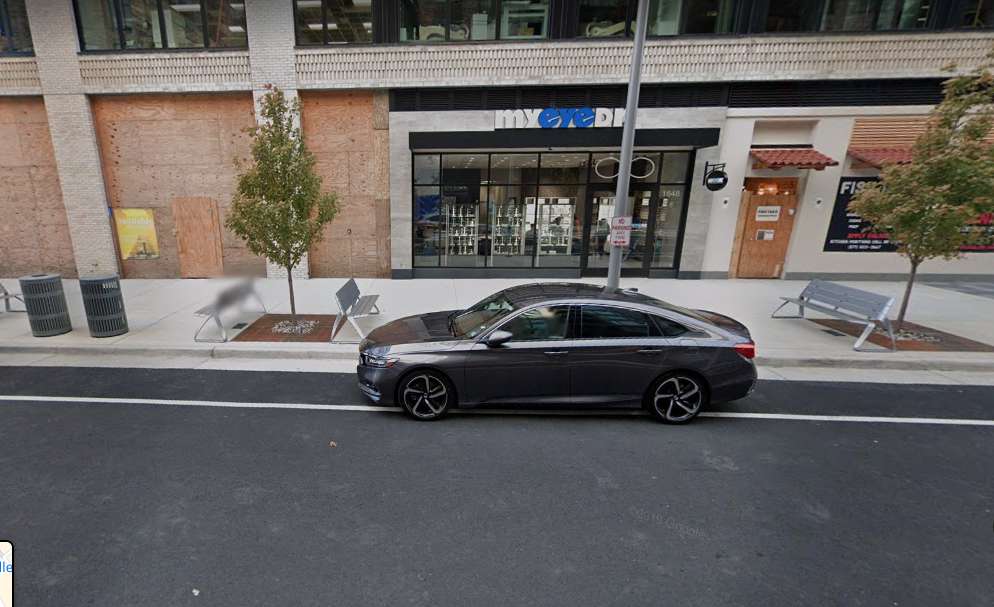
The study found that public on-street parking in Reston is incredibly limited.
Parking is available on just 6% of the 15 miles of public curb space surrounding the Wiehle-Reston East, Reston Town Center, and Herndon Metrorail stations, FCDOT Senior Transportation Planner Henri Stein McCartney said.
“We found 211 total public on-street spaces within the study area, which is pretty low,” she said. “Most parking is on private streets, which we don’t manage.”
Comparatively, Tysons had more parking. Staff found 1,272 spaces along 22 miles — or 29% — of curb space on the roadways surrounding the Greensboro, Springhill, Tysons, and McLean Metro stations.
However, parking in Tysons suffers from other problems, including cars parked in “No Parking” zones and travel lanes, along with large commercial vehicles that overstay their welcome.
“Some of these vehicles are reportedly parking for days or weeks without moving,” McCartney said. “Our parking staff has received multiple complaints from Tysons businesses about commercial vehicles that are parking long-term near their building, so we know this is an issue.”
Transportation Committee Vice-Chair Kathy Smith, who represents Sully District, told Tysons Reporter that commercial vehicles parking for extended periods is a county-wide issue.
“I think it’s good that staff is looking into how to balance people’s ability to get into businesses and getting more turnover,” Smith said. “Everybody would agree you don’t want commercial vehicles taking up space for days.”
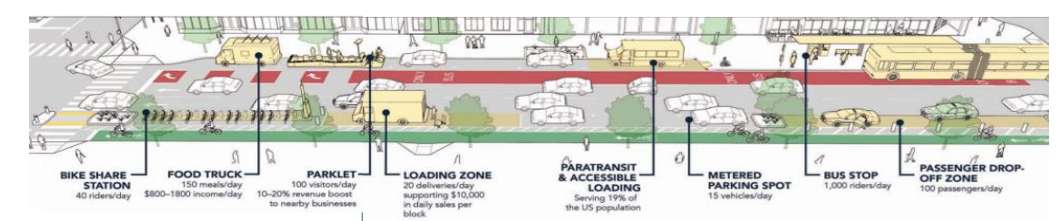
This parking plan is being developed alongside changes to the street grid in Tysons and Reston, Hunter Mill District Supervisor Walter Alcorn told Tysons Reporter. In some cases, parking policies will be developed for streets that do not yet exist, but have been incorporated into the two communities’ comprehensive plans to be more transit-oriented.
The management plan should encourage parking spot turnover to ensure that these future streets near transit stations, which are lined with mixed-use properties, do not become commuter lots, he said.
However, managed parking in Reston’s transit areas will have to overcome the controversy that Boston Properties ignited when the property manager introduced and later modified paid parking at the Reston Town Center.
“The number one lesson is, don’t make all your streets private,” Alcorn said. “We have an awful lot of private streets. What we’ve learned is that the public doesn’t have any say — it is up to the private street owner.”
While private streets make planning events more flexible, Alcorn says the 2017 flare-up, which focused mostly on the garage parking, could also be attributed in part to community members not having a say.
For the most part, though, what FCDOT is working on “is apples and oranges” compared to the RTC, he said.
Images via Google Maps, Fairfax County
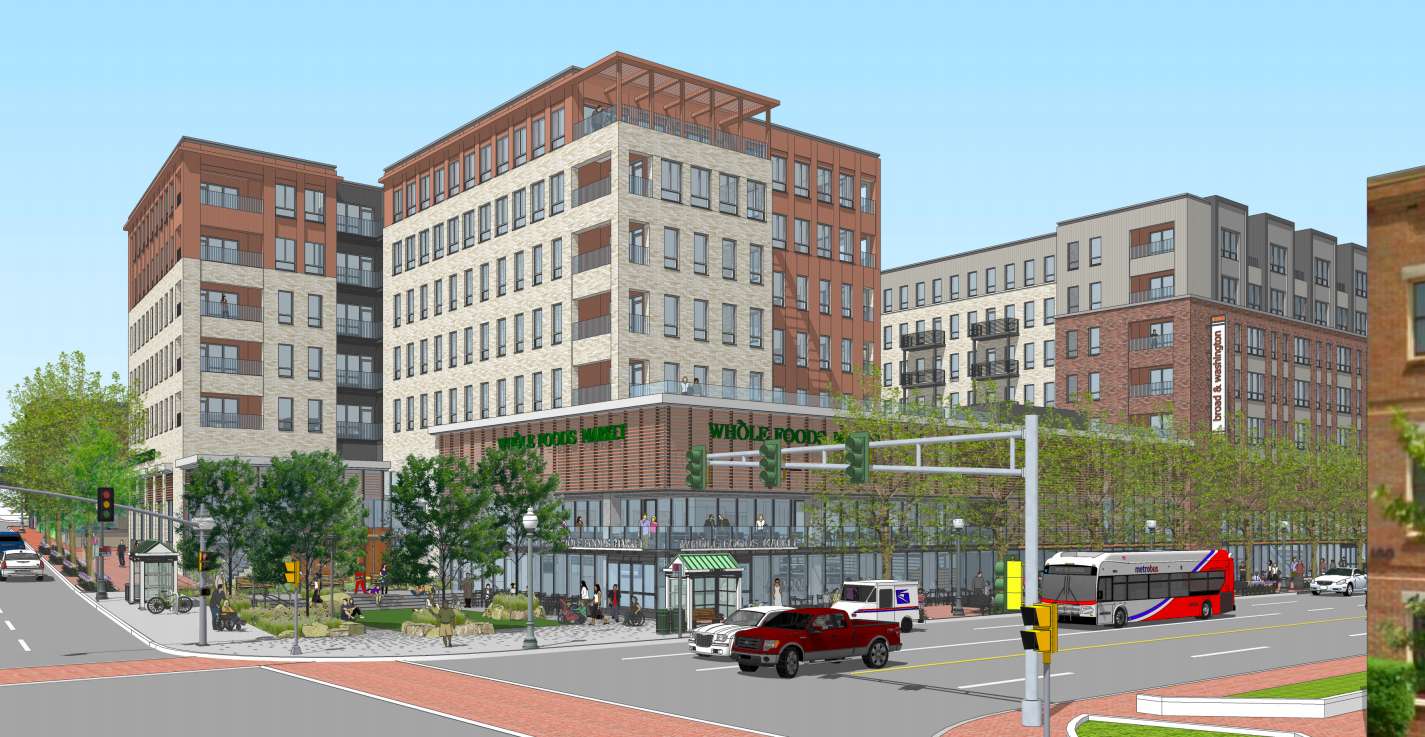
The City of Falls Church Planning Commission gave its support to the long-gestating Broad and Washington project last week, recommending after a Dec. 2 public hearing that the city council approve the proposed mixed-use development.
The commission’s unanimous decision to recommend approval of a comprehensive plan map amendment and a special exception for the project came despite some lingering dissatisfaction with aspects of Insight Property Group’s oft-revised proposal.
“Overall, I think this is a good project,” Commissioner Tim Stevens said. “There’s a lot of potential benefits for the city, and I stress potential, because there are a couple of high-exposure risks that the city faces.”
Given the current market, the commissioners concluded that there is likely little that can be done to address the project’s lack of office space. They also expressed concern about how much the project’s appeal relies on Whole Foods as the anchor, a skittishness inspired by the recent loss of the cornerstone tenant of Falls Church’s Founders Row project.
However, the commission addressed some issues by qualifying their approval with conditions related to the availability of electric vehicle charging infrastructure, the distribution of ground-floor square footage, and affordable housing requirements.
As part of a package of voluntary concessions, Insight has currently committed to providing a minimum of five electric vehicle charging stations as well as electrical conduit to support the future installation of five additional stations at the roughly three-acre site.
In its resolution recommending approval of Broad and Washington, the commission stated that the voluntary concessions agreement should require “the addition, at a minimum, of 10 conduits and related infrastructure to support future demand for equipment to charge electric vehicles.”
“That would give this project equal to what the city achieved with Founders Row,” said Stevens, who proposed the amendment. “It would be disappointing to think that we made progress with Founders Row and would possibly experience some back-sliding with this project.”
The commission also inserted a clause recommending reducing the amount of ground-floor area in the project’s main building that can be redistributed.
In its retail plan, Insight has agreed to dedicate at least 6,500 square feet of ground-floor space to retail sales and restaurant uses. 56,000 square feet on the ground floor and mezzanine levels will be devoted to a full-service grocery store – presumably Whole Foods – and 5,000 square feet on the ground floor has been reserved for the arts group Creative Cauldron.
However, the voluntary concessions agreement also includes a provision allowing the property owner to redistribute up to 10% of the ground-floor area between uses.
McGuireWoods partner Scott Adams, who represented Insight at the public hearing, told the planning commission that the developer is already reevaluating the amount of space that can be redistributed.
“[10%] probably made sense last time when we had a lot of uses on the ground floor,” Adams said. “It doesn’t work for the current configuration, so that’s something we’ll be changing in the VCs.”
The planning commission also encouraged the Falls Church City Council to explore ways to increase the number of affordable dwelling units in the Broad and Washington project. Insight has currently agreed to make 6% of the 339 units it plans to construct affordable to households that earn up to 60% of the area median income.
Noting that Falls Church lost approximately 200 affordable market-rate rental units between 2012 and 2018, Commissioner Cory Weiss initially suggested lowering the project’s required capital contributions in order to get a bigger ADU commitment, but the commission ultimately opted to be less prescriptive.
“I would support encouraging city council to consider that and look into that to see if it’s a viable option,” Planning Commission Chair Andy Rankin said. “…I just don’t want to suggest that they necessarily do it, because I don’t know what the consequences of that would be.”
Adams says Insight will submit a revised proposal that incorporates feedback from the city on Dec. 16. The city council will hold a public hearing and take action on Broad and Washington on Jan. 25, 2021.
Image via City of Falls Church
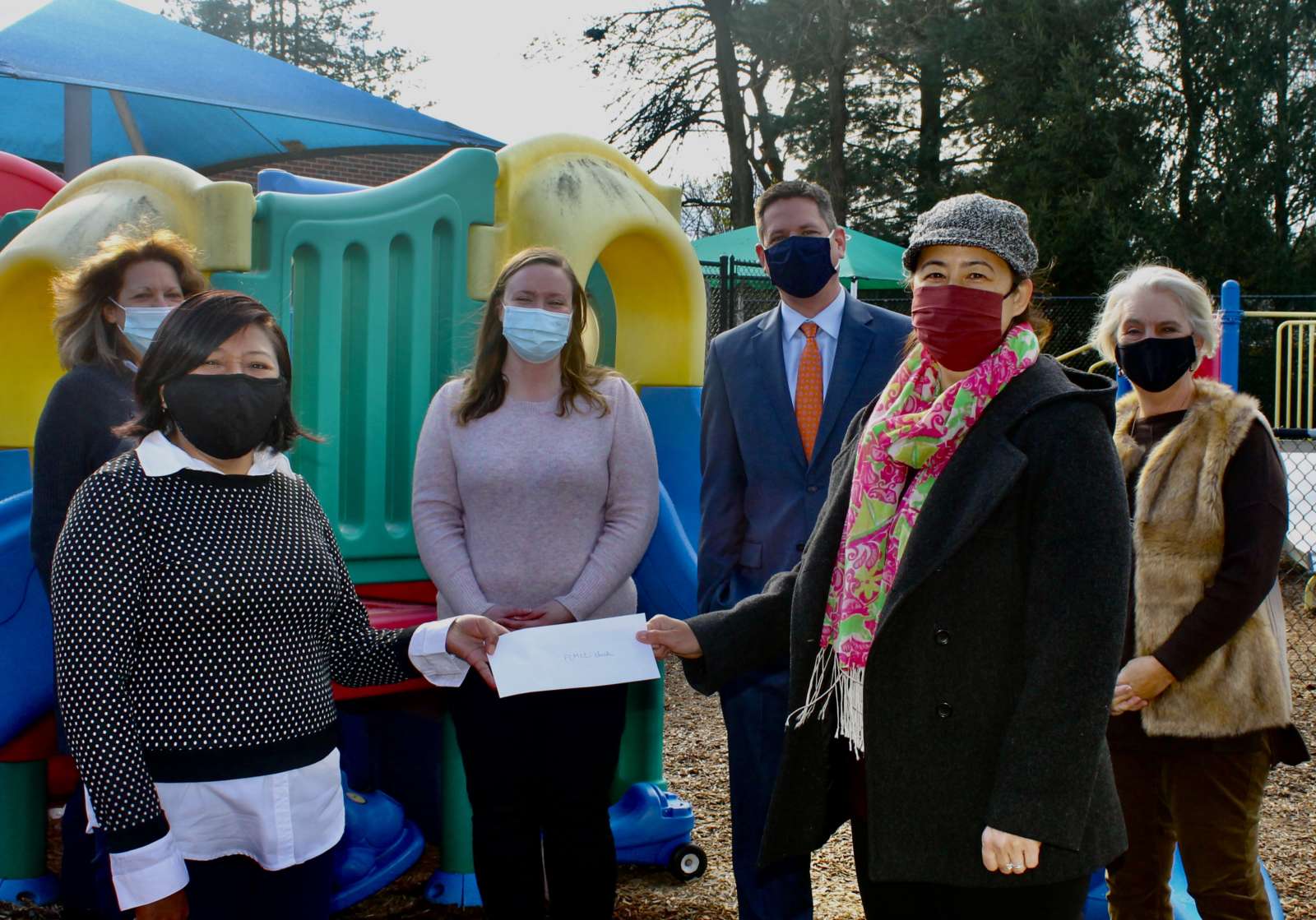
The New Dominion Women’s Club awarded a $1,200 literary grant to the Falls Church-McLean Children’s Center on Dec. 1 for Giving Tuesday, the McLean-based civic group announced today (Tuesday).
A nonprofit dedicated to supporting the local community through volunteerism and fundraising, the New Dominion Women’s Club (NDWC) received the grant in February from the Express Lanes Community Grant Program run by Transurban, the company that operates Northern Virginia’s I-95, 395, and 495 toll lanes.
The NDWC applied for the program with the goal of obtaining funds to promote early childhood literacy, a cause that it regularly supports by reading and distributing books to the Falls Church-McLean Children’s Center’s Reading Is Fundamental program.
“New Dominion Women’s Club is pleased to help FCMLCC upgrade their materials for pre-K and kindergarten students,” NDWC President Kim Marinus said. “The center’s commitment to providing a safe space for children to learn and play during this difficult time is truly admirable.”
The Falls Church-McLean Children’s Center, an early childhood education center located on Idylwood Road in Falls Church, plans to use the grant to upgrade its technology and software with Bluetooth speakers to help children hear music when they are spread out in a classroom, according to the press release.
The funds will also go toward technology intended to help students develop early literacy skills, such as rhyming, spelling, and identifying letter sounds.
“This grant is particularly well-timed for this very unusual school year,” FCMLCC Interim Executive Director Lucy Pelletier said. “Many of our books and puzzles have faded due to frequent sanitizing. The new materials were chosen for their durability and will better stand up to frequent cleanings.”
Photo courtesy Melissa Snyder

The Fairfax County Board of Supervisors met with the Fairfax County History Commission on Tuesday (Dec. 8) to discuss Confederacy-associated street and place names across the county.
This project began over the summer when the board directed the commission to create an inventory of places and structures within the county that have ties to the Confederacy after Black Lives Matter protests spread around the country following the May 25 death of George Floyd.
The resulting report identified more than 26,000 streets and places, leading the board to narrow its focus to 650 well-known Confederate officers and locally-known Confederates. After researching those names, the Commission found 150 assets to have confirmed Confederacy-associated names, according to the presentation by Anne Stuntz, the chairwoman of the history commission.
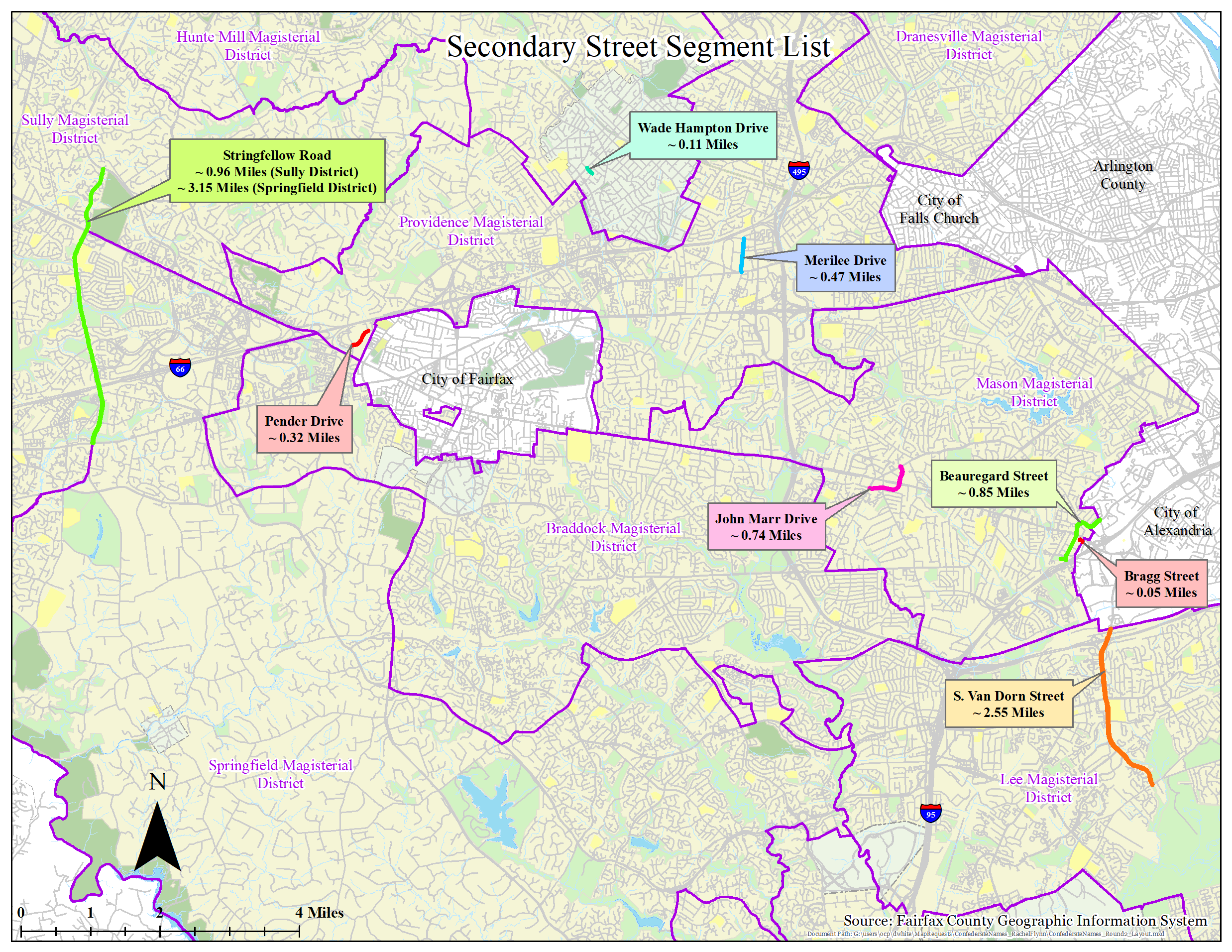
Hunter Mill District has four identified sites: the Lee Manor Subdivision, Fort Lee Street, Mosby’s Landing Condominium Complex, and Wade Hampton Drive.
Providence District encompasses 44 sites, the most of the county’s nine magisterial districts. The list includes Lee Highway, Pender Drive, Oak Marr Park, and the Stonewall Manor subdivision.
The commission recommended that the Board of Supervisors create a public dialogue on the issue through public meetings and community gatherings before deliberating and taking definitive action on the Confederate names. The commission also recommended archiving the extensive project research in the Virginia Room at the City of Fairfax Regional Library.
Fairfax County Department of Transportation Director Tom Biesiadney said that the Commonwealth Transportation Board would require public input and a formal request from the Board of Supervisors if the county decides to petition to change the name of Lee Highway and Lee-Jackson Memorial Highway.
In response to the Confederate names project, the history commission is collaborating with local African American organizations, including religious, social, and community groups, on a 2021 initiative to compile research materials on African American communities in Fairfax County.
The county supervisors shared their appreciation for the history commission’s extensive and intricate research. They also mostly agreed that the first priority should be renaming highways, and from there, they could start a community process for renaming secondary and neighborhood streets.
Lee District Supervisor Rodney Lusk expressed concern regarding the history of his district’s name.
“I was hoping that there’d be something more definitive about Lee District, in terms of where its name originated, but it appears that we still have the same set of ambiguity,” Lusk said. “We will have to have a community conversation about this name of this district.”
Springfield District Supervisor Pat Herrity warned against rushing into the name change process in the midst of the COVID-19 pandemic, emphasizing the need for “robust community participation” before moving forward.
Image via the Fairfax County History Commission
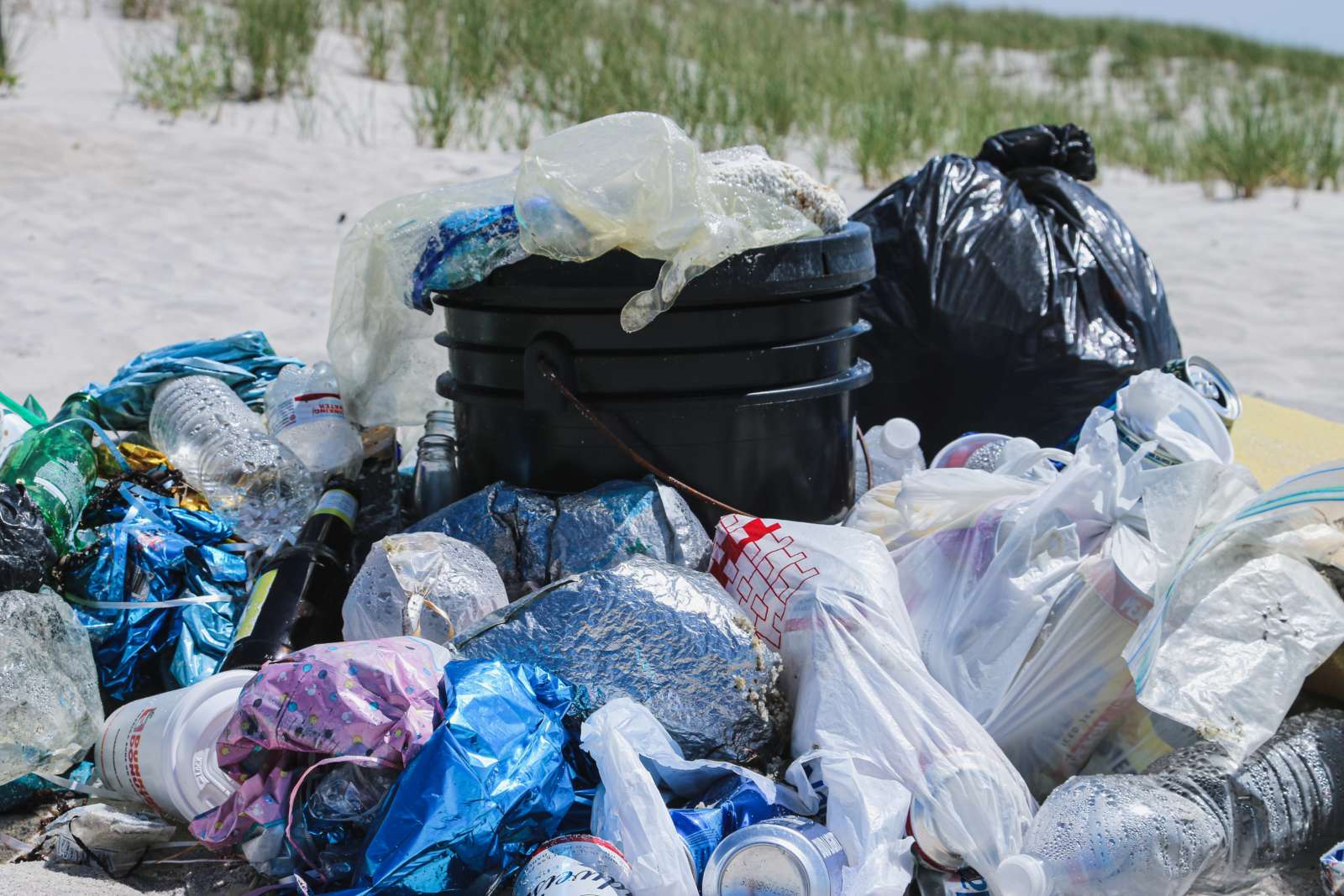
The Fairfax County Office of Environmental and Energy Coordination proposed a process for establishing a five-cent plastic bag tax during the Fairfax County Board of Supervisors’ Environmental Committee meeting on Tuesday (Dec. 8).
According to OEEC Deputy Director Susan Hafeli, legislation adopted by the Virginia General Assembly earlier this year now gives the county the ability to adopt an ordinance imposing a five-cent tax on most disposable plastic bags provided by grocery stores, convenience stores, and drugstores.
As of right now, the state has not established specific guidelines for the creation of a plastic bag ordinance. Instead, the state intends to wait until a locality adopts an ordinance to consider guidelines, according to the presentation.
Revenue collected from the new tax would be appropriated for environmental clean-up, mitigation of pollution and litter, education, and the provision of reusable bags to recipients of a federal food support program, according to Hafeli.
The proposed plastic bag tax could generate annual aggregate local revenues of between $20.8 to $24.9 million statewide, though the tax may be more of an “impetus to behavior change rather than a revenue generator,” Hafeli said.
Across the region, the Northern Virginia Regional Commission Waste Management Board has begun exploring the issues laid out in the legislation, according to Hafeli. Additionally, Arlington County is planning to convene a public workgroup in early 2021 to discuss the adoption of a plastic bag tax and issues regarding equity in the county.
The OEEC anticipates that the process of determing whether Fairfax County should instate a plastic bag tax will occur in two phases. The first phase will focus on public engagement, which would include developing a website, holding one or more workshops for input, and releasing an electronic survey.
The second phase will focus on the development of the ordinance and would involve updating the webpage with the proposed ordinance and requests for comments, giving presentations to the board, and holding a public hearing, according to Hafeli.
Several supervisors expressed concerns about the confusion regarding state guidelines, equity issues within the community, and the ability to collect sufficient research on the topic, especially in the midst of the pandemic.
However, most supervisors agreed that the environmental issue with plastic bags is significant, and that data from other jurisdictions, including the work that Washington, D.C., has done around the Anacostia River, has shown a plastic bag tax to have positive environmental effects.
Moving forward, the Board is looking to clarify the state’s policies while working in conjunction with regional partners and plan for further conversation on how to create the ordinance.
The next Environmental Committee meeting will take place on Tuesday, Feb. 2 at 11 a.m.
Photo by Brian Yurasits/Unsplash

Jinya Ramen Bar will kick off the new year with a pop-up in the Mosaic District, the noodle shop chain announced today (Wednesday).
Scheduled to open within the next six weeks, the space will be paired with a Japanese-inspired dessert shop that offers soft-serve ice cream and donuts. The pop-up space will be open Thursdays through Sundays.
Jinya’s existing Mosaic District location (2911 District Ave.) is also still open for takeout, delivery, and indoor dining in accordance with social distancing guidelines.
Jinya is also adding menu items for the holiday season that will be available at all four of its spots in the Washington, D.C., metropolitan area, including the Mosaic restaurant:
Holiday cocktails
- Sassy Old Fashioned: Toki whiskey with honey and saffron syrup and orange bitters, garnished with an orange peel and cherry
- Winter Blossom: Etsu gin with cranberry syrup, citrus, and Asian pear puree, topped with sake
Chef’s specials
- Soft Shell Crab Bun: a steamed bun stuffed with crispy soft-shell crab, avocado, and baby mixed greens
- Spicy Maze-Men: extra-thick noodles with no broth, dressed with umami bonito Japanese aioli and topped with pork chashu, kimchi, seasoned egg, green and white onions, bonito flakes, and nori (seaweed)
The specialty cocktails cost $10. The holiday menu items will be available through New Year’s Day.
Photo courtesy Jinya Ramen Bar

The McLean Project for the Arts is unveiling its two latest exhibitions today (Wednesday) with a virtual launch and artists’ talk at 7 p.m.
The Emerson Gallery will feature “Vertical Interval,” a collection of paintings and digital works by McLean-based artist Joseph Cortina. The exhibit draws on Cortina’s background as a painter and filmmaker to explore “the fleeting, elusive quality of time-based media,” MPA says.
“Vertical Interval” has been paired with multimedia artist Shanthi Chandrasekar’s exhibition “Beginningless Endless,” which will be displayed in MPA’s atrium gallery.
According to MPA, Chandrasekar has a background in physics and psychology and employs drawing, painting, and sculpture to explore “big questions of science and the natural world” in “Beginningless Endless.”
MPA Curator and Director of Exhibitions Nancy Sausser says Cortina and Chandrasekar had been on her radar for some time.
She also likes using the nonprofit’s two galleries to showcase exhibits that reflect on each other in some way. Both artists have an abstract element to their work, and these specific exhibits are focused in different ways on the idea of space.
“Shanti’s very interested…in sort of the cosmos and physics and, you know, that greater cosmic space,” Sausser said. “Joe is really interested in the space within the painting, and he has a lot of open area within his paintings that’s undefined and sort of becomes a place you can enter into.”

MPA will display both exhibitions online and in its physical galleries at the McLean Community Center, though the Emerson Gallery is largely closed to the public for the time being.
For its fall show, MPA allowed up to six visitors in the Emerson Gallery by appointment, but climbing COVID-19 case numbers in the region convinced staff members to change their approach for the new exhibition.
Sausser says people can contact MPA if they are interested in arranging a private viewing of “Vertical Interval,” but the nonprofit is mostly approaching it as a virtual show.
Images from both exhibitions will be available online tonight at the same time as the virtual launch, which will include prerecorded interviews of the artists by Sausser. Chandrasekar and Cortina will also appear live from their studios to answer questions from the public.
While navigating the COVID-19 pandemic has been challenging, Sausser says it has also opened new opportunities as MPA staff had to develop there digital and video skills. She hopes to continue offering virtual options even after both galleries resume normal operations.
“It’s definitely more work, and people aren’t experiencing [the work] the same way, but maybe the audience who gets to experience it is a little larger,” Sausser said.
Photos courtesy McLean Project for the Arts
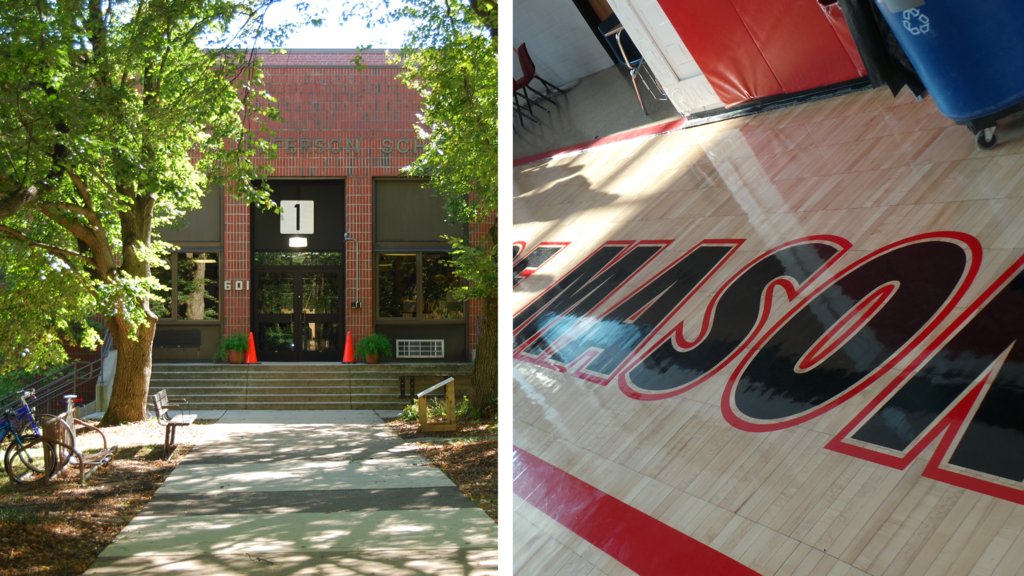
The Falls Church City School Board unanimously voted on Tuesday (Dec. 8) to rename both George Mason High School and Thomas Jefferson Elementary School.
The decision came after months of debate that involved two separate public hearings and an independently conducted survey that garnered more than 3,000 responses.
Emphasizing the care they took to consider different perspectives, the seven school board members ultimately agreed that Falls Church City Public Schools should adopt new monikers for its elementary and high schools in recognition of its goal to create a welcoming, inclusive environment for all.
“I’m in support of changing the names of our elementary and high schools, because if one student feels uncomfortable walking into a building named for a person who did not respect the dignity of another human being, that’s one too many,” School Board Member Lawrence Webb said.
The school board launched an effort to consider whether to rename Mason and Jefferson on June 30 after some community members started advocating for the changes in response to the protests against racial injustice and police brutality sparked by George Floyd’s murder in May.
During two hour-long public hearings in October, community members weighed Mason and Jefferson’s legacies as key figures in the formation of the U.S. against the pain they inflicted as slaveholders. Falls Church’s history of excluding Black people, the impending completion of a new George Mason High School campus, and the cost of renaming the schools also came up.
FCCPS estimates that renaming Mason would cost $96,760 and renaming Jefferson would cost $13,500. The school system also spent $8,500 to hire the consultant K-12 Insight to administer a public survey on the topic.
Presented to the school board on Nov. 17, the survey of students, staff, parents, and the general community found that 56% of respondents preferred to maintain the status quo, while 26% supported a name change for Mason and 23% supported one for Jefferson.
School Board Chair Greg Anderson noted that the survey was just one avenue used to solicit public feedback.
“The survey wasn’t a referendum or a generalizable, statistical, random sample of public opinion,” Anderson said. “…The survey was informative, but not decisive on its own and should be viewed as information.”
Now that the name changes have been approved, FCCPS Superintendent Peter Noonan will be accepting nominations for advisory study committees that will recommend new names to the school board. The board will announce the timeline for that process at an upcoming meeting, FCCPS says.
Anderson said the school board should continue to address inequity in education by reviewing FCCPS’s curriculum, hiring practices, and policies around diversity and discrimination. He also suggested developing a public space to educate people about Mason and Jefferson as well as the City of Falls Church’s history.
“Honestly, I’m not sure I know what this all looks like, but I think it’s an idea worth considering,” Anderson said.
Photo courtesy FCCPS
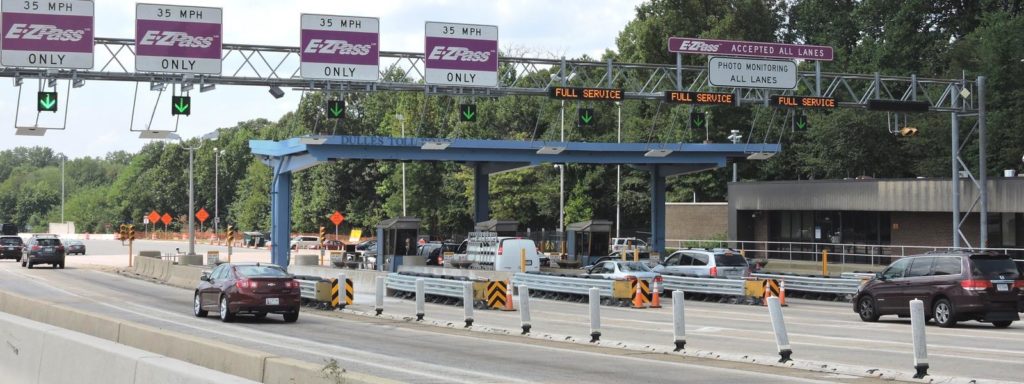
Cash will no longer be accepted at the Dulles Toll Road beginning next year.
The decision, which goes into effect on Jan. 1, was made in response to customers’ preferences for electronic toll payments, according to a statement released yesterday by the Metropolitan Washington Airports Authority.
No loose change will be accepted, and tollbooth change baskets will be removed as part of the permanent move.
Here’s more information from MWAA on acceptable forms of payment:
Any lane can be used with a valid E-ZPass account or other form of electronic tolling. Customers can visit E-ZPass Virginia for information on how to obtain an E-ZPass. If toll-lane cameras identify a license plate associated with an E-ZPass account, that account will be charged for the transaction even if an E-ZPass is not present in the vehicle.
To make it easier to get an E-ZPass, the minimum opening account balance has been temporarily reduced to $20 per transponder (from $35) for online and phone applications. E-Z Pass also offers a reloadable Virginia E-Z Pass Card, these can be purchased your local CVS Pharmacy and 7-11 Convenience Stores.
The GoToll, Slora and Peasey Drive On smartphone apps are also accepted as payment.
Motorists passing through all toll plaza lanes without electronic payment will be sent a payment notice by mail. Missed tolls which are paid within six days of the violation will not be charged an administrative fee. Customers are encouraged to visit the Virginia Department of Transportation’s online toll violation payment website for information on proactively paying missed tolls.
In early April, manual toll collecting was suspended in response to COVID-19. All personnel from toll booths were removed, and cash-exchange toll collections were suspended.
Electronic tolling became the preferred method of payment in 2003, when more than $18 million was collected with E-ZPass, compared to roughly $17 million collected in cash that calendar year.
In 2017, roughly $130 million was collected via E-ZPass while nearly $18 million was collected by cash, according to a 2018 study by the MWAA.
Photo via MWAA