


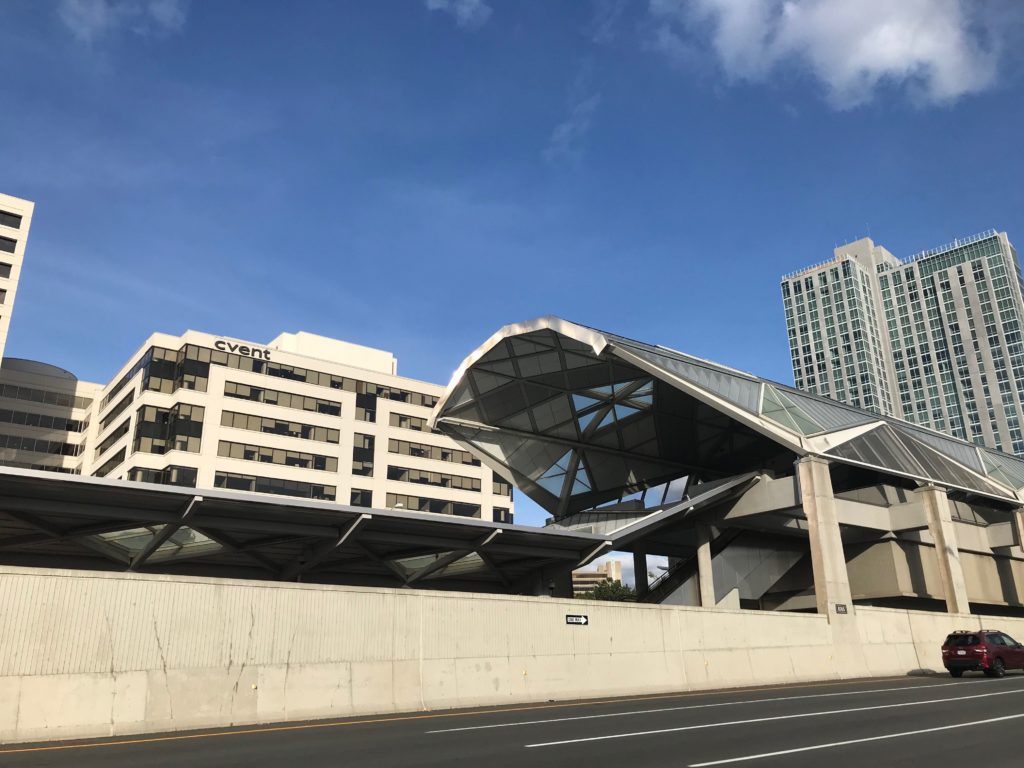
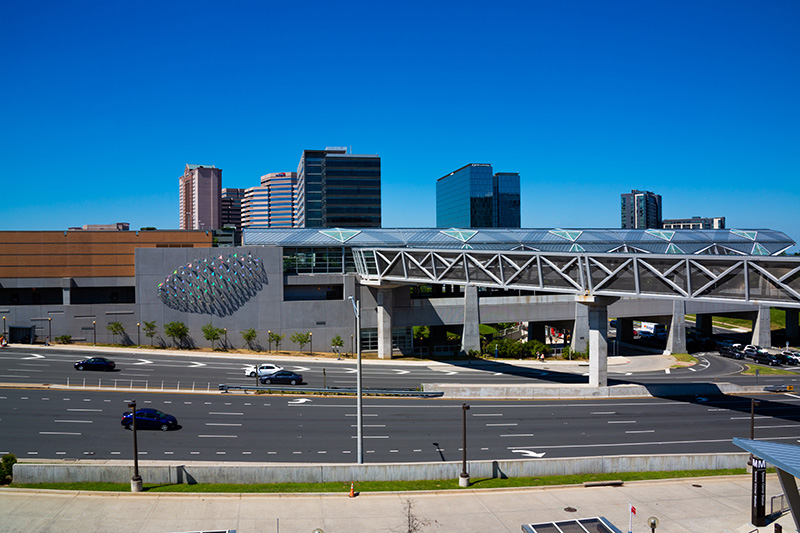
Toll revenues from the Interstate 66 Express Lanes to the tune of $1 million will fund a second entrance to the McLean Metrorail Station.
The plan is to knock down part of a wall in order to add doors and an entrance, Fairfax County Department of Transportation Special Projects Division Chief Martha Coello said.
“It really enhances the ability for people who live or work north of the station to easily access it,” she said. “Hopefully, that gives them greater incentive to use transit, rather than use their own vehicle.”
Fairfax County aims to start work “in the next year or so,” she said.
Using 66 Inside the Beltway toll revenue, the Northern Virginia Transportation Commission awarded money to six “low-cost, low-risk” transit projects as part of its Commuter Choice program for the I-66 corridor, according to an announcement on Thursday (Dec. 10).
“We’re expanding the transportation network now using a conservative strategy focused on low-cost projects and longstanding assets to ensure access to convenient, safe and reliable choices whenever people are ready to commute,” NVTC Executive Director Kate Mattice said in a statement.
Both the scope and timeline of the program are more conservative this year due to a drop in toll revenue caused by the novel coronavirus. Pre-pandemic, Commuter Choice anticipated getting $25 million in grant funding for the 2021-22 fiscal year. Instead, tolled trips dropped by nearly 50%.
The announcement called Fairfax County’s application the strongest out of the six projects, which will receive a total of $3.5 million. Other picks included renewing service for three “existing, high-performing express bus services” and converting parts of one lane of Lee Highway in Arlington into a bus and HOV-only lane.
Staff picked this batch of projects because it “minimizes the risk around the uncertainty of a return to pre-pandemic traffic volumes and makes the best use of the minimal available toll revenues,” NVTC says.
According to Commuter Choice, the program has enough money saved from previous years to continue existing projects and fund new projects.
Coello said the McLean Metro Station project “is a bit unusual” in that it was not formally part of a capital improvements plan, but rather, arose during a rezoning application from Capital One in 2012.
Working with the Washington Metropolitan Area Transit Authority, a team from Capital One designed the entrance, she said. The county received the exact amount it applied for, but Capital One has pledged to contribute to overages.
Coello says Fairfax County has been waiting for the right time to develop the site. Back in 2012, the change was not urgent enough to justify spending the money.
“Having an opportunity like Commuter Choice, this was kind of a golden opportunity,” she said. “It was a case of the right place, right time, right pieces falling in place.”
Since the Commonwealth of Virginia and NVTC established the program in 2017, Commuter Choice has provided more than $60 million grant funding to 36 projects in Northern Virginia.
Staff photo by Jay Westcott
Metro Silver Line Phase 2 Delayed Again — “Metro executive vice president of capital delivery Laura Mason said Thursday based on the latest information from the Washington Metropolitan Airports Authority – which is in charge of building Silver Line phase two – fall 2021 appears to be the best estimate for when service can start.” [ABC7-WJLA]
VHSL Issues New Face Mask Requirement for Student Athletes — “Starting tomorrow, winter athletes must wear a face mask at all times. This includes while they are engaged in physical activity. Because of safety concerns the only exceptions would be wrestling, gymnastics and swim & dive (when engaged in activity).” [McLean High School]
Fairfax County Suggests Pause on 495 NEXT — “Fairfax County supervisors approved two letters to the state transportation secretary Dec. 1 urging the Virginia Department of Transportation (VDOT) not to finalize decisions on its 495 Express Lanes Northern Extension (495 NEXT) project until Maryland officials make highway-capacity arrangements on their side of the Potomac River.” [Sun Gazette/Inside NOVA]
Comcast Expands Network in Tysons and Other Parts of Virginia — “Comcast Business today announced it has completed construction in Virginia – expanding the company’s advanced fiber-optic network to more than 2,800 additional businesses.” [Comcast Business/PR Newswire]

Updated on 12/2/2020 — The McLean Metro Station is one of 19 stations that would close if the Washington Metropolitan Area Transit Authority adopts a new budget proposed for Fiscal Year 2022.
The stations being considered for closure were identified based on low ridership levels or their proximity to another Metro station. They were all shut down earlier this year as part of Metro’s efforts to conserve resources during the initial days of the COVID-19 pandemic.
WMATA said on Mar. 24 that the McLean Metro Station only recorded 148 Metrorail trips the previous day, making it among the least frequented stations in the system.
The Greensboro Metro Station is also on the list for potential closure, since it is within less than a mile of the Spring Hill and Tysons stations.
The potential station closures are among several drastic cuts on the table as WMATA attempts to fill a nealry $500 million deficit in its upcoming budget.
Scheduled for discussion during the WMATA Board of Directors’ finance committee meeting on Friday (Dec. 4), the proposal also suggests eliminating all weekend rail service, limiting weekday train service to every half hour, and slashing bus service from 60 to 41 routes.
Under the proposal, Metro would offer an “affordable bare-bones service network to sustain essential travel and support the region’s recovery.” Ridership would be reduced to around 45% of pre-pandemic levels, and the system would only operate from 5 a.m. to 9 p.m. on weekdays.
The proposal also calls for the elimination of 2,400 jobs in addition to workforce cuts already enacted this year.
“We’re facing, obviously, a historic budget crisis. It started in [Fiscal Year] ’21 and will continue in ’22,” Metro General Manager Paul Wiedefeld said.
Metro could possibly avoid this grim outlook if Congress passes another federal COVID-19 relief package that with funding for public transit. According to the American Public Transit Association, public transit needs $32 billion just to survive.
Metro was awarded $800 million from the CARES Act in May — funding that runs out early next year.
“The latest proposed cuts to WMATA employees and service is a crisis for our region and frankly, the country,” Fairfax County Board of Supervisors Chairman Jeff McKay said in a statement. “…Congress needs to step in immediately to fund WMATA and the countless ripple effects these cuts will have.”
If WMATA adopts Wiedefeld’s proposed budget, the 19 stations that would be closed could reopen based on the financial health of Metro.
The opening of additional Silver Line stations into Loudoun County will not be affected by the budget slashes, according to the presentation.
Metro’s fiscal year begins in July. Public hearings and outreach campaigns are planned until March.
Angela Woolsey contributed reporting
Staff Photo by Jay Westcott
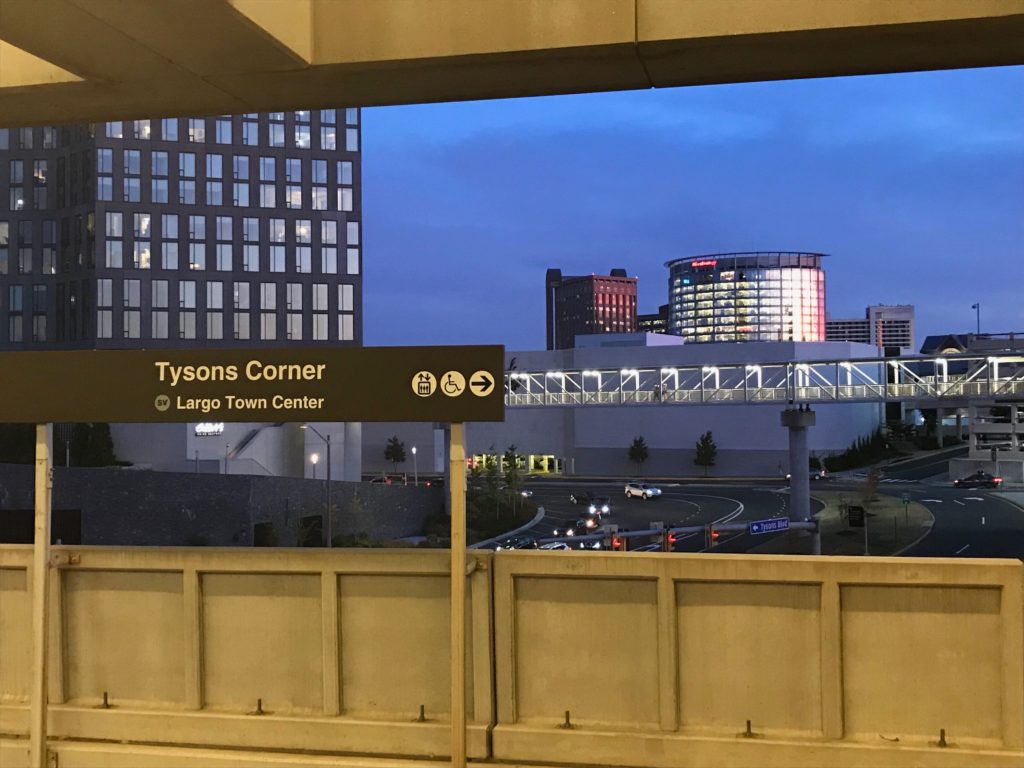
The Washington Metropolitan Area Transit Authority Board of Directors voted on Thursday (Nov. 19) to grant Fairfax County’s request to drop the “corner” from the name of the Tysons Corner Metro Station.
The board simultaneously approved a name change for the Prince George’s Plaza Metro Station in Maryland. That station will now be called Hyattsville Crossing.
The name changes were approved despite the results of surveys of riders and members of the public that found most respondents “significantly preferred” the stations’ current names over the proposed replacements, according to a report by WMATA’s safety and operations committee.
“History with Metrorail Station naming informs us that our riders and the communities we serve develop attachments to rail station landmarks and resist change,” WMATA staff said in the report.
For the Tysons station, only 36% of the online public survey’s 5,508 respondents said they like “Tysons” as a station name, compared to the 45% who disagreed and the 67% who said they like the name “Tysons Corner.”
However, 62% of respondents agreed that the name “Tysons” is easy to remember, and 58% said it would not be easily confused with other station names. 48% said the name clearly conveys the station’s location, and 47% said it describes the location well, surpassing than the 35% and 36%, respectively, who disagreed with those statements.
While the affirmative percentages are higher in all categories for Tysons Corner than they are for Tysons, those results are evidently positive enough that WMATA staff believes objections to the name change will dissipate once community members become familiar with the new moniker.
“Six in 10 survey respondents found the name [“Tysons”] easy to recall and not confusing with other names,” the staff report says. “Should the Board wish to approve the jurisdiction’s request, it is likely that the new name will become synonymous with the surrounding community over time and customers will find it sufficient for wayfinding.”
All of the Metro directors who were present for the vote supported the name changes, except for District of Columbia First Vice Chair Stephanie Gidigbi, who cited concerns about the public feedback when opting to abstain from the vote.
WMATA announced on Oct. 27 that Fairfax County and Prince George’s County had submitted formal name change requests for the Tysons Corner and Prince George’s Plaza stations.
According to the safety and operations committee report, Metro is planning systemwide signage and rail map changes in preparation for the second phase of its Silver Line service, which is not likely to start service until next summer.
With a Dec. 31 deadline for signage changes to be finalized, the Fairfax County Board of Supervisors requested that Metro rename its Tysons Corner station as part of the county’s ongoing efforts with the Tysons Partnership to rebrand the area around the Tysons Corner Center mall as Tysons.
The Board of Supervisors has also asked Metro to rename the West Falls Church-VT/UVA Metro Station to reflect that the University of Virginia no longer has facilities nearby as of April 2020.
Like Prince George’s County, Fairfax County has committed to funding the $332,000 needed to change signage at the affected stations, according to WMATA.
Staff photo by Catherine Douglas Moran
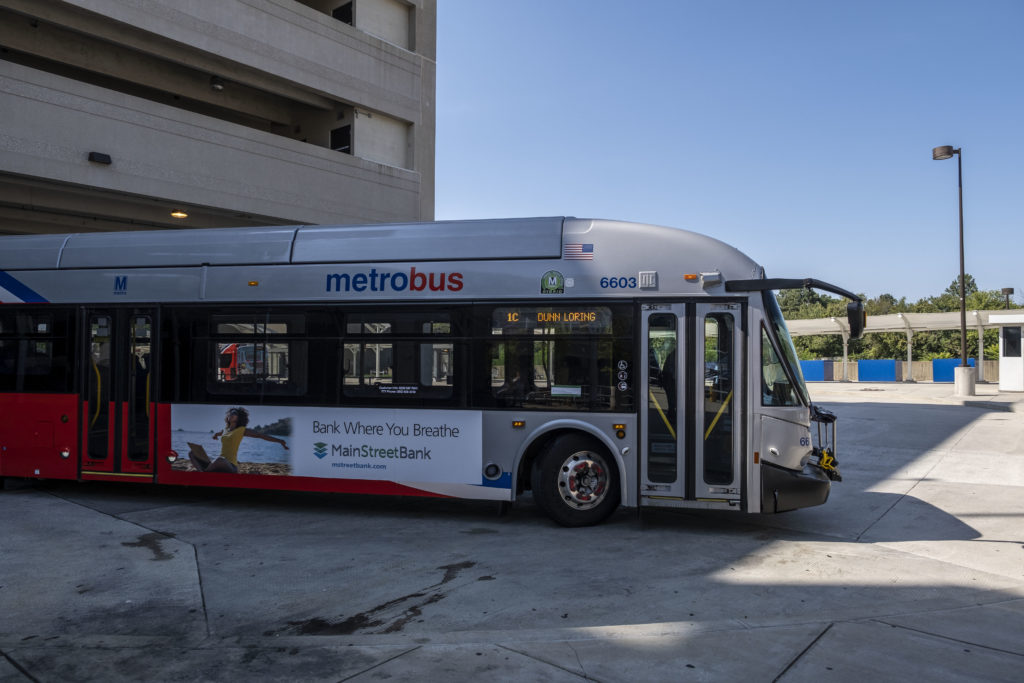
Metrorail and Metrobus users in Fairfax County may be seeing service changes next year.
Proposed by Washington Metropolitan Area Transit Authority staff to help close a $176.5 million-gap in the budget for this fiscal year, the changes span management actions to service changes to deferred capital projects. WMATA staff say the Silver Line expansion will not be impacted.
The proposed budget revisions are currently under review and will be voted on by the WMATA Board of Directors this Thursday (Nov. 19).
This deficit is mostly a result of an 80% reduction in revenue from ridership, WMATA Virginia Government Relations Officer Gregory Potts told the Greater Tysons Citizens Coalition during a meeting on Nov. 12.
The Metro saw a 90% drop in ridership across the board, including Tysons, Potts said. The declines in train and bus usage began in mid-March due to the COVID-19 pandemic, and they persist today.
Nine months into the pandemic, Metrobus ridership is down by 60%, a slight recovery from the 80% drop seen earlier in the year. That change can be partly attributed to the number of essential workers who may not be able to afford a car but still need to get to their jobs, Potts said.
“It’s been pretty eye-opening to us how important the bus is to the region,” Potts said. “Sometimes rail gets all the attention, but the bus system is really important to a lot of individuals. It’s an equity issue for us.”
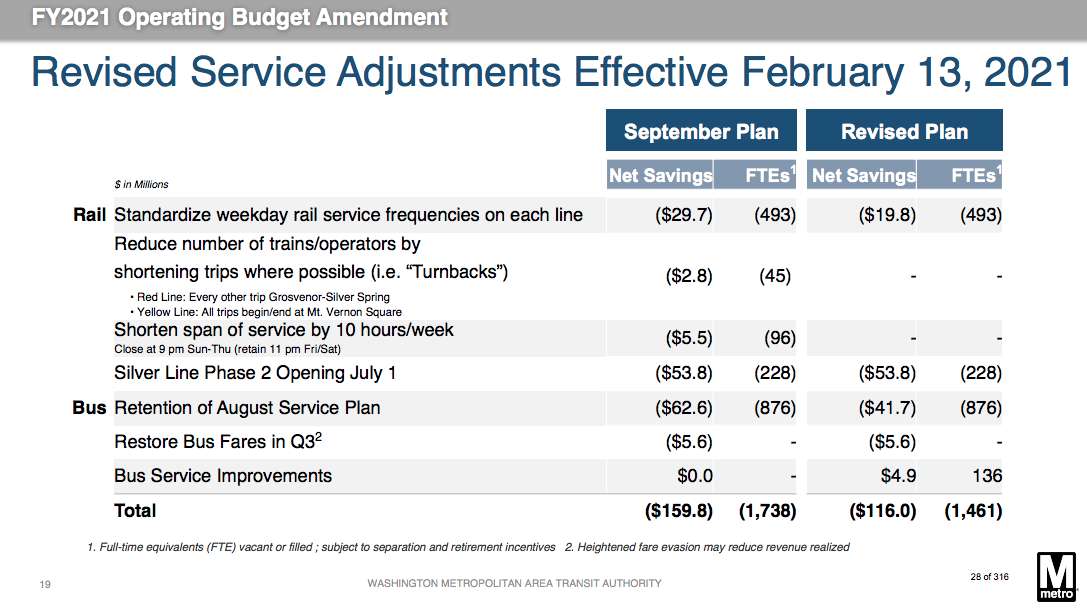
WMATA staff are recommending Board members vote to authorize management actions and save $30.5 million, to defer non-safety related capital projects and save $30 million, and to make service reductions amounting to $116 million in savings.
The cuts could have been worse. A first draft of the plan released in September had more changes and cuts, because the deficit was projected to be $212 million. The plan was revised after WMATA opened up the plan for public comment, pushed its CARES Act money further, and found additional savings in operating costs.
WMATA initially projected the $546 million it received from the CARES Act would only last through 2020, but the agency now says it will stretch until March 2021. It also saved $35.5 million that would have paid for overtime, fuel, utilities and other costs.
Despite public objection to some reductions in services, a few bus lines that have been suspended in Fairfax County will remain on hold under WMATA’s updated budget plan.
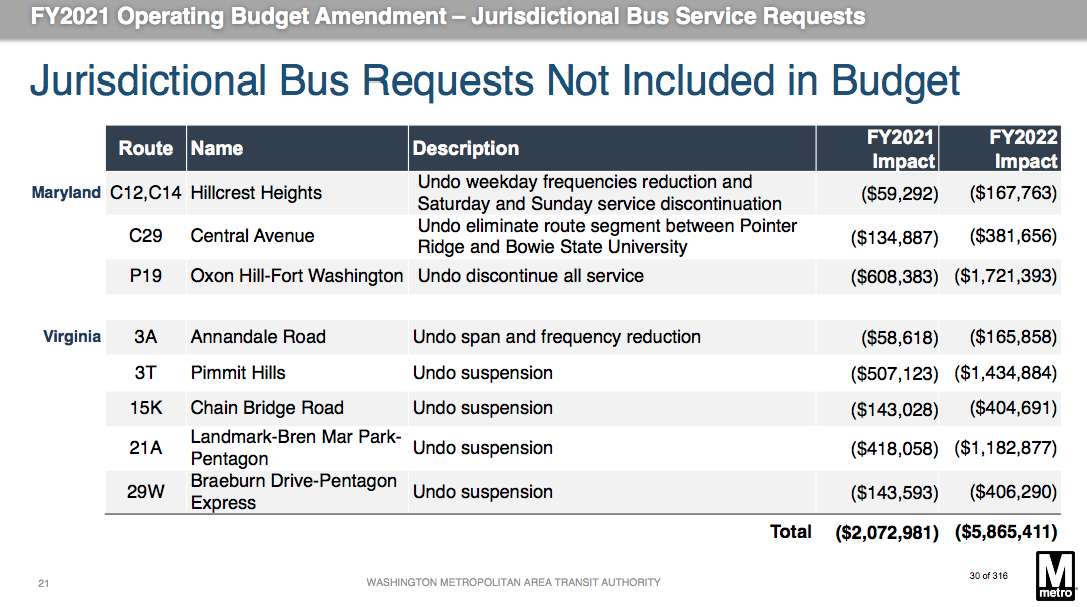
It is hard to pinpoint when transit rates could return, Potts said.
“If you’re talking about pre-COVID-19 rates or more generally, some talk of ‘normalcy,’ where there are people wearing masks but more people riding, for transit, there will be an impact for longer than we want to imagine right now,” Potts said.
Currently, WMATA cleans buses, trains, and high touch-points daily, and it disinfects on demand with an electrostatic fogger machine, he said. Staff are providing riders with masks. Bus riders board from the back and the operators are protected by plastic shields.
Earlier this year, the Metro board approved a six-month deferral of the fare changes that will last through November.
To eliminate contact with employees, WMATA launched a SmartTrip app for Apple in September that enables contactless mobile fare payment. An Android app will be available by the end of the year, according to Potts.
“That’s good for convenience and safety,” he said.
Despite initial concerns about people contracting the novel coronavirus while using public transit, some preliminary studies internationally have demonstrated that “transit has not been known to be a transmitter in the way that other facilities may be,” Potts said.
Another positive development is that platform renovations to improve safety and accessibility at the Metrorail stations in Vienna, Dunn Loring, East Falls Church, and West Falls Church were completed on time.
“We’ve finished 10 platforms in the last year and a half,” Potts said. “It’s really moving along well. With the pandemic, they could actually maintain their schedule.”
Staff photo by Jay Westcott, slides via WMATA
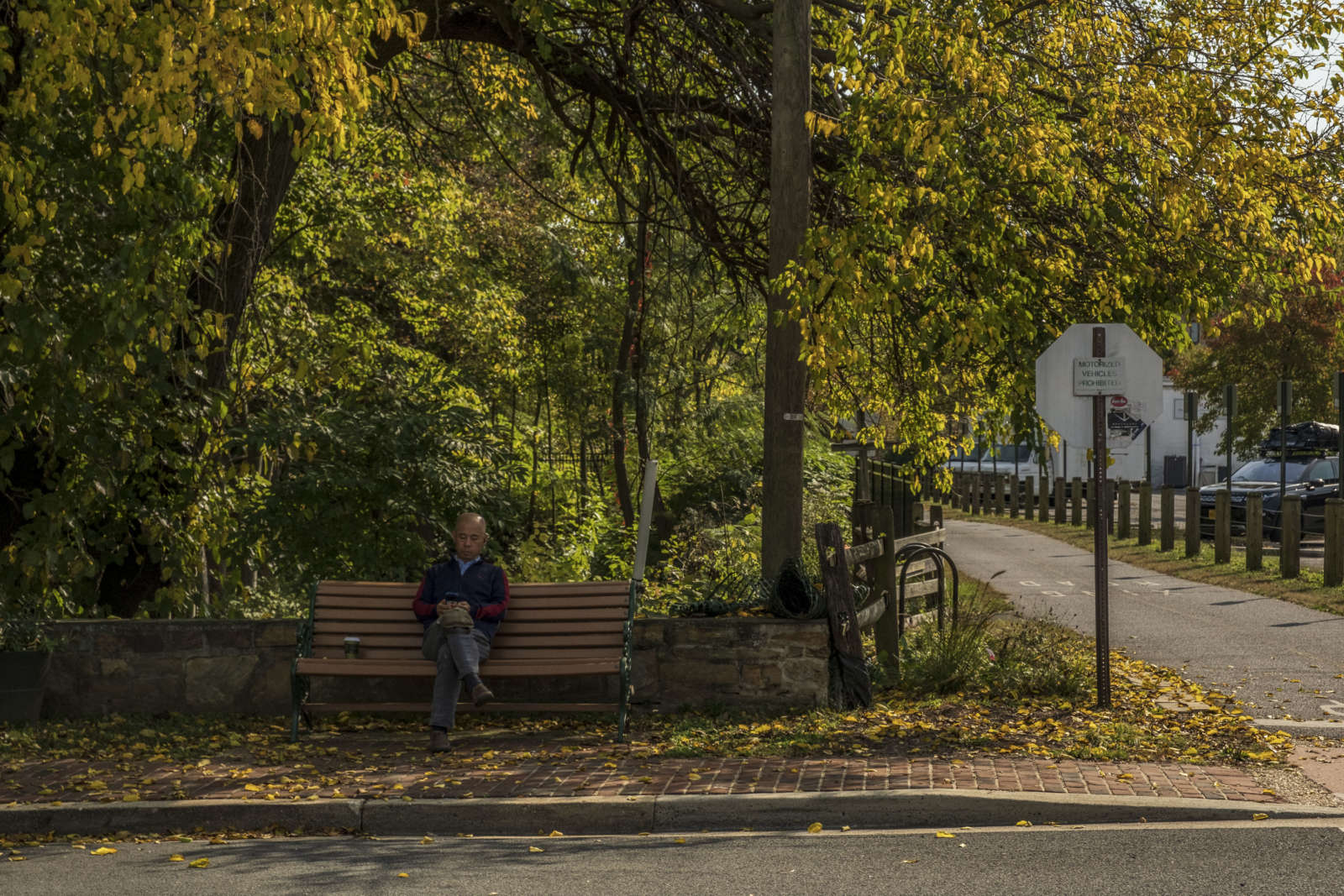
Vienna Girl Makes Eagle Scout History — “A Vienna eighth-grade student has achieved something few girls have: she’s become one of the nation’s first and youngest female Eagle Scouts.” [WJLA]
Tysons Corner Metro Station Closed for Coronavirus Cleaning — “Video posted to social media shows cleaning crews in full biohazard suits spraying the Tysons Corner station about 4 p.m. Tuesday.” [NBC4]
Vienna Planning Commission Approves New Subdivision — “A proposed six-house subdivision in southwest Vienna received a unanimous recommendation to the Vienna Town Council Nov. 4 from the town’s Planning Commission.” [Inside Nova]
Staff photo by Jay Westcott
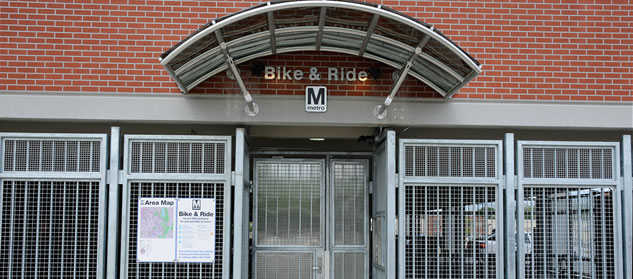
Work on Metro’s Bike and Ride facility for the Vienna Metro Station is finally nearing the finish line.
More than five years after it started, major construction on the project has now been completed, Washington Metropolitan Area Transit Authority spokesperson Ian Jannetta says.
“The Bike & Ride is being readied for customer use, including inspections and final project activities (such as integrating access control to the Metro network),” Jannetta told Tysons Reporter in an email on Oct. 30. “As soon as we have a date for when customers can use the facility, we will announce it.”
The Vienna facility is Metro’s second Bike and Ride in Fairfax County after one opened at the East Falls Church Metro Station in August. The two stations will have a combined 184 spaces for riders to park their bicycles before hopping on a train or bus.
Metro’s bike parking facilities are monitored around-the-clock by security cameras and include “fix-it stations” with a tire pump, tools, and a stand for making basic repairs and adjustments, according to WMATA.
In order to access the facilities, customers need a registered SmarTrip and must fill out an online form about 24 to 48 hours in advance of their visit, though the bike and rides are free to use.
Metro’s Bike and Ride facilities were recently the subject of a critical report by the WMATA Office of the Inspector General, which reviewed the projects after receiving public complaints and a request for information from a U.S. Senate subcommittee on federal spending oversight.
Released on Oct. 16, the report found that WMATA has spent over $5.9 million on three Bike and Ride facilities that collectively provide 304 parking spaces, amounting to approximately $19,400 per space.
The inspector general also criticized the prolonged construction schedule on the Vienna and East Falls Church facilities, the lack of timely communication with the public, and gaps in financial records for the projects.
Metro started developing Bike and Ride facilities in 2011 as part of a capital program designed to expand bicycle and pedestrian amenities at its stations.
While work on a Bike and Ride at College Park in Washington, D.C., started in August 2011 and finished in May 2012, the East Falls Church and Vienna projects were delayed by construction issues and contractor disputes, including a termination of the original contract in 2016.
Jannetta says WMATA has overhauled its structure for managing capital programs since the East Falls Church and Vienna Bike and Rides started construction in February 2015.
“While it took longer than it should have to get a new contractor on board, the issues were ultimately resolved, delivering bike capacity that will benefit current Metro riders and generations of environmentally conscious riders to come,” Jannetta said.
Photo via WMATA
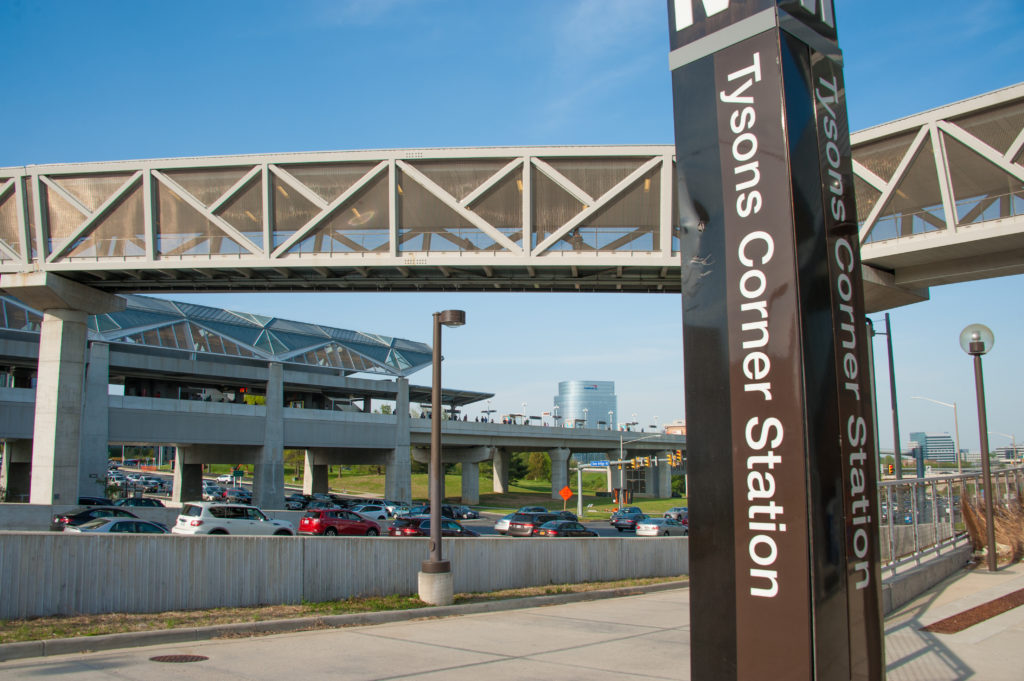
Fairfax County has requested approval to change the Tysons Corner Metro Station’s name, dropping the word “corner” so it becomes “Tysons Station.”
According to a press release from the Washington Metropolitan Area Transit Authority, the name would be changed on all system maps, digital signs, the WMATA website, SmarTrip app, in-system directional signage, and more.
Prince George’s County is also looking to change Prince George’s Plaza Station to “Hyattsville Crossing.”
Under Metro’s policy, requests to rename a station are considered by the Metro Board of Directors, who will approve or deny the request.
The board of directors has released an online survey to gauge what riders think of changing the station names as part of the process, welcoming feedback.
According to the release, the jurisdiction making the name change request must commit to funding the full cost of the change, including reprinting maps, making new signs, and reprogramming systems that provide customers information.
Additionally, according to the release, the policy has three major guidelines for any new station name:
- Names should identify the station locations by geographic features such as landmarks or centers of activity.
- Names should be distinctive and evoke imagery in the mind of the patron.
- Names should be no longer than 19 characters, except for transfer station names, which should be non longer than 13 characters.
Survey responses will be accepted through Nov. 2 at 5 p.m.
Photo via Tysons Reporter
The announcement of more delays for the Silver Line have led to concerns from Supervisors Dalia Palchik and John Foust that Metro isn’t giving the communities around the Tysons area a fair shake.
Metro was one of several topics the supervisors spoke to the McLean Citizens Association about earlier this week.
“They are currently talking about reducing Metrorail service across the system to 80%,” Foust said. “Except that they’re saying they don’t have the funds to commence service on Phase II of the Silver Line.”
While Foust said the second phase of the Silver Line expansion isn’t quite ready for opening, it will be soon, and Foust said it deserved to be treated like any other wing of the Silver Line. Foust was particularly vexed by arguments from WMATA that Metro lines that had been operational before the shutdowns will be prioritized for service.
“If they get 80%, we should get 80%,” Foust said. “We’ve invested $6 billion into the Silver Line… I’m advocating for opening Phase 2 of the Silver Line as soon as possible.”
Palchik said these issues have been exacerbated by lack of communication between WMATA and Fairfax County.
“We found out, maybe hours before the public, that the Orange and Silver lines were being shut down,” Palchik said. “The lack of communication between our boards and the WMATA boards is frustrating beyond compare. [We] need to ensure we’re not seen as the wicked stepchild of the metro system.”
Staff photo by Michelle Goldchain

The Board of Supervisors approved the receipt of a $58,212 compensation package to Fairfax County as reimbursement for this summer’s shutdown of stations along the Silver Line at the meeting on Sept. 29.
The planned shutdown had been in the works pre-COVID, but the nature of the closure changed when the pandemic hit.
“On December 11, 2019, WMATA announced the temporary closure of three Orange Line Metrorail stations west of Ballston Station during Summer 2020,” staff said in a report. “This temporary closure is part of a large construction project to rebuild 20 outdoor station platforms. The Summer 2020 shutdown was originally planned to impact four stations: Vienna, Dunn Loring and East Falls Church. Access to West Falls Church Station would be restricted but was going to remain open during the project because, it is equipped with three tracks and two platforms that can be reconstructed, one at a time. The West Fall Church Station was supposed to be the western terminus of the Orange Line during the summer months.”
When COVID-19 hit, Metro expanded those plans to include reconstruction work on all five Silver Line Metro stations, including West Falls church, to connect to Phase II of the Silver Line.
In total, nine stations were impacted.
The compensation is meant to help cover some of the costs to Fairfax County, like supplemental bus services, providing customer service and fare card loading services at the stations as Metro users were sent to buses.
Staff photo by Jay Westcott
