


For the fourth year in a row, the Tysons 2050 event has put forward a rosy view of the future of the area, but this year, those lofty dreams are weighted down by some harsh realities about challenges ahead for Tysons.
Sponsored by the Tysons Regional Chamber of Commerce, the event features voices from different industries around Tysons discussing what lies ahead for the region. Those experts recognized that the future is harder to predict this year. COVID-19 is on the rise again nationally and locally, and the onset of winter is leaving many businesses that had gone outside for activities scrambling for new solutions.
“What happens to offices and malls?” asked Sol Glasner, CEO of the Tysons Partnership. “I don’t know, and you shouldn’t listen to anyone who says they do know. The crystal ball is murky.”
Glasner said offices may need to be reconfigured, but he doesn’t believe the need for office space will fully disappear any more than retail will.
“Our shopping areas have proven adept to changing to consumer patterns,” Glasner said.
Mike Whatley, vice president of the National Restaurant Association, says one of the advantages for Tysons-area restaurants and retail is having more flexibility in using their space than their counterparts in D.C., like larger sidewalks for curbside pick-up.
“The ability to have extra space, to have extra flexibility, means restaurants will survive and thrive,” Whatley said. “When people are looking now and post-pandemic at where they want to live, you have to have that vibrant restaurant scene and culture.”
Whatley said one of the keys to surviving the season will be embracing going digital.
“Restaurants that survive are the ones that are embracing tech [and] communicating with customers,” Whatley said. “You do see a lot of them in the Tysons community, ones that are able to reach out to customers.”
Tony Hudgins, Vice President of TransitScreen, said ghost kitchens — food vendors that don’t operate out of a restaurant space — could take up a bigger role in the restaurant scene after the pandemic. Read More

The Fairfax County Board of Supervisors indicated interest in a pilot program for electric-powered buses during its transportation committee meeting on Tuesday (Nov. 10).
During the meeting, Fairfax County Department of Transportation Director Tom Biesiadny delivered an presentation that explained the “ins and outs” of electric vehicles and included a proposal for moving forward with a pilot plan.
The next step would be to return to the supervisors with a more in-depth financial plan that includes details such as when and where this would take place, and how long the demonstration would last, which could be in the early part of 2021, Biesiadny says.
“This is exciting,”said Board of Supervisors Chairman Jeffrey McKay. “Clearly we need to jump into this area and we need to do it quickly.”
Providence Supervisor Dalia Palchick supported a pilot because it would help ensure the county implements these changes correctly.
“This is the future,” she said. “We need to stop going backward. I’m hopeful to see a plan not just to see a pilot but do a demonstration project, which in my mind, means ‘how can we move forward?'”
A pilot with four buses could cost between $3.8 million and $4.2 million, a gross cost that does not take into account sources of funding. Some money has been set aside through a bus replacement program, and there are grants available, Biesiadny said.
FCDOT has in-house and external expertise from Fairfax’s “ongoing partnership with Dominion Energy” and the Richmond Highway Bus Rapid Transit team to draw from, said Tom Reynolds, the FCDOT Section Chief of Transit Services Division.
The pilot would help the department learn about the buses’ range and charging, how they perform during different seasons of the year and on various local and express routes, and what staff training needs to be done, Reynolds said.
“The sooner we do the pilot, the sooner we see the results of it, the sooner we can start to make longer-term decisions about some of the capital costs that would be necessary if we were to expand this,” McKay said.
When the county talks about costs, Palchik — who said she developed childhood asthma living in the area — and Braddock Supervisor James Walkinshaw emphasized the costs of treating asthma and the health impacts of poor air quality.
“In Virginia, we spend $87 million a year because of asthma hospitalization,” Walkinshaw said. “Fairfax County is lower, but Route One is higher. Annandale is higher. Other parts of the county are higher. It would be a small thing, but as we look at this pilot, we might want to look at locating it in parts of the county that have been hit harder by asthma.”
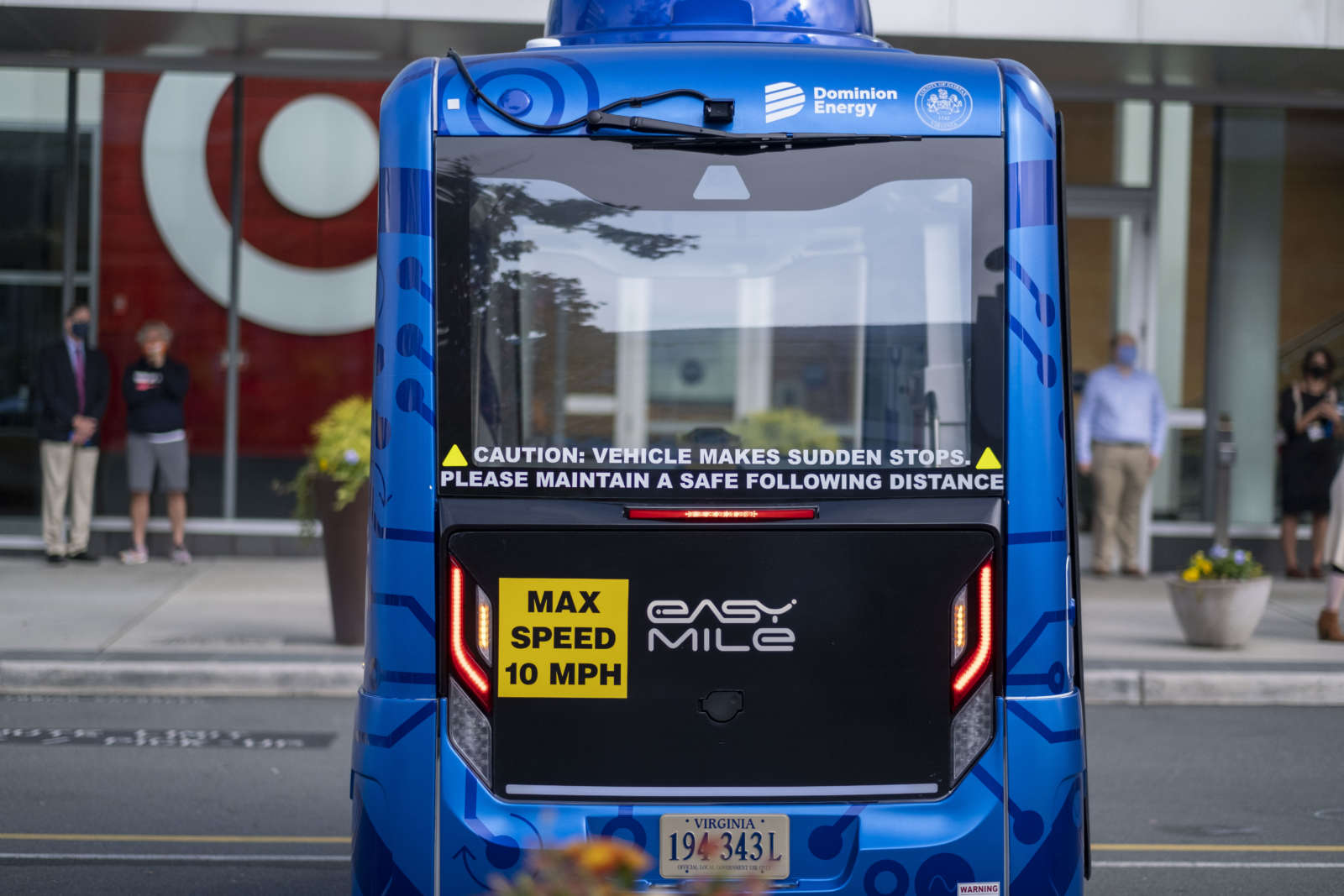
Fairfax County’s first effort to introduce electric vehicles into public transit came this year with the autonomous Relay shuttle now operating in the Mosaic District. That demonstration project is a partnership with Dominion Energy, Biesiadny said.
Photo via Electrify America; Staff photo by Jay Westcott
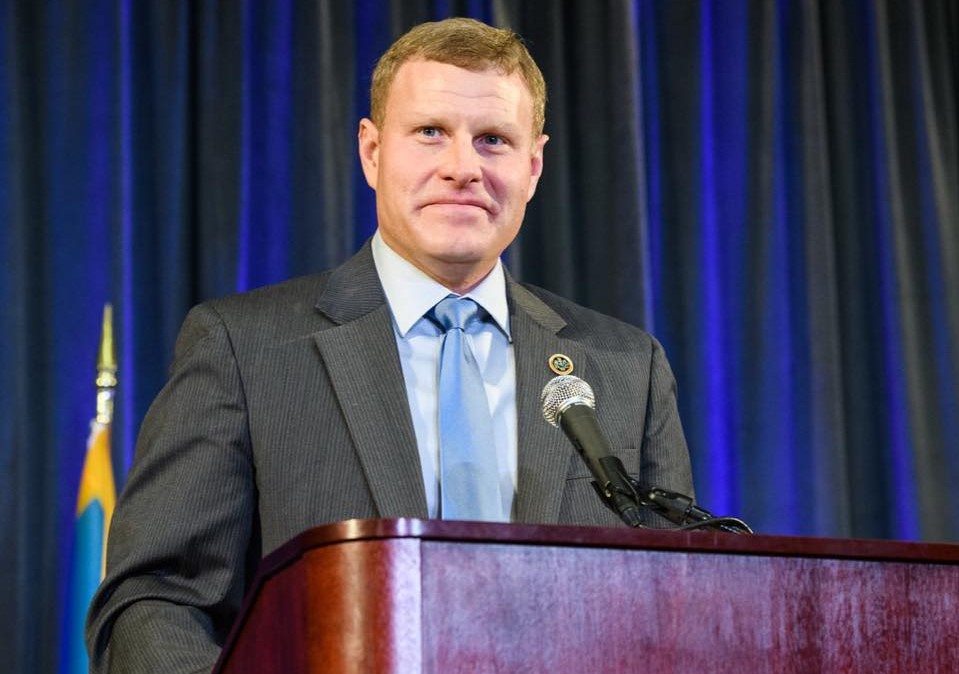
Fairfax County Board of Supervisors Chairman Jeffrey McKay was elected to serve as the 2021 president of the Virginia Association of Counties (VACo) yesterday.
The statewide group advocates with the state’s legislature for the interests of the Commonwealth’s 95 counties, according to a press release from McKay.
“I’m honored to serve as the next president of the Virginia Association of Counties. Throughout my many years with VACo, I have always considered us to be a large family,” McKay said in a speech delivered to members Wednesday (Nov. 11) morning.
“I treasure the many relationships I have built with my colleagues throughout Virginia. VACo is a great way to bring us all together to advance our communities,” said McKay.
Chairman McKay had led efforts with VACo over the last several years to drastically increase state funding for education and transportation, and to ensure the perspective of counties is heard statewide, according to the press release.
This upcoming year, Chairman McKay wants to lead VACo with the same level of attention to equity as Fairfax County.
“As a kid riding my bike with friends, I didn’t realize what this meant, but I saw firsthand that where you come from was an important factor for your future success and livelihood,” McKay said. “When I got older, I understood that this was wrong.”
“This was a driving force behind my decision to begin a career in local government and an inspiration behind the One Fairfax equity policy that I introduced in 2017. This policy has become central to all decision-making in Fairfax County by requiring us to look at all policies.”
McKay started his tenure yesterday.
Photo via Jeff McKay/Facebook

The COVID-19 pandemic has claimed another Tysons area restaurant.
Da Domenico has been permanently closed since Oct. 10 after operating at 1992 Chain Bridge Road for 39 years, owner Sayed Hussain confirmed to Tysons Reporter today.
Patch first reported the closure this morning after noticing a statement on the Italian restaurant’s website explaining that it has been unable to remain open “given the pandemic and its implications.”
Hussain says the property owner chose not to renew Da Domenico’s lease, which was coming to an end, and it was “tough” to stay in business with the challenges imposed by COVID-19, which has required restaurants to adopt a range of safety measures and restrict the number of customers they serve to enforce social distancing protocols.
Before it closed, Da Domencio had limited its operating hours to 5-9:30 p.m., though the website states that it had hoped to reopen for lunch soon.
Ongoing construction on Chain Bridge Road also contributed to the difficult decision to close, according to Hussain.
“There’s a lot of history attached to this restaurant,” Hussain said, noting that Da Domenico had garnered many loyal customers, including politicians and celebrities, during the nearly four decades it was in business.
Hussain says Da Domencio could reopen if he finds a new location, but for now, patrons can find the same Italian cuisine at its sister restaurant, Zeffirelli, in the Town of Herndon.
Zeffirelli, which Hussain also owns, has not encountered the same issues as Da Domencio and remains open, albeit with shortened, dinner-only hours.
Loyal Da Domenico patrons who visit Zeffirelli can get wine or a dessert on the house if they tell their server that they’re coming from the Tysons restaurant, Hussain says.
Photo via Google Maps

Like everywhere else in the U.S., the COVID-19 pandemic and ensuing economic fallout have hit Fairfax County hardest in its most disadvantaged communities, consultants confirmed in a presentation to the Fairfax County Board of Supervisors on Tuesday (Nov. 10).
With the exception of just two zip codes, the areas in Fairfax County with more COVID-19 cases also have more residents of color and lower average median incomes than the county as a whole, according to HR&A project manager Olivia Moss.
The zip codes with the most COVID-19 cases per 100,000 residents are concentrated primarily around Falls Church, Annandale, and Bailey’s Crossroads.
On top of that, low-income residents and people of color have been most affected by the national economic downturn that started this spring, when businesses and public spaces temporarily closed in an effort to control the spread of the novel coronavirus.
90% of all job losses in Fairfax County this year have occurred in industries like retail and food services, where average wages are less than 80% of the county’s area median income. 63% of the county’s job losses were in industries where the majority of workers are people of color.
“We know across the country, the pandemic and the resulting economic crisis has not been distributed equally across everyone and every business sector,” HR&A partner Jeff Hebert said. “So, really trying to understand what’s happening in Fairfax and how you can be part of creating a more just recovery in Fairfax is going to be really important to the community that will result after this pandemic is over.”
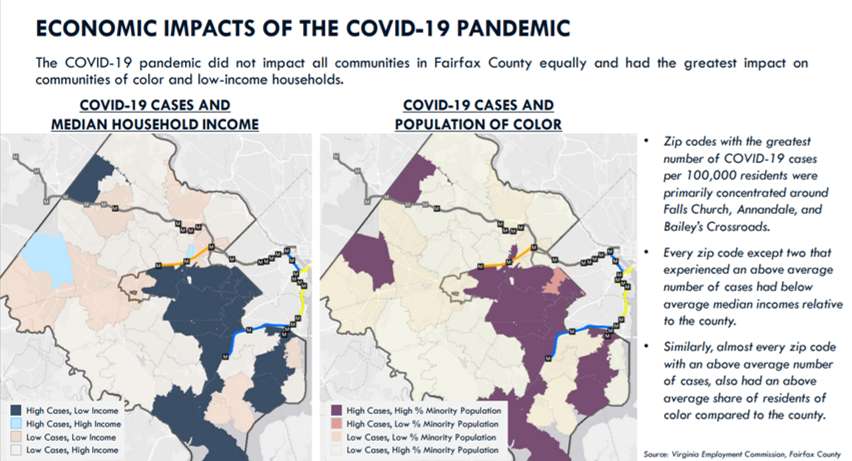
Fairfax County hired HR&A this summer to develop an economic recovery framework to guide the county’s response to the economic challenges presented by COVID-19.
To create a “new normal” that addresses the socioeconomic inequities exposed and deepened by the ongoing pandemic, Fairfax County needs recovery strategies targeted to different industries and populations based on their specific needs, Hebert and Moss say.
For instance, the county could assist the hardest-hit industries – led by the hospitality and food services sectors, which have shed 12,420 jobs or 26% of their entire workforce – by helping them reduce costs, evaluating regulatory requirements, and supporting programs to rebuild consumer confidence.
Initiatives like the RISE COVID-19 Small Business and Nonprofit Relief Grant Fund that the Board of Supervisors approved in May will be critical too. Through RISE, Fairfax County has awarded $52.5 million to 4,804 businesses so far, 72% of them owned by women, minorities, or veterans.
Lee District Supervisor Rodney Lusk says Fairfax County should adapt its recovery strategies to specific geographic areas as well as industries, noting that the pandemic’s economic impact in his district has been especially acute in the Richmond Highway corridor.
“Certain parts of Fairfax County are going to have different needs and issues,” Lusk said. “Tysons, Reston, Herndon are in a very different position than Bailey’s, Richmond Highway, and parts further south.”
Workforce development will also be essential to help people whose jobs may never return.
While 40,300 of the approximately 48,200 jobs lost during the pandemic are projected to be recovered by the end of the year, Fairfax County’s labor force has contracted by about 22,000 workers. Women in particular have been driven out by issues like inadequate or uncertain access to childcare, Hebert says.
“The reskilling piece is probably the important thing in here, from my standpoint. Not only if you’re going to help those most vulnerable in the community, you’re going to do that by making sure they have a skill set to take advantage of our future economy,” Board Chairman Jeff McKay said, suggesting the green economy as one industry with a lot of potential for growth.
HR&A will continue analyzing the impact of COVID-19 on Fairfax County before delivering a report with recommendations for recovery strategies and programs in January 2021.
Staff Photo by Jay Westcott

Thanksgiving is only three weeks away, and with coronavirus on the rise in much of the country, plans for the holiday are in flux.
The usual gatherings of family and friends are now subject to a calculation: is a big turkey dinner worth the risk of contracting a potentially deadly or debilitating disease?
For some, the solution will be a smaller dinner, perhaps with only some of the fixin’s. For others, however, it might be business as usual.
Asked about it last week on CNBC, two prominent figures in the medical field said the traditional Thanksgiving gathering was out for them this year.
"We usually have a very large Thanksgiving dinner. We're not going to have that this year," says $MRK CEO Ken Frazier. pic.twitter.com/7WEJxohXHr
— Squawk Box (@SquawkCNBC) October 29, 2020
"I'm going to forego Thanksgiving this year … I'm not going to be bringing together a large group of people," says @ScottGottliebMD on holiday plans during the pandemic. "This is the hardest point in this pandemic right now, the next two months." pic.twitter.com/Bitrwczp9H
— Squawk Box (@SquawkCNBC) October 29, 2020
What are your current turkey day plans? If they’ve changed from your usual Thanksgiving plans, let us know in the comments.
Photo via Sarah Lou/Flickr
Updated at 11:10 a.m. — Chain Bridge Road at Tysons Boulevard is now closed due to a power outage, the Fairfax County Police Department reported at 9:48 a.m. today (Thursday).
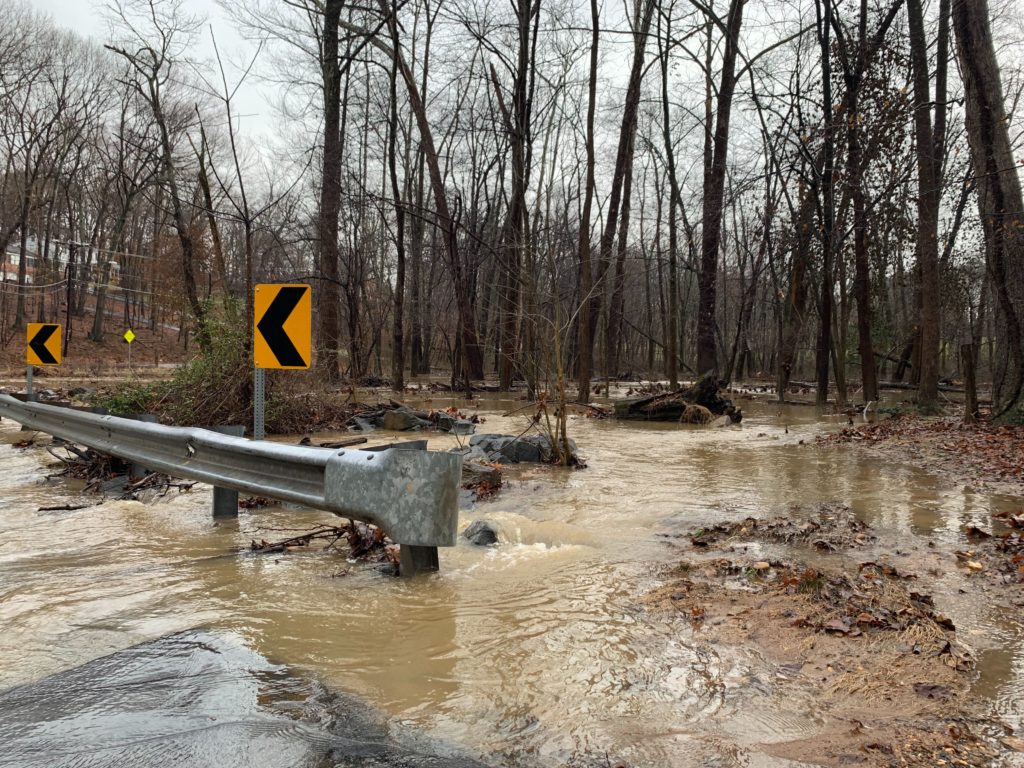
Flooding shut down two roads in the McLean area this morning.
According to the Fairfax County Office of Emergency Management, Rector Lane and Sparger Street off of Old Dominion Drive have closed to northbound and southbound traffic due to a fallen tree. Drivers should expect delays.
Old Courthouse Road at the Besley Road intersection in Tysons has also closed as a result of flooding from Wolftrap Creek, according to the Fairfax County Police Department. This is the second time in the past three weeks that Old Courthouse has closed at that particular spot because of flooding.
With rain falling throughout the day yesterday and into this morning, the Tysons area of Fairfax County was under a flood warning until 9 a.m. today (Thursday). The National Weather Service said to expect possible flooding in Vienna, Tysons, Dunn Loring, Pimmit Hills, and Wolf Trap.
The NWS reported at 8:12 a.m. that gauge reports indicated lingering flooding on Wolftrap Creek, but waters were receding, suggesting that flooding may end within the next one or two hours.
“Turn around, don’t drown when encountering flooded roads,” the NWS said. “Most flood deaths occur in vehicles.”
The Fairfax County Office of Emergency Management advised travelers to “avoid being near swollen streams.”
This morning, the NWS also issued a hazardous weather outlook for Fairfax County and the rest of the Washington, D.C., metropolitan region that remains in effect. Here is what the alert says:
This Hazardous Weather Outlook is for the Maryland portion of the
Chesapeake Bay, Tidal Potomac River, and adjacent counties in
central Maryland and northern Virginia as well as the District of
Columbia..DAY ONE…Today and Tonight
Flood Warnings remain in effect for parts of the Washington metro
area through this morning..DAYS TWO THROUGH SEVEN…Friday through Wednesday
Gale conditions are possible over the waters Sunday night.
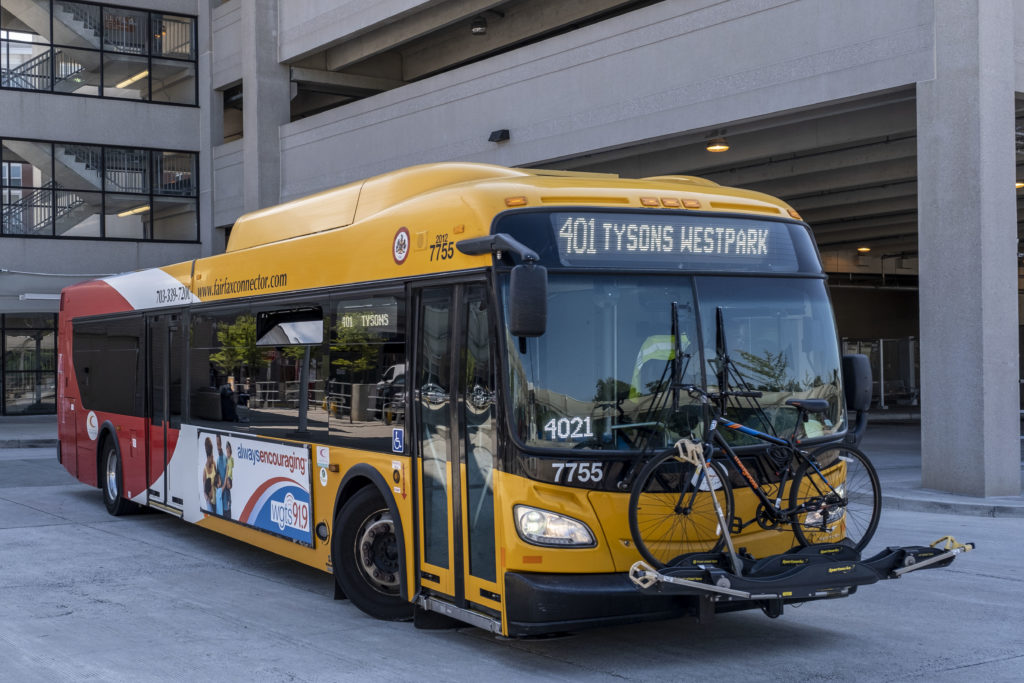
Fairfax Connector will hold a trio of community meetings next week to solicit public feedback on how it can improve its service in Vienna, Tysons, Chantilly, and Centreville.
The Fairfax County Department of Transportation is developing recommendations for ways to improve different parts of the Fairfax Connector system, which transports about 30,000 passengers on 91 routes daily and represents the largest local bus system in Northern Virginia.
The focus of the review has now shifted to the Vienna, Tysons, Chantilly, and Centreville areas after Fairfax Connector planning staff previously looked at improving service in the Franconia-Springfield area and, before that, Herndon and Reston.
“FCDOT’s goals for this process include increased mobility, better access to destinations, improved travel times, increased schedule reliability, more effective transit operations and increased ridership,” the department says.
During next week’s meetings, FCDOT staff will present three possible plans for the future of Fairfax Connector service in the relevant areas.
According to the department’s website, the first alternative will build on Fairfax Connector’s most recent Transit Development Plan, and it is designed to reduce inefficient service while providing more service to frequently busy locations like Tysons. This option is most similar to the bus system’s current service.
County staff have also proposed a “transformation” alternative that completely overhauls service in the study area, including local all-day routes, rush hour-only service to Metro stations, and express service to the Tysons and Franconia-Springfield Metro stations.
“This alternative improves frequency, span of service, and provides new regional connections such as Vienna to Reston, Centreville to Tysons, and Chantilly to the Franconia-Springfield Metrorail Station,” FCDOT says.
The third proposed alternative is a hybrid of existing service and the new regional connections suggested with the second alternative, including Centreville to Tysons and Chantilly to Franconia-Springfield.
The community meetings have been scheduled for:
- 7 p.m. on Tuesday, Nov. 17
- Noon on Wednesday, Nov. 18
- 7 p.m. on Thursday, Nov. 19
The meetings will be held online, and the same material will be presented at all of them, FCDOT head of communications Robin Geiger says.
Members of the public can also give feedback by filling out an online survey or by mailing comments to the Fairfax County Department of Transportation at 4050 Legato Road, Suite 400, Fairfax, VA 22033.
Information for registering and accessing the virtual community meetings can be found on the FCDOT website.
Staff Photo by Jay Westcott
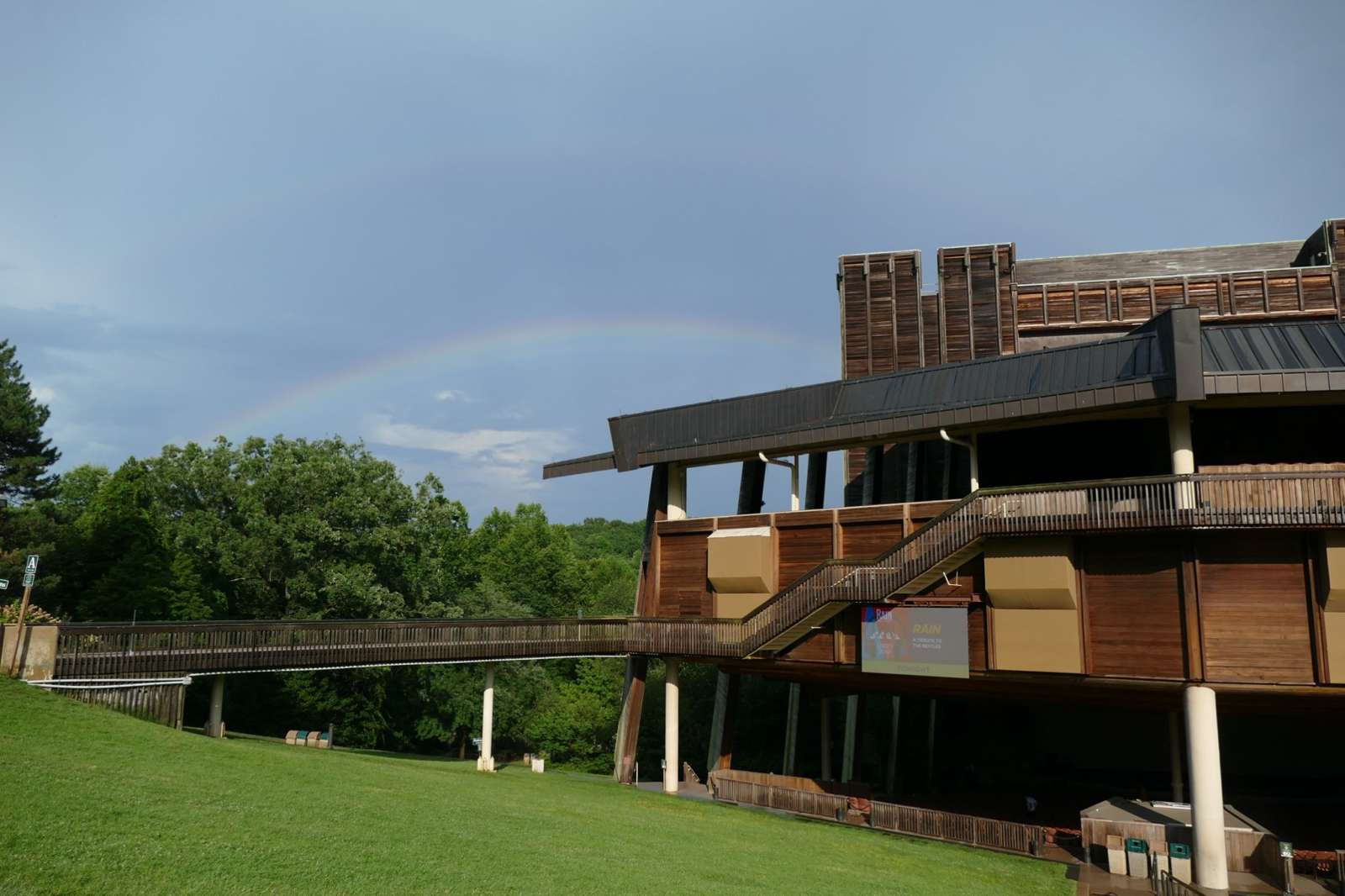
Drive-in movies have come back into fashion with coronavirus making traditional theaters unsafe. Now, Wolf Trap National Park is hosting a drive-in movie night on Friday to help support some local parent-teacher groups.
Wolf Trap will be showing Trolls 2 at on Friday, Nov. 13. Tickets are $20 per car with proof of purchase emailed.
The event is co-sponsored by the Terraset PTO and Buzz Aldrin PTA.
The lot is scheduled to open at 5:30 p.m. and access closes at 6:15 p.m. The movie scheduled to start at 6:30 p.m.
The movie will be screened in the East Parking Lot of the Wolf Trap National Park for the Performing Arts.
Food will also be available from three food trucks during the movie:
- Dangerous Dawn’s Diner (Cheesesteaks, Grilled Cheese and Tator Tots)
- Red’s BBQ (BBQ Foods)
- Lattimore’s Funnel Cake Truck (Funnel Cake and Fried Oreos)
Photo via Wolf Trap/Facebook
While one battle continues in the courtroom, a new front has opened up in the McLean area’s protracted war against Newport Academy, a for-profit rehabilitation program for teenagers and their families.
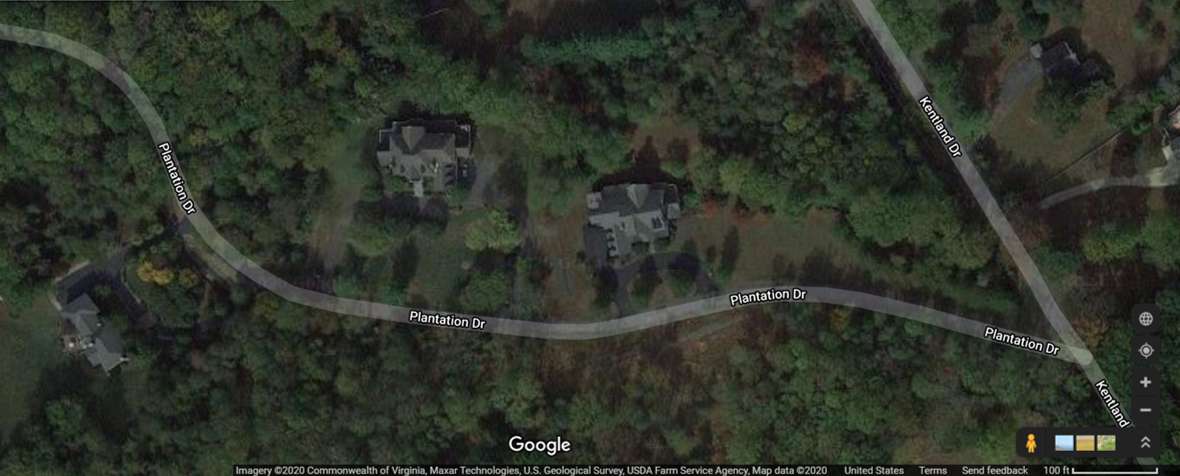
Newport Academy recently leased two properties on Plantation Drive in Great Falls that it plans to turn into residential facilities for teens with depression, anxiety, trauma, and other mental health issues, according to a letter from the company’s legal representatives to Fairfax County Zoning Administrator Leslie Johnson.
Sent on Oct. 8, the letter asks Fairfax County to affirm that the proposed use would constitute a group residential facility and, therefore, would be a by-right use, meaning it would not need to go through the county’s zoning approval process.
“The physical characteristics of the Property are ideal for such a group home,” the letter says, highlighting the property’s distance from adjacent sites, one of which has no residents. “The Property also boasts beautiful outdoor space, including both a covered and uncovered deck, and significant grounds.”
In the letter, McGuireWoods attorney Sean Murphy and Relman Colfax partner Michael Allen state that the property in question – a 10,390 square-foot home located at 11740 Plantation Drive – “contains ample space for parking,” including a garage and circular driveway, and “presents no problems for parking or local traffic.”
The law firm also sent a separate request for a use determination on the property at 11901 Plantation Drive, which would be used for the same purpose.
Newport Academy’s potential new neighbors disagree with its characterization of the two properties.
The residents who own the six other properties on Plantation Drive, which is just north of Route 7, wrote their own letter to Johnson on Nov. 3 asking the county’s zoning administration division to deny Newport Academy’s requests.
The residents argue that Newport Academy’s proposal would violate the Fairfax County Zoning Ordinance because its patients could count as transient occupants instead of residents, and because it would exceed the eight-person limit for group homes if the two leased properties are combined into a single facility.
The residents also say Plantation Drive is an “inappropriate” location for Newport Academy’s proposed facility, which would have adverse impacts on traffic and pedestrian safety.
“The proposed use presents substantial and untenable risks of harm from significant additional traffic, including large trucks, on the single lane driveway,” the residents stated. “This driveway is used by pedestrians, including children walking to and from their bus stop. There have been numerous incidents involving vehicles on the driveway in recent years.”
Newport Academy previously attracted residents’ ire when it sought to open two rehabilitation facilities along Davidson Road and on Kurtz Road in McLean.
Johnson determined in May 2019 that, since it would consist of three adjacent properties, the proposed Davidson Road facility would constitute a congregate living facility, which is not a by-right use.
Johnson found that the Kurtz Road site, on the other hand, would qualify as a group residential facility. The county board of zoning appeals ultimately upheld her decision on Mar. 11, leading residents from the surrounding neighborhood to file a lawsuit that is still waiting to be heard in Fairfax County Circuit Court.
“Due to the ongoing legal process regarding our home on Kurtz Road, we cannot comment on the matter,” Newport Healthcare Senior Director of Communications Kristen Hayes said when asked about the lawsuit.
Newport Academy has been operating a residential treatment program for adolescent girls at 1318 Kurtz Road in McLean since Mar. 22.
Plantation Drive resident Norman Chirite believes similarities to the situation with Davidson Road suggest that he and his neighbors have sufficient grounds to oppose Newport Academy’s request.
He will present their case to the Great Falls Citizens Association during its land use and zoning committee meeting tonight (Tuesday).
“I think what they’re doing is pretty problematic,” Chirite said. “It’s like they didn’t get what they wanted in McLean so they just moved down the road, and you know, we’re going to fight back a little bit.”
Unlike the Davidson Road properties, though, the houses on Plantation Drive have already been used as group residential facilities. They previously belonged to Sagebrush Treatment Center, which operated treatment programs for adult men recovering from substance abuse.
Newport Academy says that its plans for the property will be less intensive than how it has been used for the past three years.
The company says that the services it plans to provide through the facilities on Plantation Drive will be “a key resource,” especially as the COVID-19 pandemic exacerbates mental health issues for many people.
“Many teens lack access to quality treatment for mental health issues like depression, anxiety, and trauma, or face long waiting lists for programs,” Hayes said. “…We look forward to expanding in this area to provide these much-needed mental health treatment services for teens.”
Photo via Google Maps
