


Tysons Partnership Celebrates Tysons Corner Metro Station Renaming — “This is an important step forward in the effort to unify the Tysons brand and foster a cohesive sense of place across our rapidly urbanizing neighborhoods…The new station name reflects our new urban, transit-oriented reality.” [Tysons Partnership]
Post Office Collection Box Thefts Reported in Vienna — “The incidents impacted collection boxes at Church Street and Lawyers Road, which is near the Vienna U.S. Postal Service location at 200 Lawyers Road NW. According to the police department, the most recent incident occurred overnight on Nov. 22 to 23.” [Patch]
Falls Church City Councilmember Participates in Vaccine Trial — “Falls Church City Council member David Snyder, who has served on the Council since 1994, announced last week that he participated in a trial of the Moderna Covid-19 vaccine.” [Falls Church News-Press]
Tysons-based Alarm.com Concludes Virginia’s First Tech Apprenticeship Program — “Alarm.com recently wrapped up the first state-sponsored apprenticeship program for a tech company in Virginia. It included 10 weeks of technical instruction at Northern Virginia Community College, and nine months of on-the-job training.” [WTOP]

The Fairfax County Police Department is investigating two different armed robberies that took place in Tysons last week.
The first took place in the 8300 block of Greensboro Drive at 3:39 p.m. on Nov. 14. The victim was approached by a man with a knife who demanded money. The man “forcibly took a wallet from the victim before walking away from the area,” the FCPD reported in its weekly recap on Nov. 20.
The victim in that incident suffered injuries, but they were not life-threatening.
The second reported incident occurred at 2:19 a.m. on Nov. 19 in the 8600 block of Westwood Center Drive.
According to Fairfax County police, two men armed with guns forced their way into a hotel room occupied by three victims. The men assaulted one of the victims and took cash and personal property before walking away from the area.
The assaulted victim was taken to the hospital for non-life-threatening injuries, police say.
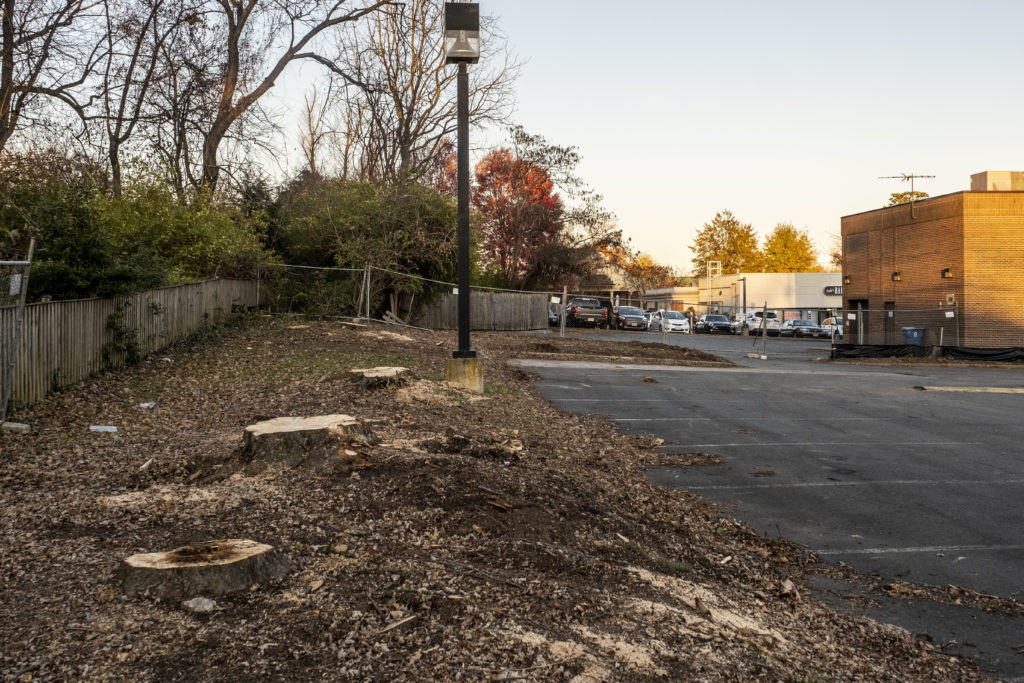
Routine Maintenance Closes Parts of Clemyjontri Park — “While some sections are closed, others will remain open and the work will rotate throughout the playground from Sat., Nov. 21 through approximately Fri., Dec. 4, 2020.” [Fairfax County Park Authority/Twitter]
Tysons Sheraton Liquidation Sale Shows Impact of Pandemic — “[Virginia Restaurant, Lodging and Travel Association Eric] Terry estimated 20 Virginia hotels closed on a temporary basis during the pandemic, and although most have since reopened, the outlook is bleak. More hotels may follow the Sheraton’s path.” [DCist]
Social Distancing Santa Offers Sense of Normalcy — “The Wells were among a stready stream of families entering Santa’s Headquarters at Tysons Corner Center Friday night with a reservation in hand for their annual picture with Santa Claus.” [ABC7-WJLA]
Pandemic Pushes Key Retailers out of Founders Row Project — “Business casualties from the coronavirus pandemic hit home for the City of Falls Church, with major retailers in hybrid theater-restaurant Studio Movie Grill and City Works restaurant both backing out of their commitment to the Founders Row Development due to financial troubles.” [Falls Church News-Press]
Staff photo by Jay Westcott
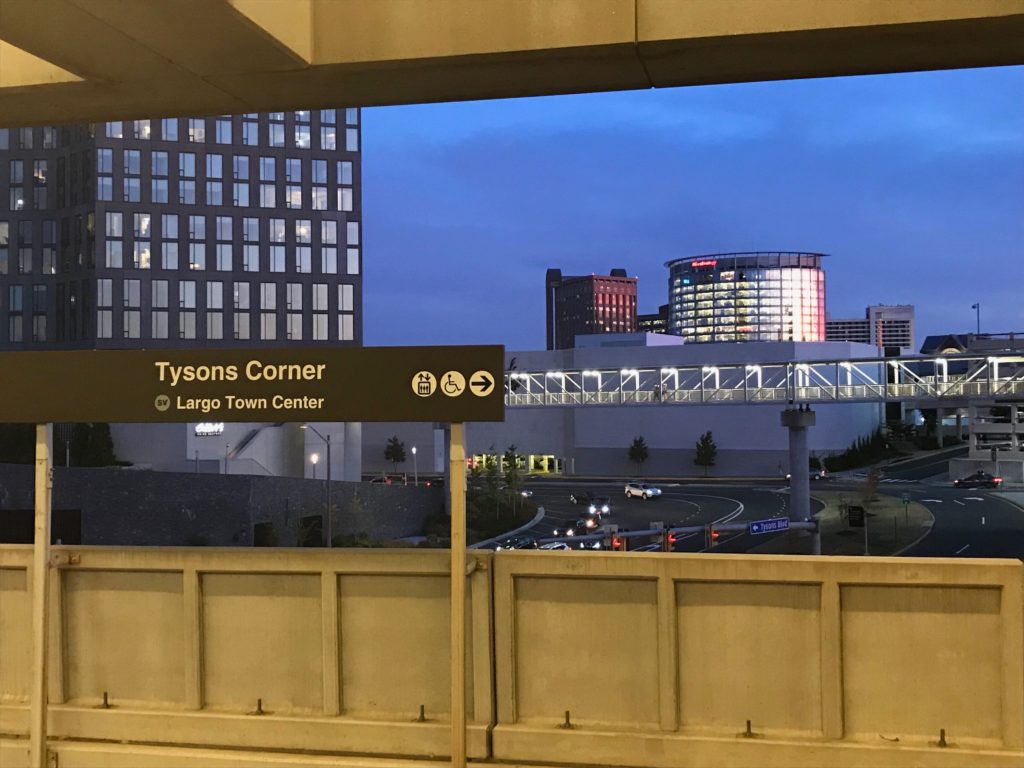
The Washington Metropolitan Area Transit Authority Board of Directors voted on Thursday (Nov. 19) to grant Fairfax County’s request to drop the “corner” from the name of the Tysons Corner Metro Station.
The board simultaneously approved a name change for the Prince George’s Plaza Metro Station in Maryland. That station will now be called Hyattsville Crossing.
The name changes were approved despite the results of surveys of riders and members of the public that found most respondents “significantly preferred” the stations’ current names over the proposed replacements, according to a report by WMATA’s safety and operations committee.
“History with Metrorail Station naming informs us that our riders and the communities we serve develop attachments to rail station landmarks and resist change,” WMATA staff said in the report.
For the Tysons station, only 36% of the online public survey’s 5,508 respondents said they like “Tysons” as a station name, compared to the 45% who disagreed and the 67% who said they like the name “Tysons Corner.”
However, 62% of respondents agreed that the name “Tysons” is easy to remember, and 58% said it would not be easily confused with other station names. 48% said the name clearly conveys the station’s location, and 47% said it describes the location well, surpassing than the 35% and 36%, respectively, who disagreed with those statements.
While the affirmative percentages are higher in all categories for Tysons Corner than they are for Tysons, those results are evidently positive enough that WMATA staff believes objections to the name change will dissipate once community members become familiar with the new moniker.
“Six in 10 survey respondents found the name [“Tysons”] easy to recall and not confusing with other names,” the staff report says. “Should the Board wish to approve the jurisdiction’s request, it is likely that the new name will become synonymous with the surrounding community over time and customers will find it sufficient for wayfinding.”
All of the Metro directors who were present for the vote supported the name changes, except for District of Columbia First Vice Chair Stephanie Gidigbi, who cited concerns about the public feedback when opting to abstain from the vote.
WMATA announced on Oct. 27 that Fairfax County and Prince George’s County had submitted formal name change requests for the Tysons Corner and Prince George’s Plaza stations.
According to the safety and operations committee report, Metro is planning systemwide signage and rail map changes in preparation for the second phase of its Silver Line service, which is not likely to start service until next summer.
With a Dec. 31 deadline for signage changes to be finalized, the Fairfax County Board of Supervisors requested that Metro rename its Tysons Corner station as part of the county’s ongoing efforts with the Tysons Partnership to rebrand the area around the Tysons Corner Center mall as Tysons.
The Board of Supervisors has also asked Metro to rename the West Falls Church-VT/UVA Metro Station to reflect that the University of Virginia no longer has facilities nearby as of April 2020.
Like Prince George’s County, Fairfax County has committed to funding the $332,000 needed to change signage at the affected stations, according to WMATA.
Staff photo by Catherine Douglas Moran

The Virginia Department of Rail and Public Transportation is currently exploring possibilities for adding more transit routes to Tysons along the Interstate 495 corridor as part of its I-495/American Legion Bridge Transit and Transportation Demand Management Study.
Joined by Virginia Department of Transportation and Maryland Transit Administration officials, DRPT presented some potential options for new connections at a public meeting on Wednesday (Nov. 18) that provided updates on the transit study and VDOT’s I-495 Express Lanes Northern Extension (495 NEXT) project.
DRPT officials have identified Tysons, Dunn Loring, Reston, and Arlington as key destinations in the corridor, noting that there tends to be more demand for travel from Maryland to Virginia than the other way around.
“There is significant travel between activity centers on the Maryland 355 corridor and Silver Spring to destinations like Tysons, Dunn Loring, and the Virginia Route 7 corridor,” DRPT Northern Virginia Transit Planning Manager Ciara Williams said. “A great deal of transit services operate in the study area. However, there are no transit services today that directly link the major activity centers.”
After looking at a variety of potential transit connections between Virginia and Maryland on 495, DRPT singled out eight possibilities that merited further study and ranked them based on their ability to add ridership relative to their cost, the service they would provide to low-income and minority populations, and the number of people and jobs to which they would improve access.
Five out of the eight preliminary possible transit routes go to Tysons. A sixth route – and the one that received the highest score – goes through Tysons to connect Bethesda and Dunn Loring.
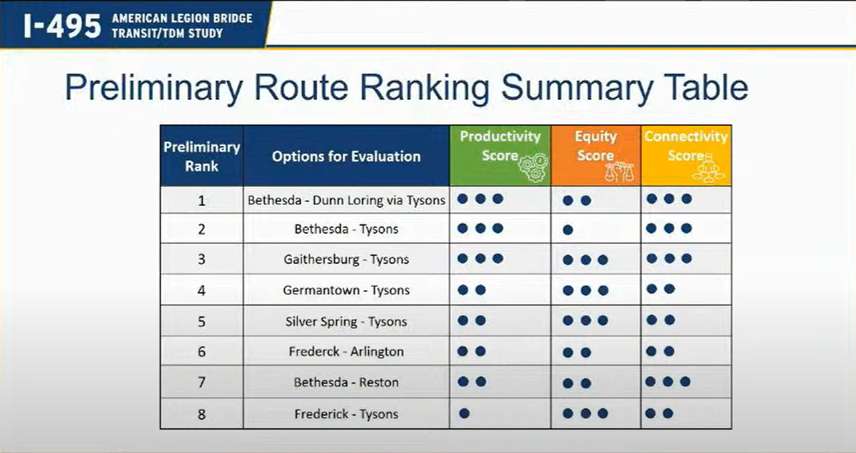
A proposed transit route that would go from Gaithersburg, Md., to Tysons during the morning peak period and in the other direction during the evening peak period is the only one that got a top score for productivity, equity, and connectivity.
However, the Bethesda-Dunn Loring and Bethesda-Tysons routes ranked higher, because a trips-per-day metric included in the productivity score was weighted higher to prioritize routes with the potential to yield the highest ridership levels, according to Williams.
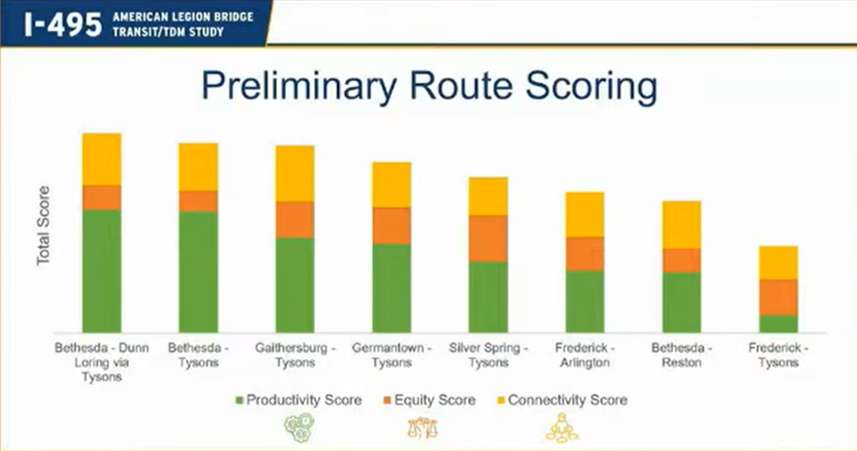
The other routes that DRPT is considering evaluating further are Germantown to Tysons, Silver Spring to Tysons, Frederick to Arlington, Bethesda to Reston, and Frederick to Tysons.
The American Legion Bridge transit study started in December 2019 after Virginia Gov. Ralph Northam and Maryland Gov. Larry Hogan announced an agreement to fund the $1 billion project to replace and widen the bridge, which is part of the Capital Beltway and currently the only way to travel between Maryland and Virginia without going through Washington, D.C.
“495 is one of the most congested roadways in all of Maryland and Virginia, and traffic is forecasted to increase in the future,” Williams said. “…We see that there’s a need for transit and TDM solutions in conjunction with the planned and managed Express Lanes to efficiently and effectively serve travel across the bridge.”
The transit study is being conducted in parallel with the proposed 495 NEXT project, which extends the existing 495 Express Lanes roughly three miles from the Dulles Toll Road and I-495 interchange to the George Washington Memorial Parkway near the American Legion Bridge.
DPRT Transportation Chief Jennifer Debruhl says the study team anticipates releasing its draft recommendations for public comment in early December before finalizing the study early next year.
Staff photo by Jay Westcott, slides via Virginia Department of Rail and Public Transportation
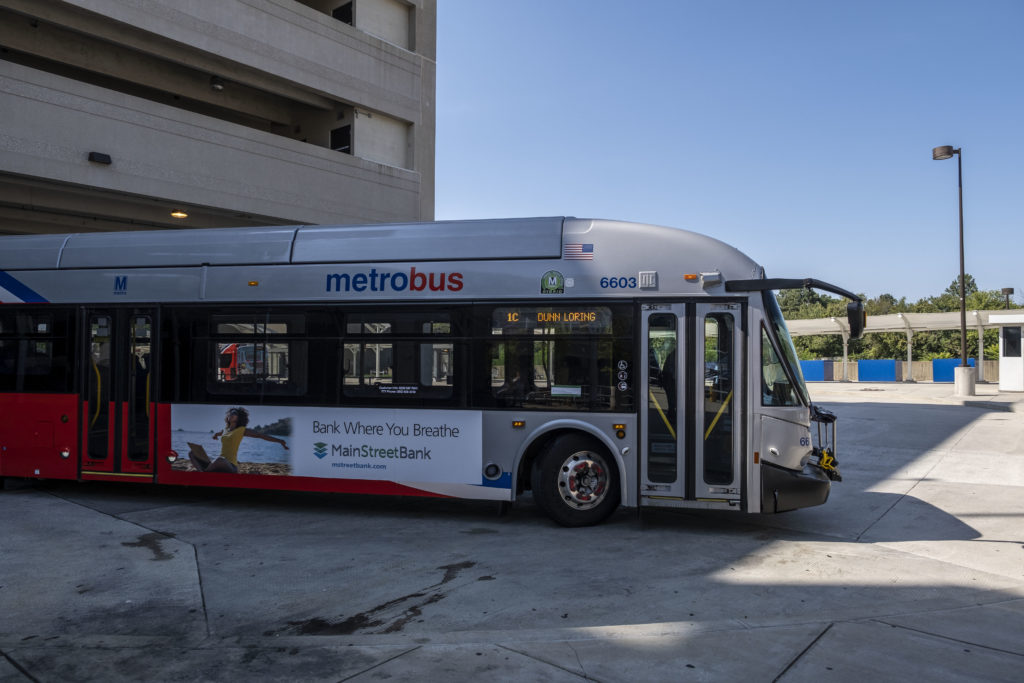
Metrorail and Metrobus users in Fairfax County may be seeing service changes next year.
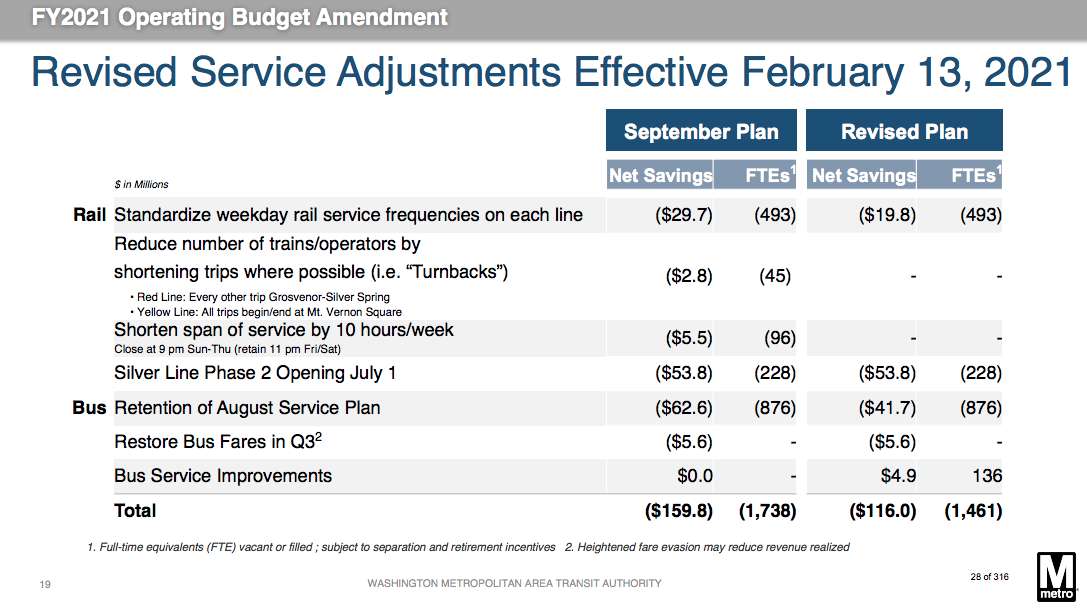
Proposed by Washington Metropolitan Area Transit Authority staff to help close a $176.5 million-gap in the budget for this fiscal year, the changes span management actions to service changes to deferred capital projects. WMATA staff say the Silver Line expansion will not be impacted.
The proposed budget revisions are currently under review and will be voted on by the WMATA Board of Directors this Thursday (Nov. 19).
This deficit is mostly a result of an 80% reduction in revenue from ridership, WMATA Virginia Government Relations Officer Gregory Potts told the Greater Tysons Citizens Coalition during a meeting on Nov. 12.
The Metro saw a 90% drop in ridership across the board, including Tysons, Potts said. The declines in train and bus usage began in mid-March due to the COVID-19 pandemic, and they persist today.
Nine months into the pandemic, Metrobus ridership is down by 60%, a slight recovery from the 80% drop seen earlier in the year. That change can be partly attributed to the number of essential workers who may not be able to afford a car but still need to get to their jobs, Potts said.
“It’s been pretty eye-opening to us how important the bus is to the region,” Potts said. “Sometimes rail gets all the attention, but the bus system is really important to a lot of individuals. It’s an equity issue for us.”
WMATA staff are recommending Board members vote to authorize management actions and save $30.5 million, to defer non-safety related capital projects and save $30 million, and to make service reductions amounting to $116 million in savings.
The cuts could have been worse. A first draft of the plan released in September had more changes and cuts, because the deficit was projected to be $212 million. The plan was revised after WMATA opened up the plan for public comment, pushed its CARES Act money further, and found additional savings in operating costs.
WMATA initially projected the $546 million it received from the CARES Act would only last through 2020, but the agency now says it will stretch until March 2021. It also saved $35.5 million that would have paid for overtime, fuel, utilities and other costs.
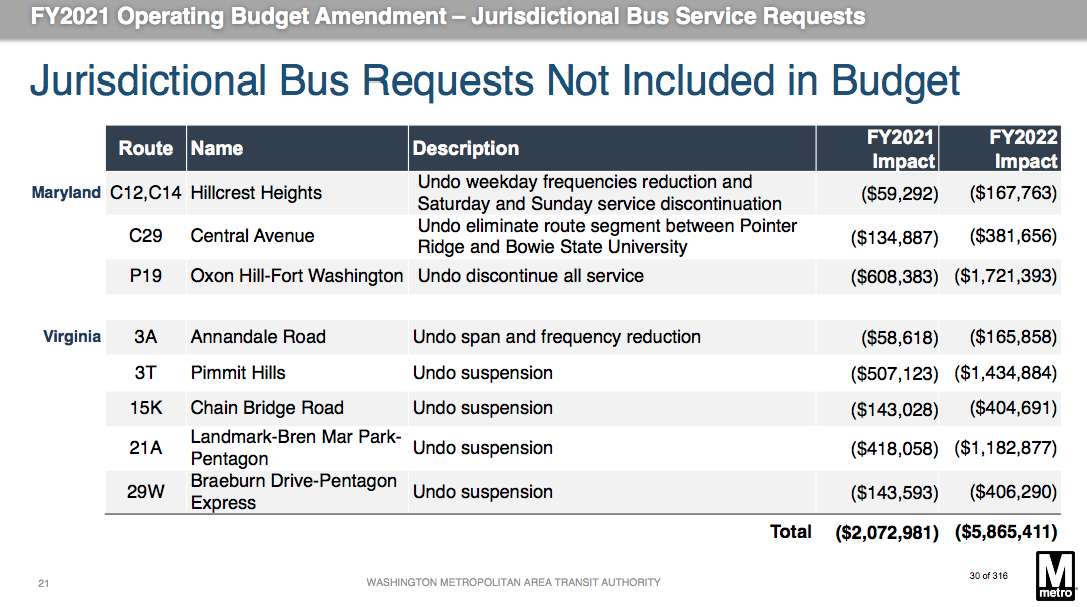
Despite public objection to some reductions in services, a few bus lines that have been suspended in Fairfax County will remain on hold under WMATA’s updated budget plan.
It is hard to pinpoint when transit rates could return, Potts said.
“If you’re talking about pre-COVID-19 rates or more generally, some talk of ‘normalcy,’ where there are people wearing masks but more people riding, for transit, there will be an impact for longer than we want to imagine right now,” Potts said.
Currently, WMATA cleans buses, trains, and high touch-points daily, and it disinfects on demand with an electrostatic fogger machine, he said. Staff are providing riders with masks. Bus riders board from the back and the operators are protected by plastic shields.
Earlier this year, the Metro board approved a six-month deferral of the fare changes that will last through November.
To eliminate contact with employees, WMATA launched a SmartTrip app for Apple in September that enables contactless mobile fare payment. An Android app will be available by the end of the year, according to Potts.
“That’s good for convenience and safety,” he said.
Despite initial concerns about people contracting the novel coronavirus while using public transit, some preliminary studies internationally have demonstrated that “transit has not been known to be a transmitter in the way that other facilities may be,” Potts said.
Another positive development is that platform renovations to improve safety and accessibility at the Metrorail stations in Vienna, Dunn Loring, East Falls Church, and West Falls Church were completed on time.
“We’ve finished 10 platforms in the last year and a half,” Potts said. “It’s really moving along well. With the pandemic, they could actually maintain their schedule.”
Staff photo by Jay Westcott, slides via WMATA
Vienna Girl Makes Eagle Scout History — “A Vienna eighth-grade student has achieved something few girls have: she’s become one of the nation’s first and youngest female Eagle Scouts.” [WJLA]
Tysons Corner Metro Station Closed for Coronavirus Cleaning — “Video posted to social media shows cleaning crews in full biohazard suits spraying the Tysons Corner station about 4 p.m. Tuesday.” [NBC4]
Vienna Planning Commission Approves New Subdivision — “A proposed six-house subdivision in southwest Vienna received a unanimous recommendation to the Vienna Town Council Nov. 4 from the town’s Planning Commission.” [Inside Nova]
Staff photo by Jay Westcott
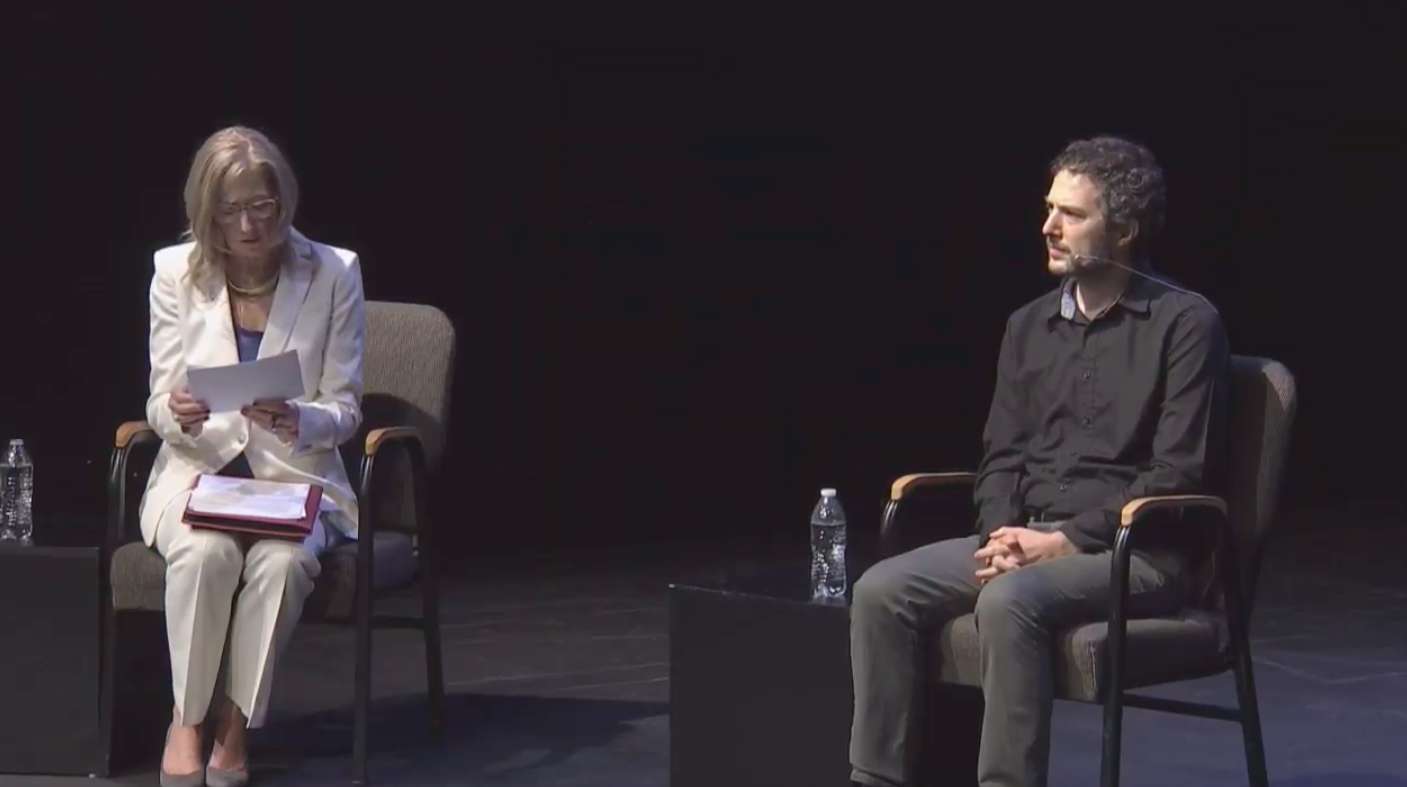
For the fourth year in a row, the Tysons 2050 event has put forward a rosy view of the future of the area, but this year, those lofty dreams are weighted down by some harsh realities about challenges ahead for Tysons.
Sponsored by the Tysons Regional Chamber of Commerce, the event features voices from different industries around Tysons discussing what lies ahead for the region. Those experts recognized that the future is harder to predict this year. COVID-19 is on the rise again nationally and locally, and the onset of winter is leaving many businesses that had gone outside for activities scrambling for new solutions.
“What happens to offices and malls?” asked Sol Glasner, CEO of the Tysons Partnership. “I don’t know, and you shouldn’t listen to anyone who says they do know. The crystal ball is murky.”
Glasner said offices may need to be reconfigured, but he doesn’t believe the need for office space will fully disappear any more than retail will.
“Our shopping areas have proven adept to changing to consumer patterns,” Glasner said.
Mike Whatley, vice president of the National Restaurant Association, says one of the advantages for Tysons-area restaurants and retail is having more flexibility in using their space than their counterparts in D.C., like larger sidewalks for curbside pick-up.
“The ability to have extra space, to have extra flexibility, means restaurants will survive and thrive,” Whatley said. “When people are looking now and post-pandemic at where they want to live, you have to have that vibrant restaurant scene and culture.”
Whatley said one of the keys to surviving the season will be embracing going digital.
“Restaurants that survive are the ones that are embracing tech [and] communicating with customers,” Whatley said. “You do see a lot of them in the Tysons community, ones that are able to reach out to customers.”
Tony Hudgins, Vice President of TransitScreen, said ghost kitchens — food vendors that don’t operate out of a restaurant space — could take up a bigger role in the restaurant scene after the pandemic. Read More

The COVID-19 pandemic has claimed another Tysons area restaurant.
Da Domenico has been permanently closed since Oct. 10 after operating at 1992 Chain Bridge Road for 39 years, owner Sayed Hussain confirmed to Tysons Reporter today.
Patch first reported the closure this morning after noticing a statement on the Italian restaurant’s website explaining that it has been unable to remain open “given the pandemic and its implications.”
Hussain says the property owner chose not to renew Da Domenico’s lease, which was coming to an end, and it was “tough” to stay in business with the challenges imposed by COVID-19, which has required restaurants to adopt a range of safety measures and restrict the number of customers they serve to enforce social distancing protocols.
Before it closed, Da Domencio had limited its operating hours to 5-9:30 p.m., though the website states that it had hoped to reopen for lunch soon.
Ongoing construction on Chain Bridge Road also contributed to the difficult decision to close, according to Hussain.
“There’s a lot of history attached to this restaurant,” Hussain said, noting that Da Domenico had garnered many loyal customers, including politicians and celebrities, during the nearly four decades it was in business.
Hussain says Da Domencio could reopen if he finds a new location, but for now, patrons can find the same Italian cuisine at its sister restaurant, Zeffirelli, in the Town of Herndon.
Zeffirelli, which Hussain also owns, has not encountered the same issues as Da Domencio and remains open, albeit with shortened, dinner-only hours.
Loyal Da Domenico patrons who visit Zeffirelli can get wine or a dessert on the house if they tell their server that they’re coming from the Tysons restaurant, Hussain says.
Photo via Google Maps
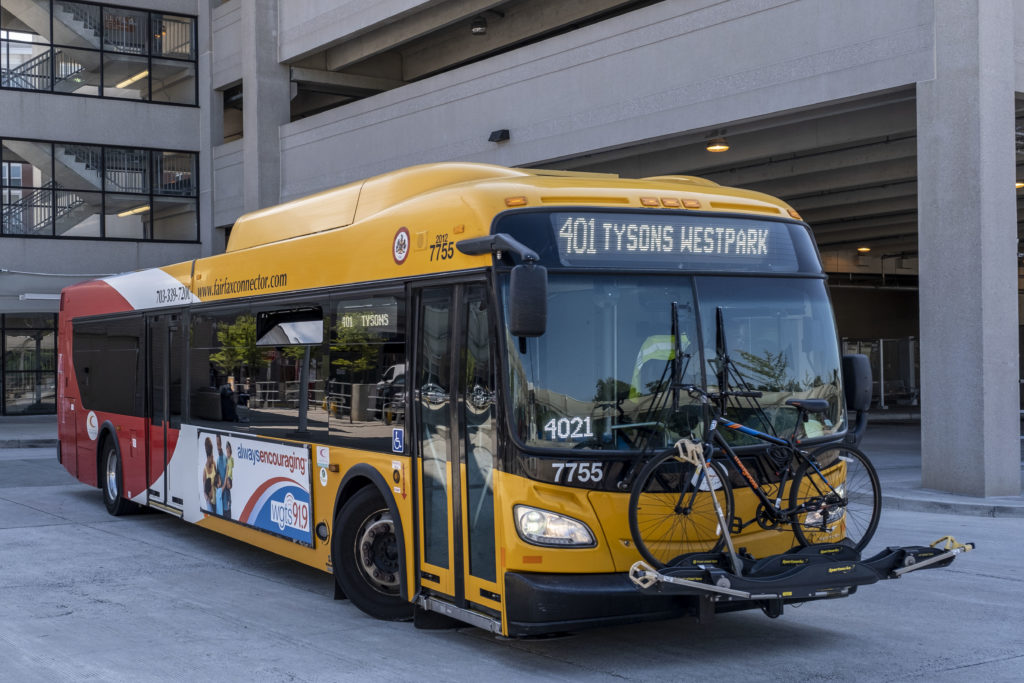
Fairfax Connector will hold a trio of community meetings next week to solicit public feedback on how it can improve its service in Vienna, Tysons, Chantilly, and Centreville.
The Fairfax County Department of Transportation is developing recommendations for ways to improve different parts of the Fairfax Connector system, which transports about 30,000 passengers on 91 routes daily and represents the largest local bus system in Northern Virginia.
The focus of the review has now shifted to the Vienna, Tysons, Chantilly, and Centreville areas after Fairfax Connector planning staff previously looked at improving service in the Franconia-Springfield area and, before that, Herndon and Reston.
“FCDOT’s goals for this process include increased mobility, better access to destinations, improved travel times, increased schedule reliability, more effective transit operations and increased ridership,” the department says.
During next week’s meetings, FCDOT staff will present three possible plans for the future of Fairfax Connector service in the relevant areas.
According to the department’s website, the first alternative will build on Fairfax Connector’s most recent Transit Development Plan, and it is designed to reduce inefficient service while providing more service to frequently busy locations like Tysons. This option is most similar to the bus system’s current service.
County staff have also proposed a “transformation” alternative that completely overhauls service in the study area, including local all-day routes, rush hour-only service to Metro stations, and express service to the Tysons and Franconia-Springfield Metro stations.
“This alternative improves frequency, span of service, and provides new regional connections such as Vienna to Reston, Centreville to Tysons, and Chantilly to the Franconia-Springfield Metrorail Station,” FCDOT says.
The third proposed alternative is a hybrid of existing service and the new regional connections suggested with the second alternative, including Centreville to Tysons and Chantilly to Franconia-Springfield.
The community meetings have been scheduled for:
- 7 p.m. on Tuesday, Nov. 17
- Noon on Wednesday, Nov. 18
- 7 p.m. on Thursday, Nov. 19
The meetings will be held online, and the same material will be presented at all of them, FCDOT head of communications Robin Geiger says.
Members of the public can also give feedback by filling out an online survey or by mailing comments to the Fairfax County Department of Transportation at 4050 Legato Road, Suite 400, Fairfax, VA 22033.
Information for registering and accessing the virtual community meetings can be found on the FCDOT website.
Staff Photo by Jay Westcott
