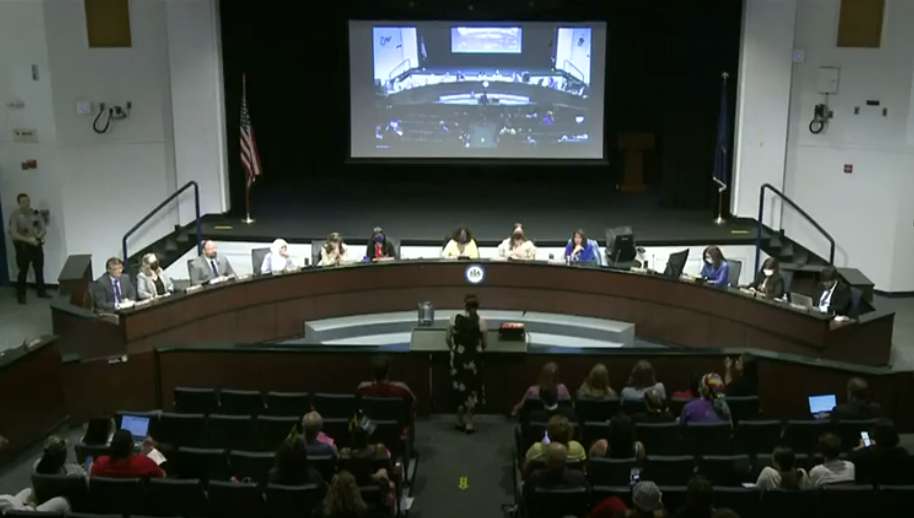

The Fairfax County School Board approved a framework yesterday (Thursday) to seek federal COVID-19 money, with the stipulation that it gets increased oversight and input on how the money will be spent.
The roughly $189 million plan would start with the upcoming school year and extend to June 2024. It is intended to help Fairfax County Public Schools respond to issues stemming from the pandemic.
“While we did have a public hearing about where people would like us to target our monies, we have not had the opportunity to get the greater details from the superintendent and his team,” Braddock District Representative Megan McLaughlin said.
The school board thanked district administrators for developing the Elementary and Secondary School Emergency Relief (ESSER) framework after learning about the incoming funds in May, but several board officials questioned whether the proposal was sufficiently detailed and provided enough accountability.
“The ESSER funds are unlike other funding by the federal government in that it has a requirement to have extensive community input and outreach,” Mount Vernon District Representative Karen Corbett-Sanders said.
The ESSER III money will support school operations, cover increased workloads for Individualized Education Program (IEP) staff, aid academic interventions, address students’ social and emotional needs, help with translation services for students, and more.
The largest costs, as identified by district staff so far, would involve:
- $54.9 million for academic intervention
- $46.2 million for special education teacher contracts
- $23.3 million for social and emotional learning needs
- Nearly $20.2 million for summer 2022 learning
- Nearly $14 million for afterschool programming and transportation
According to an FCPS presentation about the program, the ESSER money should address the impacts of the pandemic especially for students who have been disproportionately affected, and at least 20% must be used to address learning loss, among other rules.
The money will come through the Virginia Department of Education from the American Rescue Plan Act that was passed by Congress and signed into law in March.
Corbett-Sanders said FCPS faces an Aug. 1 deadline for submitting a general framework to the state before giving a more specific plan for how it will spend the funds by Sept. 1.
“Rather than just greenlighting, ‘They’re giving us $188.6 million, we’re going to put it in a line item list,’ we felt that it was important to have a little bit more comprehensive planning around the ESSER funds grant,” Corbett-Sanders said.
With the board’s initial approval, Superintendent Scott Brabrand will present an official ESSER III plan prior to the board’s Aug. 26 business meeting. He will present more detailed information, including targeted goals, operational timelines, and accountability metrics in a September work session.
The board’s motion also stipulated that state-filed amendments to the plan that reach $100,000 or more must be authorized by the board.
Fairfax County will hold more summer classes for students with disabilities later this month after staffing issues put the program in jeopardy.
After families were informed that a teacher deficit was delaying the Extended School Year program, the school district adjusted it into two blocks, the first of which is already underway, to allow it to keep class sizes low but do more with less staff.
“We’re in a special education crisis,” Fairfax County Public Schools Superintendent Scott Brabrand said Tuesday (July 13) during a work session with the school board.
He noted around half of the 400 job openings that the district currently has involve special education, but according to the school district, a second Extended School Year block is “almost fully staffed.”
“There is a full commitment that we will have a fully staffed second session of the ESY,” Mount Vernon District School Board Representative Karen Corbett-Sanders said, adding that FCPS notified families and provided a timeline for transportation, food services, and more.
Earlier this month, FCPS apologized for communications that suggested the “administration was faulting teachers for failures of the system to supply optimum programming.”
“Our staff members have gone far beyond ordinary expectations and we are grateful for their professional dedication,” the district said on social media.
While officials praised teachers and administrators for making services work this summer, FCPS is looking to build within its own ranks to help address long-term faculty shortages.
School officials are working to apply for COVID-19 relief from an ESSER III fund (Elementary and Secondary School Emergency Relief). The money comes from the $1.9 trillion stimulus in the American Rescue Plan Act, passed by Congress and signed into law in March.
Previous federal COVID-19 relief plans included ESSER funds administered by state education departments, though local school districts had to apply to obtain the funds.
The school board was slated to vote on a plan for how to spend the roughly $189 million that FCPS is seeking when it meets tomorrow (Thursday).
The money would cover a three-year span, starting with the upcoming school year through June 2024. Intended to help schools safely open after a challenging year due to the pandemic, the funds can be used to support school operations and address students’ social and emotional needs.
The proposed plan would allocate $46.2 million to special education staff, which amounts to a 7% salary increase to cover the extra 30 minutes needed each day to file Individualized Education Program paperwork due to the pandemic, according to FCPS.
The funding sought would also involve around $2.5 million for professional development. According to Tuesday’s presentation to the school board, that effort would involve two new employees each year. It isn’t immediately clear if that’s all for salaries or if other expenses are involved.
Other requests include $54 million for academic interventions, $2 million for cybersecurity, $15.9 million for after school programming and transportation at high schools, and $20.1 million for a summer 2022 learning program.
Board members pressed FCPS officials for more accountability and strategic planning in its plans for the federal funds. Community members previously weighed in through focus groups in May and June, online feedback, and a June 7 public hearing.
Wilda Smith Ferguson, a parent of a child with special needs in the district, said during the June meeting that the school system’s decisions regarding protocols haven’t taken children like hers into consideration.
“She is totally dependent on her teachers and the support staff at the high school that she attends,” Ferguson said. “I would like to see some of the money in the grant go to, basically, instead of ‘trickle down,’ trickle up. Figure out what is best for the most vulnerable and work up.”
The deadline for FCPS to apply for ESSER funds is Sept. 1.

Several Olympians competing on the world stage in Tokyo this summer can trace parts of their athletic journeys back to Fairfax County.
Swimmer Andrew Seliskar, discus thrower Chioma “CiCi” Onyekwere, and runner Trevor Stewart all qualified for the 2020 Olympics, which will take place from July 21 to Aug. 8.
The games were delayed for a year due to the COVID-19 pandemic, and they will be held without spectators after Japan announced on Friday (July 9) that it would enter a fourth state of emergency starting today (Monday) due to rising cases of the virus.
Seliskar, who graduated from Thomas Jefferson High School for Science and Technology in 2015, is taking on his first Olympics after two previous qualifying attempts at ages 19 and 15, including one where he “narrowly missed” a semi-final spot.
As a student, he broke a national high school record for the 100-yard butterfly in 2014 near Richmond with 53.24 seconds, and he won four national titles swimming at the University of California in Berkeley before becoming a professional swimmer.
The 24-year-old McLean native told Fairfax County Public Schools that he relishes his competitions against high school rivals.
“Those were great memories, and for my swimming career, those are some of the best ones,” he said.
He also told WJLA-TV that his Olympic dream began swimming with a youth swim team, the McLean Marlins.
Heats for the men’s 4×200-meter freestyle relay are scheduled for 6-8:30 a.m. EDT on July 27, and the final will air from 9:30 p.m. EDT on July 27 to 12:05 a.m. EDT on July 28.
Robinson Secondary School graduate Onyekwere will represent Nigeria at the Olympics, since she is a dual citizen of that country and the U.S.
“I feel like Nigeria made me the person I am today, so it’s so nice to give back in some kind of way and represent them,” she told FCPS.
The Michigan-born former University of Maryland athlete currently holds Nigeria’s discus throw record of 63.3 meters, which she set in April in Chula Vista, California, as part of the Nigerian Olympic Trials.
The 27-year-old engineer works for Ford and relocated back to Fairfax County last fall to be with family amid the pandemic, FCPS noted.
The qualifying round for the women’s discus throw is 8:30 p.m. EDT July 30, and the final is 7 a.m. EDT Aug. 2.
Stewart, who graduated from South County High School in 2016, will run the 4×400-meter relay race for Team USA.
His teammates include a fellow student at North Carolina A&T State University. The pair were part of a 4×400 relay team that won national titles this year for the indoor and outdoor track seasons, capping his senior year.
The 24-year-old switched from karate to track and field when he was in ninth grade. To prepare for the upcoming games, he has turned to prayer and meditation, according to FCPS.
“I worked hard for this,” he told FCPS. “There’s always room for improvement, but I’ve made it right now. I’ve made it right here.”
Heats for the men’s 4×400 meter relay are slated for 7:25 a.m. EDT Aug. 6 and 8:50 a.m. EDT Aug. 7 for the final.
The Tokyo Olympics will feature a total of 339 events across 33 sports. They will be broadcast and live-streamed in the U.S. by NBC.
Photo composite via University of California — Berkeley, University of Maryland, and North Carolina A&T

The Arlington-founded burger chain Big Buns Damn Good Burgers is coming to Vienna, looking to take over the Danor Plaza space formerly occupied by Elevation Burger (142 Branch Road SE).
Big Buns, which specializes in making different styles of burgers and also provides craft beer and more, filed for Virginia Alcoholic Beverage Control beer, wine, and mixed drinks licenses around May 28 and June 1.
“We couldn’t be more excited about these locations,” founder Craig Carey said in an email to Tysons Reporter, noting that the eatery is also working on sites in Franklin Farm and Fairfax.
Big Buns plans to open in Vienna on Sept. 1. Its hours of operation will be from 11:30 a.m. to 9 p.m. Monday through Thursday, 11 a.m. to 10 p.m. on Friday and Saturday, and 11 a.m. to 9 p.m. on Sunday, according to a state ABC application obtained by Tysons Reporter.
Patch reported that the organic-focused chain Elevation Burger closed its Danor Plaza location in March. A sign still posted to the door notes that its Arlington location remains open (2447 Harrison St. N.).
Big Buns’ planned fall opening depends on permits, construction, and hiring, but Carey believes the timeline should be doable.
“We would love more patio seating but will need to see what the county comes back with in terms of occupancy after they review our plans,” Carey wrote about possible changes from Elevation Burger’s setup.
The chain seeks to have indoor and outdoor seating, with 14 tables outside for 28 people and a full capacity for over 55 seated customers, not including a counter/bar area, according to its state ABC application.
Carey and his business partner Tom Racosky started the chain in Arlington’s Ballston neighborhood in 2007 with the goal of providing a variety of burgers as an alternative to “best burger” restaurants that each focus on their own specialty.
Those seeking jobs at the Vienna location can start at the Reston Big Buns (1908 Reston Metro Plaza) now and will transfer over to Vienna as part of a grand opening team, Carey wrote.
The chain, which typically has a staff of 25 full and part-time workers at each location, is offering $500 sign-up bonuses for workers on their 100th day.
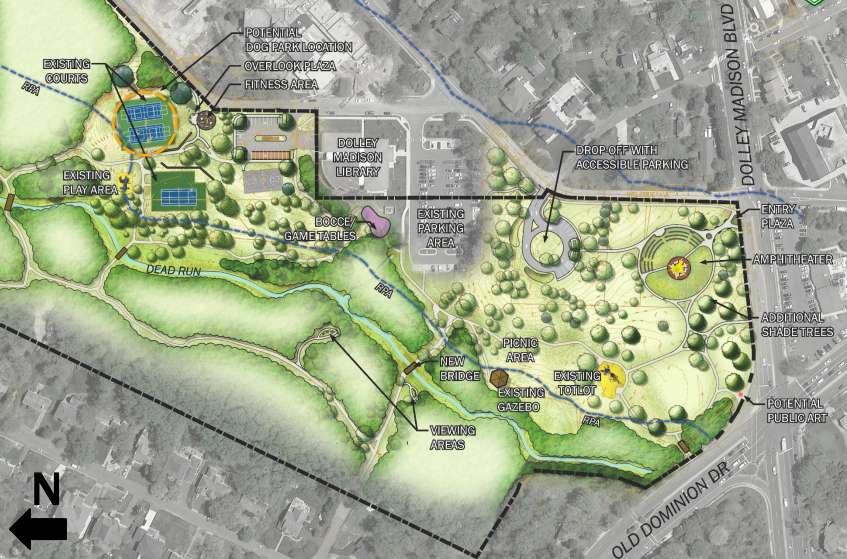
The McLean Citizens Association has concerns about how Fairfax County is approaching changes to McLean Central Park.
The MCA board of directors approved a resolution on Wednesday (July 7) questioning the concept development plan that the Fairfax County Park Authority has proposed for the park, which would add facilities such as an amphitheater and a dog park. It called for further community input, such as a community-wide survey, notices posted in the park, and another extension of the comment period.
“Document the need. Document why,” Barbara Ryan, chair of the environment, parks, and recreation committee, said in describing part of the resolution. “Don’t just destroy green…space to build things that aren’t needed.”
Adjacent to the McLean Community Center and Dolley Madison Library, the 28-acre McLean Central Park (1468 Dolley Madison Blvd.) currently has tennis and basketball courts, playgrounds, and trails.
With $2.2 million in construction funds available for the project, thanks to park bonds already approved by voters, park authority officials say the proposed ideas were in line with a 2013 master plan and held a meeting on May 24, kicking off a 30-day comment period.
The deadline for community members to submit feedback was later extended from June 25 to July 30, in part due to a request for more time by MCA.
The association has raised concerns over the amphitheater in a quiet neighborhood next to residences, saying it could create undesirable light, noise, and traffic.
In a June letter to the park authority, MCA President Rob Jackson also cited possible pedestrian safety issues, suggesting the county should study traffic impact and mitigation alternatives and have a professional conduct a parking study.
“While this may have been a community desire 8 years ago, there is simply no demonstrated need for the amphitheater,” Jackson said in the letter, which was also sent to county officials. “This is especially the case in light of the…Alden Theater at the McLean Community Center as well as the new, several stages nearing completion at the Capitol One Center.”
MCA also noted that an existing gazebo already provides space for outdoor events. The group has 500 dues-paying members and also assists others who reach out to the group when they face an issue.
FCPA spokesperson Judy Pedersen told Tysons Reporter last month that the McLean Community Center “is very interested” in seeing the amphitheater move forward.
The MCC governing board held a special called meeting on Tuesday (July 6) that focused on articulating its position on the park redevelopment plan and developing an “outreach strategy to drive support” for an amphitheater, according to the agenda.
The county has also suggested that the proposed dog park would require eliminating a tennis court, which drew concerns from players who have enjoyed the wind-protected, lighted courts and felt that money could be better used for maintenance.
While the design isn’t expected to be finalized until early next year, park authority staff told Tysons Reporter in June that the park’s three tennis courts will likely remain in their current positions in deference to the community’s expressed desires.
The MCA resolution says the county’s new proposal calls for new park elements “for which demand has not recently been articulated, documented, or even surveyed in the community, such as the proposed amphitheater, bocce courts and game tables, while neglecting needed maintenance of existing facilities, such as tennis courts, and features that were removed without community notice, outreach or comment, such as disc golf.”
A nine-hole disc golf course was in place for decades at the park but removed around 2017 or 2018, at-large board member Kevin Kierce said.
The park authority has suggested reinstating the course if possible.
FCPA Project Management Branch Manager Paul Shirey previously said the disc golf was removed due to a stream restoration project. He said the county is aware of interest in bringing it back and also checked with a disc golf course designer but need to make sure it doesn’t interrupt restoration improvements made.
“The green space was well used for over 30 years,” Kierce said.
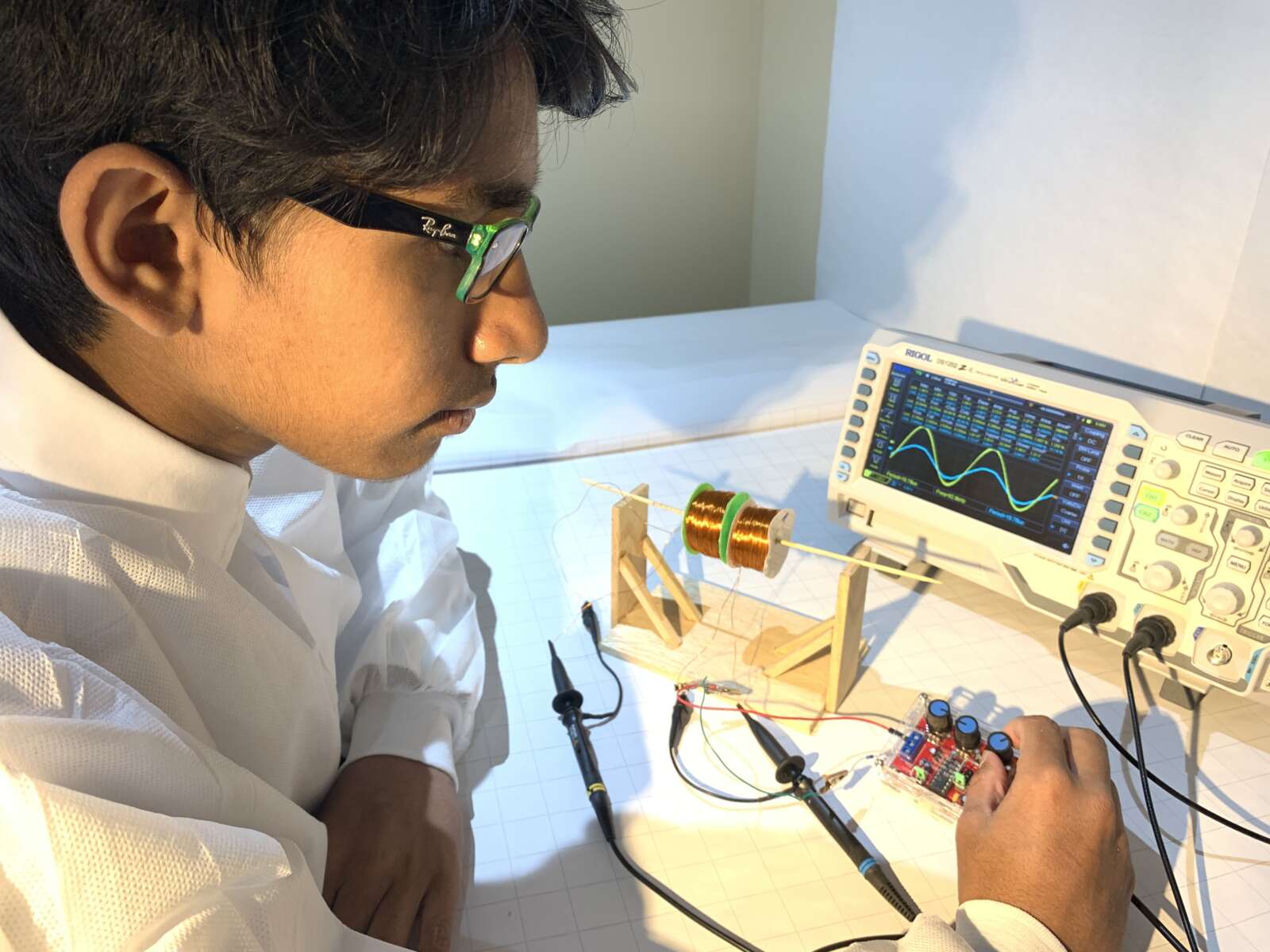
A 13-year-old Great Falls resident’s science experiment about recharging electric vehicles while they’re in motion won him statewide honors.
Kriesh Tivare earned the State Merit Award for Virginia in the national “3M Young Scientist Challenge” last month for an experiment that examined how to make contactless charging a reality using coils in a roadway to power a toy car.
“It basically charges the car as it drives over,” Kriesh said.
A partnership between the engineering company 3M and Discovery Education, the Young Scientist Challenge takes place annually and is open to students in fifth through eighth grade. Competitors submit short videos explaining the science behind a possible solution to a problem they see in their community.
A panel of judges selected a merit winner from each state as well as 10 finalists, who will compete in a final event at 3M’s headquarters in Saint Paul, Minnesota, in October. The overall winner will receive $25,000 and the opportunity to get a mentorship from the company.
In his prize-winning experiment, Kriesh explains how switches on a road could be pressed by a tire to close a circuit and use electromagnetic induction to power a vehicle, rather than having stationary charging stations restoring power.
Kriesh got the idea when his family would go on trips and have to hunt for and spend time at charging stations for their Tesla Model 3, which they normally charge every day. During one family trip in 2019 to Boston, range anxiety was evident as they had to break every five to six hours, taking 45 minutes to an hour to recharge.
“At the mall, there’s this one spot that’s dedicated to…charging, and a lot of the charging stations are already being utilized,” he said, contrasting the amount of charging stations to gas stations.
Kriesh created his own materials using a fishing rod to wrap coils hundreds of times around small PVC piping.
He used a frequency generator to power coils on a roadway model and an oscilloscope to measure how much power was induced, experimenting with different coils and frequencies to maximize efficiency.
Heading into eighth grade at Cooper Middle School in McLean, Kriesh enjoys history and math classes and could see himself as an astronomical engineer, discovering a planet or looking for life in space.
Contactless charging — the term Kriesh used for his contest entry — is becoming a reality. For example, the company ElectReon Wireless Ltd. has deployed its technology on public roadways in Israel and Sweden for buses and trucks.
Researchers in California examined the technology in the 1970s and 1980s and eventually tested electric vehicles in motion. A 1992 report investigating the feasibility of electrifying highways noted a roadway inductor would cost a “few million dollars per lane mile,” but equipment costs for vehicles were “considerably more uncertain” at that time.
A research team at Cornell University, led by electrical and computer engineering associate professor Khurram Afridi, has been working on improving road-powered charging technology for electric vehicles, which they say could have uses from electrifying highways to supporting autonomous forklifts and robots in manufacturing warehouses.
Afridi said in a video about the technology that the timing could be right to introduce changes to infrastructure in need of repair.
Kriesh is interested in continuing his experiment by looking at how 5G signals could allow road coils to charge a vehicle without pressure plates, avoiding the need for his model car to drive over switches.
“In the future, the 5G network will replace the switches within the road to activate the coils in the road instantaneously,” Kriesh said in his contest video. “Dynamic charging could be a promising future for smart, driverless vehicles.”
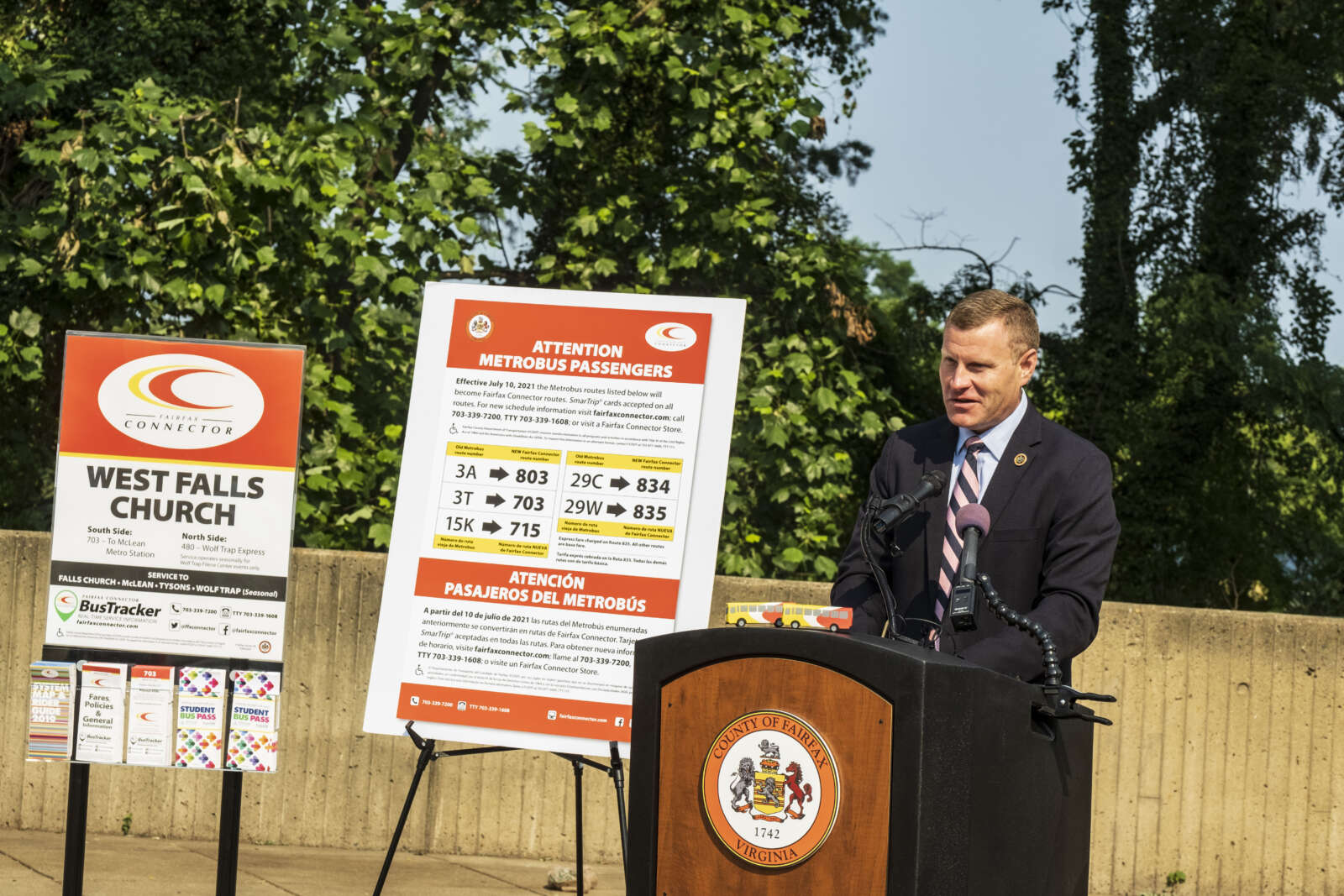
(Updated at 10:05 a.m.) Bus routes taken offline during the pandemic are making a comeback.
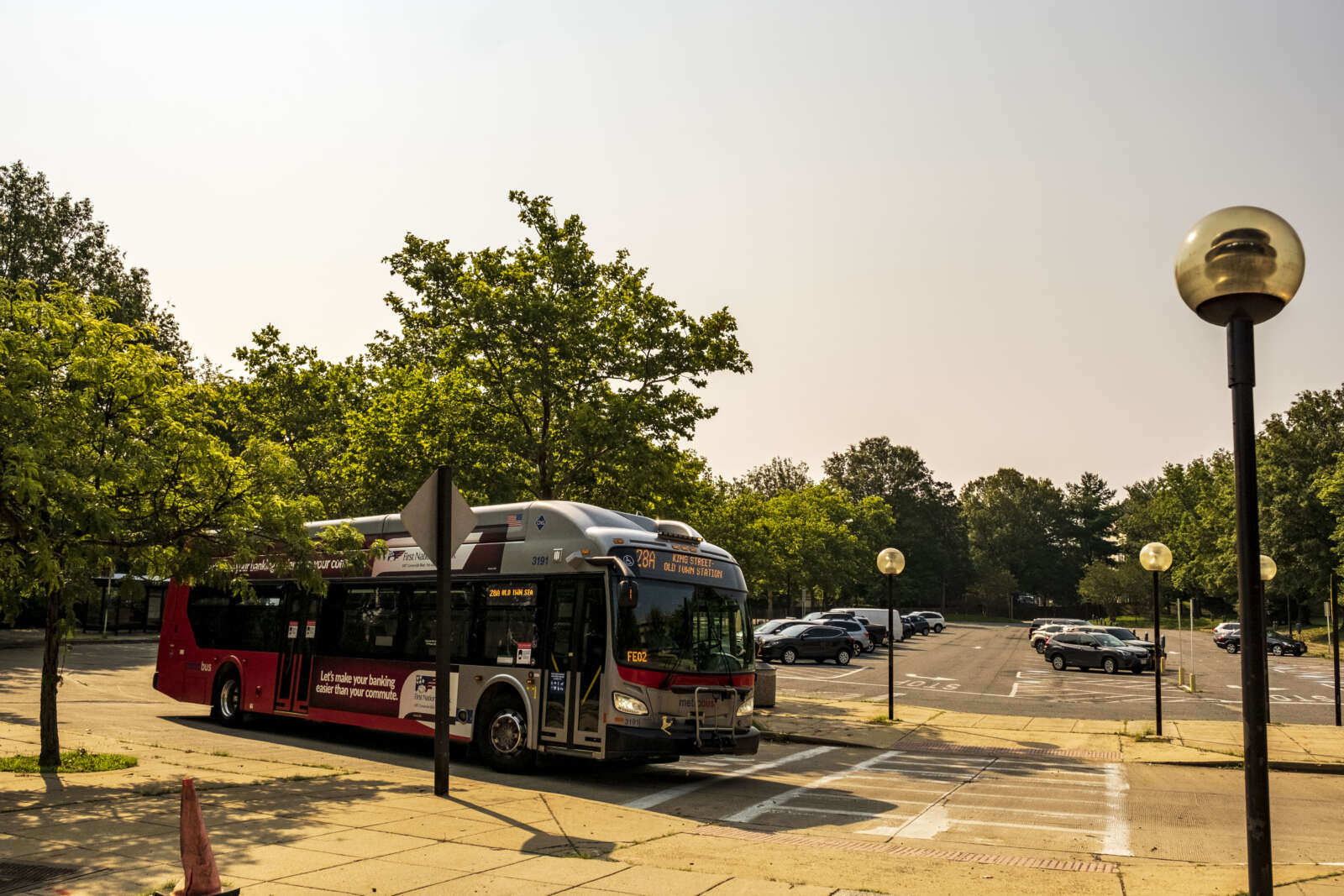
Fairfax County officials gathered outside the West Falls Church Metro station yesterday (Tuesday) to herald the upcoming changes involving the Fairfax Connector, which will take over several Metrobus routes starting Saturday (July 10) and also adjust service on several key routes.
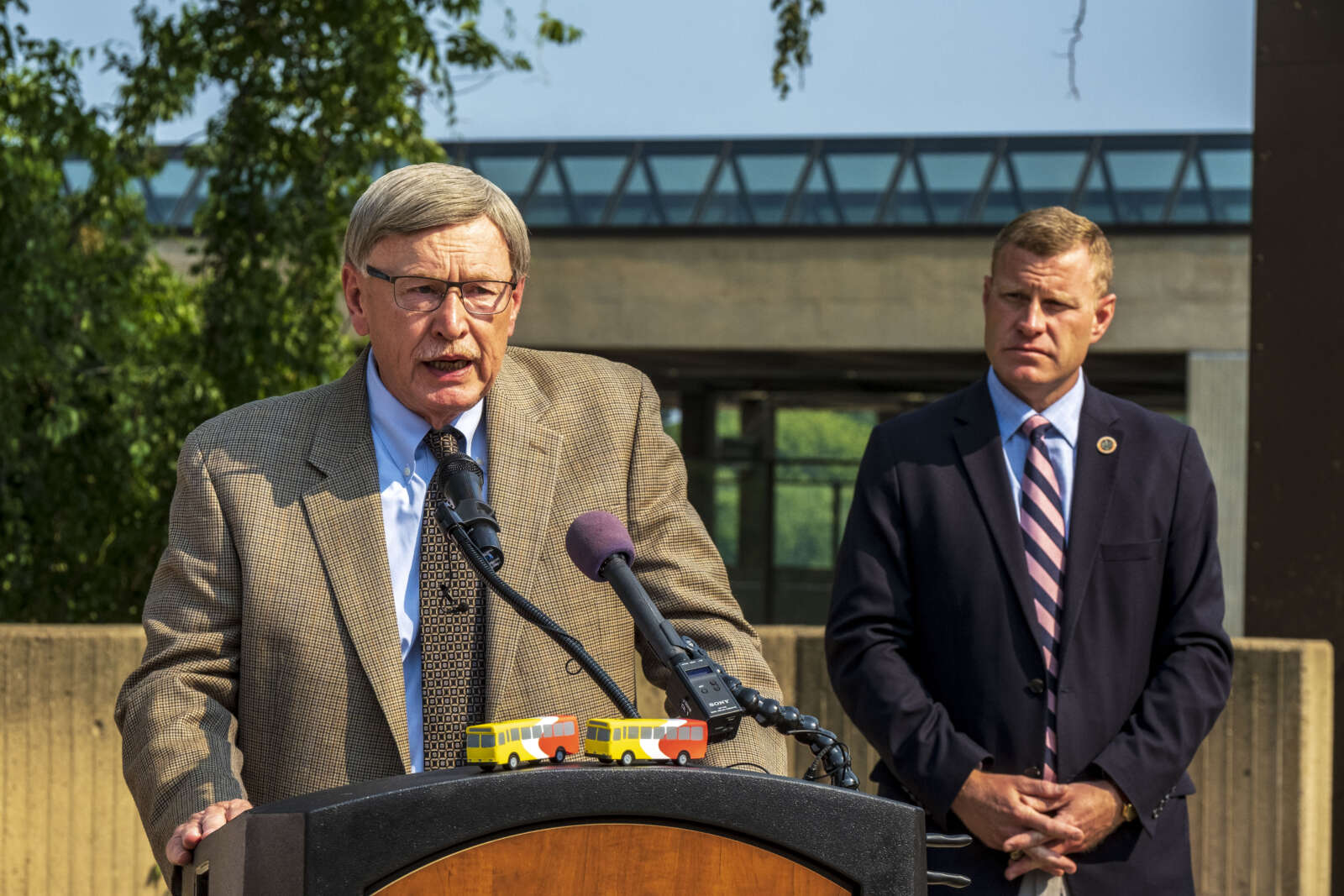
“As we come out of the pandemic, it’s never been more important to have robust bus service…to get people back on transit to remind them how convenient it is, how practical it is and how easy it is to use,” Fairfax County Board of Supervisors Chairman Jeff McKay said.
McKay noted that county officials chose the Metro station as the location for their press conference formally announcing the changes, because the new bus routes will help bring transit riders there. The five new Fairfax Connector routes are projected to serve around 69,000 residents.
Another Fairfax Connector service change also starting Saturday involves discontinuing route 422 (Boone Boulevard to Howard Avenue) due to low ridership and duplicate service provided by routes 401, 402, 462, and 467, the county said.
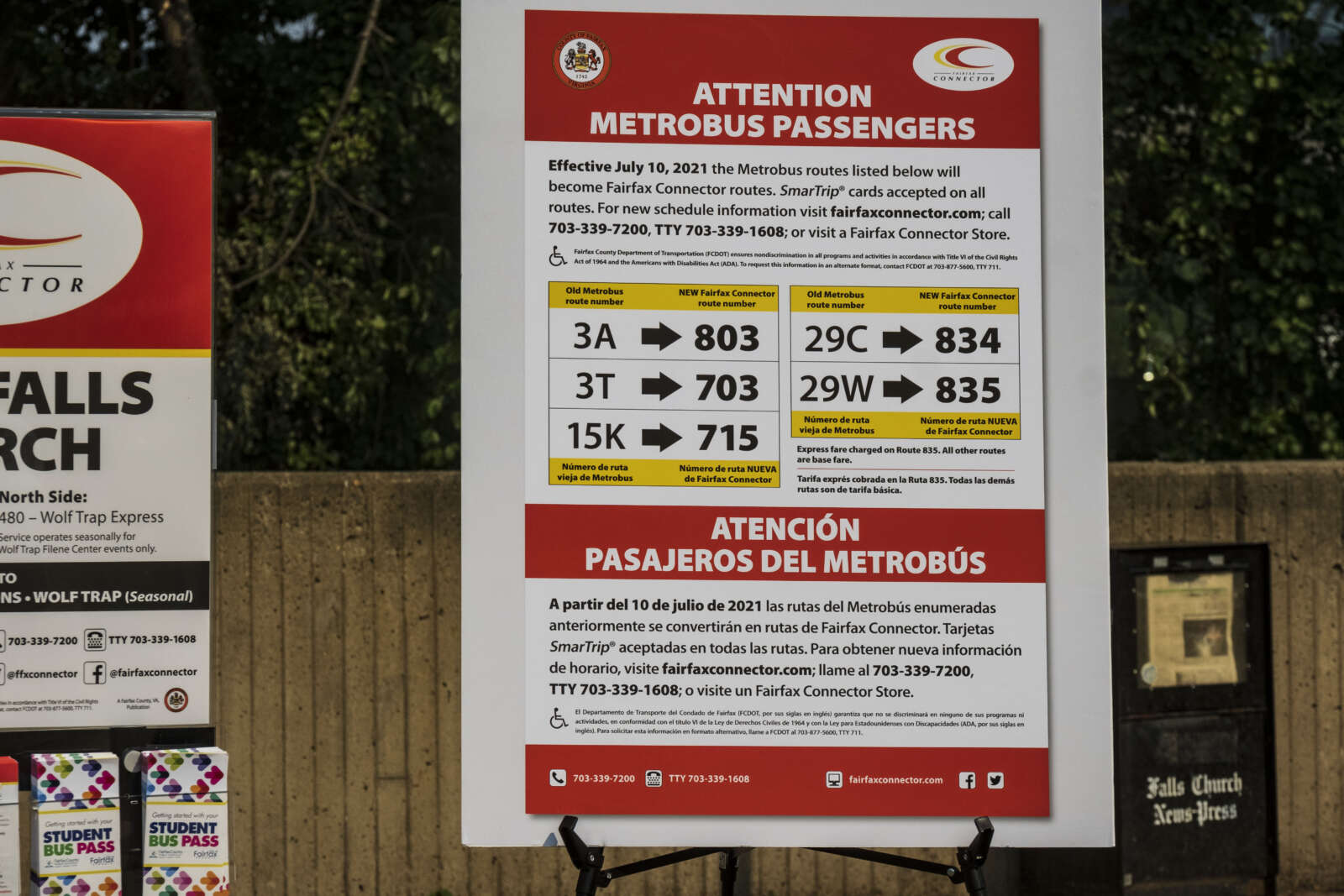
Approved by the county board in March, the changes will restore four existing routes that were run by Metrobus but had ceased operating due to the COVID-19 pandemic. The county bus system will also take over a fifth route.
The county detailed the changes as follows:
- 703: Pimmit Hills (former 3T route) will provide weekday and Saturday service, linking Pimmit Hills and Tysons to the McLean and West Falls Church Metrorail stations. The service operates every 30 minutes during weekday rush hours and every hour during weekday non-rush hours and Saturdays.
- 715: East Falls Church – Langley (former 15K route) will have weekday rush hour service every 30 minutes to further link McLean, Salona Village, and Chesterbrook Gardens to the East Falls Church Metro station.
- 803: Annandale Road (former 3A route) will deliver weekday and Saturday service, linking Lake Barcroft, Annandale, and North Springfield to the East Falls Church Metro station; it operates every 30 minutes during weekday rush hours, every 40 to 60 minutes during weekday non-rush hours, and every 45 minutes on weekends.
- 834: Annandale-Pentagon (former 29C route) will extend to Northern Virginia Community College’s Annandale Campus Route and offer weekday rush hour service every 30 minutes linking Northern Virginia Community College, Annandale and Lincolnia to the Pentagon Metro station; express service is $4.25.
- 835: Annandale-Pentagon (former 29W route) will extend to part of Olley Lane and Braeburn Drive and have weekday rush hour service every 30 minutes linking the Northern Virginia Community College and Willow Woods communities to the Pentagon Metro station; express service is $4.25.
Bus fees are $2 ($1 for seniors) and have unlimited transfers within two hours of boarding with a SmarTrip card. More information is available at fairfaxconnector.com, which also provides text and email alerts as well as customer service contact information.
“We are pleased to restore and enhance these services,” McKay said.
Other service changes involve routes 171 (Richmond Highway), 462 (Dunn Loring to Tysons), and 630 (Stringfellow Road — Centreville).
Dranesville District Supervisor John Foust called this an exciting time for Fairfax Connector specifically and transit in general, pointing to next year’s anticipated, long-delayed launch of the second phase of Metro’s Silver Line.
The moves also come as the county looks to move away from diesel buses by 2035, which the board noted last week is ahead of the Washington Metropolitan Area Transit Authority’s timeline to have electric buses by 2045.
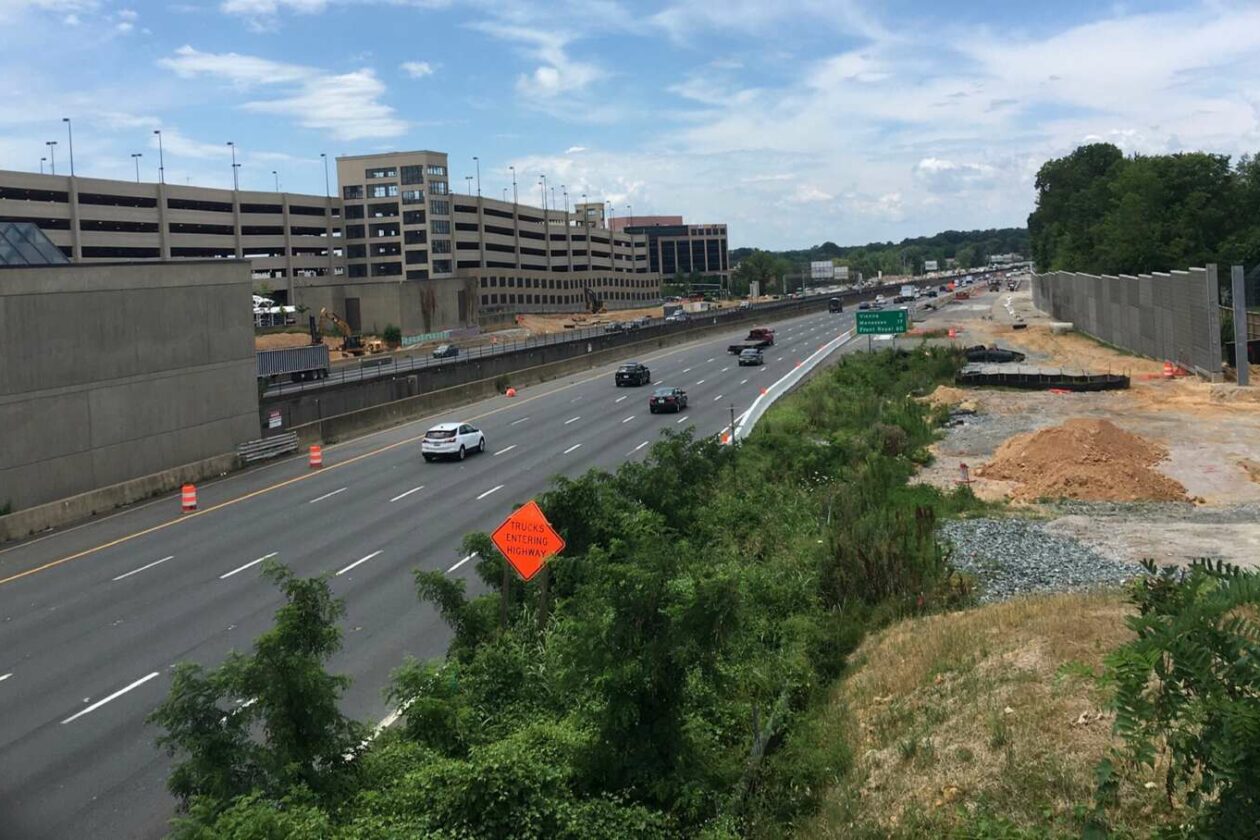
Interstate 66 project crews are rerouting more traffic along the corridor this year with future milestones — and easier commuting — in sight.
Virginia Department of Transportation and construction officials shared updates on the progress of the Transform 66 Outside the Beltway project at virtual community meetings on Tuesday and Wednesday (June 29 and 30). Express lanes in the multibillion-dollar project are slated to open in December 2022.
The added express lanes will involve tolls for solo drivers and be free for vehicles with three or more people. Other changes coming with the project include adding express ramp connections at interchanges and improved pedestrian and bicycle facilities, including a newly created I-66 Trail along the corridor.
“Every day, things are changing,” VDOT megaprojects director Susan Shaw said during the presentation on Wednesday, which focused on the area from Jermantown Road in Fairfax to I-495 in Dunn Loring. “There’s a lot of work that’s going on out there, about $60 million worth of work per month…That’s a lot of changes, and it means changes for drivers.”
She reminded community members that it is now illegal for drivers to utilize a handheld device while operating their vehicle, thanks to a new law passed in 2020 that became effective Jan. 1.
“We just ask that you really be alert when you’re driving the corridor, that you pay attention to all the signage,” she said.
Project officials reported the following timelines for improvements to I-66 interchanges:
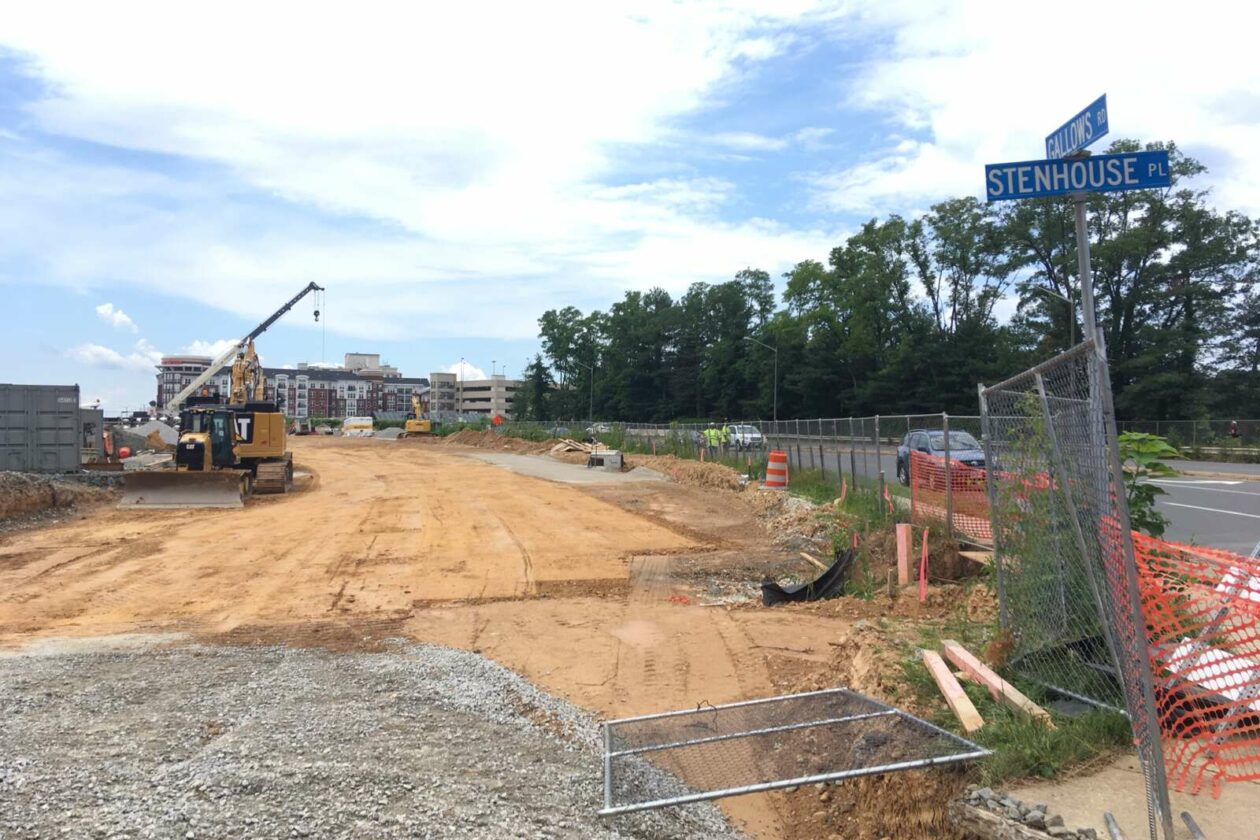
Gallows Road Bridge
- Mid-July: A traffic shift will occur
- August: The new northbound bridge opens with traffic shifting there. The old bridge will begin to be demolished overnight, and construction of the new southbound bridge will start.
- December: Work related to tying in a school driveway will occur over winter break
Nutley Street Interchange
- Permanent ramps and retaining walls are being constructed this summer
Vaden Drive Bridge
- Express lane ramps are being constructed and slated to be complete by early fall.
- A sidewalk on the west side of the bridge is scheduled to open in early fall. It runs from Saintsbury Drive to Country Creek Road.
Chain Bridge Road (Route 123)
- Southbound Route 123 traffic will shift to the new bridge in late fall.
- Permanent Route 123 ramps to I-66 will open later this year. Northbound Route 123 changes are slated for late July and the summer, and southbound ramp openings are on schedule for this fall.
- Roadwork on Route 123 north and south of the interchange will take place in early 2022.
Jermantown Road
- Pedestrian access, which didn’t exist before, will be available after the project is completed.
- Construction will take place in early July of sidewalk north and south of the bridge on the west side of the road.
Route 50
- Lanes are being shifted to new bridges. Route 50 westbound traffic switched to the new overpass on Sunday (June 27), and eastbound traffic will take over the new structure on or about July 10.
The I-66 Trail, the new shared-use path being added along the interstate, could be opened in phases, but it depends on whether it’s safe to do so, Shaw said. She said they’re not committed to anything prior to the anticipated completion of the project in mid-2023.
“Our…top priority is to make sure that…the shared use path is safe and that it’s safe while we’re completing this project,” she said.
Meanwhile, noise walls are going up in various locations along I-66, but the COVID-19 pandemic has caused delays in some materials, including steel posts and panel production, said Nancy Smith, public relations director with FAM Construction, the design-builder for the project.
To get more project updates, a project webpage is available at outside.transform66.org. Presentation videos from Tuesday and Wednesday are available on YouTube.
Updated at 3:55 p.m. Fairfax County is seeking public feedback about people’s parking habits and priorities in Tysons and Reston with a survey available now in English and Spanish until the end of July.
County staff are using the online survey to help establish a managed parking program in the Tysons Urban Center and Reston Transit Station Areas, which they hope will address issues ranging from limited parking options to avoiding vehicles reportedly remaining in spaces for weeks at a time.
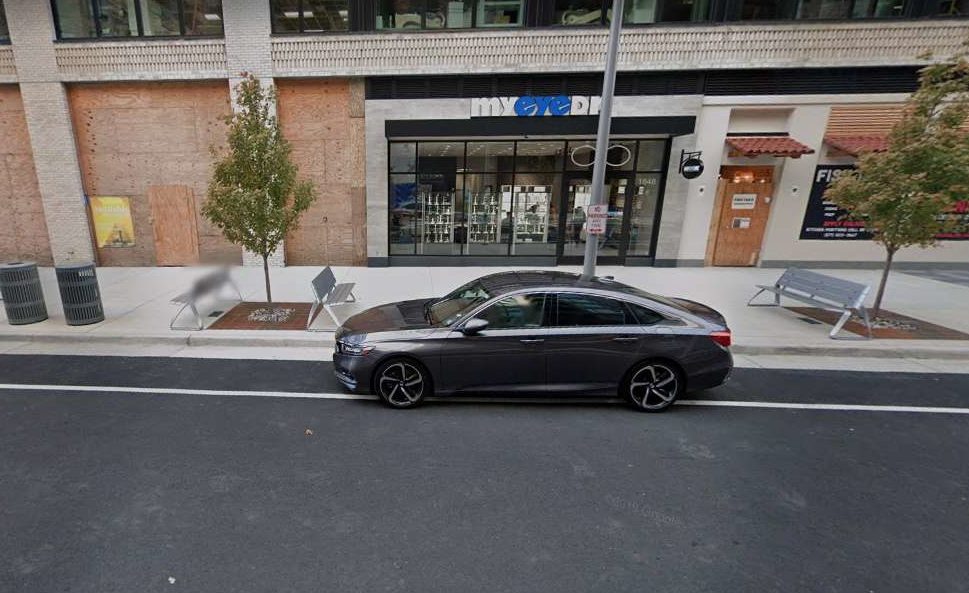
Fairfax County currently has no paid on-street parking meters and collects no money in on-street parking revenue. Parking meters are on private streets, the county notes.
In addition to asking about people’s current parking habits, the survey tells respondents to prioritize five factors that affect when and where they decide to park:
- Lowest price or free
- Proximity of parking to desired location
- Flexible payment options (credit cards, smartphone apps)
- Ability to pay with cash
- Overnight parking is allowed for free
The county is looking to get input from both commuters and residents. In addition to filling out the survey, community members can submit comments through an online feedback form, by mail to the Fairfax County Department of Transportation, and by calling 703-877-5600.
The survey will build on the results of a two-year study that FCDOT conducted to look at the availability of on-street parking on state-owned roads in Tysons and Reston.
In Tysons, the study found 1,272 on-street parking spaces along 22 miles of curb, amounting to 29% of the available space. Recommendations included implementing timed or paid parking near Metro stations to encourage turnover and addressing issues with commercial vehicles parking in front of businesses.
The county is looking to support businesses with “shorter duration parking and parking space turnover,” according to a page about the survey.
“Ultimately, the goal is to provide parking that supports the mixed-use development in these increasingly-urban areas of the County,” FCDOT said in a news release.
County staff is slated to use the information from the survey to propose policy and ordinance changes to the Board of Supervisors next year. FCDOT says the managed parking plans will mostly not take effect until new grids of streets are built in Tysons and Reston and accepted by the Virginia Department of Transportation.
Correction: This article has been updated to show when county staff expect to recommend ordinance changes.
via Google Maps
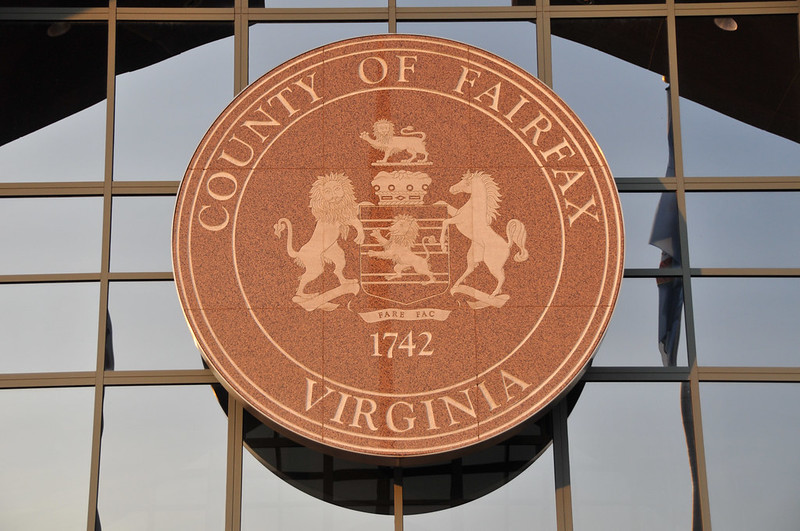
The Fairfax County Board of Supervisors is working its way toward letting public workers collectively bargain in the wake of a statewide change in 2020 to lift a decades-old restriction.
A board’s personnel committee met yesterday (Tuesday) to discuss a draft ordinance that would let Fairfax County workers make union contracts with the county government, giving them the power to negotiate pay and other benefits.
“I think we’re moving in a good direction,” Dranesville District Supervisor John Foust said after sharing concerns that the proposed ordinance might exempt too many employees from collective bargaining.
While managers, supervisors, volunteers, and other workers are slated to be excluded under the draft ordinance, the board is looking at where temporary workers such as summer lifeguards and seasonal park workers as well as non-merit employees should fall.
The proposed ordinance would serve as the framework for what can and can’t be done through collective bargaining. Once approved, it would allow workers to vote to form a bargaining unit, and employees who don’t want to be involved wouldn’t have to pay dues but could still receive the benefits of the change, Mason District Supervisor Penny Gross said.
The draft discussed Tuesday calls for collective bargaining agreements that would last three years or longer, with separate units for general government employees, police, and fire and emergency services. It also bans strikes and spells out numerous other issues.
The county’s ordinance would be separate from Fairfax County Public Schools, which has over 24,000 employees.
Gross, who chairs the personnel and reorganization committee that’s overseeing the development of the draft, said she expects the board will pass an ordinance, which could happen this year.
SEIU Virginia 512, a union that already includes over 2,000 members in Fairfax County from dues-paying maintenance workers and nurses to librarians and social workers, welcomed the board’s overall support.
But union president David Broder says the ordinance still falls short in several areas. Namely, he says it “artificially narrows” the scope of bargaining, excludes working conditions among the topics that can be negotiated, and could potentially leave thousands of workers out of the collective bargaining process.
“We’ve learned during the pandemic…that being able to bargain over working conditions is critical,” Broder said, noting the importance of safe and clean work sites, personal protective equipment availability, and scheduling.
Lee District Supervisor Rodney Lusk shared concerns about working conditions for public works and sanitation workers, expressing support for change.
Collective bargaining agreements could involve some 10,000 workers, Gross told Tysons Reporter, and the board is gathering more information on non-merit employees to help with its determinations.
“We have one opportunity to get this right, which is why we’re taking a little extra time to work on the ordinance,” Gross said.
In 1977, the Supreme Court of Virginia ruled that public-sector collective bargaining agreements weren’t permitted and existing ones were invalid, noting the state legislature could change that.
The General Assembly and governor approved legislation last year that gave localities the authority to develop ordinances for recognizing labor unions and permitting collective bargaining. That measure took effect on May 1.
The personnel committee will meet again on July 20, and the board expects to have a public hearing in October.
Photo via Machvee/Flickr