

Yesterday, the Washington Metropolitan Area Transit Authority (WMATA) released several preliminary concepts for alternative routes affecting Metro riders in Northern Virginia.
For people in the Tysons area, two concepts would create new Silver Line connections by I-66 — one north and another south of the highway.
The concepts stemmed from a study to find solutions for bottlenecking of the Silver, Orange and Blue lines at the Rosslyn Metro station, according to WMATA.
“This bottleneck limits the number of trains that can serve customers during rush hour,” according to WMATA. “In addition, running three lines on one track requires precision, and even a minor problem with a single train can impact the entire rush hour for all three lines.”
WMATA is looking to get community feedback on the ideas and plan to host a meeting on Tuesday (Dec. 17) at the Courtyard by Marriott Tysons-McLean (1960A Chain Bridge Road) from 4:30-7:30 p.m.
Let Tysons Reporter know what you think of the new concepts and which one(s) would affect you. Feel free to share ideas in the comments below.
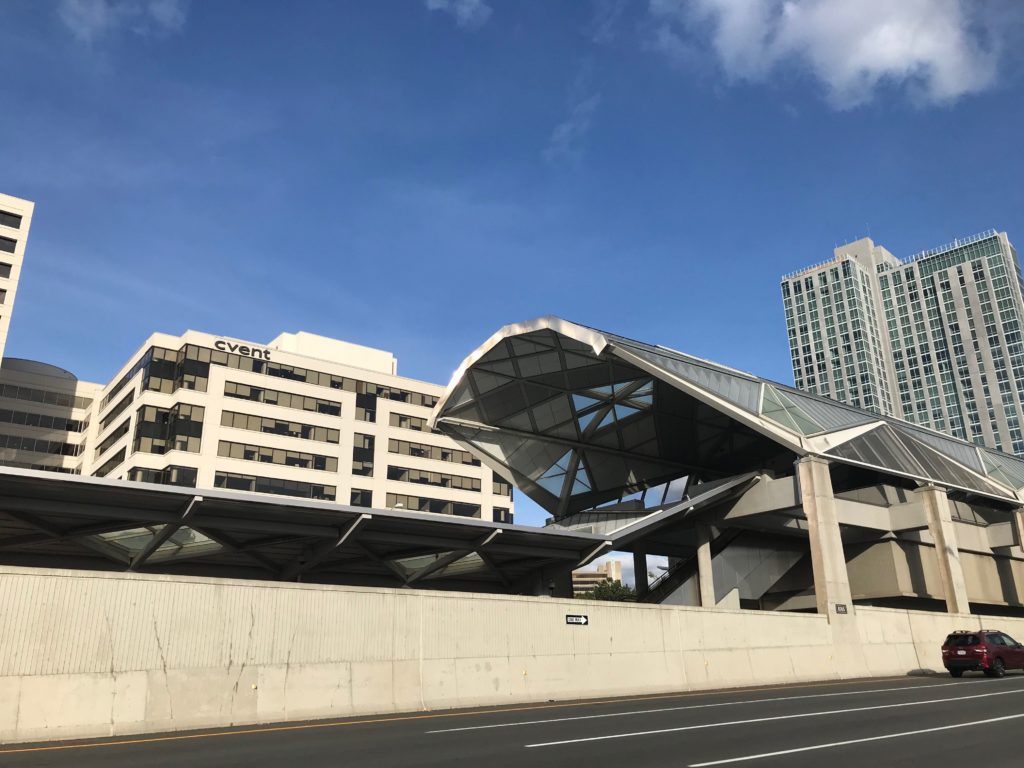
Metro riders could see some new routes for the Silver, Orange and Blue lines in the future.
The Washington Metropolitan Area Transit Authority released today (Thursday) several preliminary concepts for the three lines that include alternative routes. The concepts are a part of a two-year study to address both short- and long-term needs, according to WMATA.
More from WMATA:
Today customers on Metro’s Blue, Orange, and Silver lines experience delays, crowding, and congestion due to limitations in the system’s design. The three lines share one set of tracks from the Rosslyn tunnel, through downtown DC, to Stadium- Armory. This bottleneck limits the number of trains that can serve customers during rush hour. In addition, running three lines on one track requires precision, and even a minor problem with a single train can impact the entire rush hour for all three lines.
The BOS Study has identified several draft concepts to improve service and position Metro to serve the future needs of our region. Input from the public and stakeholders will help Metro evaluate the concepts and recommend a comprehensive strategy with a “locally-preferred alternative” to move forward with federal environmental review, design and funding in late 2020.
For people in Tysons, one option would let trains turn back at different areas along the Orange, Blue or Silver Lines, like the West Falls Church or East Falls Church Metro stations.
Another concept would create new Silver Line connections north of I-66:
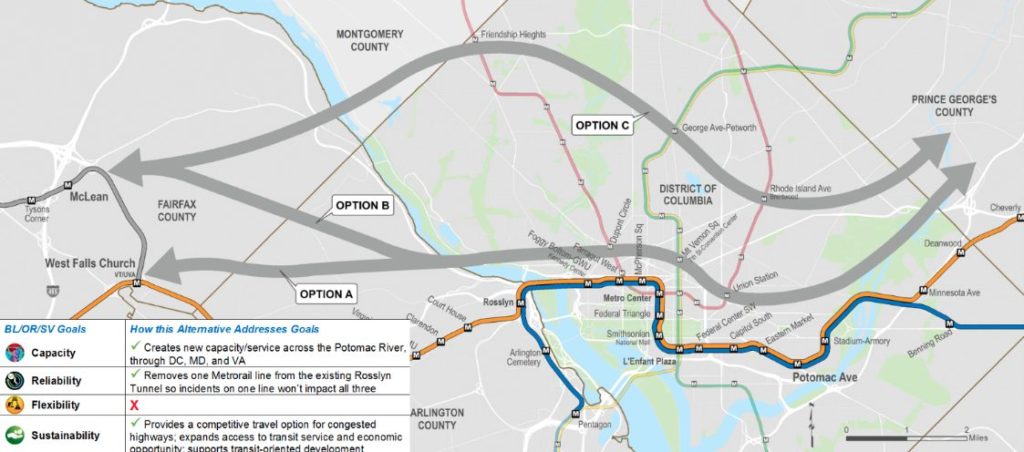
Concept: Provide new Silver Line service through a new tunnel under the Potomac River into DC and Maryland, north of I-66.
A new tunnel under the Potomac River would provide a new Silver Line “corridor” north of I-66 that could operate as local service, express service or a mix, with different service options:
Option A: Operate new Silver Line service between West Falls Church, Mid-City DC, Union Station, Northeast DC and Prince George’s County.
Option B: Similar to Option A, but Silver Line service would operate from McLean instead of West Falls Church.
Option C: Operate new Silver Line service between Tysons, Bethesda or Friendship Heights, northern DC and Prince George’s County.
Yet another concept would create new Silver Line connections south of I-66:
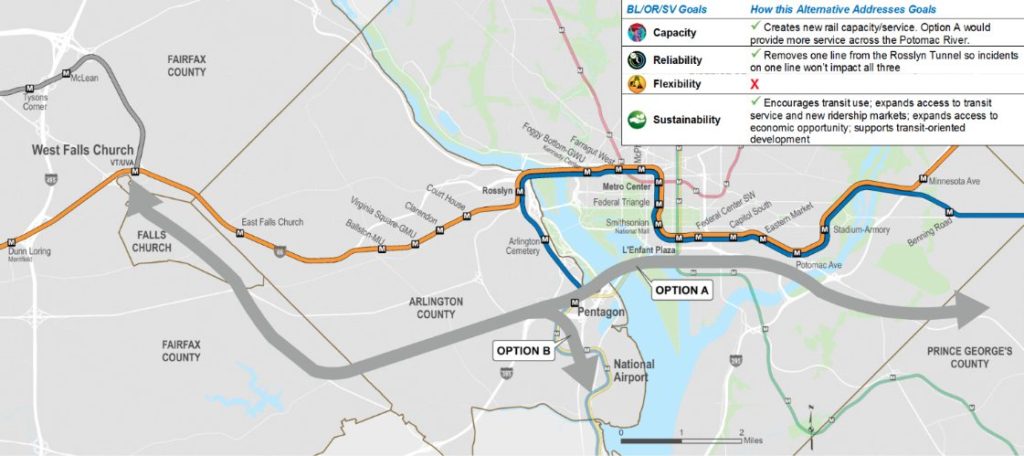
Concept: Provide new Silver Line service through a new tunnel under the Potomac River into DC and Maryland, south of I-66.
A new tunnel under the Potomac River would provide a new Silver Line “corridor” south of I-66 that could operate as local service, express service or a mix, with different service options:
Option A: Operate new Silver Line service from West Falls Church along Route 7 and Columbia Pike, then across the Yellow Line Bridge to Southeast DC and Prince George’s County.
Option B: Similar to Option A, but the Silver Line would turn southward to Crystal City and National Airport rather than heading to DC.
WMATA plans to solicit feedback from the public about the ideas at several meetings this month. The Tysons-area meeting is set to take place on Tuesday (Dec. 17) at the Courtyard by Marriott Tysons-McLean (1960A Chain Bridge Road) from 4:30-7:30 p.m.
The online survey will be open until Jan. 6.
People can find more information about the preliminary concepts online.
Metro releases preliminary concepts for public feedback to improve service on Blue, Orange, Silver lines https://t.co/bFqZLN1iwX #wmata pic.twitter.com/mm3vvVdaPH
— Metro Forward (@wmata) December 5, 2019
Two images via WMATA
Updated at 3:30 p.m. — Routes 630, 640 and 650 will also not operate a full Sunday service today, the county announced this afternoon.
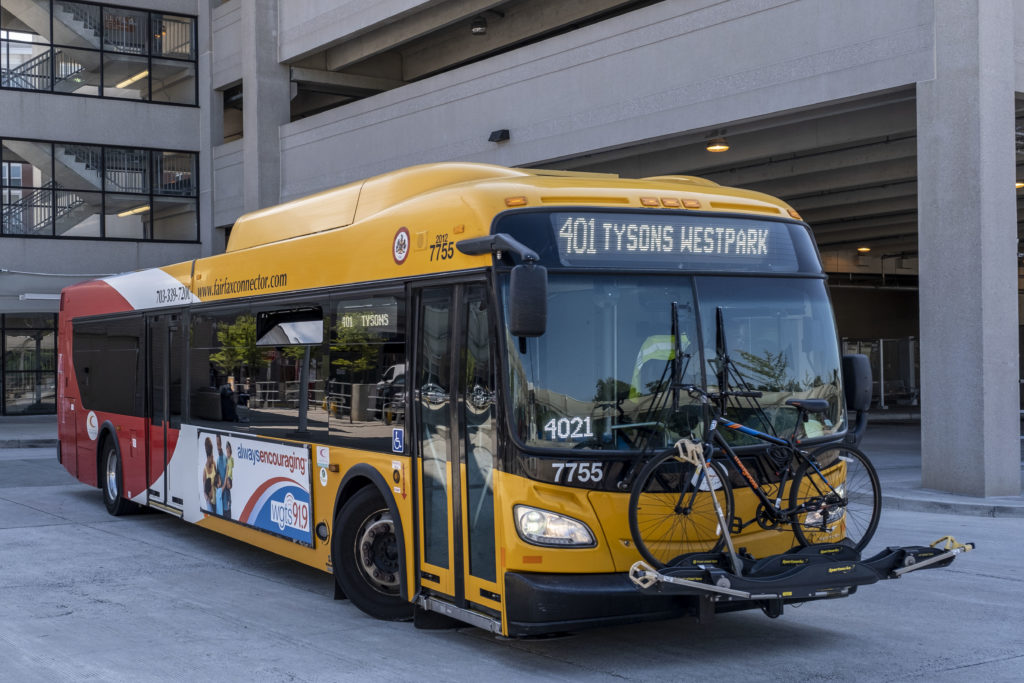
Fairfax Connector is continuing to cut its bus service today (Thursday) due to worker strikes, impacting commuters in the Tysons area.
The strike today came after negotiations for a contract extension didn’t pan out, along with a strike at a Metro garage in Lorton. Strikes are taking place until 5 p.m. today in Herndon, Newington and Fairfax.
In an announcement yesterday (Wednesday), Fairfax County said that Fairfax Connector routes will operate on a Sunday service today.
This morning (Thursday), the county said that five routes that were set to operate on a Sunday schedule won’t run today, including routes 423 and 721 in the Tysons area, and that several routes — 505, 983, 981, RIBS 2 and RIBS 4 — will not operate full Sunday service today.
That leaves Fairfax Connector with about one-third of its bus routes still in service today.
More from the county’s transportation department:
The contract between Amalgamated Transit Union (ATU) Local 1764, the union representing the bus drivers and mechanics, and Transdev, Fairfax County’s contracted bus operator, expired on Nov. 30, 2019.
As a result of the job action, Transdev does not expect all drivers represented by ATU Local 1764 to report for work on Thursday, Dec. 5, 2019, and bus service will be operated by a limited number of available personnel. The decision was made to operate a Sunday schedule instead of a weekday schedule because that is believed to be the maximum level of reliable bus service that can be provided under the current circumstances.
Fairfax County officials are urging commuters to find other forms of transportation today.
People can contact Fairfax Connector customer service at 703-339-7200 for updates on service impacts, sign up for text or email alerts and follow Fairfax Connector on Twitter and Facebook.
⚠️Fairfax Connector bus service will operate Sunday schedule today due to a job action by Fairfax Connector drivers and mechanics. Please visit:https://t.co/ztkygOkVhq to learn which routes will and will not be operating today and disregard weekday buses shown in BusTracker.
— Fairfax Connector (@ffxconnector) December 5, 2019
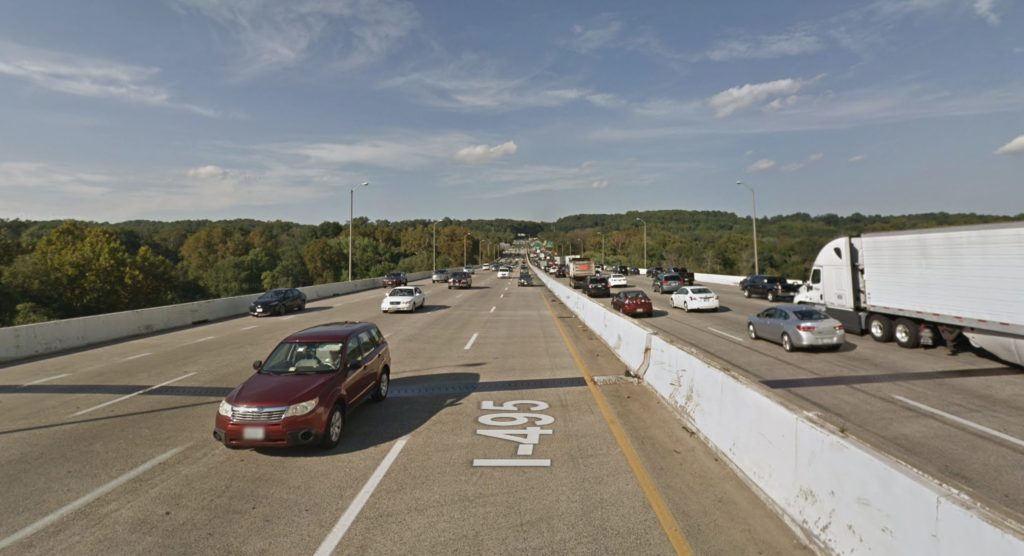
(Updated at 10:15 a.m.) Tysons area commuters heading to and from Maryland on the Beltway may see some relief from the constant traffic woes.
The governors of Virginia and Maryland announced an agreement Tuesday morning that would see the construction of a new American Legion Bridge.
The agreement to rebuild the bridge is being billed as “historic” and “a big win for Northern Virginia, the metro region, and our entire Commonwealth” by Virginia Gov. Ralph Northam (D).
The new bridge will “relieve congestion at one of the country’s worst traffic chokepoints,” according to a press release, below. “The project is expected to cut commuting time in half for many travelers, reduce congestion in the regular lanes by 25 percent, provide 40 percent more lane capacity over the old bridge, and include bicycle and pedestrian paths across the Potomac River.”
The new bridge will be build on largely the same footprint as the existing bridge, but with two new express lanes in both directions. The initial stages of construction could begin as early as 2021.
Proud to stand with @GovLarryHogan to announce our new, historic Capital Beltway Accord. Finally, our two states have come together to rebuild the American Legion Bridge—a big win for Northern Virginia, the metro region, and our entire Commonwealth.https://t.co/lamx5p3zqr pic.twitter.com/av4wOhzYjI
— Governor Ralph Northam (@VAGovernor73) November 12, 2019
More via a press release from the governor’s office:
Governor Ralph Northam (D-VA) and Governor Larry Hogan (R-MD) today announced a bi-state, bipartisan accord to create a new, unified Capital Beltway, replace the aging American Legion Bridge and relieve congestion at one of the country’s worst traffic chokepoints. The two governors made the announcement at the annual Capital Region Transportation Forum in Washington, DC.
“A new bridge means commuters will get to work and back home faster,” said Governor Northam. “Our teams have identified a way to fix one of the worst traffic hot spots in the country. This demonstrates what can get done when leaders come together to find shared solutions to tough regional problems. This is about helping people see their families more, grow their businesses, and further unlock the region’s vast economic potential.”
“The ‘Capital Beltway Accord’ is a once-in-a-generation achievement for the capital region,” said Governor Hogan. “A bipartisan, commonsense, interstate agreement such as this has eluded elected leaders throughout the region for many decades. Together with our partners in Virginia, we are building a foundation for even greater economic growth, greater opportunity for our citizens, and advancing real, lasting, transformative improvements for the entire Washington metropolitan region.”
The project complements ongoing plans by both governors in their jurisdictions–advancing a region-wide vision for a seamless network of reliable travel options around the Capital Beltway, and along Interstates 270 and 95, 395, and 66.
The project is expected to cut commuting time in half for many travelers, reduce congestion in the regular lanes by 25 percent, provide 40 percent more lane capacity over the old bridge, and include bicycle and pedestrian paths across the Potomac River.
The American Legion Bridge has been operating beyond its capacity for nearly four decades. Daily traffic has grown 390 percent since the bridge opened in 1962, with 235,000 vehicles using it daily. More than 40 percent of the region’s population travels this segment of the Capital Beltway, and the region expects to grow by another 1.2 million people by 2040. Both governors have made it a top priority to identify a long-term, seamless solution for the Capital Beltway.
The project will replace the existing lanes in each direction across the Potomac River and add two new Express Lanes in each direction for approximately three miles between the George Washington Memorial Parkway in Virginia to the vicinity of River Road in Maryland. New bicycle and pedestrian access will connect trails on both sides of the Potomac River. The project is being designed predominantly within the footprint of the existing bridge and right-of-way to minimize impact to travelers, the environment, and surrounding communities. No homes or businesses are expected to require relocation.
“This is once-in-a-generation project that will improve accessibility throughout the region,” said Virginia Secretary of Transportation Shannon Valentine. “This is a milestone in regional cooperation. We in Virginia look forward to working hand-in-hand with Maryland to deliver this transformative transportation solution.”
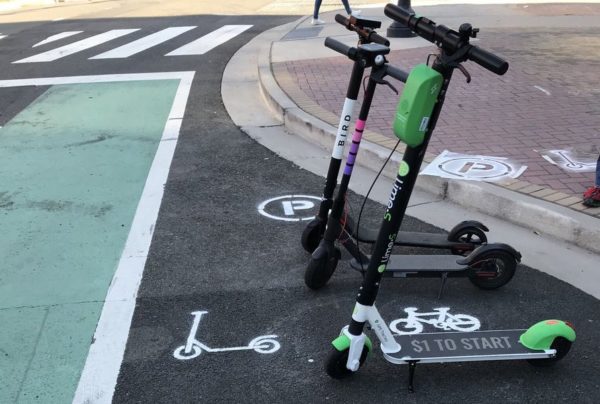
As the January deadline looms, the Falls Church City Council discussed proposals for e-scooters before state laws take effect and the city loses its chance to create regulations.
Concerns arose at both the Oct. 21 and Oct. 28 City Council meetings, including potential funding issues, underage use, parking and the upcoming pilot program. The pilot program would be limited to two scooter vendors, leaving companies to compete for a one-year trial period, Councilmember Ross Litkenhous said.
If implemented, the program would allow 14 scooters per 1,000 people into city limits. On average, the scooters would cost users $1 to unlock and a $0.25 per-minute fee, according to statistics gathered from Arlington and Alexandria.
On average 20% of e-scooter users ride them for social or entertainment purposes, while roughly 20% use them for shopping and errands. Another 20% use them to commute to the metro. Scooters could help to solve the first-to-last mile commuter problem, an expert brought in by the City Council and Councilmember Phil Duncan said.
There was some talk at the Oct. 21 meeting about using scooters to raise revenue for the city, by adding on taxes and unlocking fees. The city would charge each vendor an $8,000 permitting fee, regardless of fleet size, according to city documents. But no one seemed to have a concrete answer to the total profits.
“It would be interesting to see how much we can get out of it without impacting the demand,” Litkenhous said.
Councilmember Dave Snyder took another perspective, saying that it might cost the city more money. He said that police would be distracted by monitoring people, ensuring they are following laws and guidelines while riding the scooters.
Parking was yet another major focus of the conversations.
Several people suggested corrals, while others said that they encourage people to lean them against polls that are out of the way of pedestrians and cars. All of the councilmembers agreed that measures should be taken to ensure that they are not being left in the way of traffic or parked illegally in yards.
“Parking is going to be one of the major sources of complaints we will get, so we should prepare for that,” Councilmember Letty Hardi said.
Going forward, the Falls Church City Council will continue to discuss potential implementation plans before they make a final decision. At the next City Council meeting on Tuesday (Nov. 12), councilmembers are expected to discuss a first reading of the new ordinance regarding motorized scooters and shared mobility devices.
“I really think the success of this pilot is going to hinge on good communication,” Hardi said. “Lowering the bar to explain this won’t be perfect, [but] is important.”

This week, two public hearings in the Town of Vienna aim to get public input on a proposed motorized scooter program and extending the moratorium on new development applications for Maple Avenue.
The Transportation Safety Commission is set to unveil the proposed shared mobility devices pilot program and solicit feedback from the community on Tuesday (Oct. 29).
People can also email comments to [email protected].
Then on Wednesday, Oct. 30, the town’s Planning Commission will hold a public hearing on extending the suspension of the Maple Avenue Commercial (MAC) zone.
The proposal would extend the moratorium to June 30.
The Vienna Town Council first put the moratorium in place last September to allow the town staff time to redesign the town’s guidelines.
Both public hearings are set to start at 8 p.m. at Town Hall (127 S. Center Street).
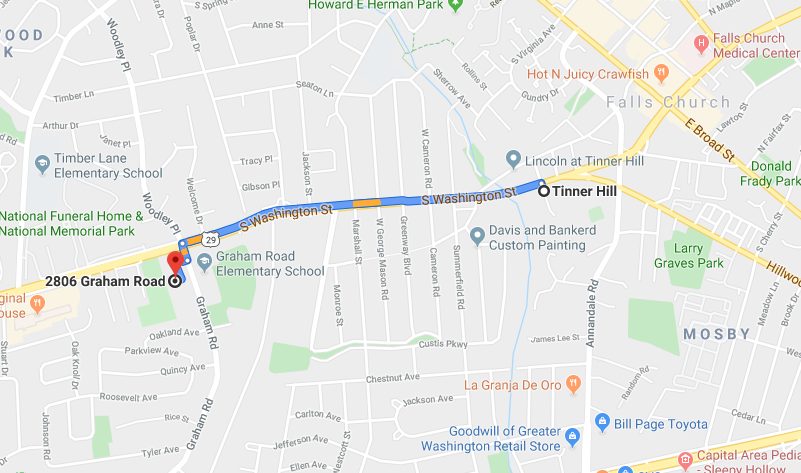
People interested in brainstorming ideas for how to make Lee Hwy (Route 29) safer can attend a meeting tomorrow (Thursday) night.
Local businesses and Virginia Tech planning students are planning to share ideas for improvements along the highway from Graham Road to Tinner Hill Road.
The meeting is set to take place from 6:30-8 p.m. at Thomas Jefferson Elementary School (601 S Oak Street).
Nearby, a study is underway to consider changes to Route 50.
Map via Google Maps
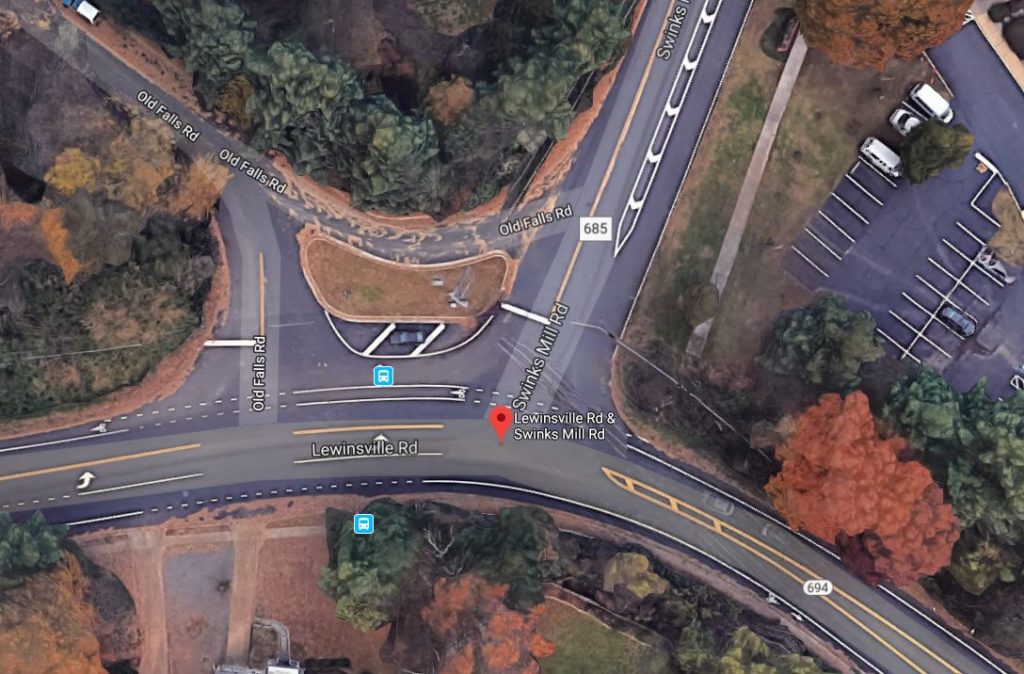
Fairfax County officials are set to consider changes to the intersection of Swinks Mill and Lewinsville Roads in McLean later this fall.
The Virginia Department of Transportation is currently studying the intersection.
The study “included survey, operational analysis, intersection concepts and collaboration with Fairfax County,” Jenni McCord, a VDOT spokesperson, told Tysons Reporter.
A traffic signal, a traffic signal with intersection modifications and a roundabout are under consideration, she said.
Dranesville District Supervisor John Foust said that the intersection would need more than a traffic signal to improve congestion and safety.
“Given the layout of the current intersection, installing a traffic signal is not straightforward,” Foust said. “Even though the intersection meets the VDOT warrants for a traffic signal, VDOT is required to evaluate other measures to make the intersection safer.”
Foust said that he plans to meet with VDOT and the Fairfax County Department of Transportation in late fall to discuss the options and funding.
“The final report is being drafted and should be completed later this fall, and will include high-level cost estimates for all three concepts being analyzed,” McCord said.
Map via Google Maps
Next week, people can give their input on ways to improve Route 50 in the Falls Church area of Fairfax County.
The Virginia Department of Transportation (VDOT) is holding a meeting on Monday (Oct. 21) to get community feedback about a Route 50 study that started in June and is currently underway.
The study is looking at potential safety and operational changes for three miles of Route 50 between Jaguar Trail and Wilson Blvd. Up to 51,000 vehicles travel daily in the area of Route 50, according to VDOT.
Possible improvements include:
- traffic signal timing/operations
- turn lane
- turn restrictions
- access management
- pedestrian enhancements
- “innovative intersections“
The meeting is set to take place in the cafeteria at Falls Church High School (7521 Jaguar Trail) from 6:30-8:30 p.m. A short presentation will start at 7 p.m., followed by time for questions with VDOT staff.
People can take an online survey and submit comments at the meeting or by Thursday, Oct. 31, to Bobby Mangalath, at 4975 Alliance Drive, Fairfax, VA 22030.
VDOT plans to hold another information meeting when the study wraps up in the spring.
Photo via VDOT
The Vienna Town Council is looking to add new transportation options to make getting around town easier.
Michael Gallagher, the director of public works, presented information about microtransit service and potential grants to the Vienna Town Council last night (Monday).
Microtransit falls in the middle of private, individual transportation like taxis and mass public transit.
“It’s like Uber with shuttle buses,” Gallagher said, adding that it’s designed to be low-cost or fare-free.
People within a certain geographic area would be able to request rides through an app. Microtransit routes and schedules are flexible to try to match the demand for trips, he said.
“There’s really no data yet because it’s fairly new,” he said, noting that D.C. is one of the areas around the country exploring microtransit service.
Microtransit would cost between $200,000-$400,000 per year for the third party running the system, Gallagher estimated.
As for funding, Gallagher told the Town Council the upcoming application deadlines for the Metropolitan Washington Council of Governments (MWCOG), Northern Virginia Transportation Commission (NVTC) and Department of Rail and Public Transportation (DRPT).
Councilmembers were supportive of pursuing the new option.
“If we can get a grant for a pilot program, I think that would be a great option for the town,” Councilmember Pasha Majdi said. “I think this should be considered without making major budget commitments.”
Councilmember Linda Colbert supported the idea for a trial period, adding that she is interested in seeing how many people would use microtransit compared to Uber or another ridesharing service.
Most of the debate was about how quickly the town staff would need to act in order to meet different grant deadlines.
Councilmember Douglas Noble argued the town should not seek funding immediately, saying that microtransit needs to be considered in the context of other transportation options. The council is set to hear about the multi-modal study from Kimley-Horn on Nov. 6.
Majdi noted that there may not be a lot of information about microtransit’s feasibility since it is a new technology.
Gallagher said that he is meeting with NVTC in about two weeks to discuss potential grants. The Town Council said that it will continue the discussion of microtransit service this year.
“Do you want to get a microtransit service that gives everyone a ride everywhere wherever they want to go 24/7 or do you want a shuttle that takes people back and forth to the Metro?” Majdi said. “Very, very different levels of service.”
