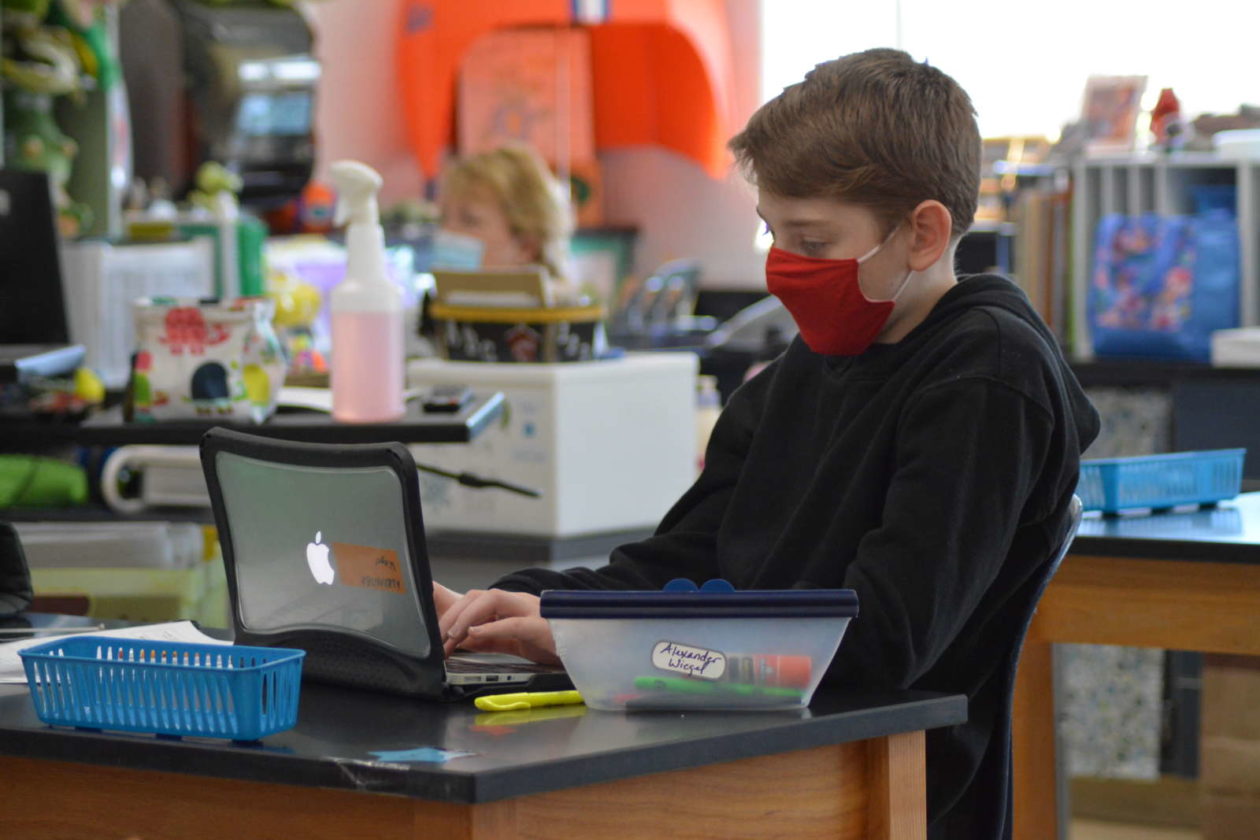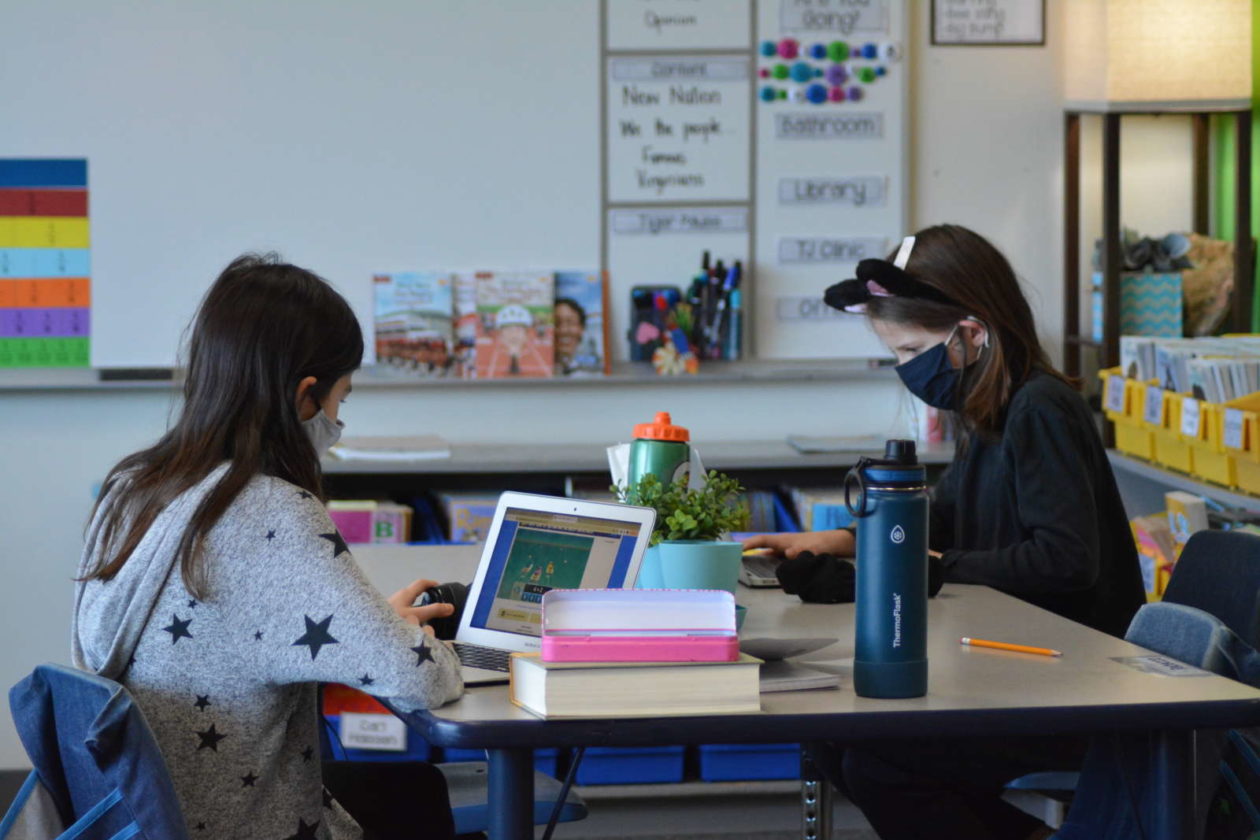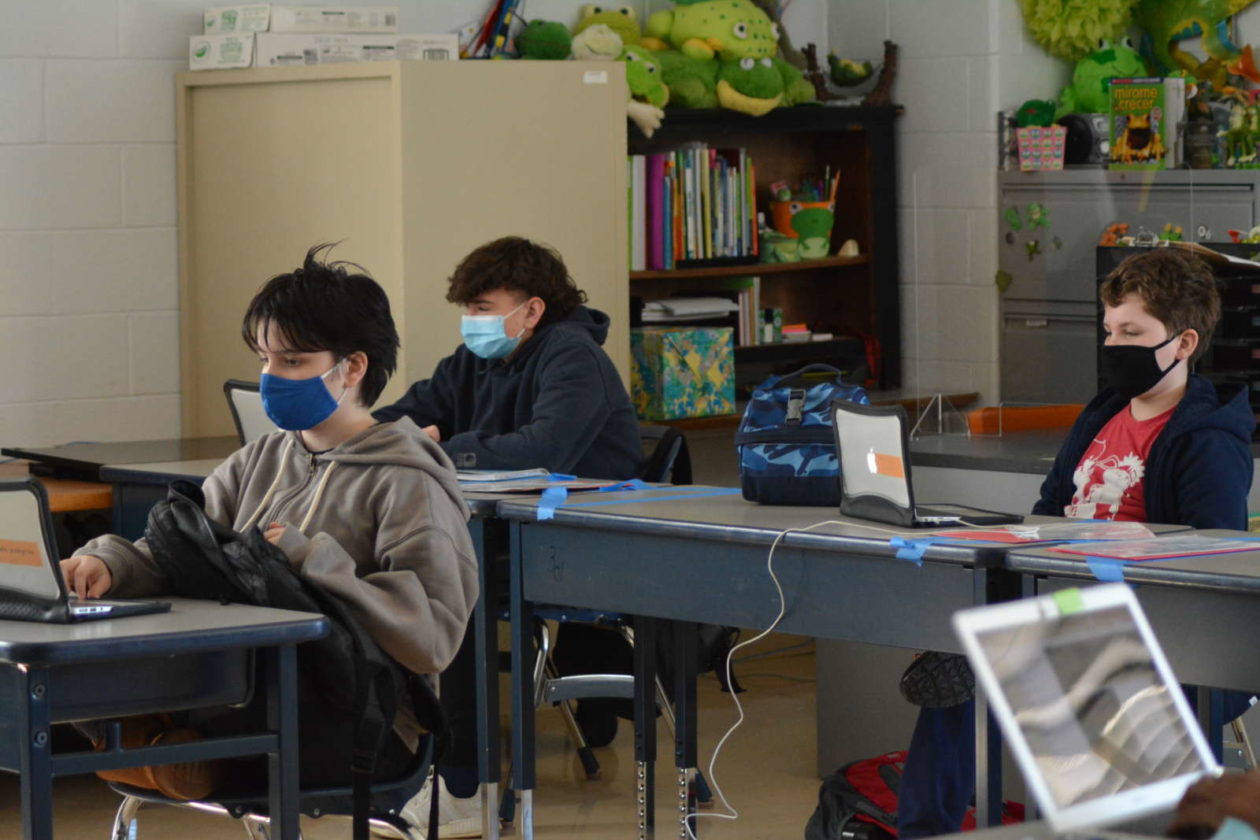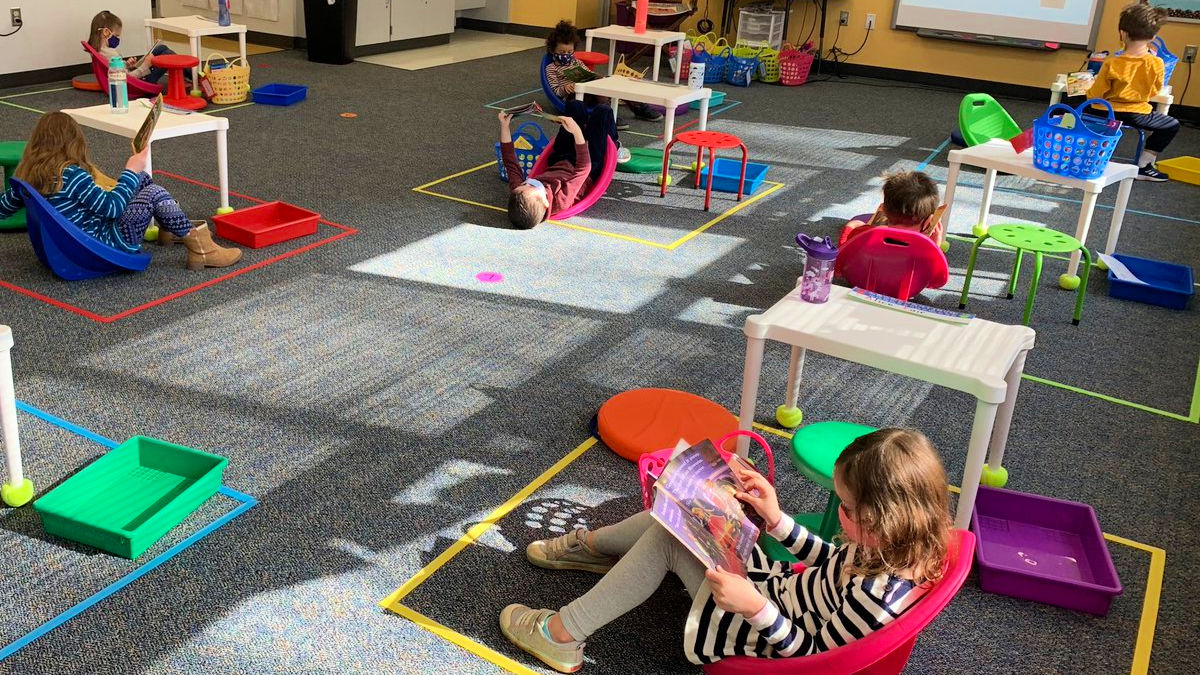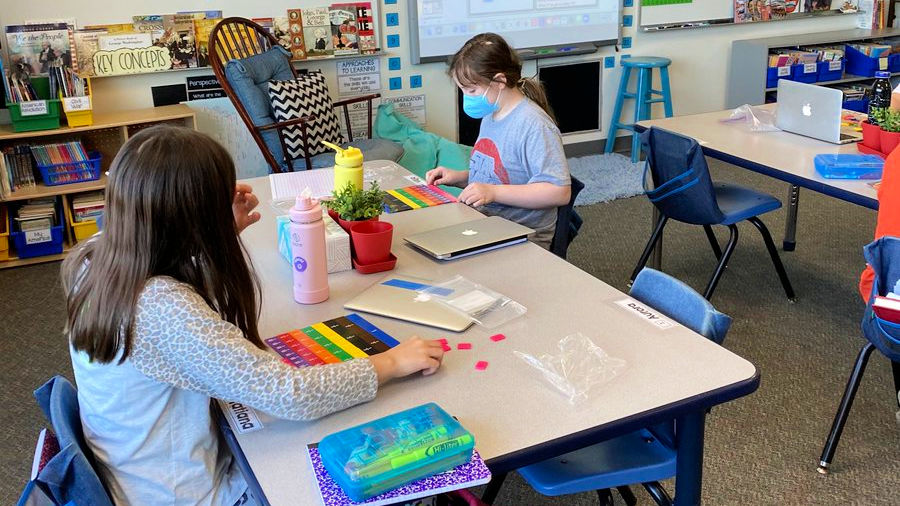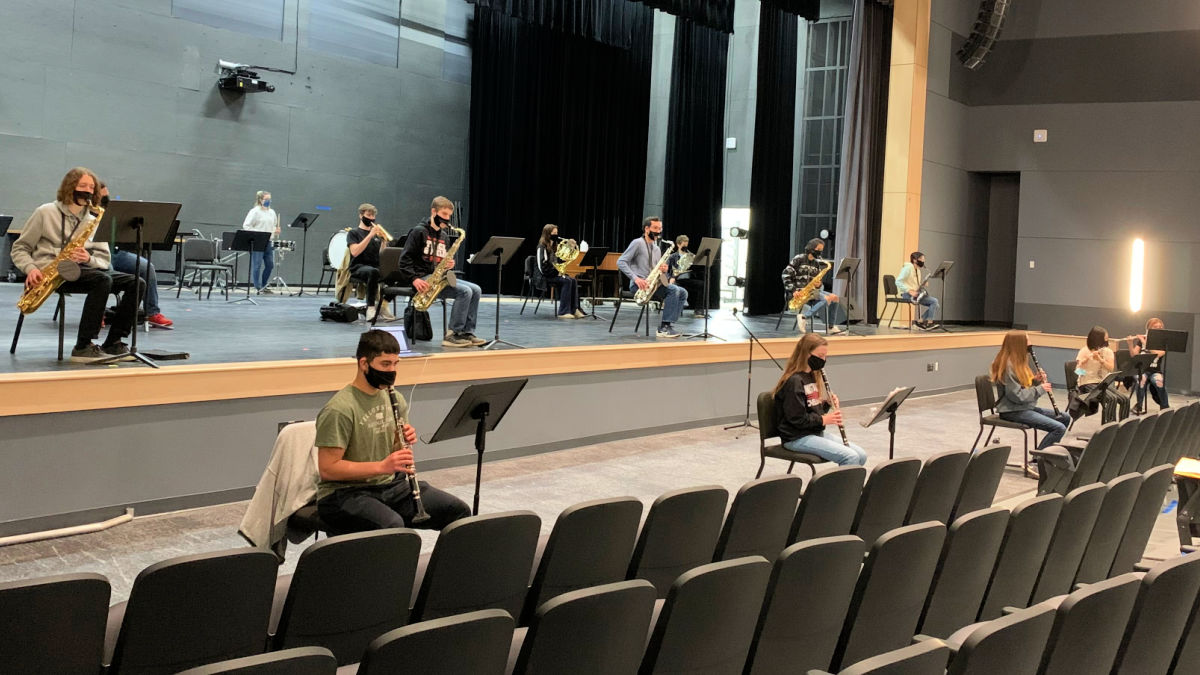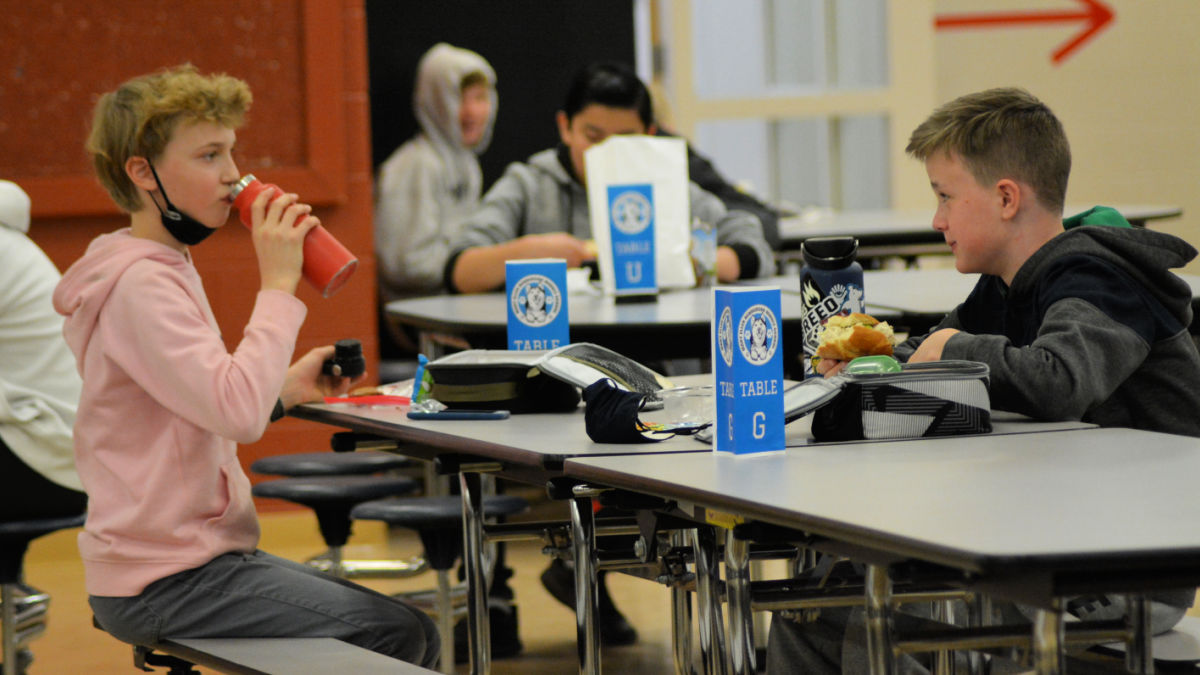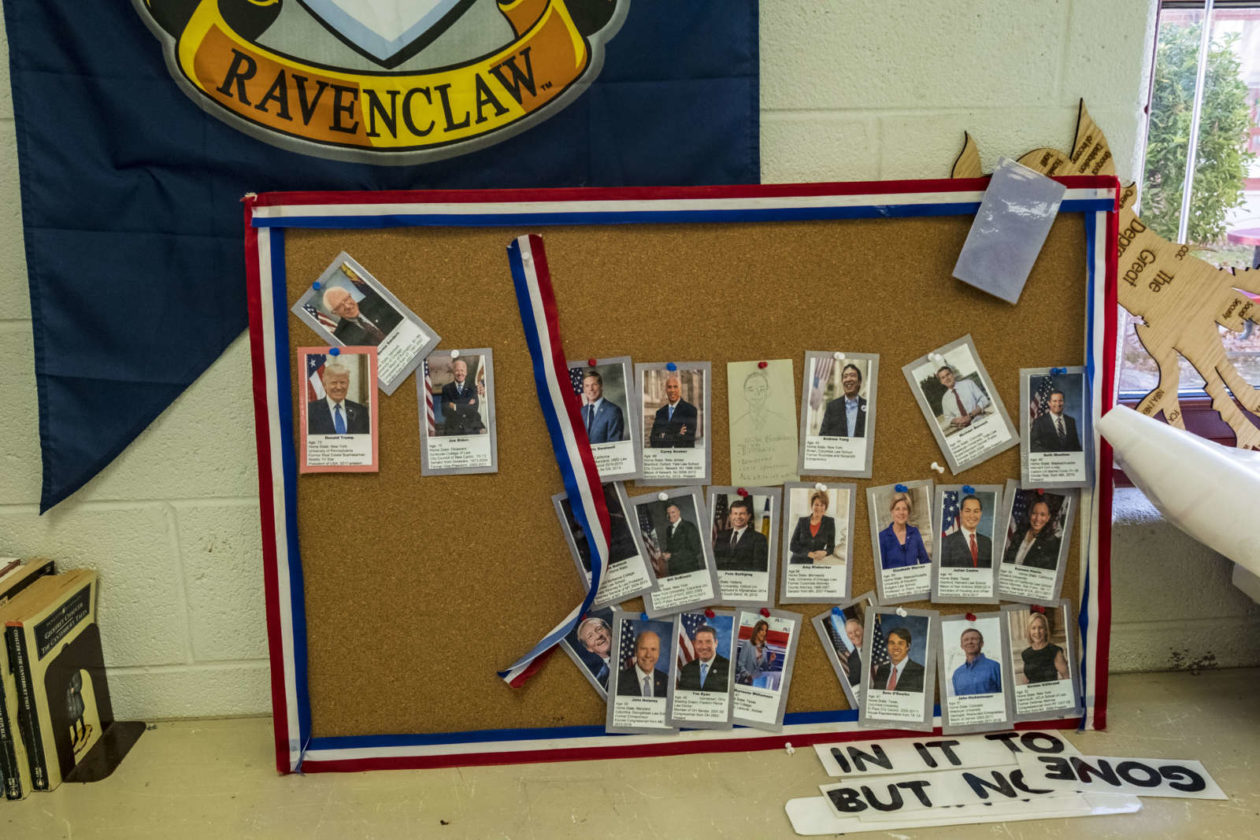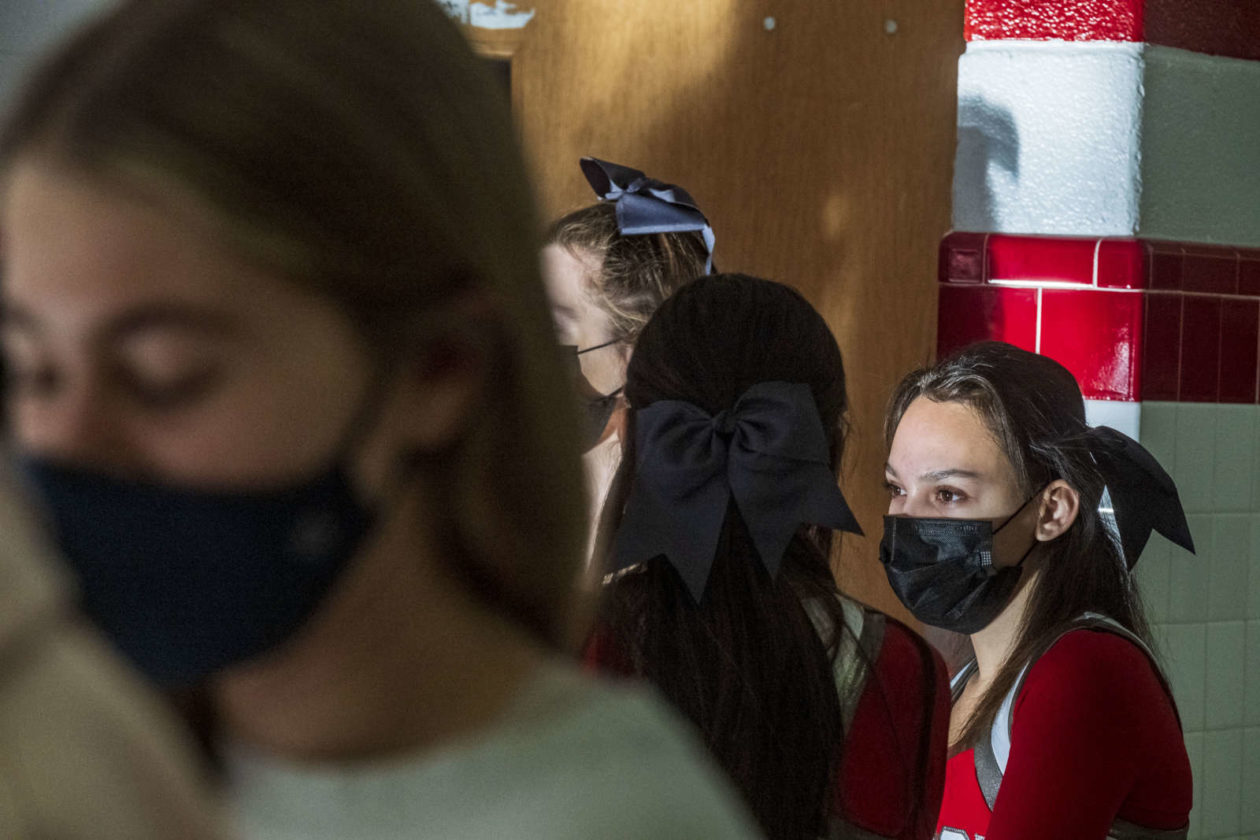

The City of Falls Church’s plan to reopen school buildings remains on track, and some students could be learning in-person full-time after spring break, which runs from March 29 to April 2.
Like their Fairfax County peers, Falls Church City Public Schools students currently have the option of going into school twice a week or taking all-virtual classes. Students getting special education services and children in the Virginia Preschool Initiative are in-person four days a week.
“It’s been quite a couple of weeks,” FCCPS Superintendent Peter Noonan said during a school board meeting Tuesday night (March 9).
Unlike Fairfax County, though, Falls Church has announced plans to potentially let some students attend in-person classes five days a week in the near future.
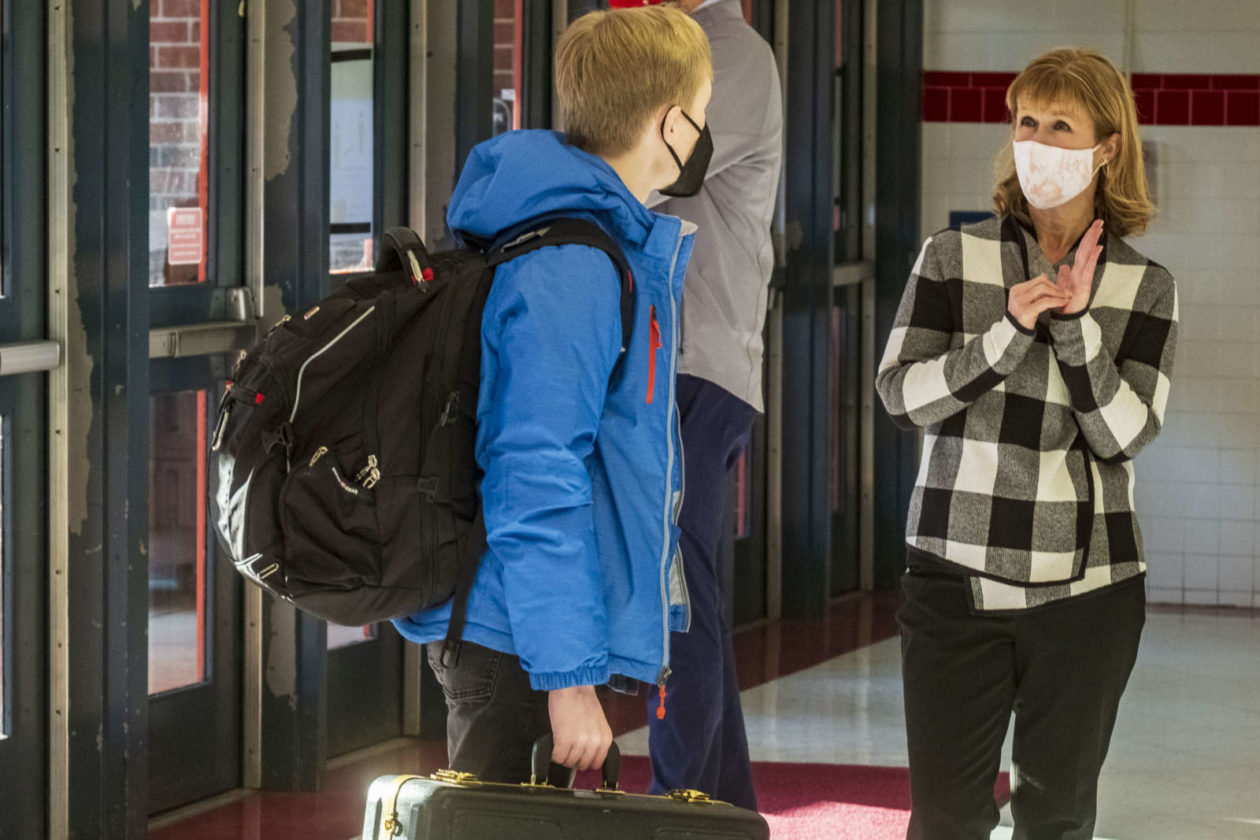
Staff at Jessie Thackrey Preschool and Thomas Jefferson and Mount Daniel elementary schools have started planning for a return to full-time, in-person instruction on April 6. Classes will be led by teaching staff members who have been fully vaccinated.
FCCPS spokesman John Wesley Brett said, on that day, both elementary schools will return to the “pre-pandemic” schedule of 8:50 a.m. to 3:50 p.m., including the usual early release at 1:15 p.m. on Wednesdays.
“Each school will implement mitigation procedures and work to ensure that continuity of instruction is provided,” he said. “Parents may opt to have their child remain in a virtual model and have until March 15 to make their choice known.”
FCCPS also hopes to eventually expand full-time, in-person learning to secondary students, but planning is more complex, Noonan said.
FCCPS is also in the process of reviewing new guidance on school reopenings that the Virginia Department of Health and Virginia Department of Education released on Tuesday.
“There is a growing chorus from VDH and VDOE to get our students back in school sooner rather than later,” he said. “That’s something I think we can all agree with, and it’s something we all want.”
The VDOE advises schools to weigh the risks of not opening schools over concerns that 100% of COVID-19 risks cannot be mitigated.
“Long-term school closures as a mitigation strategy for COVID-19 transmission may cause inadvertent harm to children,” the guidance said. “For example, children who do not have in-person instruction may suffer learning loss with long-term effects, mental health issues, or a regression in social skills.”
FCCPS could move forward more quickly if it follows the lead of other school systems across the nation that have reduced social distancing requirements from six feet to three feet, argues Courtney Mooney, a parent who has been advocating for five days a week of in-person instruction as part of the group Falls Church City Parents for Schools.
Mooney noted that the six-feet rule is not universally agreed upon by scientists and health experts. For instance, the World Health Organization recommends physical distancing of at least one meter — or three feet — after a study it funded found that would be sufficient to significantly reduce the risk of infection by the novel coronavirus.
“I think Superintendent Noonan wants our kids to be back,” Mooney said. “FCCPS needs to continue actively engaging parents and providing the level of detail they’ve provided the last two weeks.”
She credited FCCPS for responding to what she described as mounting frustration and declining trust among parents. As more details are released, parents are trusting the planning process more, she said.
Noonan has also incorporated parents, teachers, staff and community representatives into a newly formed Reopening Advisory Group that met for the first time this week, Mooney said.
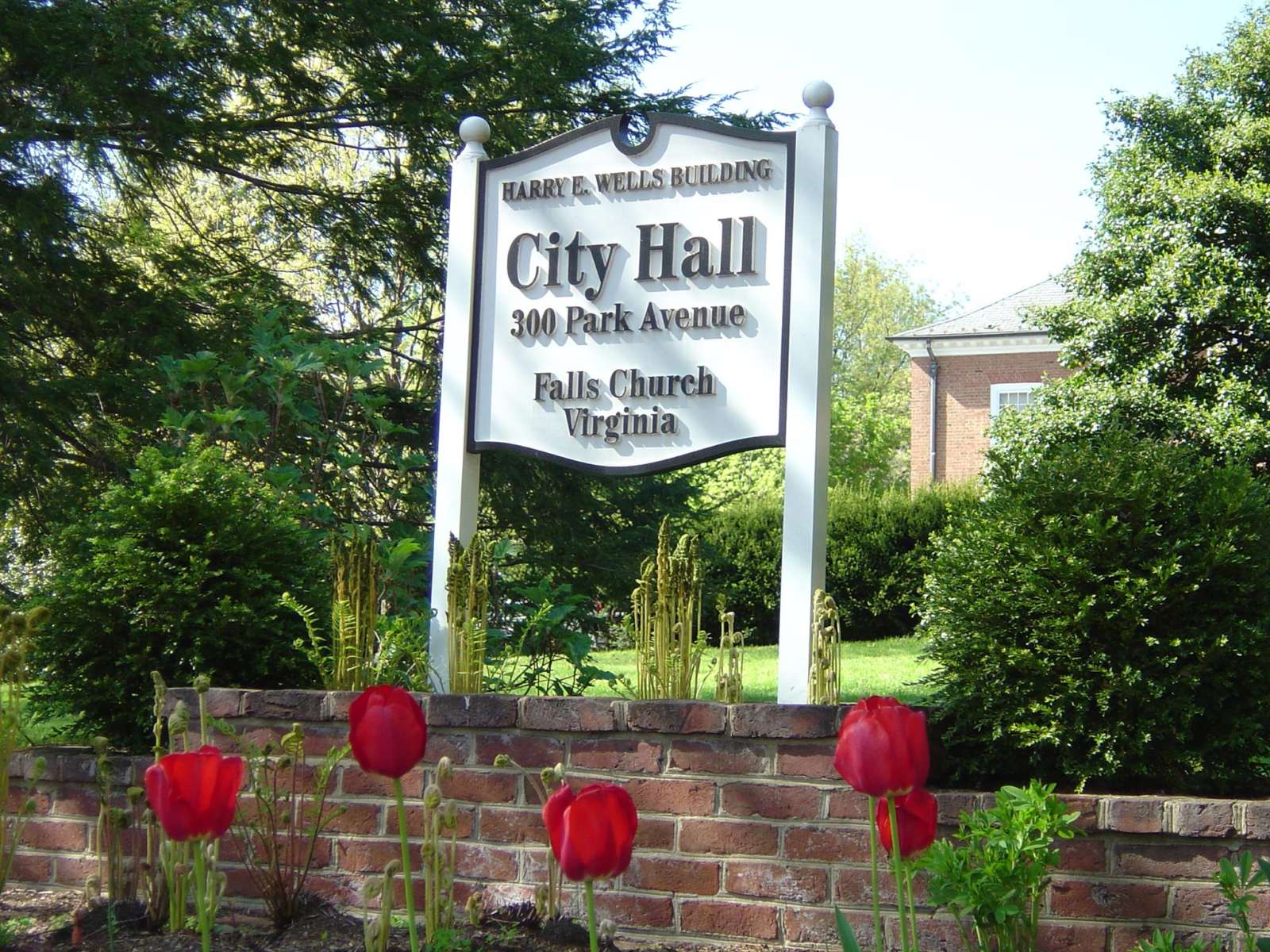
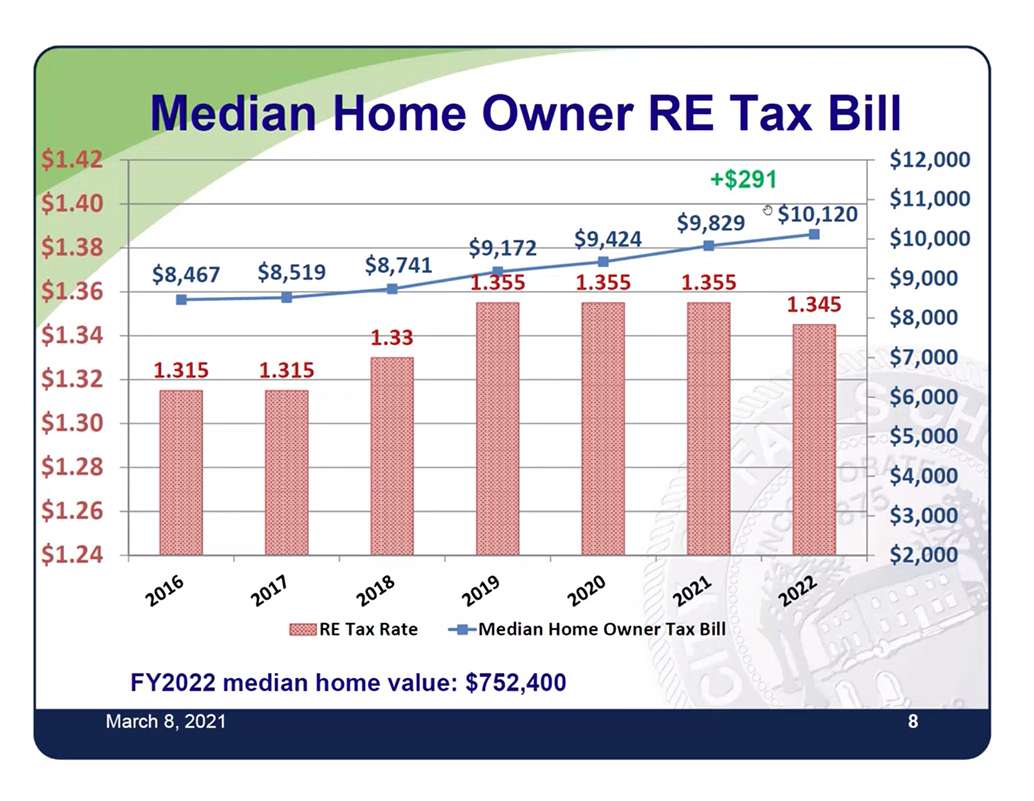
Following in the footsteps of his Fairfax County counterpart, Falls Church City Manager Wyatt Shields is proposing a one-cent reduction in the real estate tax rate as part of the city’s advertised fiscal year 2022 budget.
However, because of rising assessed values, the average homeowner will still experience a $291 increase in their tax bill next year.
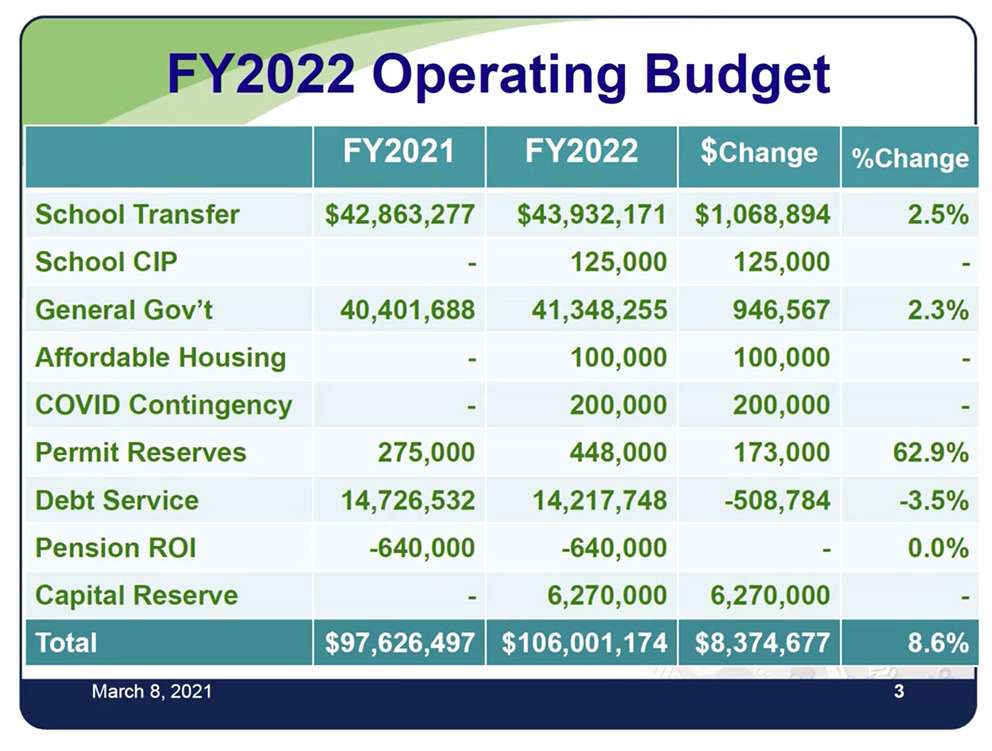
Presented to the city council on Monday (March 8), the advertised budget increases city government operating expenses by 2.3% (or $946,567) and public schools funding by 2.5% (or just over $1 million).
“With vaccines rolling out, and springtime in the air, we need to maintain vigilance but certainly have optimism toward the future — and hopefully, this budget reflects that as well,” Shields said.
Falls Church City School Board Chair Shannon Litton called the proposed $1 million funding increase for FCCPS “a bit better than we expected, given COVID-19.” The school division will also be receiving an additional $20,000 from the state and $31,000 from the federal government, she said.
Shields said the budget keeps revenues in line with forecasts from December without proposing a larger increase on residential real estate taxpayers. The city saw year-over-year increases in taxes on groceries and online sales, but a large decrease in revenue from hospitality taxes.
Highlights of the budget include funding for:
- $145,000 for body-worn cameras and civilian positions to support the department, which is a first step in addressing recommendations from the Use of Force Review Committee
- $200,000 in coronavirus contingency funds to address uncertainties, either revenue shortfalls or increased demand for services and assistance
- $150,000 to develop a Parks Master Plan
- $100,000 for the Affordable Housing Fund to supplement the $3.75 million Amazon REACH grant funds and leverage future developer contributions.
Shields has also proposed increasing stormwater management rates by 2%, or $4, for a median homeowner to pay for projects intended to address smaller-scale nuisance flooding. He anticipates that the city will need to increase rates by 10 to 15% for the next five years to fund six larger-scale stormwater management projects.
The advertised budget gives Falls Church City employees a 3% merit compensation increase, and a 3.5% step increase to uniformed police staff, but Shields told the city council on Monday that this small-scale growth is not sustainable in the long-term.
“My budget guidance for six years in a row was to keep non-personnel expenses flat,” he said. “So, it is really important to emphasize that after six years in a row of doing that — in addition to cuts made last year due to COVID-19 — our budgets are extremely lean.”
The city has about $3.94 million in unfunded needs across all departments, he said. These range from adding positions, including police officers, IT staff, and economic development staff, to maintaining public amenities, such as basketball and tennis courts and athletic fields.
Other highlights include:
- A $500,000 decrease in debt service, as due to the cancellation of planned debt issuance during the current fiscal year and refunding prior bonds from 2013 and 2011 at lower interest rates.
- A $4.5 million transfer from the 10-acre land at the George Mason High School campus to capital reserves.
- Anticipated concessions from Founders Row for $1.8 million, which will also be placed in capital reserves.
In addition to flood mitigation, other public safety spending includes investments in sidewalks, paving — which Shields said has been underfunded since the Great Recession — and neighborhood traffic calming activities. State grants will pay for improvements to the Park Avenue “Great Streets” project, the Oak Street Bridge and the Washington and Columbia intersection.
The city will also receive funding through the Biden administration’s American Recovery Act.
“That congressional aid [is] needed and necessary, and we will use it very well for infrastructure and capital needs,” Shields said.
Community members will get a chance to learn about the budget and share their comments at a town hall from noon to 1:30 p.m. on Thursday (March 11). Budget meetings will be held on March 22 and April 12, and there will be a second town hall on April 15 before the city council is slated to adopt the budget on April 26.
Photo via City of Falls Church Government/Facebook, charts via City of Falls Church
Fairfax County’s COVID-19 inoculation efforts are about to get a major boost in the form of a new mass vaccination site that’s expected to open by the end of March.
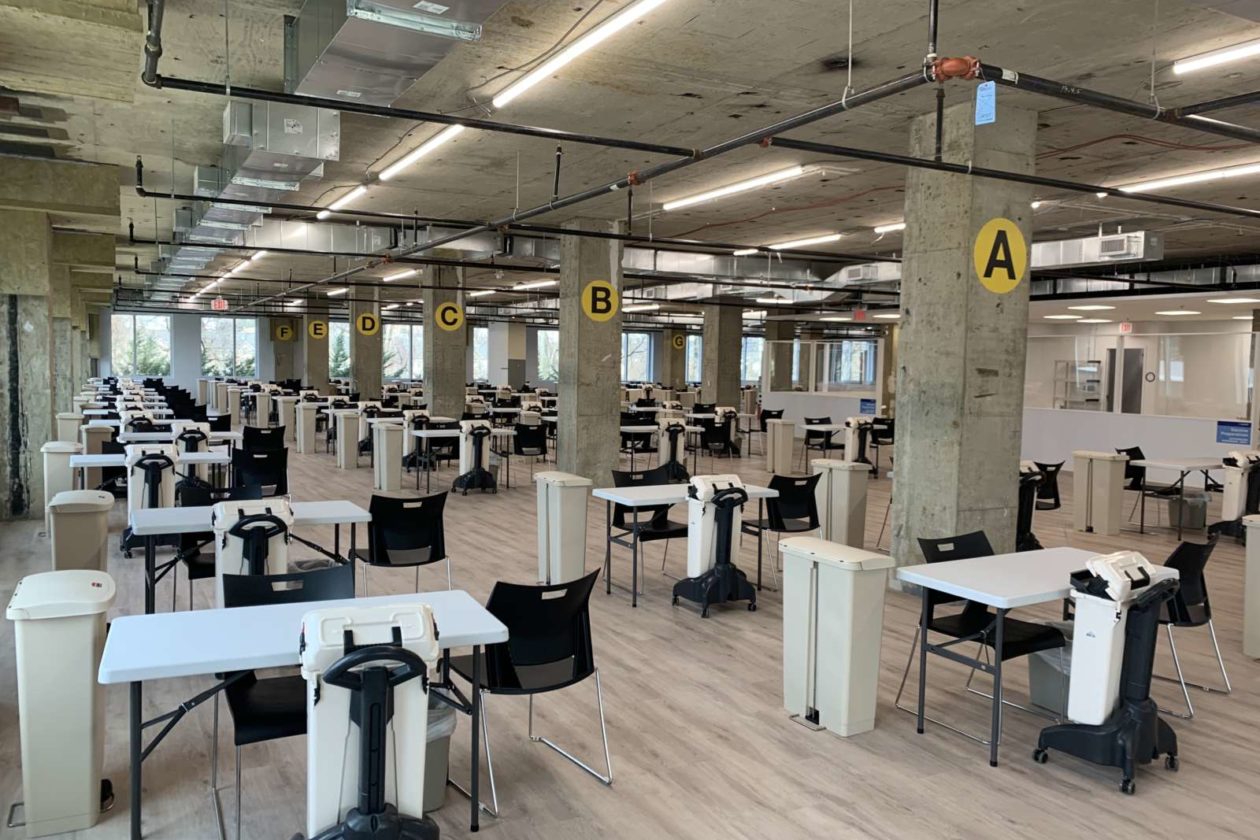
The county is collaborating with the City of Alexandria and Inova Health Systems to convert Alexandria’s Victory Center (5001 Eisenhower Avenue) into a mass vaccination center that could accommodate thousands of people looking to get the COVID-19 vaccine.
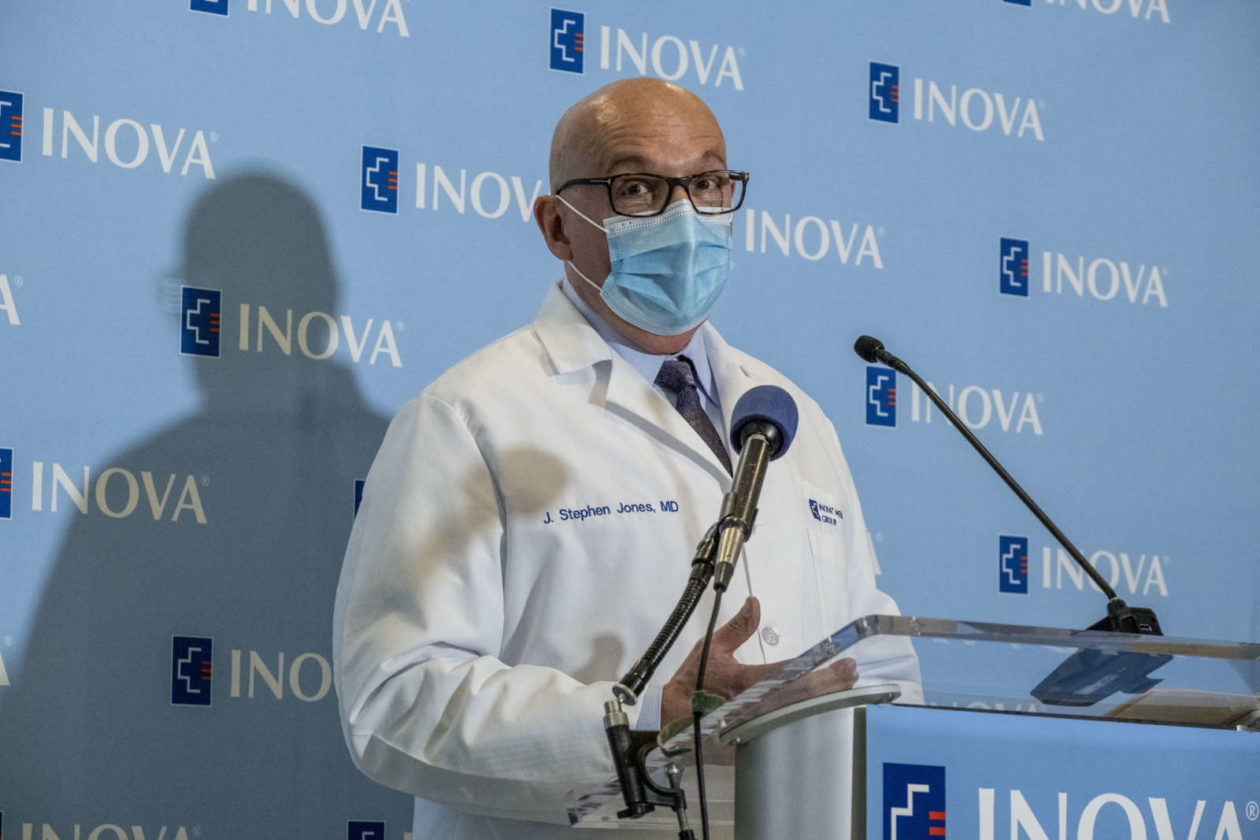
At a press conference yesterday (Tuesday), Inova President and CEO Dr. Stephen Jones said that, depending on the availability of supplies, the planned facility could enable the healthcare system to dispense 6,000 vaccine doses per day, doubling its current rate of roughly 3,000 doses a day.
“I feel a responsibility to get as many people vaccinated as possible,” Jones said.
Once it opens, the vaccination center will serve residents of Alexandria and Fairfax County. Eligible individuals must pre-register to get in line for an appointment either through the Fairfax County Health Department or, for non-county residents, the state registration system.
According to its website, Inova is currently assisting Fairfax County with eligible adults between the ages of 65 and 74, but it has also served essential workers, including Fairfax County Public Schools teachers.
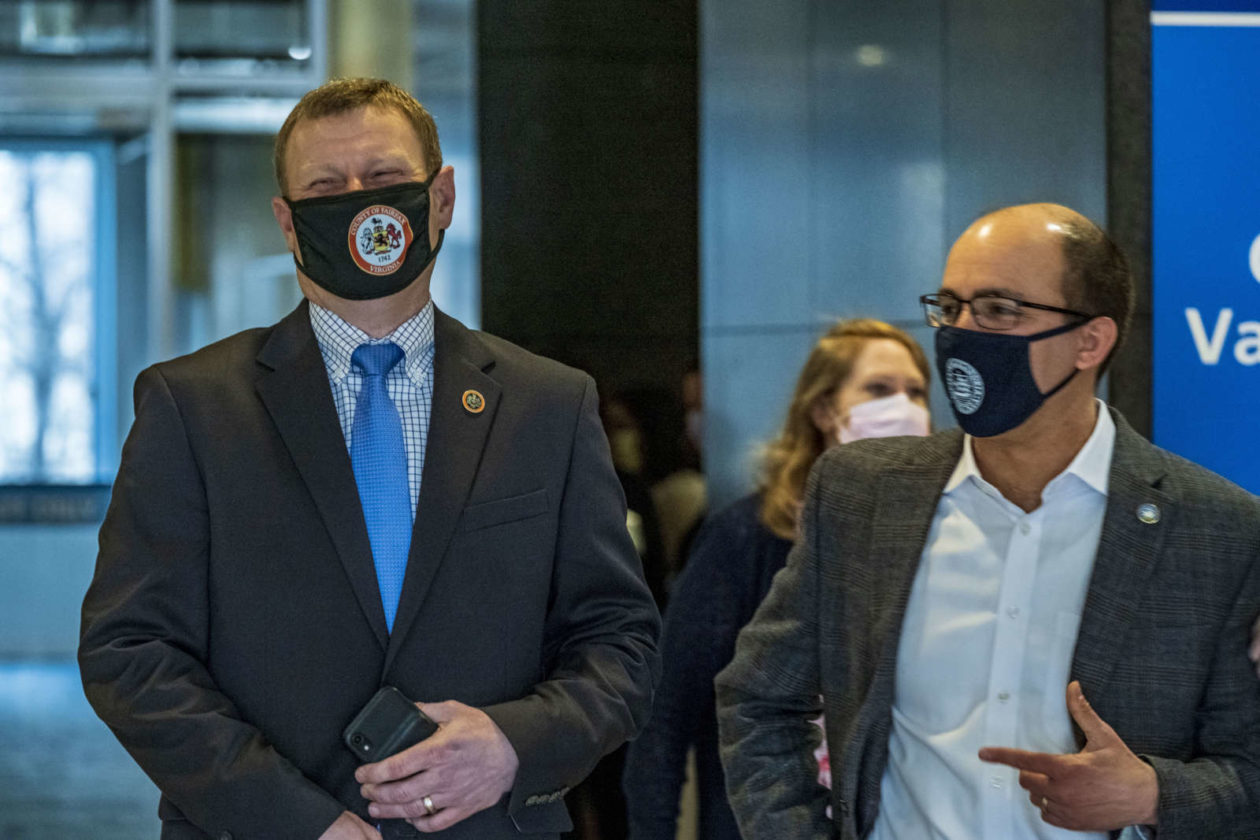
While the pace of vaccinations continues to be limited by supply availability, Fairfax County Board of Supervisors Chairman Jeff McKay says the addition of the Victory Center as a vaccination site will ensure the county and Inova can keep up as more vaccines start to come in.
According to the county’s vaccine data dashboard, Fairfax County’s latest shipment from the Virginia Department of Health included 19,220 doses for the week of March 1-7, a step up from the 13,000 doses that the county was typically getting just a few weeks ago.
As of 5:30 p.m. yesterday, there were more than 106,000 people on the FCHD waitlist. 298,332 people have registered to get a COVID-19 vaccine through the county health department, which has allocated 217,476 doses either by administering them itself or distributing them to partners like Inova.
“We were told by the [state] to expect a major increase in doses in the coming weeks,” McKay said. “We want to have the infrastructure to take care of those doses. We can’t control the dosage, but what is in our control is capacity.”
Inova chose the Victory Center in Alexandria for its mass vaccine clinic because of the building’s size and proximity to local transit facilities, including the Van Dorn Street Metro station.
The accessibility of the COVID-19 vaccine has been a top concern for Fairfax County in recent weeks, as health officials say the populations most affected by the pandemic have faced more challenges in getting vaccinated, often due to vaccine hesitancy or limited access to transportation, internet, and other services.
The county has been working to expand its partnerships with other localities, healthcare providers, and community organizations to reach different communities, though the process has not been entirely conflict-free.
McKay encourages everyone who is eligible to get the vaccine to take advantage of any chance to do so.
“This is an act of necessary charity,” McKay said. “It’s not about us, but about every person we interact with, like grocery store workers, transit workers, your children and their teachers…This gives us a convenient opportunity to do the right thing.”
Vernon Miles contributed to this report.
A year ago yesterday (Sunday), Virginia’s first COVID-19 case was reported in Fort Belvoir when a U.S. Marine tested positive for the virus.
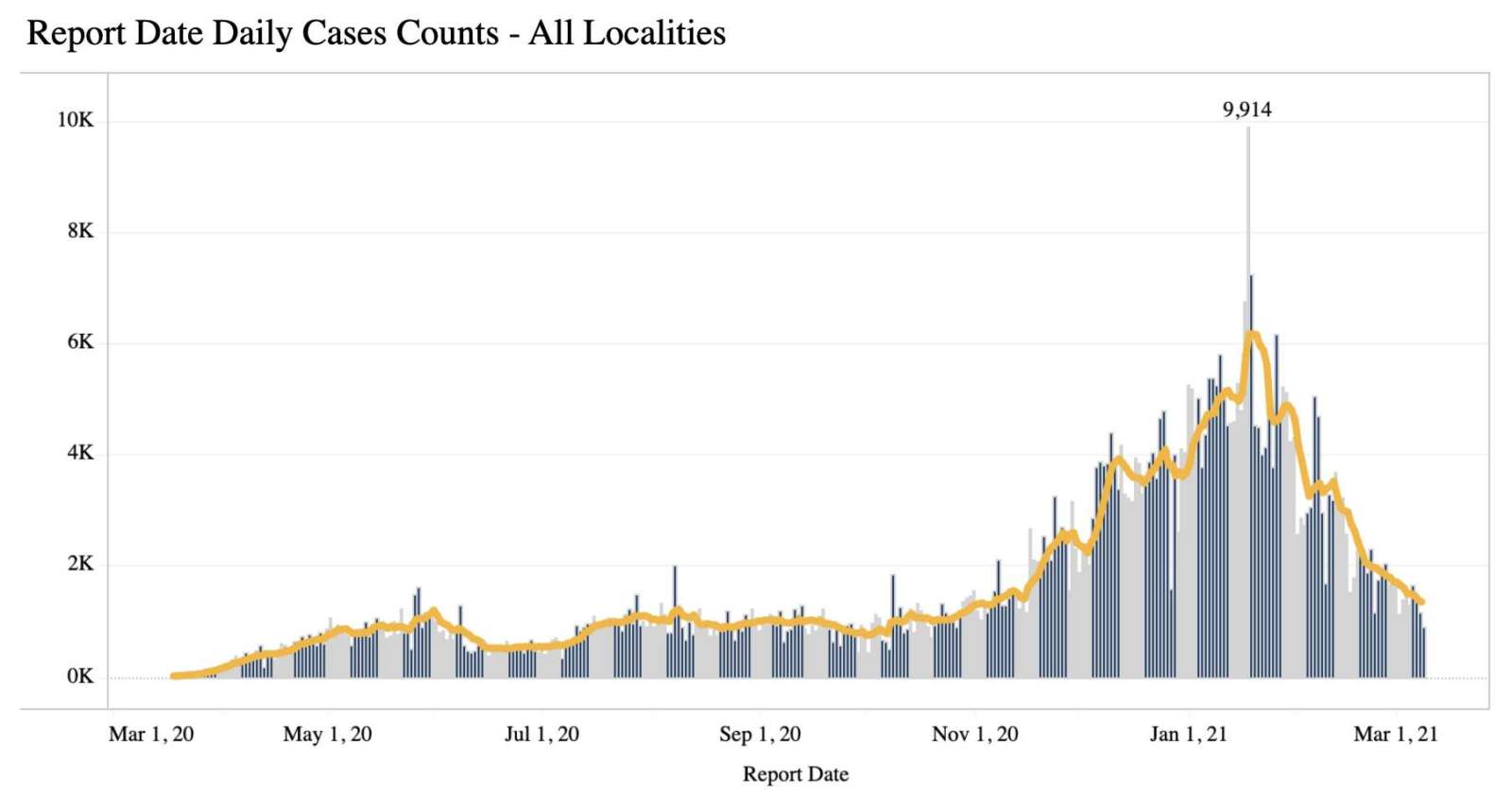
Since then, the Fairfax Health District has recorded 68,680 COVID-19 cases. The death toll now sits at 1,036 people, and 3,617 people have been hospitalized due to the novel coronavirus.
Still, in a hopeful trend, the case rate in Fairfax County has continued to fall after peaking on Jan. 17. Just today, the county reported 127 new cases today — a substantial dip from the all-time high of new cases — 1,485 in a single day — in January.
The weekly case average of reported cases has fallen to the lowest levels since Nov. 8 last year, when the weekly case average was 153. As of today, the weekly case average rested at 159.6.
The decrease comes as the Fairfax County Department of Health picks up its vaccination pace. After several weeks of scheduling for people who pre-registered on Jan. 18, the county has begun scheduling appointments for people who registered on Jan. 19.
Last week, the county vaccinated 21,791 people, a pace that has remained relatively stable since vaccinations began earlier this year.
Still, 108,883 people — 37 percent of the total number of people registered — remain on the county’s waitlist. Overall, the county has received 193,742 doses from the Virginia Department of Health and administered or distributed 193,878 doses. 93,560 people in Fairfax County have been fully vaccinated, according to VDH data.
The county has currently only deployed the Pfizer and Moderna vaccines.
Local health officials are evaluating how many Johnson & Johnson doses it will receive, how many doses will be allocated in clinics, and how much will be allocated to the county’s health partners. Last week, the state health department announced that it expects to receive 69,000 doses on a weekly basis.
Images via CDC on Unsplash, Virginia Department of Health
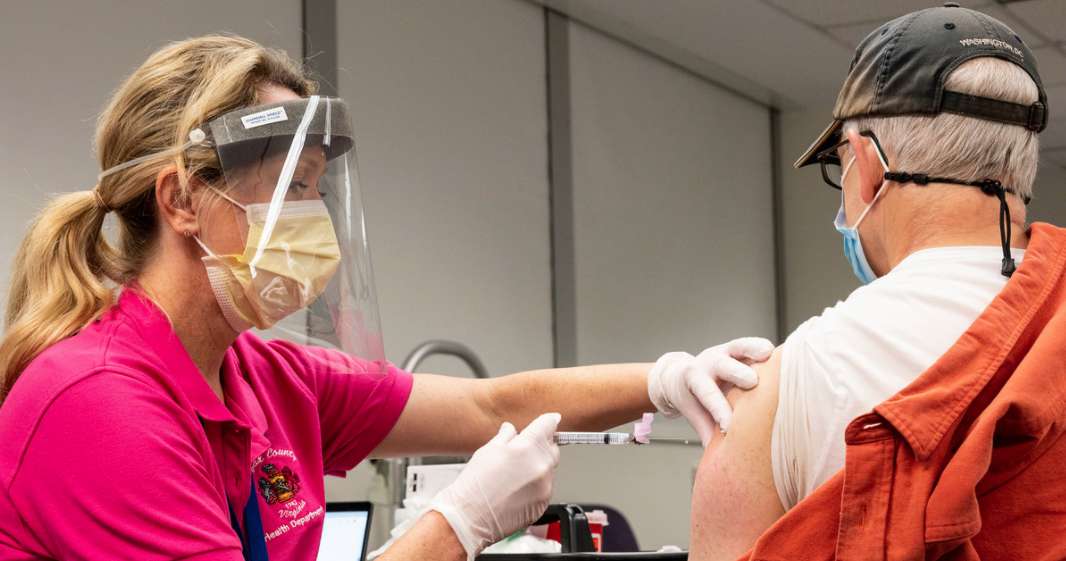
Thanks to federal and state partnerships, some local retail locations of CVS, Walgreens, Safeway, and Harris Teeter are offering no-cost vaccine appointments separate from Fairfax County.
However, with demand far exceeding supply, appointments remain extremely hard to come by, even as the one-dose Johnson & Johnson vaccine begins to roll out.
Virginia is currently in Phase 1b, meaning those 65 or over and those with 16 to 64 with underlying medical conditions are eligible to receive the vaccine.
The Virginia Health Department tells Reston Now, Tysons Reporter’s affiliate site, that more than 80,000 doses are being given to retail pharmacies statewide for distribution, an increase from last month.
The 69,000 J&J vaccine doses announced last week started coming in yesterday (Mar. 4), VDH confirms, and clinics across the state are expecting to start using it today (Friday).
VDH also says that they’ve directed retail pharmacies to “prioritize” those 65 and over to “make significant progress in vaccinating that vulnerable population.” All of this provides hope that more vaccines and more appointments will soon become available for those that are eligible.
Early last month, CVS began offering vaccine appointments at local stores. Currently, it is providing the vaccine through 41 pharmacies in Virginia with appointments booked through their website, but that includes only one location in Fairfax County.
CVS spokesperson Amy Thibault says there are roughly 41,580 appointments per week available at the 41 locations statewide, meaning each store has about 1,000 appointments per week. Most of them are using the Moderna vaccine.
However, as of today, all appointments have been booked at the one Fairfax location.
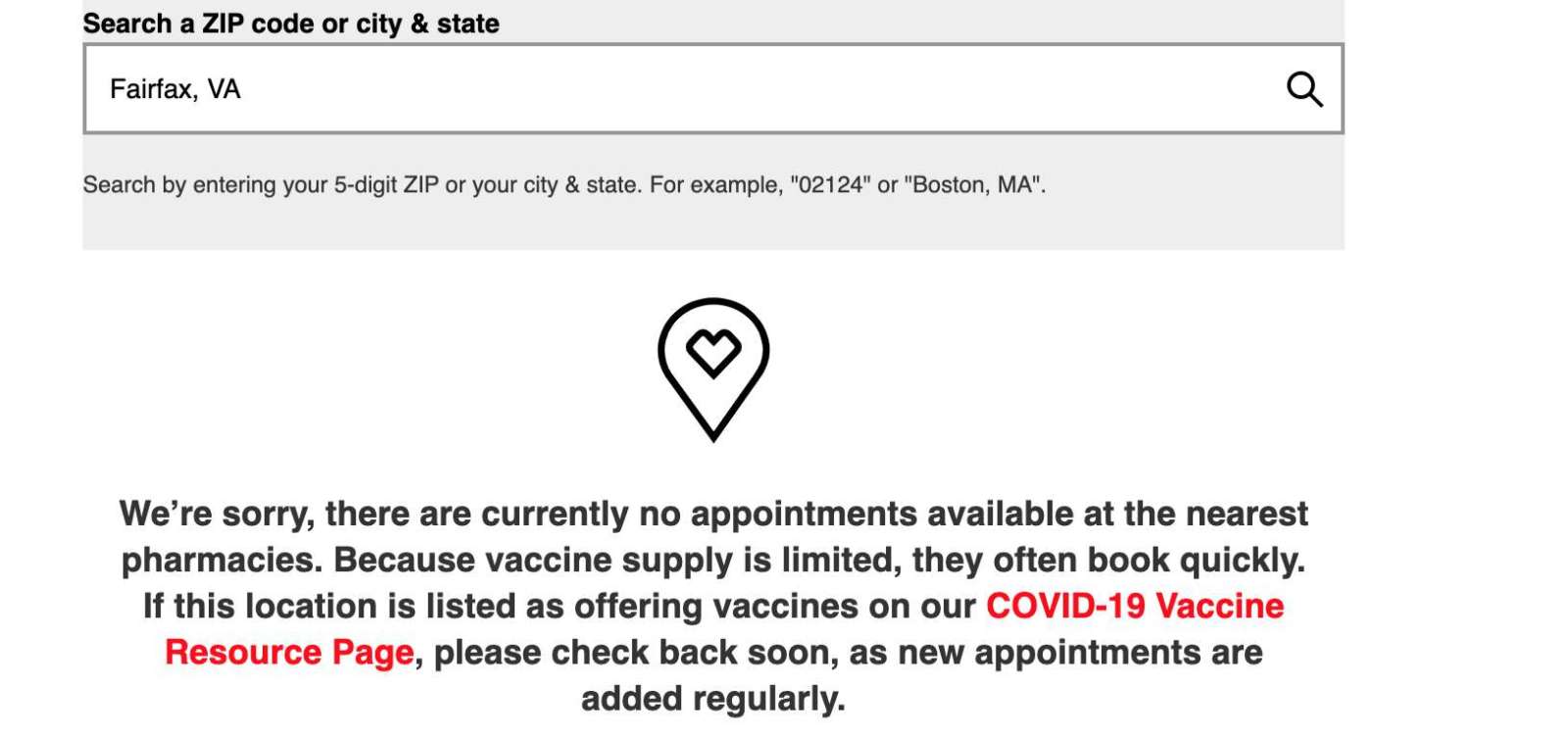
“In most (if not all) states, the number of individuals who are eligible to receive the vaccine under the state’s rules far outnumber the state’s available doses,” Thibault said.
Currently, more than 100,000 people are on the Fairfax County Health Department’s waitlist. As of Mar. 4, close to 150,000 people in Fairfax County have gotten at least one vaccine dose, and 87,401 people have been fully vaccinated, according to the VDH data dashboard.
Thibault confirmed that CVS is receiving a “one-time allocation” of 212,000 doses of the Johnson & Johnson vaccine this week that will be sent to stores in 17 states. Scheduling for that began yesterday (Mar. 4) on the CVS website, with vaccinations starting today (March 5).
She says CVS has the capacity to administer 20 to 25 million doses a month nationwide, assuming there’s an adequate amount of not only the vaccine, but also other supplies.
Other retail pharmacies offering vaccines in Fairfax County face similar challenges.
Safeway and its parent company Albertsons are offering appointments to those 65 and over. According to their online scheduler, the one-dose Johnson & Johnson vaccine is now being offered.
Locations in the county include one on Elden Street in Herndon, South Lakes Drive in Reston, Georgetown Pike in Great Falls, and West Ox Road in Fairfax.
So far, no appointments are currently available at least through March 13 at any locations.
“Store supply is based on allocations from state and local health departments. New appointments are added to the online scheduler as more vaccine become available,” Albertsons spokesperson Andrew Whelan told Reston Now. “Demand is high and appointments are often claimed very quickly. As dose allocations increase, so too will the opportunity to secure an appointment.”
Walgreens joined the federal partnership on Feb. 24 and has started administering vaccines in Virginia. But, right now, there are no appointments available within 25 miles of Tysons, Reston, or Fairfax.

Harris Teeter’s website says limited quantities of vaccine would be available at select locations in Virginia starting on Mar. 1, but a company spokesperson told Reston Now that this hasn’t happened yet.
“Harris Teeter is expected to receive limited quantities of the vaccines soon at nine pharmacies in and around Northern Virginia…Appointments will be released as vaccine allocations arrive,” the spokesperson wrote.
Giant has taken another approach. Instead of creating its own appointment system, the grocery chain is using the vaccine supply allocated to them by the federal government to help the Fairfax County Health Department vaccinate their waitlist.
“People invited from the queue will be able to select from several Giant locations within the Fairfax Health District,” the health department said on its blog. “Locations and details will be included in the appointment scheduler email.”
Photo via Fairfax County Health Department
Updated at 5:25 p.m. — Inova Health Systems does not conduct credit checks when people looking to schedule a COVID-19 vaccine appointment create an account on its MyChart patient portal, a spokesperson told Tysons Reporter.
The spokesperson clarified that Inova does an identity verfication check to ensure that patient information is accurate since the healthcare system is working off of the Fairfax County Health Department’s registration queue.
Inova also says that people have the option to upload a photo of their health insurance card, but it is not required to create a MyChart account.
“There’s nothing more important to us than vaccinating as many people as possible, but we need to make sure we’re doing so in a safe, reliable, and secure way,” Inova Chief Communications Officer Tracey Schroeder said, noting that Inova has administered a total of over 186,000 COVID-19 vaccine shots.
Inova says MyChart gives it a way to confirm patient identities and report data on COVID-19 vaccinations to the Virginia Department of Health as required by the state.
Earlier: While Fairfax County has smoothed out many of the issues that plagued the early rollout of its COVID-19 vaccine registration system, frustrations have now emerged around a key partner in the county’s vaccination efforts: the Inova Health System.
Eligible Fairfax County residents can get in line for a vaccine appointment with Inova by pre-registering through the county’s health department, but to actually schedule the appointment, the healthcare system requires that individuals create an account for its MyChart patient portal, a process that county leaders say is overly demanding in the type of information people are expected to provide.
During a health and human services committee meeting on Tuesday (Mar. 2), the Fairfax County Board of Supervisors urged county staff to work with Inova to address concerns about its scheduling process, which Providence District Supervisor Dalia Palchik said seems to be “a bit more intrusive in their questions.”
“If you go through the county, it’s a beautiful process at this point. If you go through Inova, it is very troubling,” Dranesville District Supervisor John Foust said. “Some people are refusing to go through that process, and that just puts it back on our health department to try to figure out what to do with those people, so something needs to be done.”
To create a MyChart account, users must undergo a credit check and upload a photo of their health insurance card, which could be challenging for people who don’t have a smartphone or are inexperienced with using that technology. (Correction: Inova says that it conducts a patient identity check, not a credit check, and that the option to upload a photo of a health insurance card is not mandatory)
The sign-up form also asks for the last four digits of the applicant’s social security number, though an astrisked note clarifies that it is not required.
According to Inova, this information is requested to verify patients’ identities, and it has no impact on a person’s insurance or credit score.
“MyChart provides for a more reliable registration system and a more consistent patient/user experience,” Inova said in a statement to Tysons Reporter. “Use of MyChart helps us to better manage appointments, vaccine supply, and to provide more accurate data to the [Virginia] Health Department. It also enables same day scheduling — which the health department’s system does not — so if there are cancellations, someone can fill that vacant slot.”
Inova says it has been modifying the registration and scheduling process based on user feedback.
“Maintaining a positive patient experience is important to us,” Inova said. “We’ve been listening to feedback and making changes to streamline the registration process while also balancing the imperative to verify patient identify and protect personal medical information.”
The Fairfax County Health Department confirmed that it is working with Inova to resolve these concerns.
Inova is currently assisting the county in vaccinating residents between the ages of 65 and 74. The healthcare system has also hosted clinics for eligible essential workers, including public school teachers and staff, and emergency first responders.
The county health department has emphasized that people should not let questions about health insurance deter them from getting vaccinated, stating that the COVID-19 vaccines are free but some providers will ask for the information in order to collect administrative fees from the insurance company.
Fairfax County leaders fear that confusion stemming from differences in the registration and scheduling process used by various providers could make administering the COVID-19 vaccine more difficult.
“We are already hearing from people that proof of medical insurance or proof of residency or citizenship are being required,” Board of Supervisors Chairman Jeff McKay said at Tuesday’s committee meeting. “Frankly, my opinion is we shouldn’t be partnering with folks who have to do that deep of a probe or else we’re building even more hesitancy problems in the future.”
Photo via Google Maps

Hispanic residents of Fairfax County are seven times more likely to die from COVID-19 than their white, non-Hispanic counterparts when adjusted for variations in age, county data suggests.
Fairfax County Director of Epidemiology and Population Health Dr. Benjamin Schwartz reported that sobering trend to the Fairfax County Board of Supervisors during its health and human services committee meeting yesterday (Tuesday) as part of a broad overview of the county’s efforts to implement an equity-focused strategy to distribute COVID-19 vaccines.
Knowing that the pandemic has disproportionately affected communities of color, especially Black, indigenous, and Latino people, Fairfax County staff calculated the relative risk levels for infection, hospitalization, and death faced by different races and ethnicities, using white, non-Hispanic individuals as the control group.
According to the county, the results show that the risk of contracting COVID-19 is 1.8 times greater for Black people than for white people and four times greater for Latino or Hispanic people, who are also seven times more at risk of hospitalization.
In Fairfax County, Black people are being hospitalized at more than three times the rate of white people and are almost three times as likely to die from the disease.

Schwartz says the data focuses on community transmission, excluding long-term care facilities, and it has been adjusted for age, meaning it eliminates variances in age across different populations. It shows, for instance, that Latinos are more likely to die from or be hospitalized by COVID-19, even though the county’s Latino population is generally younger and older people are considered more at risk.
“This really highlights the social, economic, and medical risk factors pertaining to different groups in our county,” Schwartz said, mentioning large households, exposures through work, and underlying health conditions among the factors that have made some populations more vulnerable to COVID-19.
Fairfax County Chief Equity Officer Karla Bruce says the county is utilizing its COVID-19 Vulnerability Index as well as data showing the disease’s spread to identify areas that need a targeted approach for vaccine outreach and distribution, often because residents have limited access to medical care, transportation, and other public services.
“There are a lot of intersecting factors which are preventing people’s access to resources or access to the vaccine,” Bruce said. “So, we want to understand and look at how we might be better able to connect people to what will enable them to then connect to the vaccine.”
The county has been working with different community partners, including nonprofits and faith-based organizations, not only to counter vaccine hesitancy with education and trust-building, but also to identify people who are currently eligible to get vaccinated and register them for an appointment.
To improve the accessibility of the vaccine, the Fairfax County Health Department has been developing a network of community-based partner clinics that is expected to grow in the coming weeks, as seen in the slide below:
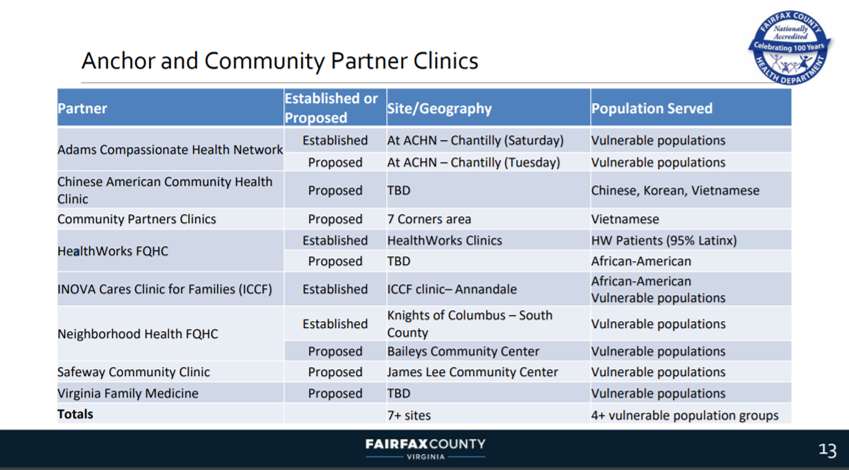
Schwartz says the Neighborhood Health federally qualified health center at the Bailey’s Community Center and the Safeway community clinic at the James Lee Community Center in Falls Church will start administering vaccinations this coming weekend.
The health department is also looking at sites in Lorton, Springfield, and Centreville, but the agreements are still being finalized.
“It will take a couple of weeks to have our clinics established, to confirm medical and non-medical staff for those clinics, and to get into a rhythm with the vaccinations,” Schwartz said. “But we are anticipating making substantial progress to reduce disparities in who receives vaccination in the county.”
Photo via Fairfax County, slides via Fairfax County Health Department (1, 2)
On Tuesday (Mar. 2), about 25,000 middle and high school students in Fairfax County entered school buildings to learn for the first time since the COVID-19 pandemic closed them last March.
The latest cluster of students to start in-person learning under Fairfax County Public School’s Return to School plan included children in eighth, ninth, and 12th grades. For most freshmen, it was their first time setting foot inside their new school.
FCPS first restarted in-person classes on Feb. 16 for some special education and career and technical education students before phasing in kindergarten, preschool, and more students with disabilities on Feb. 23. Except for special education students, everyone who opted for hybrid in-person learning is still getting two days of virtual instruction on top of two days of in-person instruction.
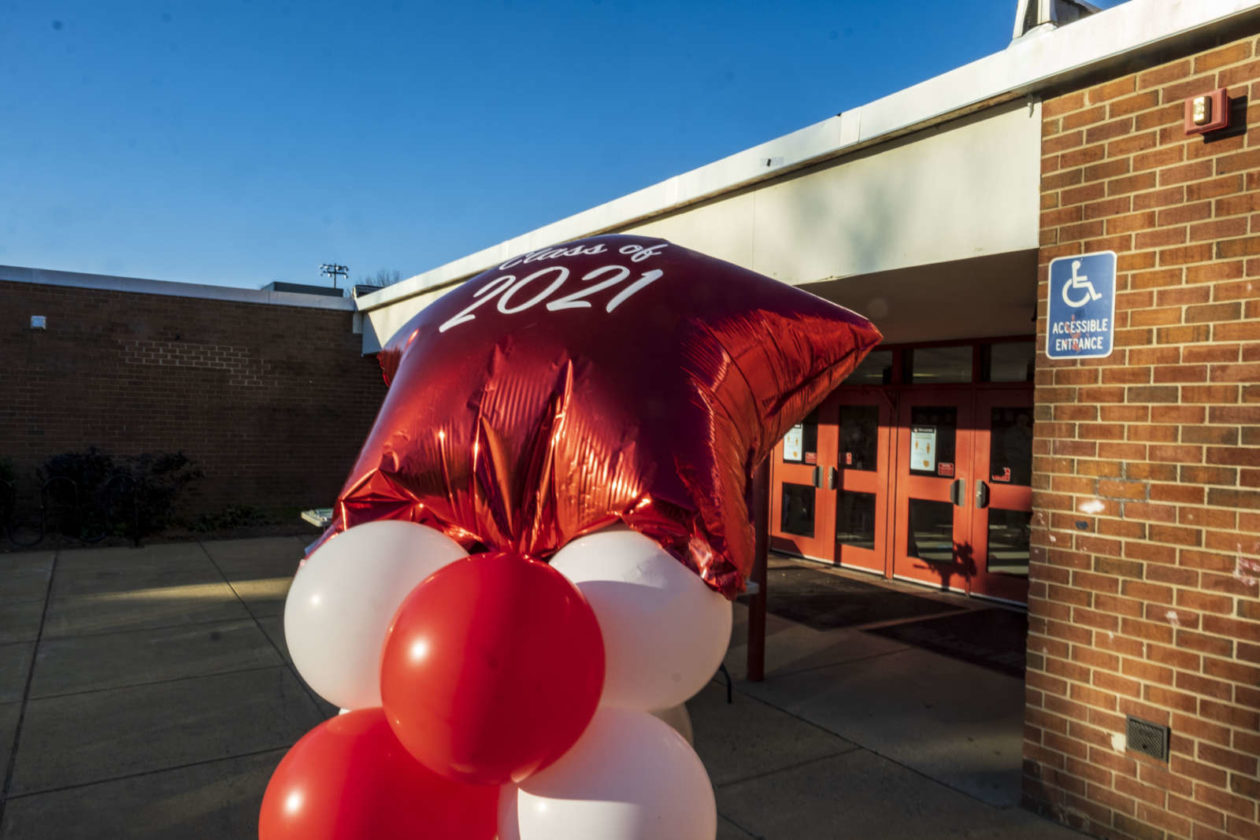
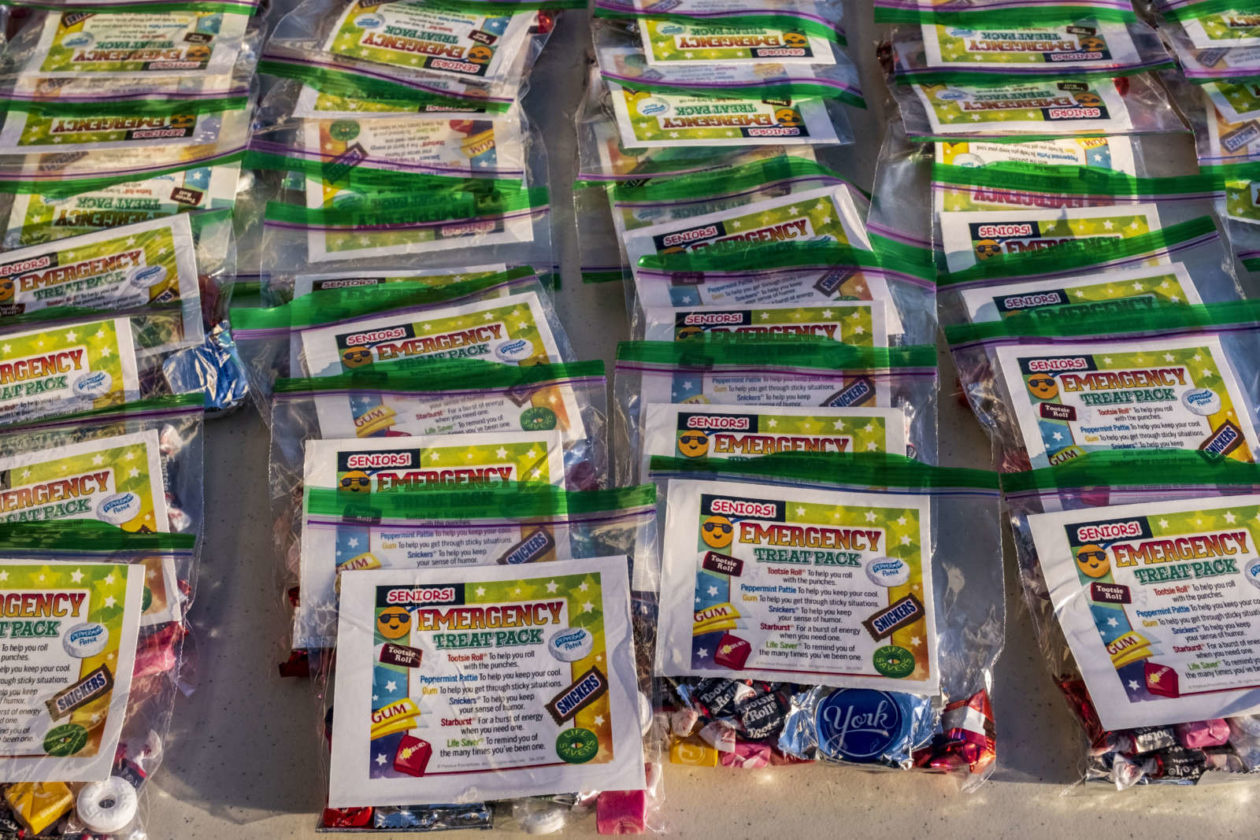
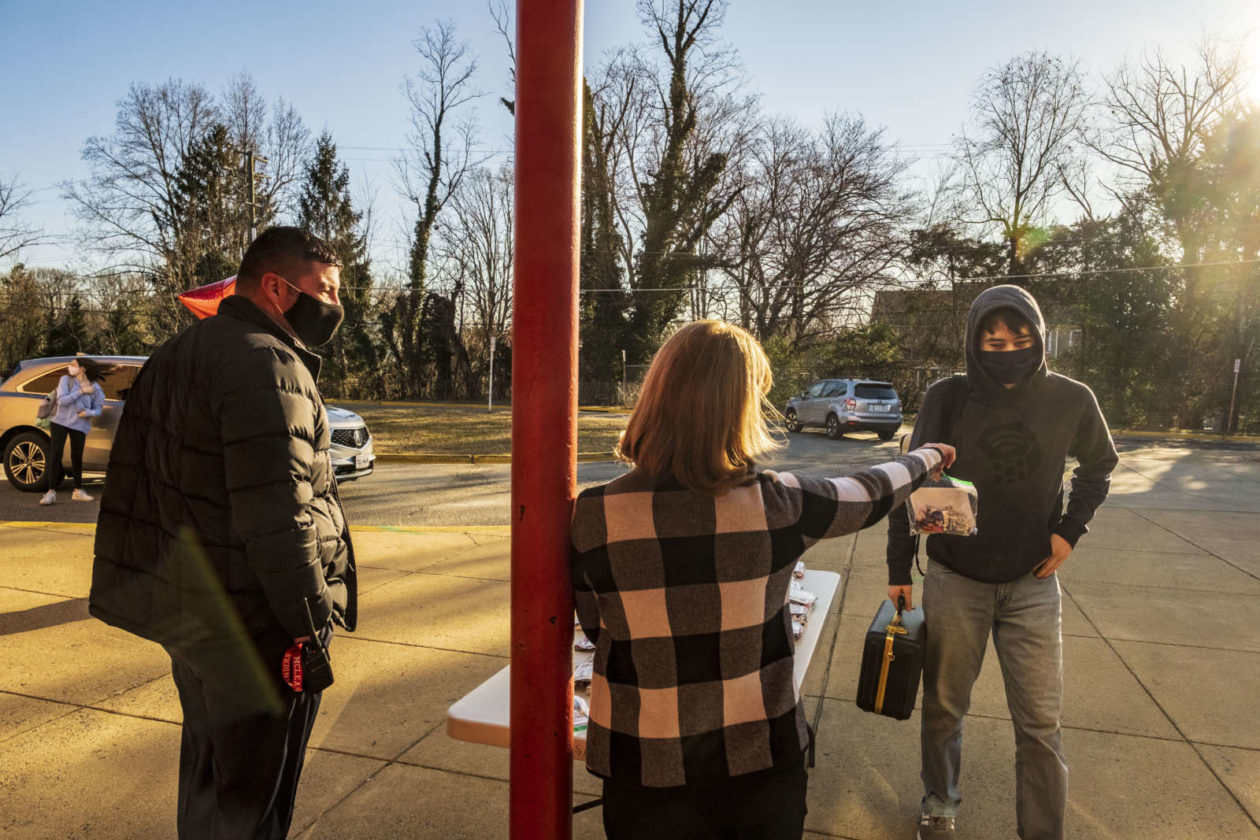
At James Madison High School in Vienna, students arrived to the sight of an inflatable air dancer, while McLean High School students were greeted by clapping, cheering, and mask-wearing administrators who handed out gift bags to seniors.
TODAY IS THE DAY! We are safe, ready and steady as we welcome students back into the building today. A huge thank you to our admin and staff for all the work they put in towards making today possible. ❤️🖤 WE BELIEVE ❤️🖤 pic.twitter.com/J5WSA8rNzh
— MadisonHS (@JamesMadisonHS) March 2, 2021
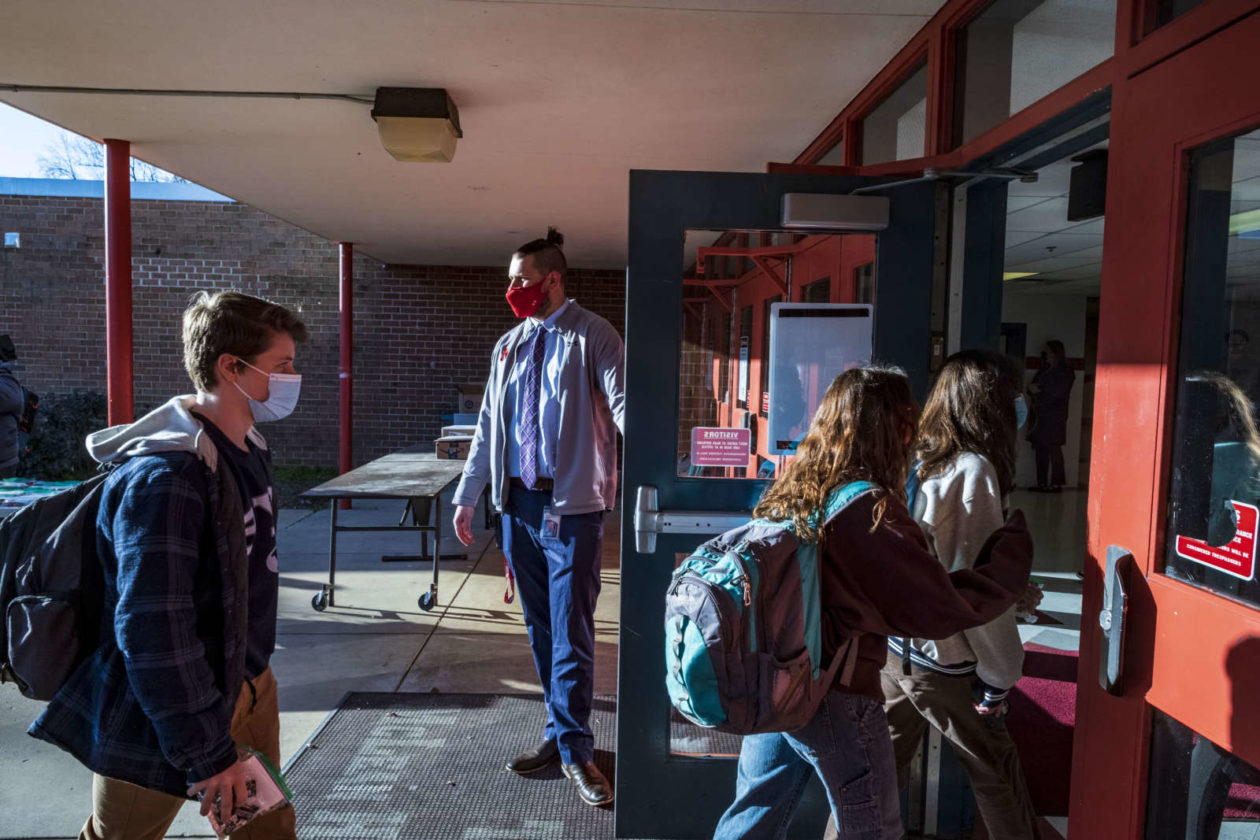
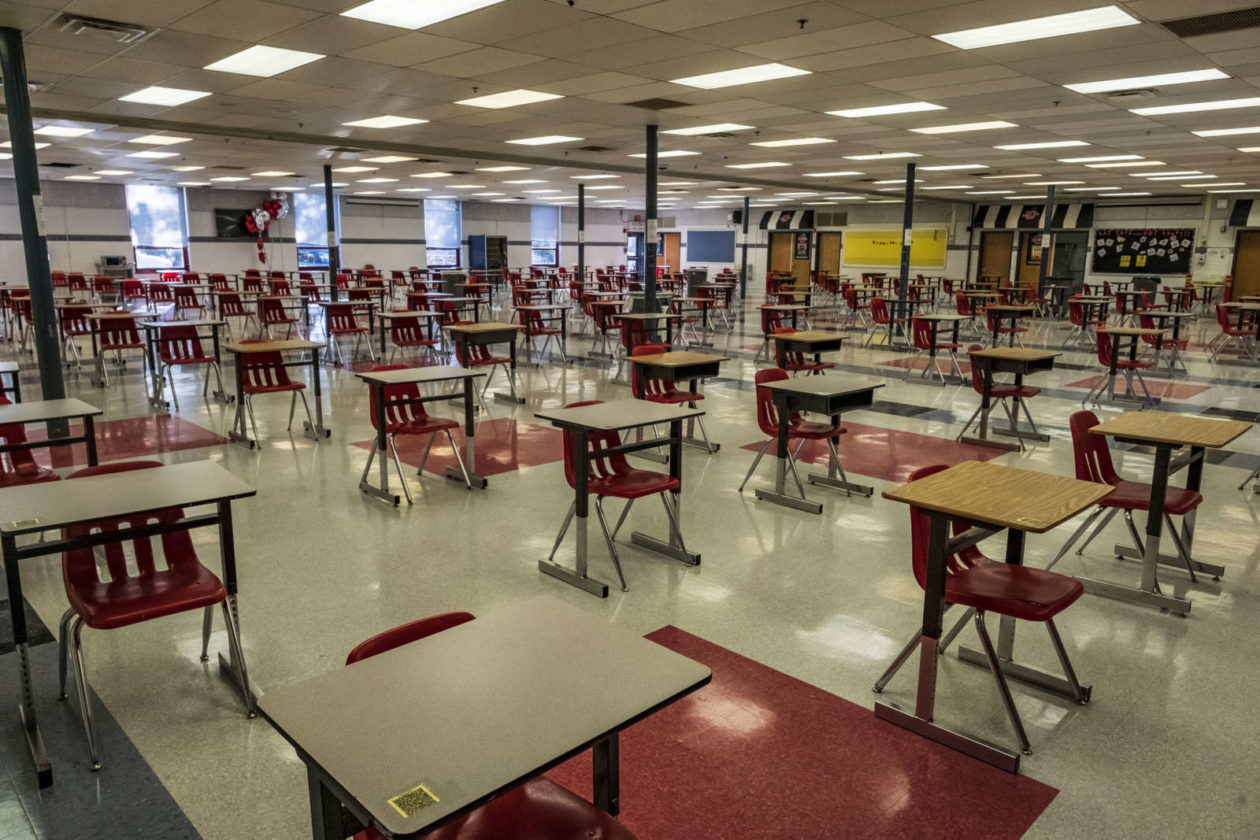
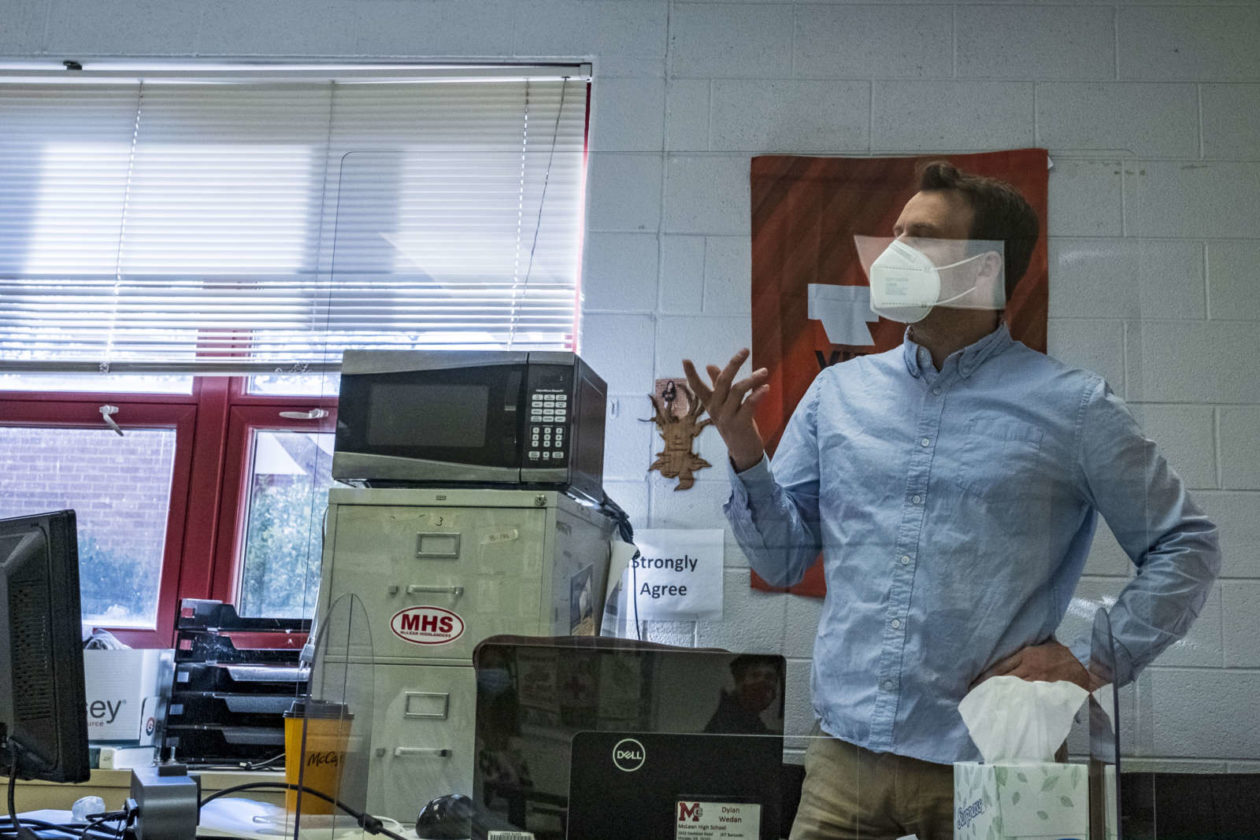
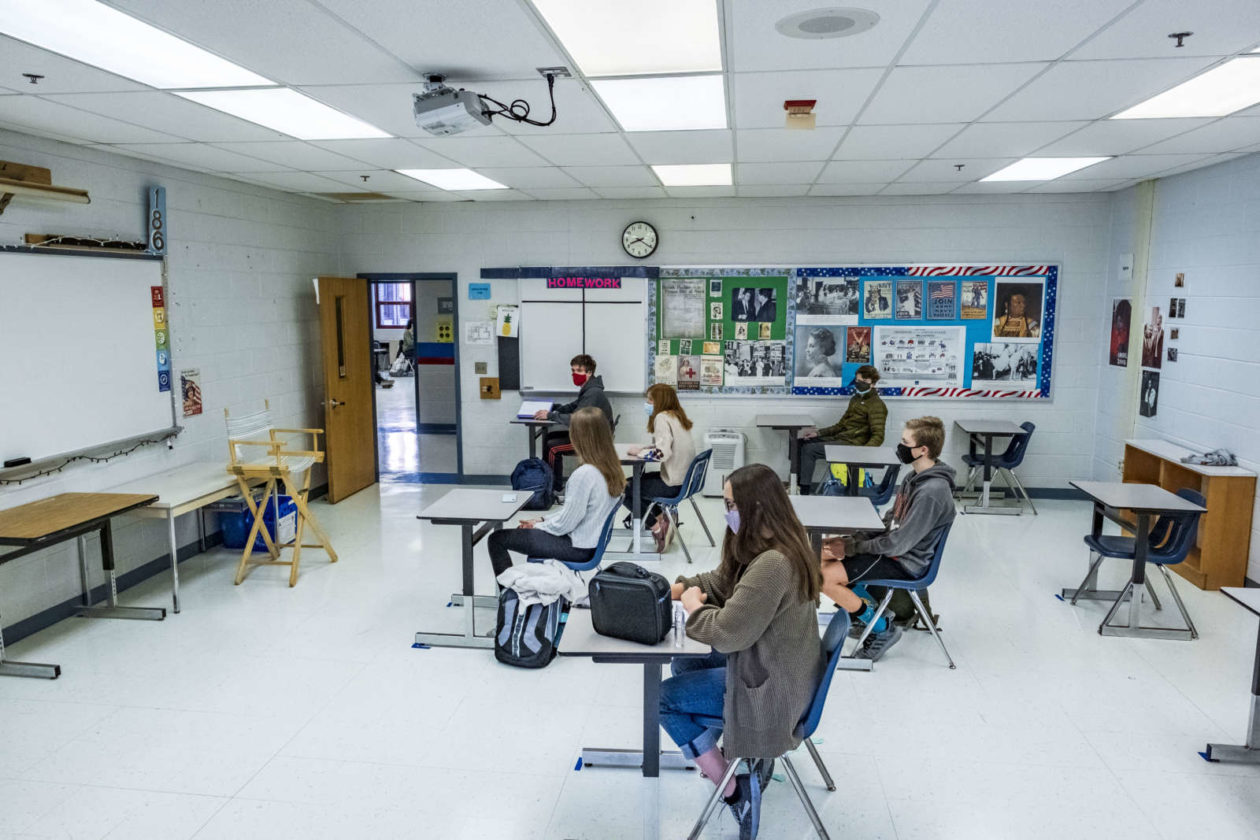
Returning students at McLean High encountered some jarring changes, from teachers’ desks outfitted with plexiglas shields to a cafeteria transformed into a giant, socially distanced classroom. Other parts of the building seemed to have “frozen in time,” as McLean High School Principal Ellen Reilly put it.
For instance, a board listing upcoming events had not been changed since Mar. 12, 2020 — the day before schools closed.
“We know it’s not going to be perfect,” Reilly said of resuming in-person classes. “We know that we’re going to have some problems this week as we learn another new way of teaching. We’re doing concurrent [instruction] now, but we’ve prepared as best we can, and we’re going to get it right.”
Reilly isn’t sure how many faculty members have received the COVID-19 vaccine. FCPS worked with the Fairfax County Health Department and Inova Health Systems to get staff vaccinated as they prepared to restart in-person classes.
“That’s their personal business. They can opt to have it or not to have it, and it’s not for me to know if they have or not,” she told Tysons Reporter.
As of Mar. 2, FCPS has reported 1,027 COVID-19 cases, including 617 among staff and 276 among students.
McLean High School senior Nathan Legg says he “hung out with friends” throughout the year, but he still missed the experience of being in school from a social perspective as well as an academic one.
While the past 12 months have been far from how he pictured concluding his high school tenure, he is determined to make the best out of his remaining time as a Highlander.
“It’s really exciting,” Legg said. “I’m glad to finally get in and try and make something of my senior year.”
Jay Westcott contributed to this report.
(Updated at 12:10 p.m.) The Fairfax County Health Department has completed sending out vaccine appointment invitations to 42,000 eligible residents who signed up on Jan. 18 and is now hopeful it will be able set up appointments at a faster clip.
“Now that we have got thru [Jan. 18 registrations], we anticipate that we will move more quickly through the other dates,” Fairfax County Health Department spokesperson Tina Dale told Reston Now, Tysons Reporter’s affiliate site. “In addition, we are working with more vaccination partners, so this, too, will assist us in moving through our registration list faster.”
If residents registered on Jan. 18 or before and have not received an invite, Dale says they should check their spam folder. If there’s no email with the subject line “Schedule Appointment,” residents should call the COVID-19 vaccine hotline at 703-324-7404, and a call taker should be able to assist.
The county’s dashboard now says they are currently making appointments for those who registered on Jan. 19.
Jan. 18 was the first day that the county allowed residents who qualified for Phase 1b to register for COVID-19 vaccine appointments. Phase 1b includes residents 65 years old and over and those 16 to 64 with underlying medical conditions.
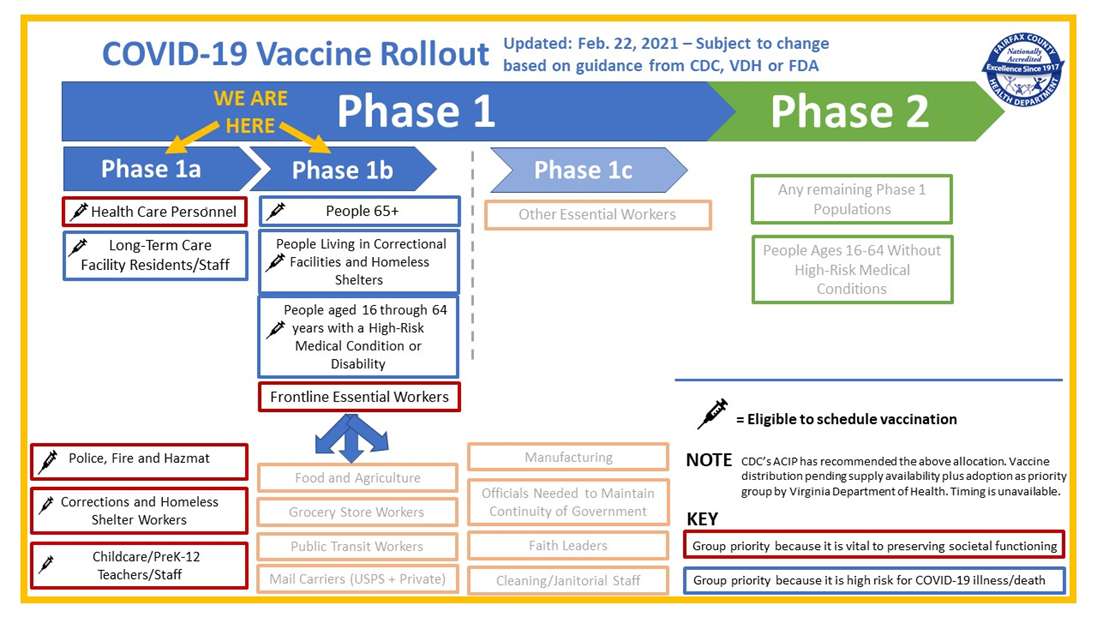
When vaccine appointments opened to those in Phase 1b that day, more than 42,000 eligible signed up and registered — far exceeding any other day.
In fact, the county’s vaccine dashboard shows that the 42,000 registrations on Jan. 18 alone matched the number of registrations over the next four days combined.
The county acknowledged when the dashboard launched in mid-February that sending invitations for scheduling a vaccine appointment to everyone who signed up on Jan. 18 would take “several weeks.”
As of noon today, more than 95,000 residents remain on the waitlist, which means they are awaiting an invitation to schedule an appointment.
The county says it doesn’t have an estimated timeline for when those remaining people will receive an invitation to sign up for a vaccine appointment or when the county will open appointments sign up those in Phase 1c for appointments.
However, the Virginia Department of Health expects the vaccine supply to increase over the next two months, Dale says, and the Commonwealth has said they expect to get through all of those who are eligible and want the vaccine in Phase 1b by mid to late April.
Essentially, demand still far outweighs supply — a continued issue since the vaccine first started being distributed in December.
Overall, about 176,700 residents have been vaccinated in Fairfax County, which represents just over 15% of the county’s total population.
That rate is comparable to Virginia and the country as a whole, which have, respectively, vaccinated about 16% and 15% of the population, according to The Washington Post.
Additionally, on Friday (Feb. 26), the county acknowledged that there were issues with about 2,800 registrations “not being correctly captured in the system due to technical errors.”
Dale says that these registrations have been corrected and were a result of a combination of issues, including both “user error and system error.”
Since then, the county has added new features to the registration to reduce the possibility of user error, like providing two fields for email addresses and limiting the number of characters for phone number and zip code.
The county is also asking people to review the spelling of their names and email addresses and to ensure their date of birth is accurate to make sure there are no errors.
Photo via Fairfax County Health Department
The rate of new COVID-19 cases and hospitalizations in the Fairfax Health District remained steady over the past week, as Virginia announced over the weekend that a third vaccine will be available for distribution starting this week.
With an additional 132 cases reported today (Monday), there have now been a total of 67,547 COVID-19 cases recorded in Fairfax County and the cities of Fairfax and Falls Church. The novel coronavirus has put 3,564 people in the hospital and killed 969 people since the district identified its first presumptive positive case roughly one year ago.
Fairfax County has averaged 198 new cases over the past seven days, maintaining a weekly average has hovered around 200 cases since Feb. 20. While that represents a significant decline from the winter peak of 697 cases on Jan. 17, the COVID-19 case rate has not yet returned to the relatively low levels seen last summer and into the fall before cold weather set in.
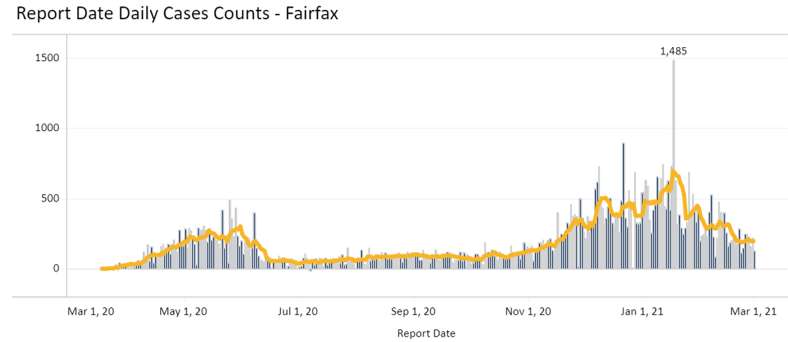
With new cases and testing positivity rates falling across Virginia, Gov. Ralph Northam has eased some of the public health restrictions that had been put in place to limit the spread of COVID-19.
Starting today, the 10 p.m. curfew on alcohol sales at bars and restaurants has been lifted, and the caps on outdoor social gatherings has increased from 10 to 25 people. After previously being limited to 250 people, outdoor entertainment and amusement venues can also now have up to 1,000 people or 30% capacity.
The most notable development in the U.S.’s efforts to control the pandemic came on Saturday (Feb. 27), when the Food and Drug Administration granted an emergency use authorization to a new COVID-19 vaccine from Johnson & Johnson that only requires one dose, instead of the two needed for the already authorized Pfizer-BioNtech and Moderna vaccines.
The Virginia Department of Health said that the state expects to receive 69,000 doses of the Johnson & Johnson vaccine this week that will be prioritized for mass vaccination clinics. An additional allotment will go to pharmacies that are participating in a federal partnership that focuses on vaccinating people 65 and older.
“VDH encourages all providers who schedule vaccine appointments to advise individuals which vaccine they will receive,” the state health department said. “…All three vaccines have been proven to be effective at preventing COVID-19-related hospitalization and death.”
According to the VDH data dashboard, Fairfax County has now administered 224,329 vaccine doses to 140,803 people. 83,526 people in the county have been fully vaccinated.
The Fairfax County Health Department is still working through the 44,036 people who signed up for a vaccine appointment on Jan. 18, which saw more registrations than any other day so far. As of 10 a.m. today, the county had registered 267,170 people for an appointment, 95,457 of whom were still on the waitlist.
❓ FAQ: How Much Progress Has Been Made on Scheduling Appointments for People Who Registered on Jan. 18?
👉 As of Feb. 26, approximately 63% of the people who registered on Jan. 18 have either been vaccinated or offered an appointment. https://t.co/RjxBNrvkl5 pic.twitter.com/TwQyl78KJB— FairfaxCounty Health (@fairfaxhealth) February 27, 2021
Images via CDC on Unsplash, Virginia Department of Health