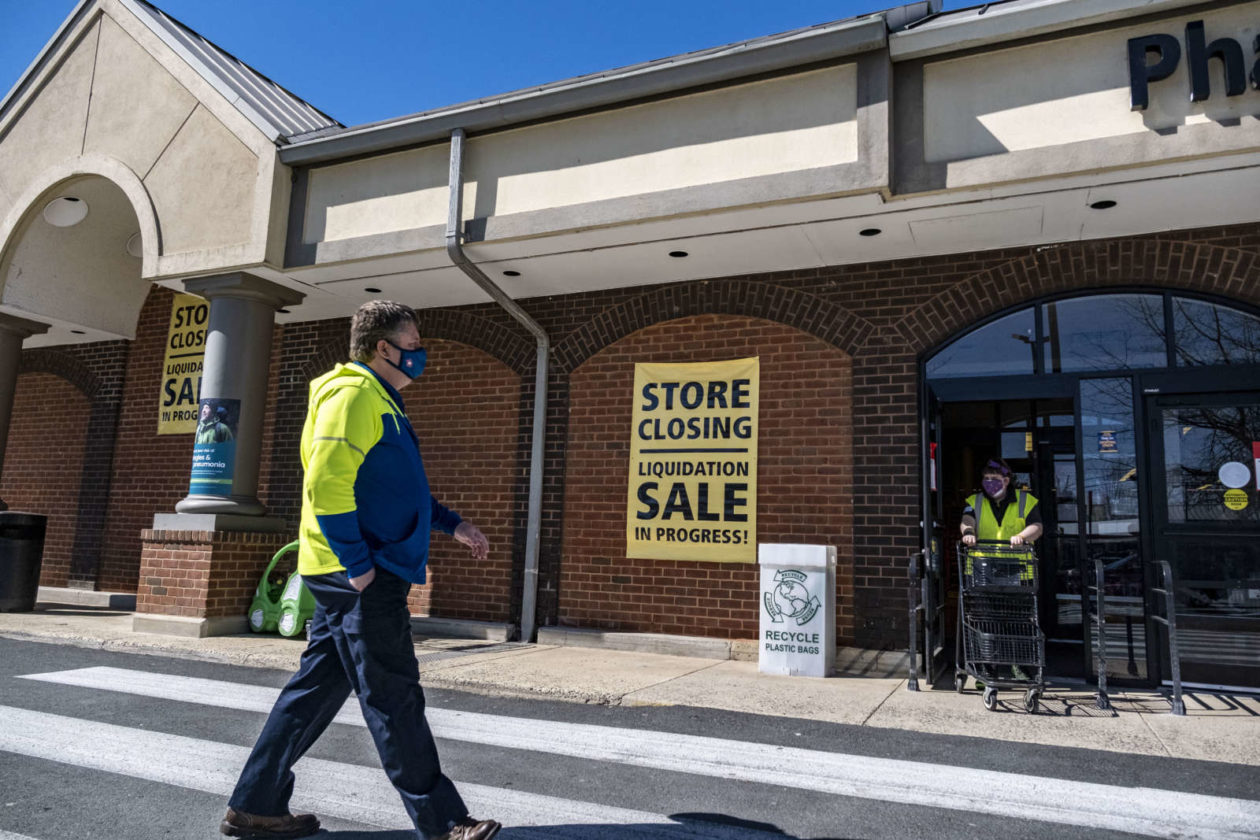

The Safeway grocery store on Chain Bridge Road in McLean will soon be no more.
Tysons Reporter received several tips from readers about the impending closure after “going out of business” signs advertising sales popped up last week at the Safeway located at 1330 Chain Bridge Road.
A Safeway spokeswoman confirmed that the store is expected to close on April 30.
This is the only store that Safeway is closing in its mid-Atlantic division, which includes Virginia, D.C., Maryland, and Delaware, says Safeway Mid-Atlantic spokesperson Beth Goldberg.
“Closing a store is always a tough decision, but we sometimes have to make those decisions so we can invest appropriately in other areas of our business,” she said. “Like all retailers, we are constantly evaluating our store portfolio and look at every angle of the business. This includes our real estate.”
The parent company, Albertsons, will still have 111 Safeway stores in the D.C. area after this one closes, she said.
“We have no immediate plans to close any other locations,” she said.
A Lidl will be taking its place.
DMV-area retail-only real estate brokerage firm H&R Retail, which owns the Safeway property on Chain Bridge Road, now lists the German supermarket chain as a tenant. The chain, which is expanding its footprint in Northern Virginia, is known for its low prices.
Lidl spokesperson Chandler Ebeier confirmed to Tysons Reporter that the grocery retailer “will be opening a store in this location in the future, but it is too early to offer specifics at this time.”
“We look forward to serving the community in the future,” he said.

A year ago yesterday (Sunday), Virginia’s first COVID-19 case was reported in Fort Belvoir when a U.S. Marine tested positive for the virus.
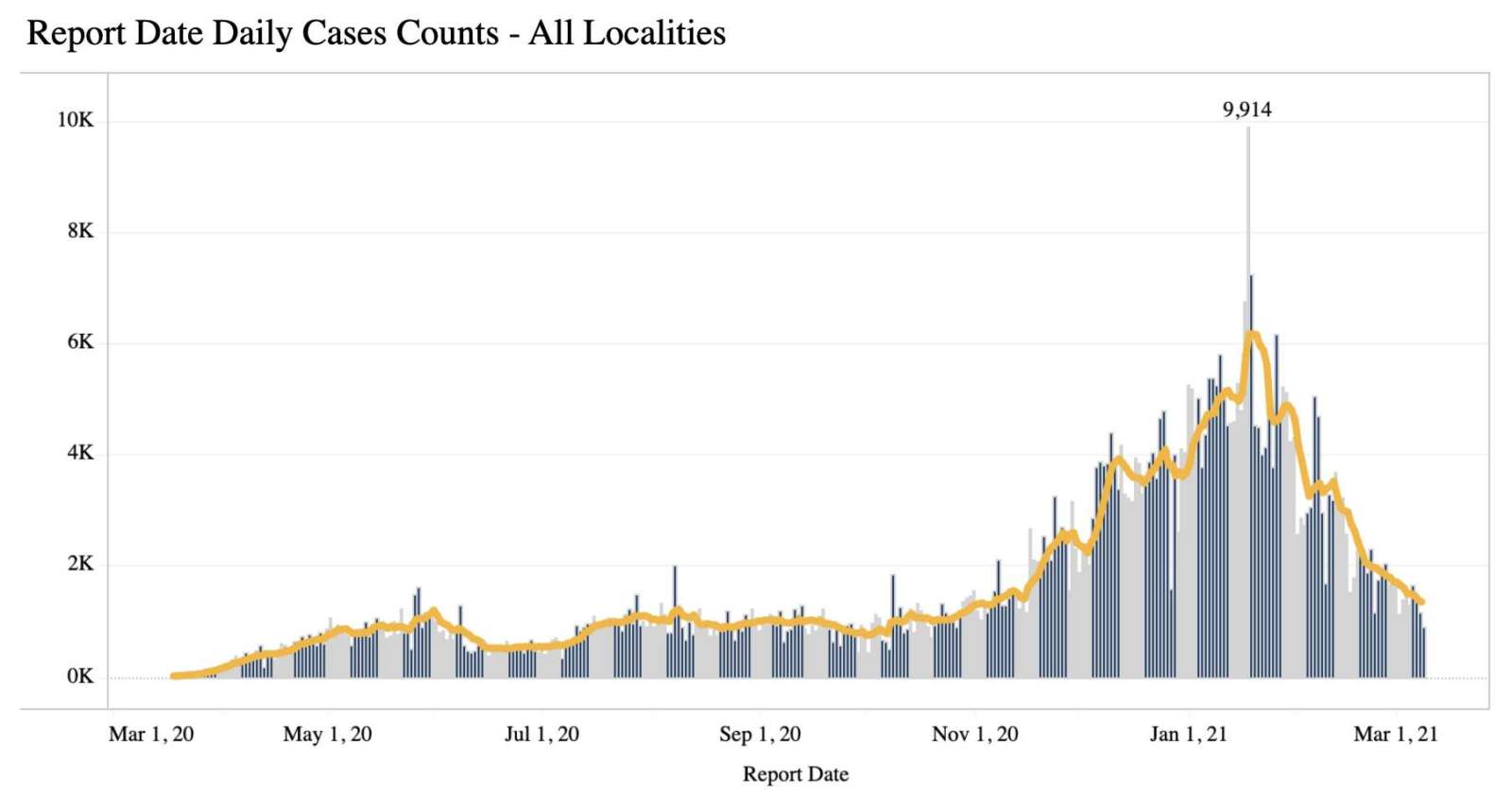
Since then, the Fairfax Health District has recorded 68,680 COVID-19 cases. The death toll now sits at 1,036 people, and 3,617 people have been hospitalized due to the novel coronavirus.
Still, in a hopeful trend, the case rate in Fairfax County has continued to fall after peaking on Jan. 17. Just today, the county reported 127 new cases today — a substantial dip from the all-time high of new cases — 1,485 in a single day — in January.
The weekly case average of reported cases has fallen to the lowest levels since Nov. 8 last year, when the weekly case average was 153. As of today, the weekly case average rested at 159.6.
The decrease comes as the Fairfax County Department of Health picks up its vaccination pace. After several weeks of scheduling for people who pre-registered on Jan. 18, the county has begun scheduling appointments for people who registered on Jan. 19.
Last week, the county vaccinated 21,791 people, a pace that has remained relatively stable since vaccinations began earlier this year.
Still, 108,883 people — 37 percent of the total number of people registered — remain on the county’s waitlist. Overall, the county has received 193,742 doses from the Virginia Department of Health and administered or distributed 193,878 doses. 93,560 people in Fairfax County have been fully vaccinated, according to VDH data.
The county has currently only deployed the Pfizer and Moderna vaccines.
Local health officials are evaluating how many Johnson & Johnson doses it will receive, how many doses will be allocated in clinics, and how much will be allocated to the county’s health partners. Last week, the state health department announced that it expects to receive 69,000 doses on a weekly basis.
Images via CDC on Unsplash, Virginia Department of Health

Commercial office development will be essential to future economic recovery efforts in Tysons and Fairfax County, a new study says.
Released last Thursday (March 4) by the Tysons Partnership, an economic report and market study developed by the consulting firms HR&A Advisors, Toole Design, and Wells & Associates argues that Tysons will need at least 1.9 million square feet of new office space over the next 10 years — despite predictions that the COVID-19 pandemic could permanently alter white-collar workplaces.
“In early 2021, we remain in the midst of the global COVID-19 pandemic, with fallout still being measured,” the economic report says. “However, office investments to date are seeing a strong performance return and will certainly play a key role in County and regional pandemic economic recovery efforts.”
According to the report, Tysons saw a 40 to 75% drop in the use of office space after COVID-19 arrived, following regional and national trends, but prior to the pandemic, vacancy rates had been declining, dipping four percentage points between 2015 and 2019.
In addition, the study projects that office-based employment in Tysons will grow by 7%, or 7,500 jobs, by 2030.
Office work is already integral to Tysons’ economy. Office workers constitute 81% of the total 107,000-person workforce, with the largest sector — the professional services industry — employing two of every five workers in the area. Tysons accounts for 17% of Fairfax County’s office-using jobs.
Tysons outpaced the rest of the county with a 9% job growth between 2015 and 2020, and that faster growth is expected to continue over the next five years, albeit at a slower rate of 5%. Professional services will still be the largest sector, but the biggest area of growth will be in healthcare, which is projected to grow by 24% through 2025.
However, the projected office-using job market growth is far short of what developers would need to fill all of the office space that is in the works for the Tysons area.
If all projects in construction and 50% of all proposed projects in Tysons are completed, that would result in 4.5 million square feet of new office space that could accommodate an estimated 18,200 workers, according to the market study.

In comparison, driven by the opening of the Metro Silver Line in 2014, Tysons added 1.9 million square feet of office space between 2015 and 2020, a 7% growth in inventory that surpassed the rate for both Fairfax County overall (4.7%) and Arlington County (4%).
Though they anticipate future job growth, the economic report and market study acknowledge that “long-term trends remain uncertain” due to the pandemic, which triggered a 5% climb in office vacancy rates and sent the leasing market plummeting from 81 deals in the first quarter of 2019 to just five in the fourth quarter of 2020 so far.
“Tysons Partnership leaders understand much work remains to be done as recovery efforts begin post COVID-19 and in identified areas where continued investment and resources are essential, including housing affordability, mobility, and implementation,” the partnership said in a news release.
Outside the office market, the report says that Tysons has cemented its role as a regional retail hub over the past decade, generating $3.5 billion in annual retail spending, which represents 17% of Fairfax County’s total retail spending.
As reported at the Tysons Partnership’s “State of Tysons” event in December, Tysons’ residential population grew 39% from 2010 to 2018, a rate four times higher than the county’s average growth. Led by mid- and high-rise developments, Tysons has expanded its housing stock by 34% to 13,800 units since 2010, and it is projected to grow by 36% to nearly 19,000 units by 2025.
“The investment on behalf of the public and private sectors in smart, sustainable urbanization is working,” Tysons Partnership president and CEO Sol Glasner said.
The full report and market study can be found on the Tysons Partnership website. The nonprofit plans to use the collected data to develop a dashboard that “will serve as the go-to information hub for a wide range of stakeholders and promote the growth of Tysons,” according to the market study.
Staff photo by Jay Westcott, slide via Tysons Partnership

The City of Falls Church is taking steps to show its appreciation for the arts.
When it meets tonight (Monday), the Falls Church City Council will conduct its first reading of a draft comprehensive plan amendment to establish an Arts and Cultural District. The council reviewed staff recommendations for the proposal at a work session last week.
The amendment would “add new policy goals and objectives to promote public art and a proposed Arts & Cultural District Map,” according to the staff report presented by Falls Church City planner Emily Bazemore.
“Public art is important in all communities and becomes even more so when a city goes through a period of redevelopment and reinvestment,” Bazemore said. “The policy…outlines specific short-term actions as well as long-term strategies that the City of Falls Church can utilize to work towards its vision and commitment to public arts.”
Virginia state law lets localities create arts and cultural districts within their boundaries “for the purpose of increasing awareness and support for the arts and culture.” Localities can offer tax incentives and regulatory flexibility to encourage the development of arts and cultural venues in the districts.
Since it was reviewed during a Sept. 21 city council work session, the proposal has been amended to clarify the Falls Church’s vision and emphasize providing more support for local artists. The changes were based on input from various city groups, including the Falls Church City Planning Commission, Arts and Humanities Council of Falls Church, and Falls Church Village Preservation and Improvement Society (VPIS).
“The Arts and Humanities Council as well as VPIS and the Historical Commission all recommended adding language that ties into how history plays an important role in public art and how we can use public art to utilize a way to remind us of our past,” Bazemore said.
The map for the proposed Arts and Cultural District has been revised to include houses of worship. The Arts and Humanities Council and VPIS specifically recommended St. James Catholic Church and The Falls Church Episcopal as examples of church-owned land that could be incorporated.
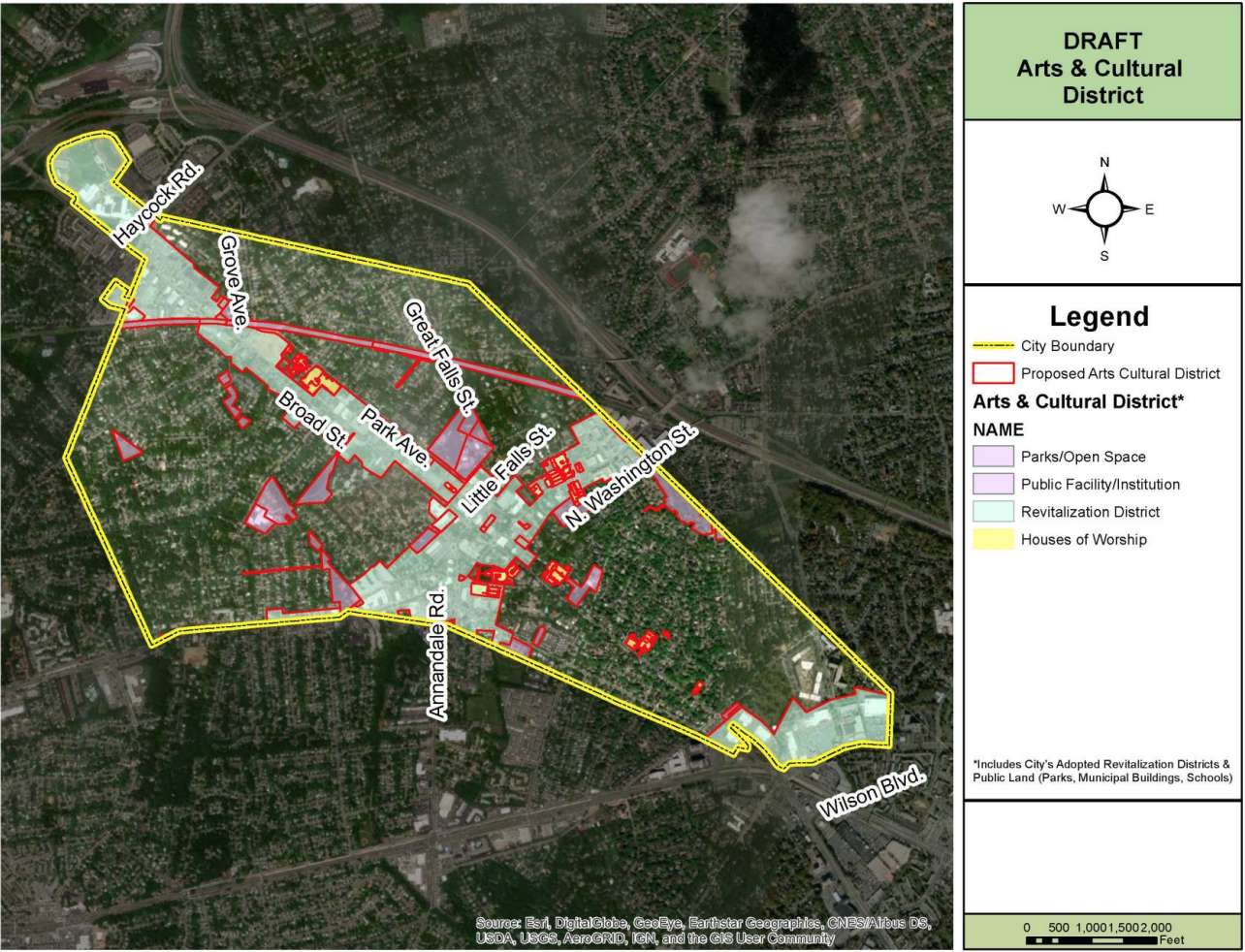
In addition to creating an arts district, the proposed comprehensive plan amendment suggests that Falls Church support public art by establishing a registry, expanding efforts to feature temporary art displays, and incorporating public art in parks and open spaces around the city.
The amendment recommends that the city support a public art program by allocating regular funding from its operating or capital improvements budget each year, which could also go toward arts-related festivals and events. Another option could be working with the private sector to include public art in development projects or provide monetary contributions to a public art fund.
Bazemore clarified that the amendment text does not apply to private residences.
“The thought is more commercial and, of course, public facilities and parks,” she said.
While the staff report says adopting the amendment will not have a direct fiscal impact, Councilmember Letty Hardi argued that, if Falls Church wants to encourage public art, the city will have to devote money and staff to make it a priority.
According to Hardi, the City of Falls Church currently allocates just $50,000 per year to nonprofit arts and humanities groups, funds that mostly go toward operations rather than artwork. It also does not have any staff dedicated to developing art projects.
“Policies and recommendations are only as good as where we put our budget and our priorities,” Hardi said. “So, while it’s good that we have our map and we’re talking about how important public art is, I’d love to make sure that we have people and budget dollars allocated against this…I think that’s something we should consider either in this budget cycle or future budget discussions.”
After tonight’s meeting, the proposed amendment will be referred to the planning commission. Staff has recommended scheduling a public hearing and final vote for March 22.
Image and map via City of Falls Church

Public Hearings on Metro Budget Begin Today — The Metro Board of Directors is holding virtual public hearings this week on the transit agency’s proposed FY 2022 budget, which could significantly reduce rail service and close 22 stations, including the McLean station. The first meeting starts at 11 a.m. today, and the hearing scheduled for 6 p.m. on Wednesday (March 10) will focus on changes in Virginia. [WMATA]
Police Report More Commercial Burglaries in Tysons Area — Between Feb. 27 and March 4, Fairfax County police responded to burglaries at Sunoco (8030 Lee Highway), Grand Mart (6326 Arlington Blvd.), Ba Le Bakery (2822 Graham Rd.), Exxon (2081 Chain Bridge Rd.), and Macy’s (8000 Tysons Corner Center). [Fairfax County Police Department]
Inova and UVA Open New Medical Campus in Fairfax — The University of Virginia School of Medicine welcomed its first class of 36 medical students to a new campus developed in partnership with Inova Health Systems. Students will primarily train on the Inova Fairfax Medical Campus in Falls Church, but they will have opportunities to work across the nonprofit healthcare system’s facilities. [Inside NoVA]
School Board Votes to Advance Solar Panel Program — The Fairfax County School Board voted unanimously to move forward with a program to install solar panels on school buildings in an effort to reduce greenhouse gas emissions and electricity costs. Discussions are currently underway for projects at three schools, but Fairfax County’s original request for proposals included 87 sites. [Fairfax County Public Schools]
Deadline Approaching for McLean Community Center Governing Board Candidates — Petitions to become a candidate for a seat on MCC’s governing board must be submitted by 5 p.m. this Friday (March 12). There are three open seats on the board for adults and two for youth. [McLean Community Center/Twitter]

Patrons of Caboose Tavern will soon be able to grab a breakfast sandwich and morning coffee from the Town of Vienna brewpub (520 Mill St. NE).
Caboose Brewing Company announced yesterday (Thursday) that it will launch daily breakfast service at the tavern on Monday (March 8). Breakfast hours will go from 8-11 a.m. every day.
To celebrate the service change, Caboose Tavern will provide a free coffee or espresso beverage with any breakfast purchase on Monday through Wednesday.
The new menu offers breakfast staples, such as pancakes and artisan bagels, as well as fried chicken and smothered meat lovers’ biscuits, a build-your-own charcuterie and cheese board, and “breakfast on a stick,” a pork sausage fried in house-made pancake batter, corn dog-style.
There are also pastries that were designed to pair with Caboose Tavern’s new coffeehouse beverages, which are all hand-crafted, according to a press release.
The breakfast items will be available for dine-in service, takeout, or delivery.
Caboose Brewing owner Jennifer McLaughlin says the company decided to expand its breakfast and coffee service based on its success at Caboose Commons, the brewhouse it operates in the Mosaic District.
“Introducing breakfast and coffee at Tavern will transfer the same values and energy to our Vienna location,” McLaughlin said. “Opening up a space for people to gather with friends, hunker down to work, and start the day off right with a hearty breakfast and a cup of coffee felt like the logical step to take in our constant effort to enrich our community.”
Photo by Courtney Beazell

The Fairfax County Park Authority is one step closer to planning for more dog parks in the county due to an increase in demand and the authority’s currently limited offerings.
The county recently completed a draft report of a dog park study that was initiated in 2019 and conducted by the FCPA and Fairfax County Park Foundation. A survey soliciting feedback for the study attracted more than 4,600 respondents.
“The purpose of the study was to assess needs and priorities for dog parks throughout the county, and to adopt strategies for long-term planning, development and management of dog parks,” FCPA wrote in a statement.
The report calls on FCPA to construct at least one dog park by 2025 to meet service needs in the area and to implement revised guidelines and standards for future dog parks. Survey respondents most sought a new dog park in the planning districts of Upper Potomac and Bull Run.
 The county currently has 13 public dog parks, 11 of which are owned and operated by FCPA.
The study recommends creating future parks based on geographic distribution and the overall goal of 20-minute drive access throughout the county and 10-minute walking access in densely populated areas. The density of licensed dogs in a given area would also be considered.
The study does not recommend any changes to existing dog park rules or operating hours.
Volunteering could also become a stronger component of managing dog parks. The report suggests using volunteers to manage existing and future programs more efficiently.
A virtual meeting on the draft report is set for Tuesday, March 23 at 7 p.m. A staff presentation on the findings and recommendations of the report will be followed by a public comment period.
Other recommendations related to operations and maintenance. While the county found that maintenance standards and practices are consistent with other jurisdictions, there is a need for more regular maintenance, particularly waste management.
The report also cites a need for more water sources, rule enforcement, and shade.
Comments will be accepted through April 23. They can be submitted by email to [email protected] or through the dog park study website.
Photo via DC Bulldog Meetup/Facebook, map via Fairfax County Park Authority

As Fairfax County moves to expand its use of renewable energy, the Board of Supervisors is looking for feedback on the next round of county facilities being considered for solar panel installations.
The board will hold a public hearing on Tuesday (March 9) to determine whether the county should lease roof space at 22 county-owned properties to the energy company Sigora Solar, which would be responsible for installing, operating, and maintaining solar photovoltaic panels at the sites.
Sites under consideration in the Tysons area include:
- McLean Government Center and Police Station (1437 Balls Hill Road)
- Wolf Trap Fire Station #42 (1315 Beulah Road)
- McLean Community Center (1234 Ingleside Avenue)
- Thomas Jefferson Library (7415 Arlington Boulevard)
- Merrifield Center and Kerrifield Center Garage (8221 Willow Oaks Corporate Drive)
This is the second set of properties that county officials have proposed as possible locations for solar panels. The county previously approved leases for roof space at eight sites, including the Providence Community Center, in October.
In an effort to pivot to renewable energy as a means of reducing greenhouse gas emissions, Fairfax County announced in December 2019 that it had awarded contracts to multiple solar power companies in what was the “largest solar power purchase agreement initiative by a local municipality in Virginia” at that time, according to the Fairfax County Office of Environmental and Energy Coordination.
In addition to Sigora Solar, the county has contracted with the providers BrightSuite — a subsidiary of Dominion Energy — and Ipsun Solar for the initiative, which could also include Fairfax County Public Schools facilities.
In the board package for Tuesday’s meeting, county staff say there is no expected net cost from the solar panels. Sigora Solar has offered a fixed rate of $0.069 per kilowatt per hour (kWh) on a 25-year contract term. The county will save $0.016 per kWh compared to current electric costs which will help pay off the costs of installation and upkeep to Sigora Solar.
The public hearing is expected to start around 4 p.m. Like the rest of the Board of Supervisors meeting, it will be available to watch via the county’s cable TV channel and online live stream, and live audio can be accessed by calling 703-324-5300.
Image via Flickr/Minoru Karamatsu
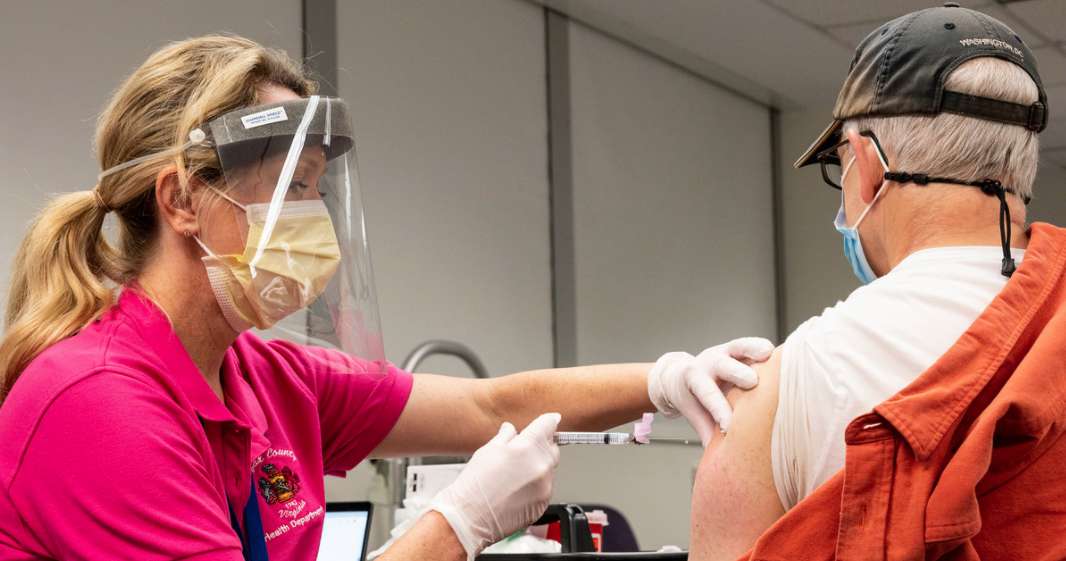
Thanks to federal and state partnerships, some local retail locations of CVS, Walgreens, Safeway, and Harris Teeter are offering no-cost vaccine appointments separate from Fairfax County.
However, with demand far exceeding supply, appointments remain extremely hard to come by, even as the one-dose Johnson & Johnson vaccine begins to roll out.
Virginia is currently in Phase 1b, meaning those 65 or over and those with 16 to 64 with underlying medical conditions are eligible to receive the vaccine.
The Virginia Health Department tells Reston Now, Tysons Reporter’s affiliate site, that more than 80,000 doses are being given to retail pharmacies statewide for distribution, an increase from last month.
The 69,000 J&J vaccine doses announced last week started coming in yesterday (Mar. 4), VDH confirms, and clinics across the state are expecting to start using it today (Friday).
VDH also says that they’ve directed retail pharmacies to “prioritize” those 65 and over to “make significant progress in vaccinating that vulnerable population.” All of this provides hope that more vaccines and more appointments will soon become available for those that are eligible.
Early last month, CVS began offering vaccine appointments at local stores. Currently, it is providing the vaccine through 41 pharmacies in Virginia with appointments booked through their website, but that includes only one location in Fairfax County.
CVS spokesperson Amy Thibault says there are roughly 41,580 appointments per week available at the 41 locations statewide, meaning each store has about 1,000 appointments per week. Most of them are using the Moderna vaccine.
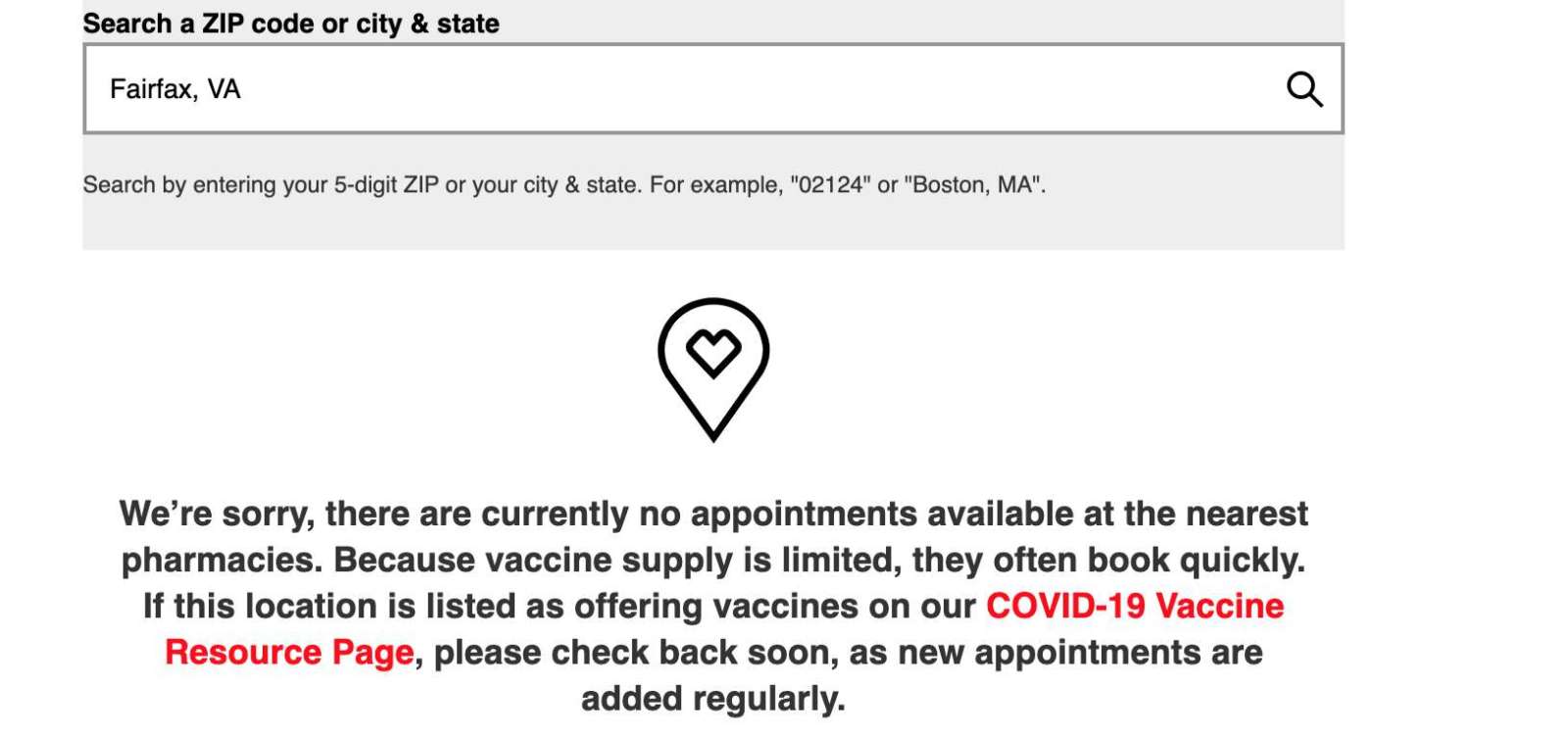
However, as of today, all appointments have been booked at the one Fairfax location.
“In most (if not all) states, the number of individuals who are eligible to receive the vaccine under the state’s rules far outnumber the state’s available doses,” Thibault said.
Currently, more than 100,000 people are on the Fairfax County Health Department’s waitlist. As of Mar. 4, close to 150,000 people in Fairfax County have gotten at least one vaccine dose, and 87,401 people have been fully vaccinated, according to the VDH data dashboard.
Thibault confirmed that CVS is receiving a “one-time allocation” of 212,000 doses of the Johnson & Johnson vaccine this week that will be sent to stores in 17 states. Scheduling for that began yesterday (Mar. 4) on the CVS website, with vaccinations starting today (March 5).
She says CVS has the capacity to administer 20 to 25 million doses a month nationwide, assuming there’s an adequate amount of not only the vaccine, but also other supplies.
Other retail pharmacies offering vaccines in Fairfax County face similar challenges.
Safeway and its parent company Albertsons are offering appointments to those 65 and over. According to their online scheduler, the one-dose Johnson & Johnson vaccine is now being offered.
Locations in the county include one on Elden Street in Herndon, South Lakes Drive in Reston, Georgetown Pike in Great Falls, and West Ox Road in Fairfax.
So far, no appointments are currently available at least through March 13 at any locations.
“Store supply is based on allocations from state and local health departments. New appointments are added to the online scheduler as more vaccine become available,” Albertsons spokesperson Andrew Whelan told Reston Now. “Demand is high and appointments are often claimed very quickly. As dose allocations increase, so too will the opportunity to secure an appointment.”
Walgreens joined the federal partnership on Feb. 24 and has started administering vaccines in Virginia. But, right now, there are no appointments available within 25 miles of Tysons, Reston, or Fairfax.

Harris Teeter’s website says limited quantities of vaccine would be available at select locations in Virginia starting on Mar. 1, but a company spokesperson told Reston Now that this hasn’t happened yet.
“Harris Teeter is expected to receive limited quantities of the vaccines soon at nine pharmacies in and around Northern Virginia…Appointments will be released as vaccine allocations arrive,” the spokesperson wrote.
Giant has taken another approach. Instead of creating its own appointment system, the grocery chain is using the vaccine supply allocated to them by the federal government to help the Fairfax County Health Department vaccinate their waitlist.
“People invited from the queue will be able to select from several Giant locations within the Fairfax Health District,” the health department said on its blog. “Locations and details will be included in the appointment scheduler email.”
Photo via Fairfax County Health Department
The Fairfax County Planning Commission voted unanimously on Wednesday (Mar. 3) to recommend that the county replace its current zoning code with a new draft resulting from the Zoning Ordinance Modernization Project (zMOD) that has now been underway for almost four years.
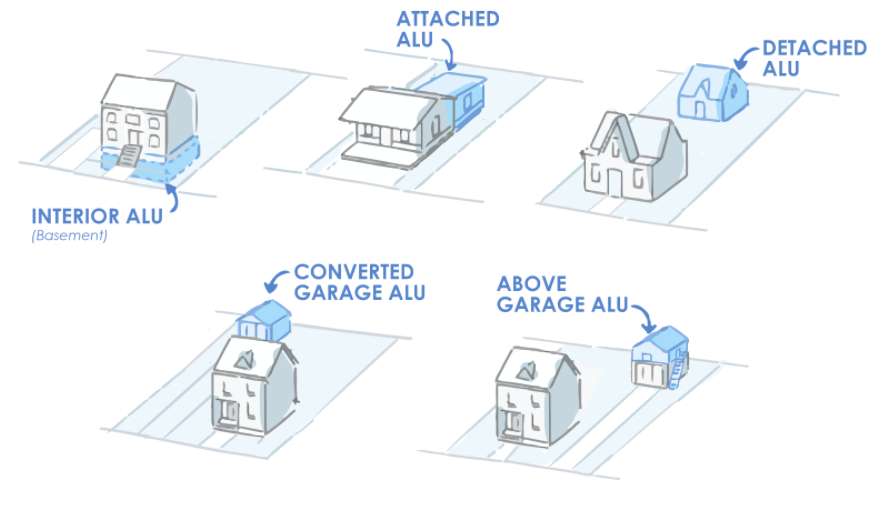
The 12-0 vote came after more than an hour of debate over the county’s proposed regulations for accessory living units (ALUs) — independent residential units located on the same property as a primary dwelling — and home-based businesses, which have emerged as two of the most contentious components of the 614-page document.
“The zMOD result on ALUs and home-based businesses, I believe, misses the mark,” Mason District Commissioner Julie Strandlie said. “It does not incorporate community concern and avoids a significant opportunity to make a real difference in housing policy. If we want to successfully expand housing options, we need community input, involvement, and buy-in.”
Released on Feb. 17, the draft zoning ordinance crafted by county planning staff and the consultant Clarion proposed allowing ALUs for single-family detached dwellings with an administrative permit if they meet certain requirements, including a maximum gross floor area of 800 square feet or 40% of the principal dwelling and that an occupant be at least 55 years old or have a disability.
Citing an “exceptional amount” of public opposition to that proposal, including at a public hearing on Jan. 28, the planning commission recommended that the Fairfax County Board of Supervisors instead utilize a special permit review process for all ALUs, which requires property owners to notify neighbors and make their case at a public hearing.
“This [administrative] process — what I’m seeing and what I’ve personally experienced — it pits neighbor against neighbor, or potentially could put neighbor against neighbor,” Mount Vernon District Commissioner Walter Clarke said. “I think it’s only fair, and we owe it to the citizens of this community, to have a process whereby they still can be engaged.”
The commission also recommended lifting the requirement that an occupant have a disability or be 55 years or older when an ALU is approved with a special permit, and allowing units to fill a basement or cellar based on its existing size on the date the new zoning ordinance becomes effective.
The commission also recommended amending the draft to prohibit on-site customers for home-based businesses approved through an administrative permit, except in cases involving instructional activities at a “specialized instruction center” — i.e., private tutoring or music lessons — or a health and exercise facility.
Instruction centers and health and exercise facilities could have up to four students at a time and eight students in a day. Other home-based businesses could have customers if they obtain a special permit.
In addition, all home-based businesses will have to be approved by the Fairfax County Health Department if there is a well or septic tank on site, a provision that was already proposed for ALUs.
While acknowledging that ALUs could help people who otherwise might not be able to afford to live in Fairfax County, the majority of commissioners ultimately expressed reservations about loosening restrictions across the entire county without getting a clearer sense of the potential impact on traffic, parking, and other issues, especially in high-density areas.
“While I do believe that accessory living units can provide an opportunity for additional living space in our very expensive county, I believe additional time is needed for study of the proposed countywide applications of accessory living units by administrative review,” At-Large Commissioner Timothy Sargeant said.
The commission recommended that the Board of Supervisors direct the county planning department to convene a task force that will study ALUs and home-based businesses for 18 months and deliver a report with any recommendations for further changes to the zoning ordinance.
Earlier in the meeting, the commission shot down a proposed zoning amendment that would have altered regulations for flags and flag poles, calling it “a solution in search of a problem.” The county’s only existing regulation for flags is a limit of three per lot.
Fairfax County launched its zMOD initiative in March 2017 with the goal of simplifying and updating a document that had not undergone a comprehensive revision since it was first adopted 40 years ago.
The Board of Supervisors is scheduled to hold a public hearing on the new zoning ordinance on Tuesday (Mar. 9). If the ordinance is adopted as it was approved by the planning commission, it would take effect at 12:01 a.m. on July 1.
Image via Town of Vienna