

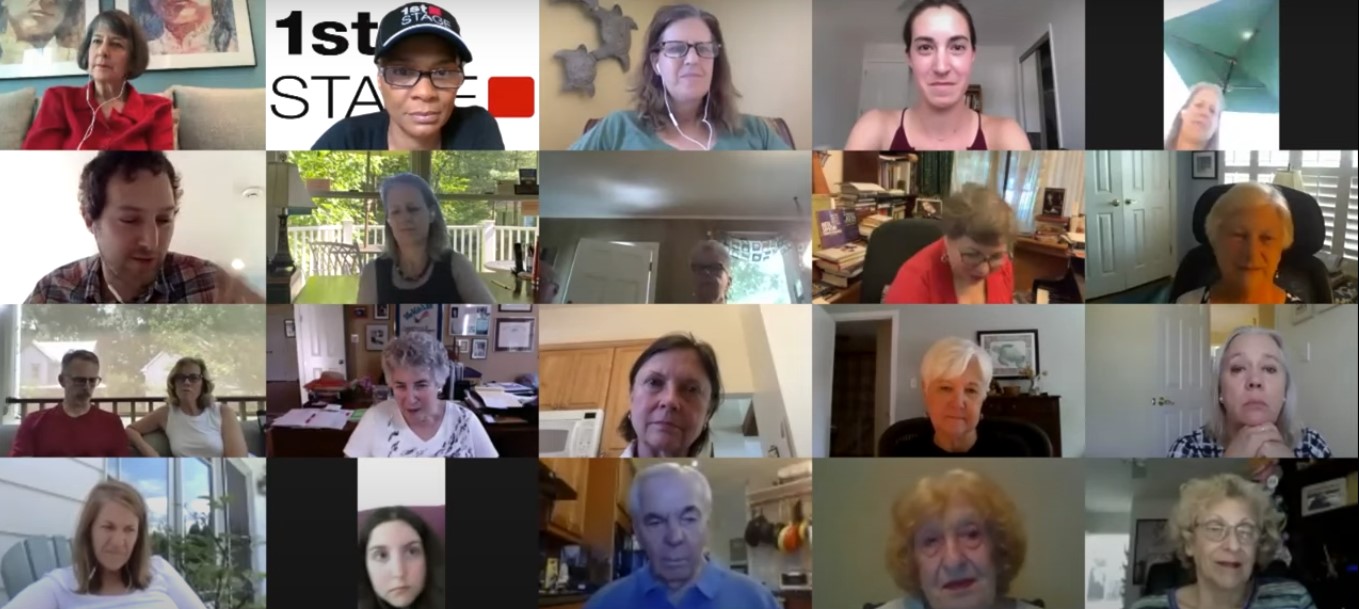
“When we can’t do theater, what can we do?” Alex Levy, the artistic director of 1st Stage Theatre, posed during a recent Zoom conversation with local artists.
Levy was at his brother’s house while sharing his thoughts on what the future of 1st Stage during the hour-long “Cultural Tysons” panel.
More than 50 households logged on as Levy; local painter and teacher Deborah Conn; bookstore owner Jen Morrow; and Lori Carbonneau, the head of the McLean Project for the Arts, weighed in on various facets of COVID-19’s impacts on Tysons’ art scene.
Levy introduced himself to viewers by tackling a perception of Tysons — and Northern Virginia west of Arlington — as a “cultural wasteland.” His fellow panelists agreed that the pandemic is highlighting how small businesses and local artists and institutions contribute to the area’s culture.
“It reinforced how much people want local,” Jen Morrow, the owner of Bards Alley in Vienna, said during the Zoom panel.
The bookstore is currently offering curbside pick-up and online shopping. The “Take a Chance on Me” option for staff to recommend books in the store based on shoppers’ chosen genres and price points has “been a home run,” she said.
“I think people are really discovering how much they miss their access to the arts,” Conn, the local watercolor painter, said. “They need the arts. They need the theater. They need the books.”
With some of her art hanging behind her, Conn talked about the changes she’s experienced during the pandemic: better class attendance now that she’s teaching via Zoom, a greater demand for more demos and more creative ways to showcase art.
Conn, who is also the gallery curator at 1st Stage, shared that one of her friends started a fence post art gallery, while a few others are doing driveway galleries: “We have to be seen.”
The virtual meeting on Saturday (June 13) was part of the Community Conversations series that 1st Stage started five years ago.
“It’s a really popular thing that we did, and we realized it was one of those things that we can move to a digital platform during the pandemic,” Levy told Tysons Reporter earlier this week. “So we started that two months ago, doing these community conversations via Zoom.”
While success stories might make the pivot to online look easy, the panelists shared the uncertainties they still face months into social distancing, quarantine, stay at home orders and COVID-19 restrictions.
Some things haven’t been figured out yet, like how to offer in-person summer classes or host ArtFest online, Carbonneau, MPA’s executive director, said. While MPA missed an exhibition in the spring, the arts organization is moving forward with plans for a virtual exhibition.
1st Stage, in particular, has been grappling with how to reconcile its mission and atmosphere — “Our primary mode of work is to gather people in small spaces,” moderator Emily Wall, who is the theater’s associate producer, said — with state and local requirements to reduce the risk of spreading the virus.
In March, the theater suspended its upcoming productions and closed its doors. A month later, the theater announced that “A New Brain,” which was supposed to run March 26-April 19, will be its next show, but the dates haven’t been determined yet. The Logan Festival of Solo Performance is canceled for July but plans to return next year.
Levy said during “Cultural Tysons” that institutions with video skills and equipment before the pandemic had an easier time adjusting. Even organizations that weren’t focused on tech before now have incentives to catch up.
Carbonneau noted that the switch to online programming allows for greater geographic diversity. For example, one of MPA’s students is in Italy, while one of its teachers is in New York opening a studio, she said.
The increased accessibility to audiences and artists is an “exciting” opportunity for the theater, Levy told Tysons Reporter.
“In our [Zoom panel] on Saturday, people from all over the county [were] part of the conversation, and that’s been a really cool benefit,” he said. “These virtual conversations have allowed us to open up to a whole group of people who would never be able to be a part of it because they’re just physically too far at any given time.”
For people who missed the Zoom panels or want to view them again, the recorded conversations are archived on 1st Stage’s YouTube channel — another perk of holding virtual events.
In addition to the Community Conversations series, 1st Stage is also planning a series of Zoom classes to address a longing for human connection.
“We are going to create a series of classes that are not really intended for professionals but intended for people to connect to art-making in ways where they maybe never have before and to do it with our artists and with each other,” he told Tysons Reporter.
Another idea, which is in the planning stages, would allow multiple organizations to co-produce a piece for Zoom. “We can break apart the way we make theater… and then see what happens when we bring it together and then let it be a live event so that it still has some of that feeling of theater where anything can happen,” he said.
While Zoom will make these ideas possible, Levy said the pandemic’s impact on the theater’s season has opened up time to reimagine future plans.
“Normally I think we need to be done by, you know, X days because we had to put it into our season,” he said about the co-production idea. “Now we can say, ‘Let’s let it go at the pace that feels like it’s creating the best work, and when it’s ready, we’ll do it.'”
Currently, the theater is using this time to talk about how to invest in artists in the longterm and “how we disrupt our own process every now and then.”
“We’ve been having conversations about like, ‘Well what would it look like to start talking to an artist, not six months before we do a show but two years before we do a show?’ and ‘What can we change about the way we build and create a show when we think like that?'” Levy said.
Questions about the use of space outside the theater — 1st Stage is currently looking into opportunities to perform outdoors — and how the relationship with the audience will change are also on the list.
While 1st Stage normally starts the theatrical process with a play, Levy said he wonders what would happen if they started with a blank page instead. The theater has also been reaching out to actors to see if they want to write plays and asking playwrights if they have an interest in directing.
“We have long believed that theater gets made in a certain way,” he said. “I think who’s in those power positions are going to be shaken up… Theater is no different than any other institution where those in power can hang onto that power and tend to reinforce it.”
Levy sees art institutions as a guide — “Our job is to be out ahead of governments and for-profit businesses and model what it can look like” — and the questions 1st Stage is tackling fit into a bigger query about how to disassemble power structures.
“I think the kinds of stories we tell are going to change. I think the kind of people that tell those stories are going to change. The ways in which we tell them are going to change,” he said.
Ultimately, Levy hopes the disruption will alter not only future art, but also the ways that art gets made.
“What this is really allowing us is to think about what years from now might look like too. So, to build something that is not about ‘Oh this is a cool show,’ but build something that says ‘This is a way in which we create cool shows’ for years,” he said.
Image via 1st Stage Theatre/YouTube
Madeline Taylor contributed to this report

On Friday, local Lions clubs donated nearly $20,000 to Merrifield-based Food for Others.
The Fairfax Lions Clubs, along with several other local clubs and the Lions of Virginia Foundation (LOVF), raised $19,525 to support Food for Others’ mobile food program for people impacted by the coronavirus pandemic, according to Food for Others and the Fairfax Lions Club.
“LOVF matched donations of individual Lions clubs,” the press release said.
The contributing clubs included:
- Fairfax Lions
- Falls Church-Annandale Lions
- Burke Lions
- Springfield Global Lions
- Clifton Lions
- Alexandria Asian-American Lions
“It is deeply gratifying how the various Fairfax area Lions Clubs quickly teamed together and partnered with LOVF to contribute this money to put help put food on the table and provide some comfort to our neighbors in need in these hard times,” Mike Rumberg, the president of the Fairfax Lions Club, said.
Food for Others’ mobile food program delivers emergency food to people who can’t get food from distribution centers, according to a press release.
People who want to support Food for Others can donate items like canned chili, canned chicken, rice, pasta sauce and canned fruit; start a vegetable or herb garden to grow produce; and spread the word about Food for Others’ efforts.
Photo via Food for Others/Facebook
Plans to Make Juneteenth a State Holiday — “Virginia Gov. Ralph Northam said Tuesday he will propose legislation to make Juneteenth, a celebration observed on June 19 commemorating the end of slavery in the United States, be recognized as a paid state holiday.” [Vienna Patch]
Transportation Webinars Start Today — The Fairfax Alliance for Better Bicycling, the City of Fairfax, Fairfax County, the Coalition for Smarter Growth and Mason’s Department of Parking and Transportation teamed up on a series of webinars on active transportation. The series kicks off today at noon. [George Mason University]
No Phase Three Yet — “Virginia won’t enter Phase Three of its reopening plan this week, Gov. Ralph Northam said Tuesday. Speaking during his twice-weekly news conference in Richmond, Northam said that although the state’s health metrics are trending in the right direction, he’s not ready to lift restrictions further that were designed to stem the spread of the coronavirus.” [Inside NoVa]
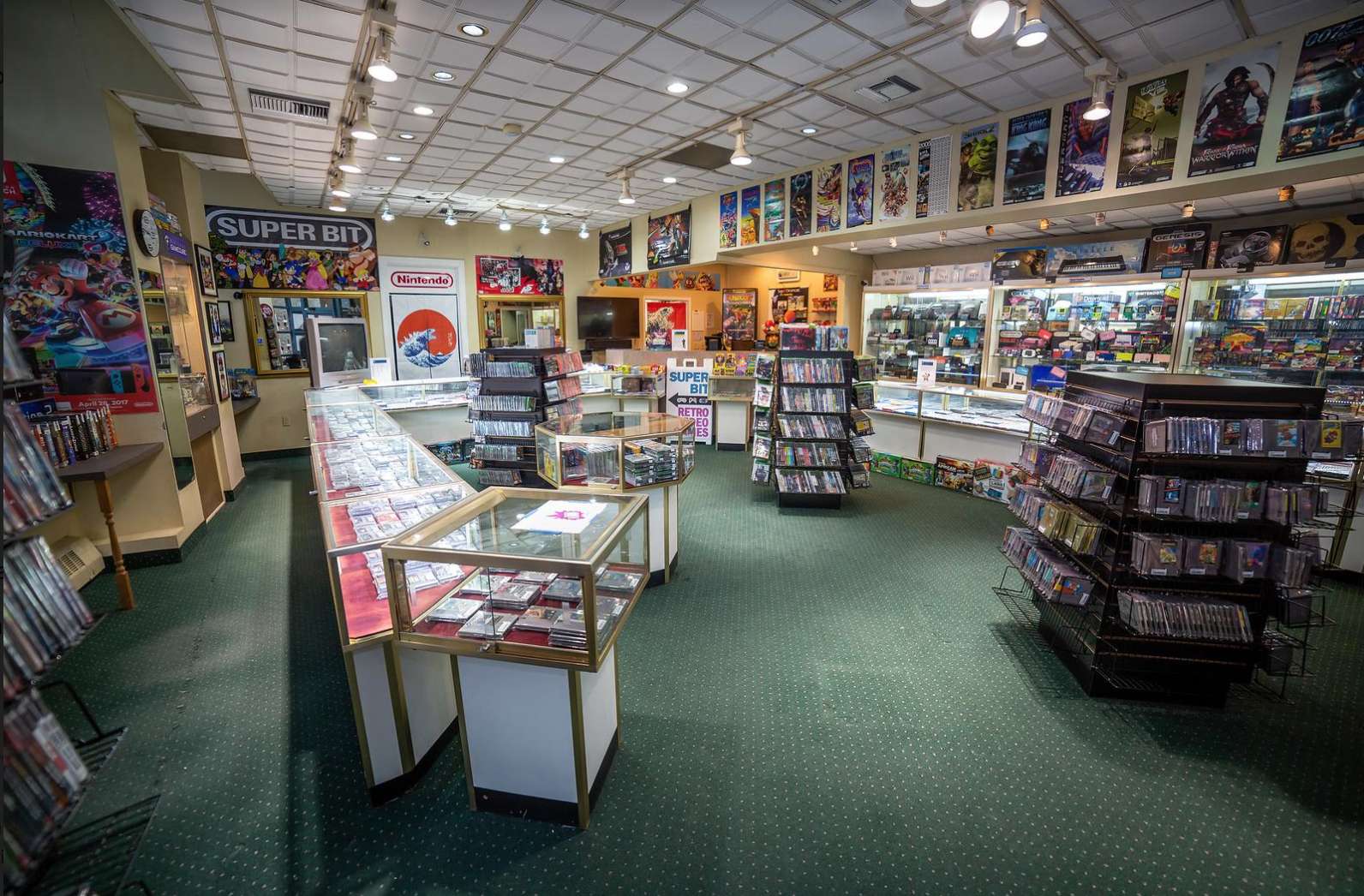
After the coronavirus pandemic altered plans to open Super Bit Video Games, owner Chris Jackson decided to temporarily shift his model so he could safely supply customers with video games and toys.
Instead of inviting people into the store (101 E. Broad Street), which sells retro video games and other similar items, Jackson said he set up a curbside pick-up system so customers could limit in-person contact.
“We were pretty much in a bad spot,” he said but added that between pick-up options, eBay sales and Instagram advertising, the business still ended up being sustainable.
Now, two weeks after customers have finally been welcomed into the store, sales have “substantially” picked up, according to Jackson.
“It’s been awesome to finally get to meet these people,” Jackson said. “The first two weeks have been outstanding.”
Though people were still stopping by for curbside pickup, many customers were awaiting the day when they could visit the interior of the store, he said.
“A lot of the people coming by seem to understand who we are and what we do,” he said. “Because of that, we have a good chance of this level of interest being maintained over a period of time.”
Since people aren’t really out-and-about like they used to be before COVID, Jackson also expects foot traffic to pick up in several months.
As a “destination retail location,” Jackson sees customers stopping by from all over the greater D.C. area, including Falls Church, Vienna, Arlington and even Maryland.
Because the store wasn’t open before the pandemic, Jackson isn’t sure if sales picked up because of quarantine boredom, but he did say the community seemed very supportive on social media before the pandemic hit Northern Virginia.
“One of the biggest reasons I wanted to open this place was to provide a place for the retro gaming community,” he said. “There aren’t a lot of places in this area that do this.”
Bestsellers so far, according to Jackson, include older Nintendo gaming systems along with GoldenEye, Super Mario 64 and even Sega systems, which he said he grew up with.
To keep customers safe, Jackson requests that customers wear masks and social distance while they browse.
“So far everyone has been great with that stuff,” he said, adding that they allow roughly four people maximum in the shop at any one time.
If people want to check out the shop, they can visit Wednesday-Saturday from 10 a.m. until 6 p.m. and Sundays from noon until 5 p.m. The shop is closed Mondays and Tuesdays.
Photo courtesy Chris Jackson

Due to the uncertainty of the COVID-19 pandemic, Fairfax County Public Schools (FCPS) has three scenarios for reopening schools this fall.
In May, a task force was created to prepare recommendations for FCPS reopening. On June 9, Gov. Ralph Northam unveiled his phased reopening plan, which provides flexibility for schools in Virginia.
The school board discussed the proposed Return to School plan, which includes three reopening scenarios, Monday afternoon.
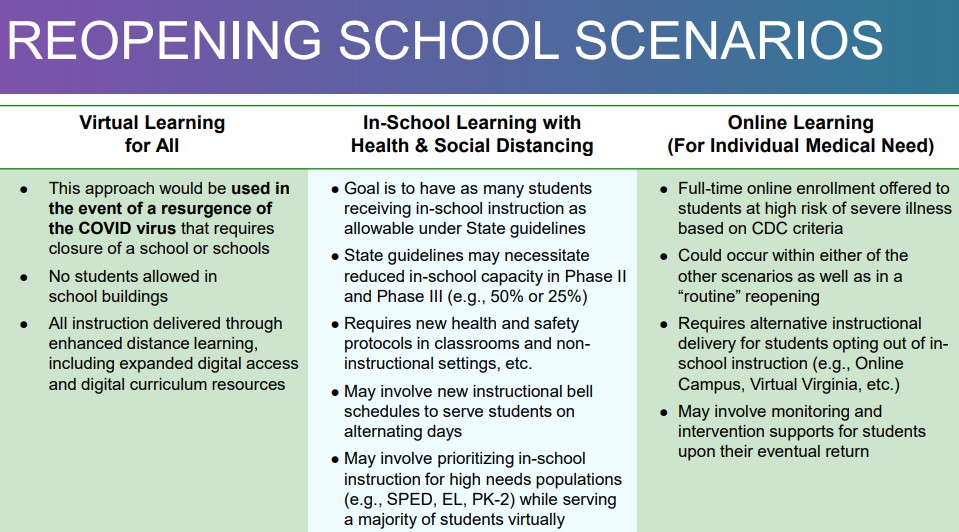
The three scenarios are:
- virtual learning for all students
- in-school learning with health and social distancing
- online learning for students with a high risker of severe illness
In the first scenario, students would not be allowed in buildings but the staff would be. Students would have four days of synchronous learning per week and one day of asynchronous learning.
Meanwhile, the second scenario has two proposals for attendance in the buildings at any one time — 50% and 25%.
In-school learning would include cleaning of high-touch areas, daily health screening forms, social distancing in classrooms and on buses and restricting buildings to visitors.
Finally, the third scenario would make groups of students and teachers for online instruction. With the online model, students would receive four days of synchronous learning per week and one day of asynchronous learning.
Additionally, FCPS has proposals for what would happen if the pandemic prompted another shutdown. The plan also mentions shared elements of the three scenarios — middle and high school students having access to laptops via FCPSOn — and how they address equity.
Discussion during the meeting today noted that FCPS needs to prepare for the possibility that more than one scenario might happen, especially if there’s a resurgence of COVID-19.
How to keep students and staff dominated the school board’s discussion.
Gloria Addo-Ayensu, the director of the Fairfax County Health Department, said that there aren’t plans to test students prior to them coming back to school. Addo-Ayensu noted that screening forms are a recommendation from the Centers for Disease Control and Prevention.
Addo-Ayensu and Benjamin Schwartz, a medical epidemiologist with Fairfax County, said that data on the impact of COVID-19 on kids is limited.
They said that the infection rate is unknown for kids and added that information is emerging on Multisystem Inflammatory Syndrome of Children (MIS-C) — a rare but serious COVID-19 complication.
Input from local health data and the Fairfax County Department of Health will inform the final decisions, according to the plan.
“You’re talking hundreds and hundreds of kids coming in at once,” Superintendent Scott Brabrand said, adding that social distancing cannot be guaranteed in schools.
Brabrand said that safety procedures are also important for retaining staff: “We don’t want folks resigning.”
FCPS is looking to get face shields for bus drivers and special education teachers, Brabrand noted. Ricardy Anderson, the representative for the Mason District, called for teachers to receive face shields as well.

If FCPS decides to go with an in-person reopening that alternates days for students, childcare could become an issue for families.
Dranesville District Representative Elaine Tholen suggested that FCPS coordinate with the Fairfax County Park Authority so that families and staff have childcare options.
Tholen proposed a “creative idea” to turn outdoor space at the schools and nearby parks into childcare centers contained in tents, adding that kids could access WiFi outside the schools.
Brabrand and Hunter Mill District Representative Melanie Meren agreed that more childcare is needed, with Brabrand calling it a “great idea.”
As FCPS moves forward with plans for the fall, the school board is aware that the botched rollout of online learning this spring puts more pressure on the school system to get the reopening right.
“We can’t risk another failure like we did before,” Providence District Representative Karl Frisch said.
Brabrand addressed the criticism of the distance learning attempts, saying it’s important that FCPS does not overpromise and under-deliver: “We did that before.”
Families will have several opportunities to provide feedback on the recommendations ahead of the deadline for FCPS to announce a reopening decision on June 26.
FCPS plans to host a town hall on Tuesday, June 16, that will talk about the Return to School plans. The town hall is set to run from 6:30-7:30 p.m. and will include Brabrand, the assistant superintendent of Facilities and Transportation Services and the manager of School Health Services.
People can also submit feedback by emailing the superintendent at [email protected] and fill out a survey.
FCPS also plans to hold a virtual public hearing on the Return to School plans at 6:30 p.m. on Thursday, June 18. People can register online to speak.
Photo via Element5 Digital/Unsplash, infographics via FCPS

Locals can use more indoor and outdoor facilities now that Fairfax County has entered the second phase of easing COVID-19 restrictions.
Fairfax County Public Schools (FCPS) announced today that its athletic fields have reopened for permitted use. Its basketball courts and playgrounds are also open.
“There is no special cleaning of playground equipment; visitors use at their own risk and must adhere to social distancing guidelines,” according to FCPS.
FCPS noted that the decision was based on guidelines from state and local health officials and the Centers for Disease Control and Prevention.
People can also start using indoor pools — outdoor pools opened during the first reopening phase — and head to fitness centers, which can open at 30% occupancy. Zoos and botanical gardens may also allow people to come back.
In the Town of Vienna, the Vienna Dog Park, tennis courts and the Community Garden reopened today and playgrounds will reopen Saturday (June 13).
Meanwhile, the City of Falls Church is now allowing people to use its playgrounds and picnic shelters. Its tennis courts are available by reservation-only for residents.
Photo by tommy boudreau on Unsplash

Falls Church Eatery Facing Eviction — “The Falls Church location of Hot N Juicy Crawfish is staring down an eviction lawsuit filed on June 1… The governor of the commonwealth put a moratorium on evictions earlier this week, but it only applies to residential tenants. The family-run business now finds itself fighting for its future in the neighborhood.” [Washington City Paper]
Farmers Markets Are Back — The McLean Farmers Market opens today and the Vienna Farmers Market returns on Saturday. [Tysons Reporter]
It’s Almost Showtime — “Just last week, AMC Theatres said it had ‘substantial doubt’ that the company could keep operating if pandemic-related closures continued. However, the company announced Tuesday it expects to reopen almost all of its locations worldwide by mid-July.” [Patch]
Law Enforcement Legislation — “Lawmakers in Virginia will take up the issue of police reform when they meet in a special session later this summer. The legislature joins the growing ranks of jurisdictions in the Washington region that are planning on tackling an issue that has taken increased urgency in the wake of widespread national protests sparked by the police killing of George Floyd.” [DCist]
Test Backlog — “State health officials announced Monday that 13,000 test results backlogged at the health department will be added to data tables that are updated daily to reflect the number of COVID-19 tests and cases in the state. Staff had prioritized positive test results, according to the statement, so the backlog largely includes negative test results.” [Inside NoVa]

On Friday, Northern Virginia localities will head into the second phase of rolling back COVID-19 restrictions. The Town of Vienna shared today what people can expect.
Community events have been canceled through August, and the town plans to offer virtual programming this summer, like no- and low-touch summer camps starting July 6.
Here’s an overview of the town’s tentative changes:
- Town Hall reopens to the public July 6 (currently open by appointment only)
- Vienna Community Center reopens July 6
- playgrounds reopen Saturday (June 13)
- Teen Center, Bowman House, Freeman Store & Museum, Town Green rentals and basketball courts remain closed
Tomorrow, the park restrooms, tennis courts, the Vienna Dog Park and the Community Garden will reopen.
Town officials will continue to meet virtually under a continuity of governance ordinance with occupancy capped at 26 people in the Council Chambers.
Fairfax County’s Hispanic community is bearing the brunt of the COVID-19 pandemic.
Although Hispanic individuals comprise just under 17% of the total population, they account for nearly 66% of all confirmed cases in the county.
The gap has raised alarms about equity issues between different racial groups in the county. County health officials say that higher infection rates may be caused by the need to go to work, lack of sick leave, the inability to socially distance while on the job and lack of unemployment insurance.
Cases have grown over the last three months in the Hispanic community, while the effort to flatten the curve in the black and white communities has been more successful, county data show.
“This risk reflects a group’s niche in society rather than a particular racial effect,” said Benjamin Schwartz, a medical epidemiologist with the Fairfax County Health Department.
Many local Hispanic residents work in jobs where the risk of transmission is especially high.
Roughly 25% of Hispanic men in the county work in natural resources, construction or maintenance, according to the 2018 American Community Survey. That’s compared to just 5% of blacks in the same industry.
Similarly, 45% of Hispanic women work in the service industry, more than double the percent of black women in the same industry, according to the survey.
Additionally, roughly 12% of Hispanic households are defined as overcrowded based on county metrics, compared to 4% of the black community and less than 1% of the white community.
But the same racial disparity is not prevalent in other parts of the county. In Richmond, for example, blacks are being hit hard by the pandemic while poor whites are disproportionately impacted in southwestern Virginia.
On a national level, blacks account for a higher share of confirmed cases and deaths compared to the rest of the population, according to the Kaiser Family Foundation.
Roughly 20% of the COVID-19 cases in the Fairfax Health District, which includes the county, do not contain race and ethnicity information.
Exacerbating the Divide
At Cornerstones, a nonprofit organization based in Reston, the pandemic has exacerbated the daily struggle with housing, poverty, quality education, and living-wage jobs.
Already, 33% of families in Cornerstones’ affordable rental housing have lost all or some of their income due to mass layoffs. Some have limited access to daycare and the internet, complicating long-distance learning, even if the school system provides a laptop for students.
Parking lots may offer free wifi access, but a car and time are needed to park there. Others turn to families and friends to watch their children, increasing the risk of exposure for all.
Public health officials are also seeking ways to improve community communication and increase testing in local hotspots, including the Town of Herndon.
In April, 385 new households came to Cornerstones’ pantry in need of food. That’s more than six times the number of new households in fiscal year 2019.
“For low-income members of the immigrant community in the time of COVID, it’s never one thing. The pandemic only exacerbates their daily struggling with housing, poverty, quality education, and living-wage jobs,” said Sara Newman, the division director of community change partnerships at Cornerstones.
For these residents, the financial burden of COVID-19 is “inescapable,” Newman said.
“Unpaid rents are continuing to accumulate. People keep working or look for employment regardless of the viral spread so they can keep a roof over their family and food on the table.”
Photo by Morgan Von Gunten/Unplash
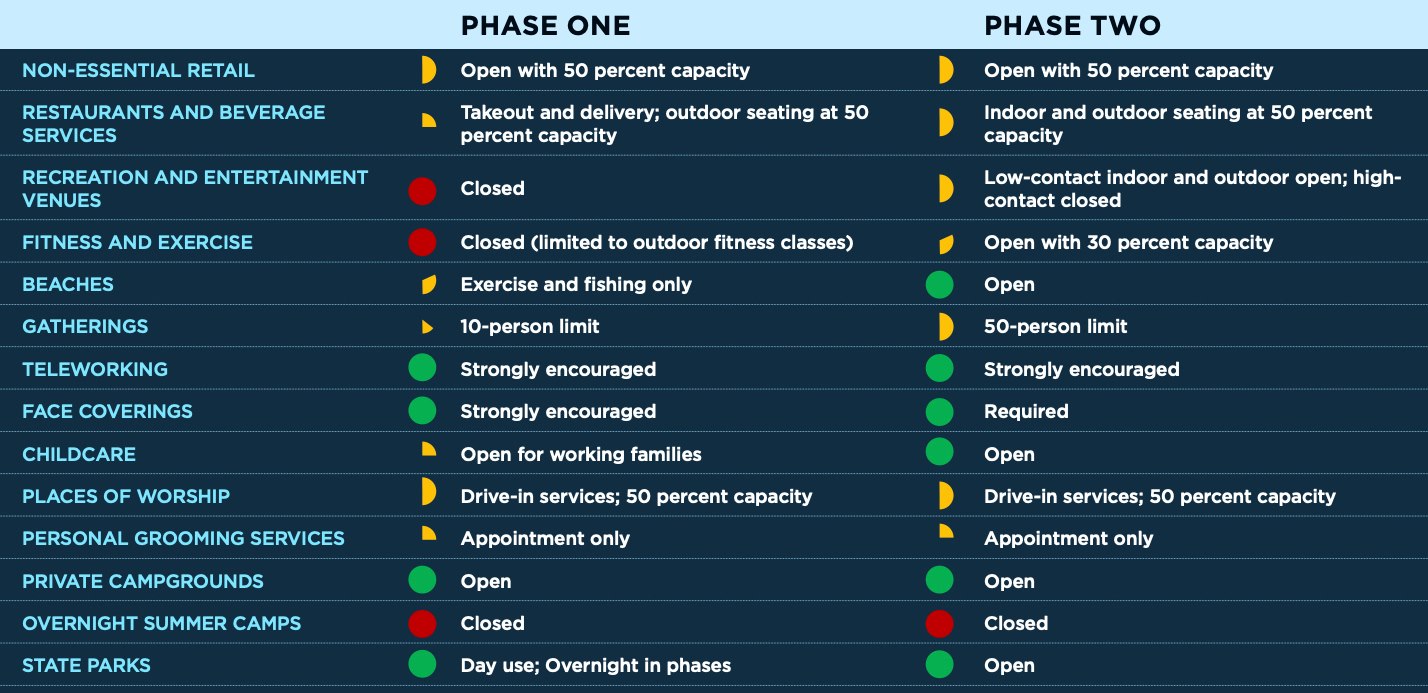
As Northern Virginia localities prepare for the second reopening phase on Friday, here’s what people can expect.
Northern Virginia and the City of Richmond delayed entering phase two when the rest of Virginia started the phase last Friday (June 5). Gov. Ralph Northam said that trends of COVID-19 data indicate that Northern Virginia is ready for the next phase.
Here’s a snapshot of the phase two guidelines:
- “safer at home” guidance, telework encouraged
- face coverings required in indoor public places
- social gathering maximum raised from 10 to 50
- restaurants can have indoor dining at 50% occupancy
- fitness centers can open indoor spaces at 30% occupancy
- indoor and outdoor swimming pools can open
- still closed: overnight summer camps, indoor entertainment venues, amusement parks, fairs and carnivals
Museums, zoos, aquariums, botanical gardens and outdoor concerts, sports and performing arts venues may open with some restrictions as long as they don’t have shared equipment.
“All businesses should still adhere to physical distancing guidelines, frequently clean and sanitize high contact surfaces, and continue enhanced workplace safety measures,” the plan says.
Meanwhile, phase two continues current guidelines for religious services, non-essential retail and personal grooming services, according to the plan.
School Schedule
Northam also unveiled yesterday his phased plan to reopen K-12 schools.
“I know that parents are very interested in our plans for how to safely return children to our classrooms,” Northam said.
Previously, Northam closed schools on March 23 for the remainder of the 2019-2020 school year. “I believe these closures have helped mitigate the spread of COVID-19,” he said.
Northam said that the plan will let schools “slowly” offer in-person classes for the summer and 2020-2021 school year.
“We’ll start with small groups, and we will allow each school division the flexibility that it needs to respond to the needs of its own locality,” Northam said, adding that the plan provides schools with options instead of serving as a mandate.
In every phase, the schools must follow guidance from the Centers for Disease Control and Prevention, including daily health screenings of students and staff, remote learning and working options for high-risk students and staff, required face coverings for staff — and encourage used for students — when social distancing isn’t an option.
More about the plan from Northam’s website:
The K-12 phased reopening plan was developed by the Office of the Secretary of Education, Virginia Department of Health, and the Virginia Department of Education and is informed by guidelines from the Centers for Disease Control and Prevention (CDC).
All PreK-12 schools in Virginia will be required to deliver new instruction to students for the 2020-2021 academic year, regardless of the operational status of school buildings. The PreK-12 guidance is aligned with the phases outlined in the Forward Virginia blueprint and provides opportunities for school divisions to begin offering in-person instruction to specific student groups…
Local school divisions will have discretion on how to operationalize within each phase and may choose to offer more limited in-person options than the phase permits, if local public health conditions necessitate. Entry into each phase is dependent on public health gating criteria, corresponding with the Forward Virginia plan. School divisions will have flexibility to implement plans based on the needs of their localities, within the parameters of the Commonwealth’s guidance.
The opportunities for in-person instruction in each phase are as follows:
- Phase One: special education programs and child care for working families
- Phase Two: Phase One plus preschool through third-grade students, English learners, and summer camps in school buildings
- Phase Three: all students may receive in-person instruction as can be accommodated with strict social distancing measures in place, which may require alternative schedules that blend in-person and remote learning for students
- Beyond Phase Three: divisions will resume “new-normal” operations under future guidance
Beginning with Phase Two, local divisions and private schools must submit plans to the Virginia Department of Education that include policies and procedures for implementing Virginia Department of Health and CDC mitigation strategies.
State Health Commissioner M. Norman Oliver, MD, MA has issued an Order of Public Health Emergency that requires all Virginia PreK-12 public and private schools to develop plans that demonstrate adherence to public health guidance. Public schools must also outline plans to offer new instruction to all students regardless of operational status.
Graph via Virginia Gov. Ralph Northam
