

The trajectory of COVID-19 cases in Fairfax County continues its upward climb this week.
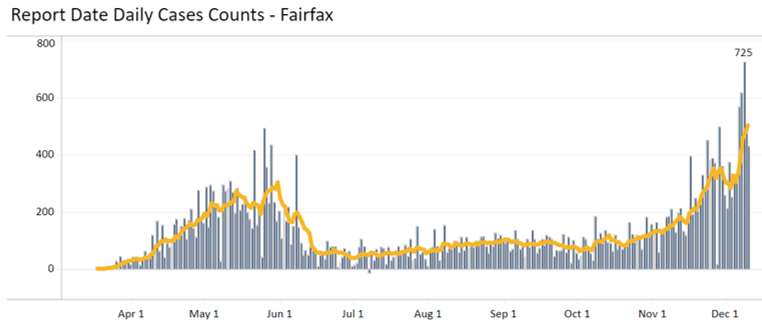
As of today (Monday), the trailing weekly average of new cases hit 471, with an all-time high reported on Saturday when cases hit a weekly average of 505.
While the county’s caseload continues to break all local records, the acceleration of new cases reported daily seems to have slowed slightly.
Nonetheless, the county reported the highest number of daily cases — 725 — last week on Dec. 7. Overall, the case trajectory continues to be exponential over the last month, suggesting that community transmission is occurring.
Another measure to determine community spread — the test rate positivity — remained high this week. The county’s rate is 10.6 percent, slightly down from last week’s rate of 11.5 percent. The state’s rate is 10.9 percent.
New statewide restrictions went into effect today, including a curfew from midnight to 5 a.m., a 10-person cap on social gatherings, and an expanded mandatory mask requirement.
An initial shipment of the Pfizer vaccine was cleared by the Food and Drug Administration last week. Virginia Gov. Ralph Northam stated that the Commonwealth would receive its first shipment within the following 24 to 48 hours with initial distribution targeted toward healthcare workers and long-term care facilities.
Meanwhile, the county is urging residents to celebrate the holidays with the people in their immediate household.
“We must find a way to recognize our traditions without putting ourselves and others at risk,” said Fairfax County Health Director Gloria Addo-Ayensu.
Here are some shopping tips for a healthy, safe and enjoyable holiday 🛍️
Check out our recommendations for family celebrations and entertainment: https://t.co/U2eRplxu3k pic.twitter.com/CpqHqa5TR9
— FairfaxCounty Health (@fairfaxhealth) December 13, 2020
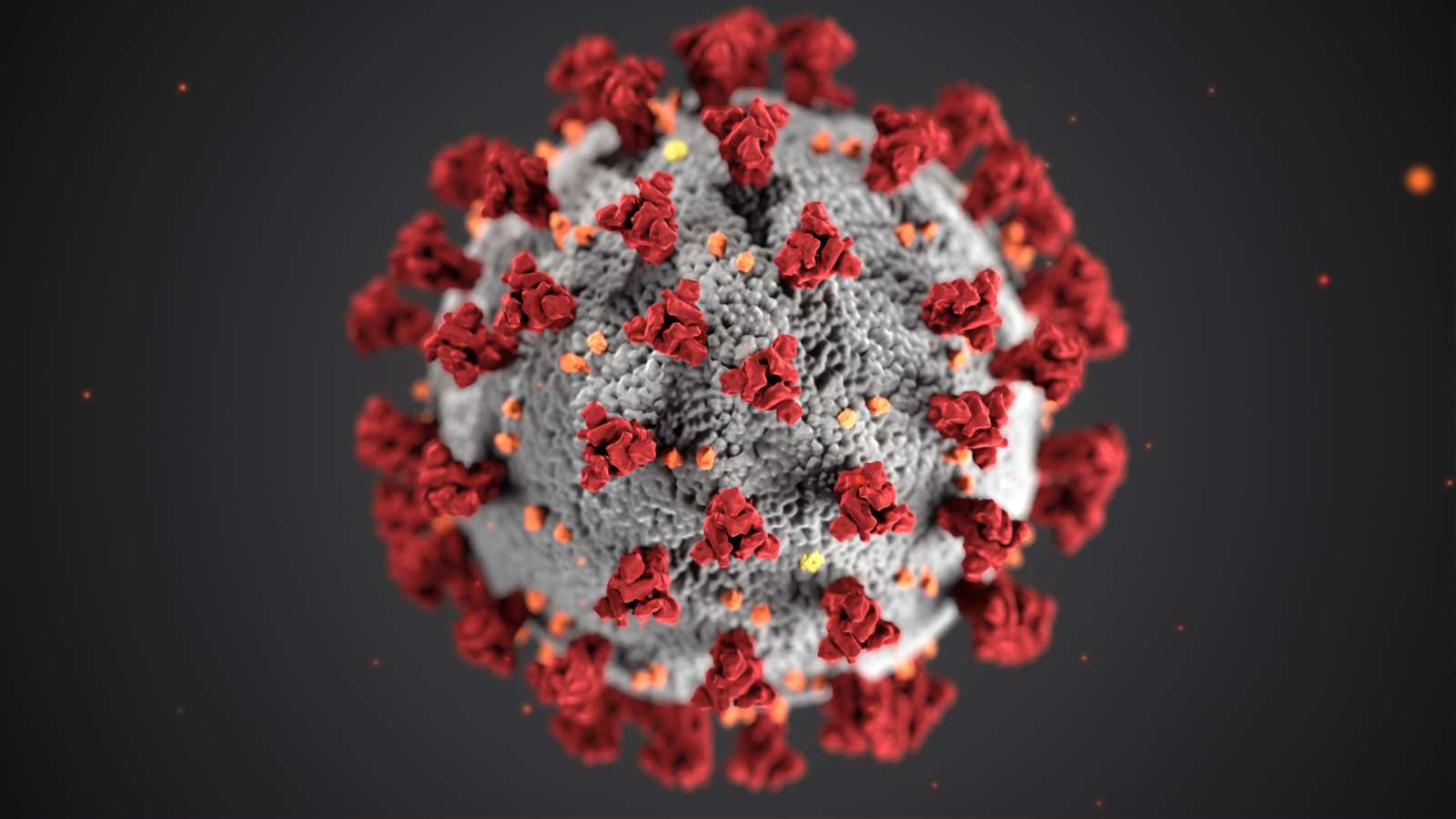
Image via CDC on Unsplash
Virginia Gov. Ralph Northam announced a series of new guidelines today (Thursday) aimed at getting the COVID-19 pandemic under control as case numbers soar in Fairfax County and throughout the state.
Starting at 12:01 a.m. on Dec. 14, all Virginians will be expected to stay at home between 12 and 5 a.m. unless they are traveling to and from work, obtaining food and goods, or seeking medical attention.
While the modified stay-at-home order only applies to those early morning hours, Northam urged people to stay home whenever possible during other hours of the day as well, stating that he “strongly” encourages people to telework if they can.
“We already have strong public health measures in place, and with these additional steps, we can turn this around,” Northam said. “Virginians, if you don’t have to be out, stay at home. Whenever we are around other people, we all need to wear a mask, indoors and out.”
The new COVID-19 mitigation measures that take effect on Monday also include an expansion of the state’s existing requirement that all Virginians 5 and older wear a mask in indoor public settings.
Now, all individuals 5 and older will be required to wear face coverings in all indoor settings other than their own home and in all outdoor public settings when within six feet of another person.
The limit on indoor and outdoor social gatherings has been reduced from 25 to 10 individuals. Like before, this rule applies primarily to parties, celebrations, and other social events, but not religious services, workplaces, and schools.
The prohibition on alcohol service in dining establishments after 10 p.m. remains in place, and all restaurant workers are required to wear a mask, even if they don’t interact with customers face-to-face.
Northam said that state agencies will step up their enforcement of social distancing, cleaning, and mask-wearing requirements for businesses. Virginia has issued 181 letters for COVID-19 rule violations so far.
However, the governor declined to follow the lead of some neighboring jurisdictions in shutting down indoor dining, stating that social distancing requirements already significantly reduce the capacity of restaurants.
Despite calls for a statewide return to virtual learning from teachers’ unions in Northern Virginia, Northam also did not introduce any new guidelines for educational institutions, leaving decisions regarding school operations up to the discretion of local officials.
“Local leaders know what’s right for their community,” Northam said. “We’re going to keep working with local leaders to make sure they have the information they need to make the right decisions.”
Virginia is now averaging 3,700 new COVID-19 cases per day, three times higher than the peak of 1,200 daily cases in May. The statewide testing positivity rate is 11%, and more than 2,000 Virginians are currently hospitalized, an 80% increase over the last four weeks.
The Fairfax Health District recorded 440 new cases today, and its seven-day average hit a new high of 501.9 cases after reporting a single-day record of 725 new cases on Dec. 8.
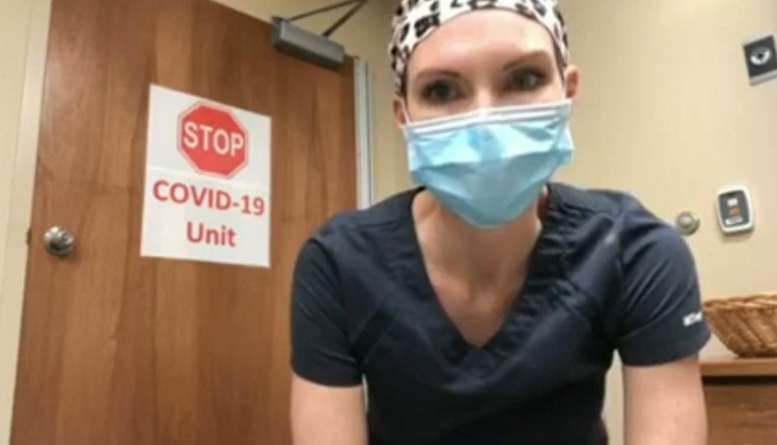
During his announcement, Northam played a video from a healthcare worker named Emily who has been working in a COVID-19 intensive care unit over the past month. She described holding patients’ hands as they died and putting an “ungodly” number of people in body bags.
“I cry a lot. This is real,” Emily said. “…If you could stop just one case by wearing a mask or staying home when you didn’t have to go out, it would help us so much.”
Images via Governor of Virginia/Facebook, Virginia Department of Health
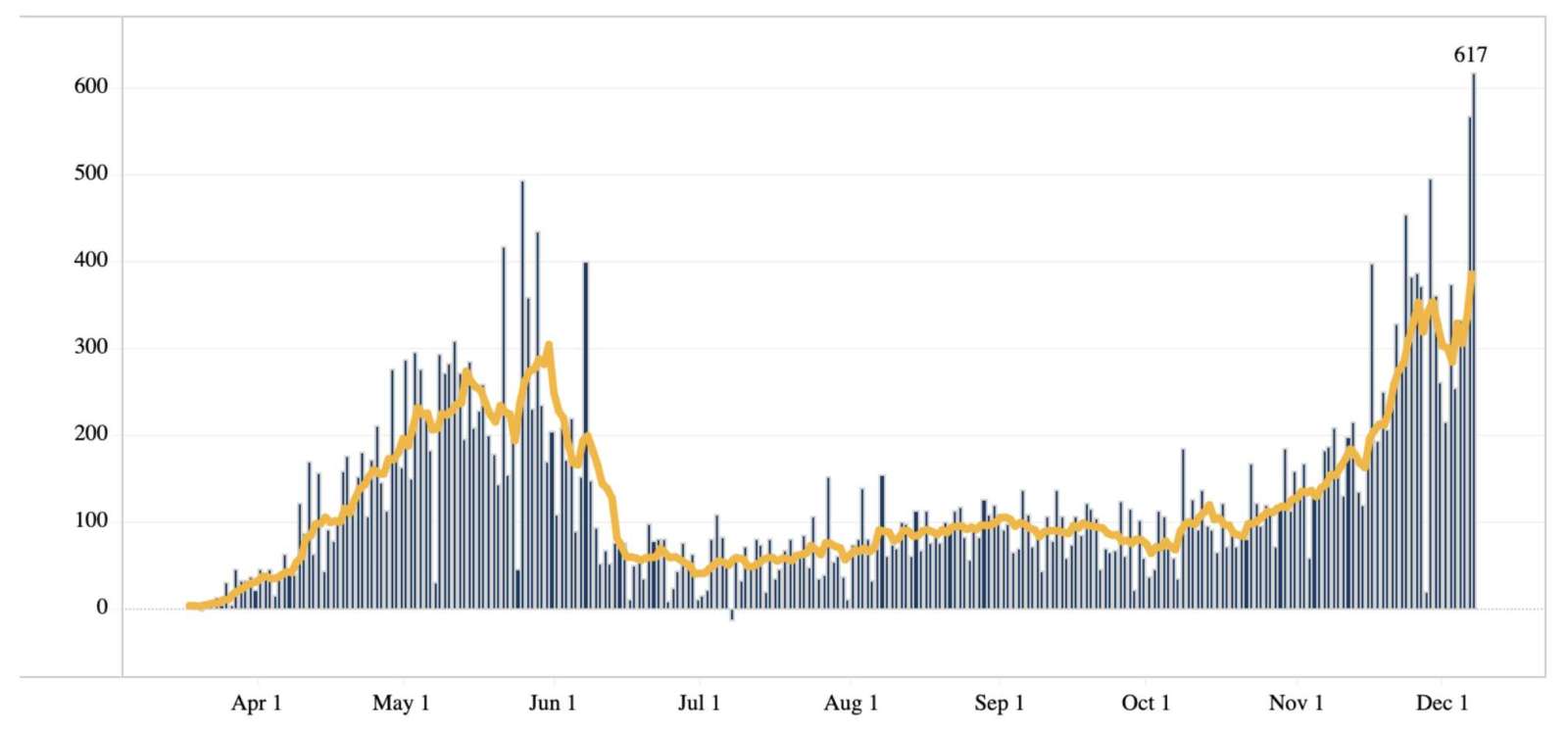
The number of new daily COVID-19 cases in Fairfax County has reached an all-time high as of this weekend, far surpassing the previous peak immediately after Thanksgiving weekend and previous records over the summer.
The county recorded the highest number of new cases in a single day today (Monday) — 617 — since the pandemic began earlier this year. Both numbers exceed case counts that hovered around 500 on Thanksgiving weekend and when cases first peaked in June.
Cases also continue to soar statewide. Virginia shattered previous records on Sunday by recording 3,880 new cases. Over the summer, cases peaked at 2,015.
The latest numbers suggest that the second wave of the COVID-19 pandemic is surging with more strength than ever before, even as the reality of a new vaccine materializes.
Hospitalizations in the state and in the county also continue to climb.
Fairfax County reported 20 new hospitalizations today (Monday) for a seven-day average of 15 daily new hospitalizations, the highest rate since early June. The 53 new hospitalizations reported on May 3 remains the county’s peak.
Another measure to determine community transmission — the weekly test positive rate — also continues to increase. The state’s test positivity rate is 10.8 percent while the county’s is at 11.5 percent. VDH updates data on the COVID-19 pandemic once a day at 5 p.m.
The county and the state have been preparing for the dispersal of a vaccine, which could have federal approval as early as this month. The Virginia Department of Health announced on Dec. 4 that the state is expecting to receive an estimated 480,000 doses of vaccine by the end of the year, a sizable increase from the roughly 70,000 doses that Gov. Ralph Northam previously stated Virginia would get in its first shipment.
Photo via Virginia Department of Health
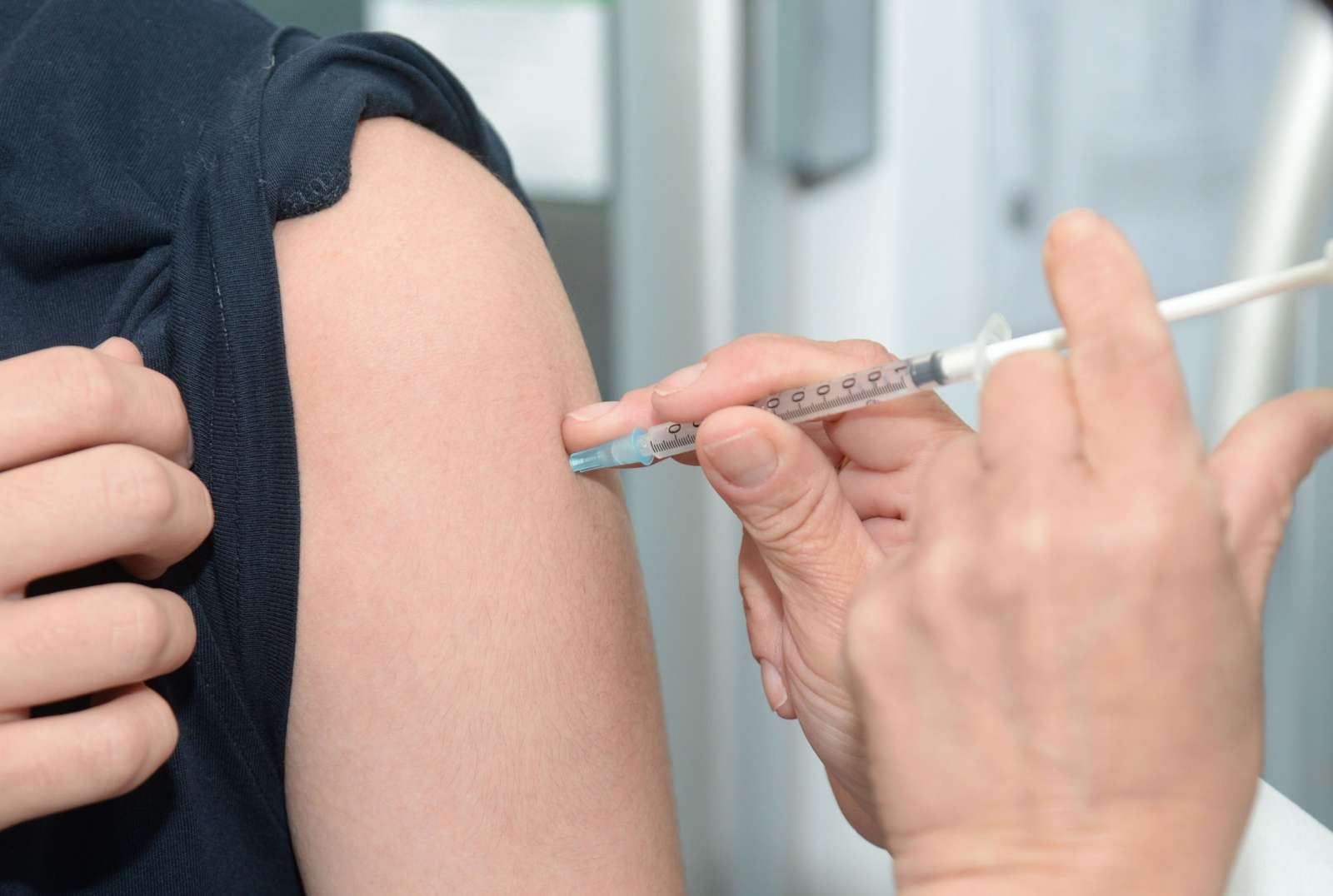
With the emergency approval of a COVID-19 vaccine expected before 2021, county officials are one step closer to getting ready for mass vaccination planning.
At a meeting on Tuesday (Dec. 1), the Fairfax County Board of Supervisors voted unanimously to accept a $500,000 state grant for the county’s mass vaccination program. Funds will be available through the state’s $22 million Coronavirus Relief Fund, which will be used to create a statewide program to distribute the vaccine once it is available.
Two companies — Pfizer and Moderna — are awaiting emergency authorizations of their vaccines in the United States. The U.S. Food and Drug and Administration is expected to authorize the approvals in mid-December.
The Centers for Disease Control and Prevention’s advisory committee on immunization practices voted earlier this week to make the first priority group health care workers and long-term care residents.
The county’s program also allocates roughly $14 million to help local health districts like the Fairfax Health District prepare for mass vaccination efforts. The grant must be used for facility rental costs, hiring for temporary positions, travel costs, printing, signage, and other expenses related to operating vaccination clinics.
Fairfax County Executive Brian Hill said his health department is actively working on a vaccination plan for the county “as we speak.” He noted that the county’s plan will depend heavily on the state’s strategy and other conditions, including who will receive the vaccine first.
“Once we know the particulars, we will have a plan in place per the Virginia Department of Health guidelines,” Hill said.
A county-based mass vaccination workgroup has been meeting since mid-June to discuss vaccination plans.
Hunter Mill District Supervisor Walter Alcorn urged the county to provide information on how the plan would be administered. He added that lines for the H1N1 vaccine program rivaled the lines the county recently saw for early voting.
“I just want to make sure we see what the plan is particularly as it relates to logistics,” he said.
Funds from the state grant must be spent by the end of the month, after which point unspent dollars will revert back to the state. However, county staff noted that the federal government could extend the date for the overall program. Acceptance of the grant requires no local match.
State officials are also considering other funding sources to support next year’s vaccination program. The Virginia Department of Health estimates that the program will cost $120 million.
Virginia is expected to get a little over 70,000 doses in the first shipment from Pfizer.
“When our turn comes, my family and I will have no hesitancy about getting vaccinated, and I strongly encourage every Virginian to get the vaccine. That is our only path to getting back to that near normal,” Gov. Ralph Northam said in a press briefing yesterday (Wednesday).
Image via Hyttalo Souza/Unsplash

Updated on 12/2/2020 — The McLean Metro Station is one of 19 stations that would close if the Washington Metropolitan Area Transit Authority adopts a new budget proposed for Fiscal Year 2022.
The stations being considered for closure were identified based on low ridership levels or their proximity to another Metro station. They were all shut down earlier this year as part of Metro’s efforts to conserve resources during the initial days of the COVID-19 pandemic.
WMATA said on Mar. 24 that the McLean Metro Station only recorded 148 Metrorail trips the previous day, making it among the least frequented stations in the system.
The Greensboro Metro Station is also on the list for potential closure, since it is within less than a mile of the Spring Hill and Tysons stations.
The potential station closures are among several drastic cuts on the table as WMATA attempts to fill a nealry $500 million deficit in its upcoming budget.
Scheduled for discussion during the WMATA Board of Directors’ finance committee meeting on Friday (Dec. 4), the proposal also suggests eliminating all weekend rail service, limiting weekday train service to every half hour, and slashing bus service from 60 to 41 routes.
Under the proposal, Metro would offer an “affordable bare-bones service network to sustain essential travel and support the region’s recovery.” Ridership would be reduced to around 45% of pre-pandemic levels, and the system would only operate from 5 a.m. to 9 p.m. on weekdays.
The proposal also calls for the elimination of 2,400 jobs in addition to workforce cuts already enacted this year.
“We’re facing, obviously, a historic budget crisis. It started in [Fiscal Year] ’21 and will continue in ’22,” Metro General Manager Paul Wiedefeld said.
Metro could possibly avoid this grim outlook if Congress passes another federal COVID-19 relief package that with funding for public transit. According to the American Public Transit Association, public transit needs $32 billion just to survive.
Metro was awarded $800 million from the CARES Act in May — funding that runs out early next year.
“The latest proposed cuts to WMATA employees and service is a crisis for our region and frankly, the country,” Fairfax County Board of Supervisors Chairman Jeff McKay said in a statement. “…Congress needs to step in immediately to fund WMATA and the countless ripple effects these cuts will have.”
If WMATA adopts Wiedefeld’s proposed budget, the 19 stations that would be closed could reopen based on the financial health of Metro.
The opening of additional Silver Line stations into Loudoun County will not be affected by the budget slashes, according to the presentation.
Metro’s fiscal year begins in July. Public hearings and outreach campaigns are planned until March.
Angela Woolsey contributed reporting
Staff Photo by Jay Westcott
COVID-19 is now more widespread in Fairfax County than it was when the pandemic’s first wave hit in the spring.
Reporting 262 new cases just today (Monday), the Fairfax Health District has recorded a total of 31,388 COVID-19 cases since the novel coronavirus first arrived in March. 2,561 people have been hospitalized, and 638 people have died from the disease.
Fairfax County officially surpassed the spring peak on Nov. 24 when it reported 308.3 cases on average over the previous seven days. The highest seven-day average recorded in the spring was 303 cases on May 31.
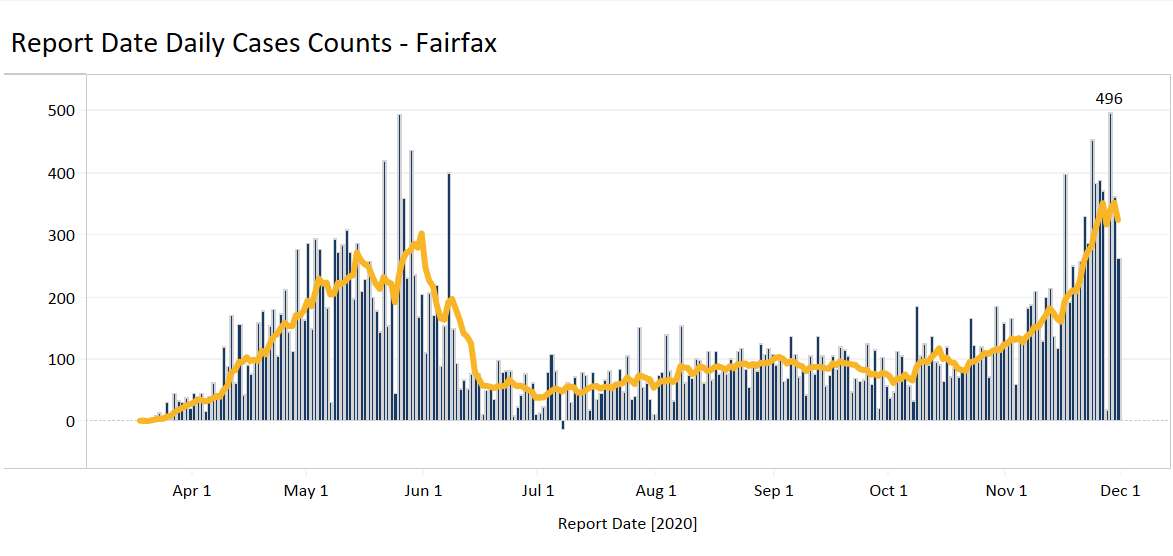
The weekly average caseload then hit an all-time high of 352.3 cases on Sunday (Nov. 29) before dipping down to a seven-day average of 324.9 cases today, according to Virginia Department of Health data.
Fairfax County also recorded its highest single-day case count of the pandemic this past weekend when it saw 496 new cases on Nov. 28. The previous record was 493 cases on May 25.
However, Fairfax County’s hospitalization and death rates remain well below where they were in the spring.
Currently, Fairfax County is averaging 7.86 hospitalizations over the past seven days, compared to the peak of 35.57 hospitalizations over seven days recorded on May 4. The county is seeing a seven-day average of 1.29 deaths right now, but the seven-day average was 14 deaths on May 4 after there was a single-day record of 31 deaths on May 3.
The surge in COVID-19 cases that Fairfax County is witnessing right now falls in line with the overall trend for Northern Virginia as a region, which recorded its highest seven-day moving average of 815.7 cases on Nov. 29.
By comparison, the pandemic’s spring surge peaked at a seven-day regional moving average of 685.3 cases on May 31.
The continued upward trajectory of COVID-19’s spread in Fairfax County comes after health officials warned that the traveling, intimate family gatherings, and in-person holiday shopping typically associated with Thanksgiving weekend could exacerbate the pandemic.
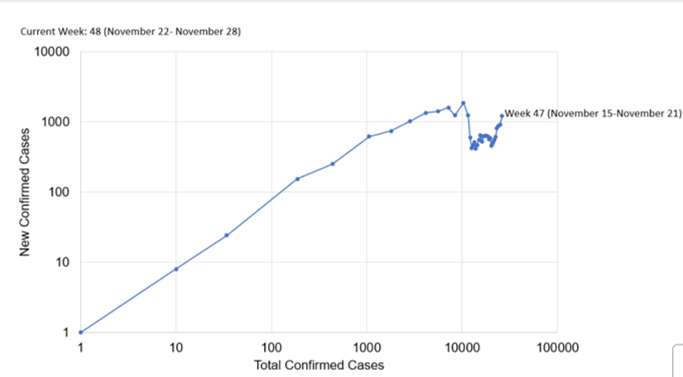
Given the lag time between when someone is exposed to the coronavirus and when a new case is actually reported, Fairfax County’s current COVID-19 data suggests the worst may still be on the horizon.
Images via CDC on Unsplash; graphs via Virginia Department of Health, Fairfax County Health Department
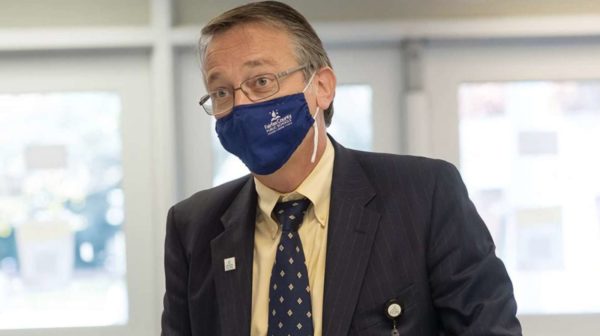
Updated at 3:30 on 11/24/2020 — Fairfax County Public Schools Superintendent Scott Brabrand announced today that plans to start in-person learning for more students, including kindergarteners, preschoolers, and special education students, on Dec. 1 have officially been put on hold.
“We understand that the pandemic’s disruption to your children’s education, to your jobs and incomes, and to your other caregiving responsibilities has been tremendous,” Brabrand said, stating that the school system will restart phasing students into in-person instruction again “as soon as our specific health metrics indicate that it is safe.”
Earlier — An ongoing local surge in COVID-19 cases has forced some Fairfax County Public Schools students to revert to online learning for the first time since FCPS started phasing in-person learning back in on Oct. 5.
FCPS announced on Monday (Nov. 23) that administrators had notified families that students in Group 4 would return to all-virtual instruction that day after Fairfax County’s health metrics surpassed the threshold that determines whether they should continue learning in person.
“The health metrics that guide our return to school in person reached a threshold yesterday that indicated we must dial back our Group 4 cohort in order to comply with the metrics we had stated to our community,” FCPS Director of News and Information Lucy Caldwell said in a statement.
Group 4 consists of 2,900 students, including elementary students at Burke School and students in specialized high school career preparatory programs. Affected classes range from culinary arts and musical theater to robotics, veterinary sciences, and the Junior Reserve Officers’ Training Corps (JROTC).
These students had been permitted to learn either virtually or through a hybrid model with two days of in-person instruction and two days of online instruction since Oct. 26.
Based on metrics recommended by the U.S. Centers for Disease Control and Prevention, FCPS determined that Group 4 could continue in-person learning as long as Fairfax County’s COVID-19 caseload did not exceed 200 cases per 100,000 people for seven consecutive days.
The county’s positivity rate for novel coronavirus testing also had to stay at or under 10%.
Fairfax County officially passed the 200-case threshold on Sunday (Nov. 22). At 289.8 cases per 100,000 people, Monday marked eight consecutive days of the county exceeding that limit.
The county’s cases-per-100,000-people and testing positivity rates must both fall under the established thresholds for seven consecutive days for students to resume in-person learning.
“As soon as these metrics indicate that it is safe to return to in-person instruction, Group 4 students will be phased back into schools,” FCPS said on Monday.
This is the second consecutive week that Fairfax County’s COVID-19 spread has required FCPS to revise its Return to School timeline.
Superintendent Scott Brabrand announced on Nov. 16 that FCPS would pause plans to welcome back an additional 6,800 kindergarten, preschool, and special education students that had been scheduled to return to classrooms on Nov. 17.
FCPS has set Dec. 1 as a possible new day for those students to start in-person learning, but with health experts anticipating the pandemic to worsen over Thanksgiving break, that date looks extremely tentative.
“As far as Group 5, we had indicated we would be communicating their in-person return closer to the December 1 date,” Caldwell said. “The numbers right now have not decreased as we have been hoping.”
With FCPS closed for the week starting on Wednesday, Caldwell says the school system will share more information on what Group 5 students can expect either today (Tuesday) or at the end of the break on Nov. 30.
Roughly 5,500 FCPS students are still attending in-person classes. Most of them are in special education, English Learners, career preparation, and other specialized programs.
Though their established thresholds are looser, those cohorts could potentially join Group 4 students in transitioning back to learning exclusively online.
“Given the COVID-19 infection rates in our community, we do anticipate that it may be necessary to dial up and dial back our in-person cohorts,” Caldwell said.
Photo via FCPS
As Thanksgiving approaches, Fairfax County reported the highest weekly average of COVID-19 cases since the pandemic began earlier this year. The news comes as the county and state record peaks in the number of new cases reported and appear to confirm fears of a second wave of cases.
Even as the possibility of a vaccine becomes reality, health officials are urging residents to avoid celebrating the holiday with members outside ones’ household, if possible.
As of today (Monday), the state’s health department reported 453 new cases, second only to the highest number of new cases (493) per day that was reported on June 25. To date, the county has had 38,798 cases, 2,474 hospitalizations and 614 deaths.
Based on the current trajectory of cases, more evidence shows that cases have been growing at an exponential rate in the county over the last month.
The county’s test positivity rate is 8.3 percent, more than one percentage point higher than the statewide test positive rate, which is currently 7.2 percent. In the state, 3,242 new cases were reported today, according to state health data.
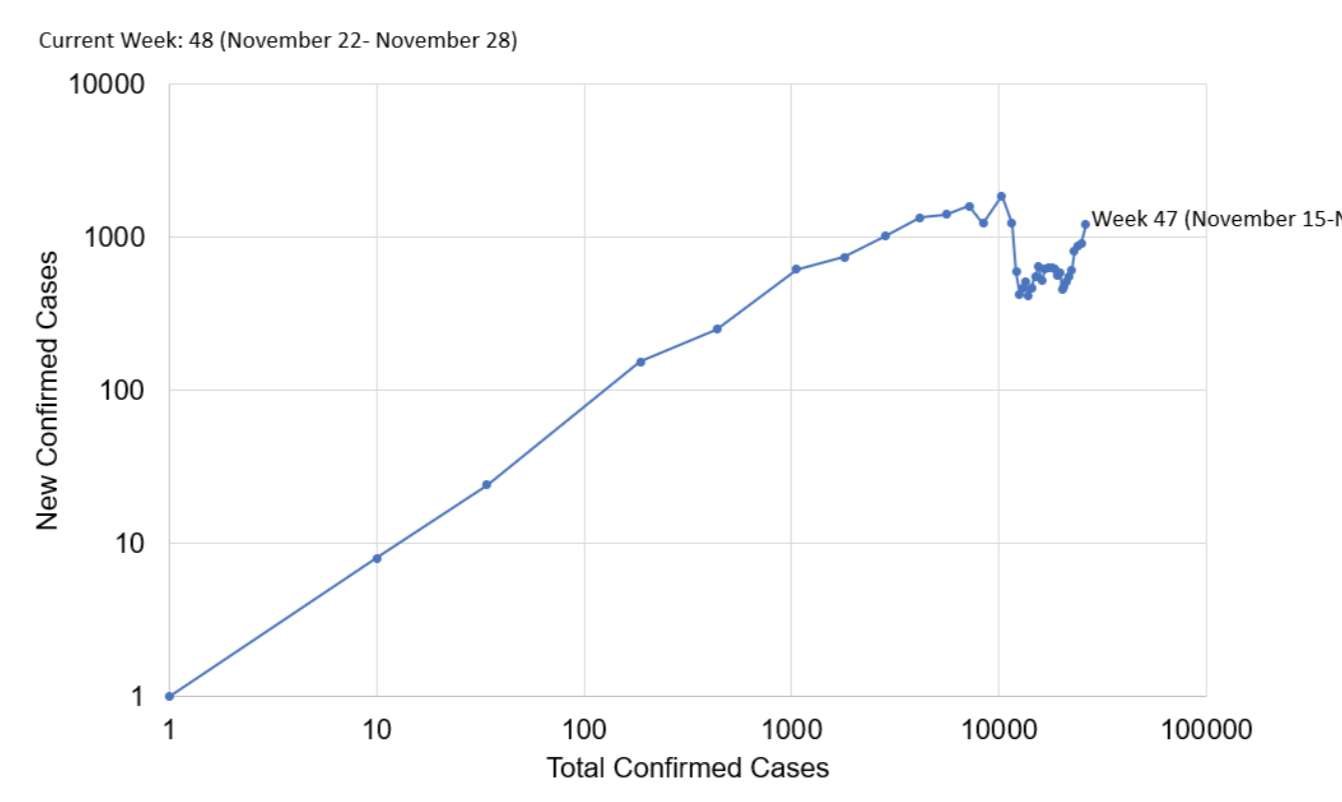
Similar surges have been detected regionally recently.
“The number of new COVID-19 cases in the Fairfax and Loudoun health districts is officially surging, according to new analysis from the University of Virginia, and the Northern Virginia region’s overall caseload is at its highest level since it peaked May 31,” Inside NOVA reported.
The Virginia Department of Health attributed some of today’s case counts to “a catch-up from the VDH data system being down for upgrades for a few hours this weekend.”
Hospitalizations, however, remain relatively low in the county. Two new hospitalizations were reported today, and no new deaths were reported.
Photo via Unsplash; graph via Fairfax County Department of Health
The long awaited COVID-19 vaccine is reportedly on its way.
On Nov. 9, Pfizer Inc. and its German partner BioNTech unveiled their preliminary results on a potential COVID-19 vaccine. Pfizer and BioNTech followed up with an announcement on Nov. 18 that the vaccine is 95% effective with a consistent efficacy across age, race, and ethnicity demographics during its ongoing trials.
On Friday, the pair formally requested an Emergency Use Authorization (EUA) from the U.S. Food and Drug Administration (FDA) to allow a faster rollout of a vaccine to the American public.
Shortly after Pfizer and BioNTech reported their preliminary results, Moderna Inc. and the National Institute of Allergy and Infectious Diseases (NIAID) — which is part of the National Institutes of Health — announced on Nov. 17 that they had co-developed a second vaccine candidate with an efficacy of 94.5%.
Well before these announcements, though, Fairfax County health officials were preparing for the distribution and accessibility of a COVID-19 vaccine once one becomes available.
“We’re working on all of the logistics of getting the vaccine out,” said Dr. Benjamin Schwartz, the Fairfax County Health Department’s director of epidemiology and population health. “We’re working on communicating with our health care partners, health care providers, [and] health care organizations so that we can not only make sure we’re able to vaccinate them, but also if they want to deliver vaccine to their patients, that we can tell them how to do so.”
Schwartz says plans are still being made as the county and health department learn more about the two-dose vaccine and its availability in the coming weeks or months.
Though some plans will need to be finalized, Schwartz shared that a portion of the county’s plans will be to focus initially on priority groups that are most at risk for severe illness. Those groups include health care workers as well as residents and staff of nursing homes.
The county’s method for distribution will also take a variety of approaches, according to Schwartz. He detailed that the vaccine will be distributed in some cases by facility and, in others, by the local health department. He also said that some national chain pharmacies and private providers interested in vaccinating would be part of the distribution plans.
Those plans are contingent on the availability of a vaccine. The FDA has scheduled a meeting of its Vaccines and Related Biological Products Advisory Committee (VRBPAC) for Dec. 10 to discuss the EUA request from Pfizer and BioNTech, according to a press release from the FDA. Though the VRBPAC may provide advice to the FDA, the FDA will have the final decision on the pharmaceutical companies’ EUA request.
If the EUA request is approved, Pfizer has announced plans to distribute the vaccine as soon as possible in December.
“We will continue the work already underway to make sure we can begin shipping the vaccine immediately after authorization or approval,” Pfizer Chairman and CEO Albert Bourla said in a video released by the company on Nov. 20. “Based on current projections, we expect to produce globally up to 50 million doses in 2020 and up to 1.3 billion doses by the end of 2021.”
According to Schwartz, once a vaccine is approved, its distribution would be a function of the federal government, which will decide how to allocate the vaccine to the states. The state health department would then allocate the vaccine to local health departments or jurisdictions.
“We’re still communicating and learning how that’s going to work,” Schwartz said. “We are in constant communication with the Virginia Department of Health and still obviously getting more information about how that’s going to occur.” Read More

Vienna residents and employees who are struggling to make housing and utility payments due to COVID-19 may be eligible for help.
Through its new CARES Fund, the Town of Vienna will provide $100,000 in assistance to residents and workers for up to one month of housing expenses and gas and electric bills. The program is first come, first served, and recipients do not need to repay the town, which will allocate the funds through direct payments.
“As the health crisis continues to linger, some families are finding it increasingly difficult to hold on financially,” Vienna Economic Development Manager Natalie Monkou said in a statement.
“The Town has been fortunate to have received CARES Act funding through Fairfax County that has helped us weather, to some degree, the financial impacts of the coronavirus pandemic,” Monkou said. “We want to share what we’ve received with those most in need and provide assistance to those who live and work in Vienna.”
The town may contribute up to 5% for administrative costs, making the entire appropriation worth up to $105,000. The Vienna Town Council approved an agreement establishing the fund on Nov. 2.
“We know the funding is limited, so we’re trying to target to help as many people as possible. That’s why it’s limited to up to one month for housing and utilities,” Monkou told the town council on Nov. 2.
The Vienna CARES Fund will be administered through Fairfax County, and the direct payments will be made by the Committee for Helping Others.
Although her office does not have a list, Monkou told the town council that staff “will be working to target residents and business workers who fit the eligibility criteria.”
Recipients must earn less than 60% of the area median income and must provide proof of income, mortgage or rental agreement, and utility billing.
Those who do not live in Vienna may be eligible if they live in Fairfax County and work for a business in Vienna with a valid business license.
The eligibility process could be quick, if applicants have the needed information on hand and can upload it, Monkou said, adding that for those who do not meet eligibility, there are other programs at the county level.
During the meeting, Mayor Linda Colbert told Monkou she was glad this program could work out.
“I know it’s not the end-all for the group of people we’re going to help, but I think it matters and it’s important that we’re doing this,” she said.
Interested Vienna residents and business employees must contact Fairfax County Coordinated Services Planning at (703) 222-0880 to be screened for eligibility before being referred to the Committee for Helping Others for assistance.
For more information about this program, email [email protected].
