


This regularly-scheduled sponsored Q&A column is written by Val Sotillo, Northern Virginia-based Realtor and Falls Church resident. Please submit your questions to her via email for response in future columns. Enjoy!
Question: We just bought our first home a couple of weeks ago. How can we tough out our first winter as homeowners and avoid weather related problems?
Answer: Winter is coming and you’re not too late to get your home ready for it. Hopefully you had a home inspection before buying your house and all the systems are working properly or you’re aware of any issues that need attention.
Whether you’re a new homeowner or have been one for a while, there’s always something you can do to avoid home maintenance issues and save some money.
Exterior
- Clean up the remnants of fall and check for any signs of wear to the exterior of your home.
- Check your rain gutter downspouts. When gutters backup, they overflow and water runs down your home. Keep the gutters clean and make sure water is getting moved away from the home. Add downspout extenders if necessary.
- Make sure the soil around your foundation hasn’t settled, creating areas for water to pool at your foundation. If you find a low spot, simply fill it in with some soil. Saturated soil around a foundation can create a problem when it freezes and thaws throughout the winter months.
- Always disconnect garden hoses before winter arrives. Drain garden hoses or freezing water will split them open and you’ll have to replace them every year.
- Keeping your home’s pipes warm and insulated is key to avoiding the expensive mess of a frozen and burst pipe. Treat any existing water leaks and cover any exposed pipes with insulation. Winterize your outdoor faucets to prevent them from freezing, which can lead to a burst pipe and spray hundreds of gallons inside the house.

Interior
- A high-tech thermostat (Nest is ideal and it makes a great gift for homeowners!) can do wonders for managing your energy bills, but even a regular programmable thermostat can lower your bills significantly. While you might prefer your home to be a toasty 72 degrees, it costs money to keep the temperature that high throughout the day. So while you’re at work, set it to something like 65 degrees and push it back up when you get home. While the savings might not seem like much in one bill, you’ll definitely notice at the end of the season.
- Change your filters and have the system inspected by a reputable HVAC contractor.
- If you have a few rooms you rarely use, just close those vents and shut the doors so that you’re only heating the rooms you do use.
- Did you know if you replace your old water heater with a new Energy Star-qualified heater, you could save up to 50% on your heating bills? That huge savings can help your new water heater pay for itself. Hot water heaters typically are set at 140 degrees. Lower the temperature on yours to 120 for fuel savings. You’ll reduce the chance of accidental burns and the water still will be plenty hot for bathing, washing clothes and doing dishes.
- Set fan blades to move clockwise in winter, and run fans slowly. This will lift cool air to the ceiling and push heated air down where you can enjoy it. Now set the thermostat a bit lower and enjoy the warmth.
- By properly insulating your home and sealing up your basement and attic, you can save up to 10% on your annual energy bills.
- Look for air leaks. Things like winter-weather stripping and draft stoppers are easy to install and even easier to remove when warmer weather rolls around. Only use your kitchen and bathroom exhaust fans when you absolutely have to — they pull hot air out of your home and can represent a small increase in your heating bill.
Don’t Forget The Attic Read More
This regularly-scheduled sponsored Q&A column is written by Val Sotillo, Northern Virginia-based Realtor and Falls Church resident. Please submit your questions to her via email for response in future columns. Enjoy!
Question: I’m looking to buy a remodeled home but I’m afraid of buying a bad flip and wondering if you have any tips for spotting them during showings.
Answer: Whether or not a home has been recently renovated for sale by an investor or homeowner, it’s important for you to do as much digging and inspecting as possible to verify the quality of the work and materials.
Never assume that because a home has been professionally remodeled and looks new that you do not need to perform an inspection. A home inspection is most valuable when buying a flipped property because you’re paying a premium for it being/appearing new.
However, inspections take place after entering into a purchase agreement and cost money, so I’ll highlight some things you can look for before making an offer that will give you an idea of the quality of the work.
Exterior
- Driveway — Repaving a driveway is expensive and often ignored in cheap flips. Look for cracks or other damage in the driveway. If the driveway has been redone, that’s a good sign.
- Roof — You don’t need to be a roofing expert to know whether a roof looks to be old and damaged or in new or good condition.
- Downspouts — You want to see water runoff extending away from the home by 8-10 ft. Not being dropped right next to it, which is often overlooked by inexperienced or cheap investors.
- Lawn — Grass takes time and money to look good so if the lawn is in good condition, that’s a great sign.
- Windows — Windows are very expensive and you can tell a lot about an investor by the windows they install. Are they good quality? Did they replace none, some or all of them? Do they have a warranty?
Interior
- Floor Plan — Did the investor make decisions that leave you scratching your head like a shortage of kitchen cabinets, awkward toilet placement or tiny clothes closets? It’s not easy to redesign a floor plan and novice remodelers almost always make mistakes.
- Plumbing — Turning on faucets will also signal if there are issues with the water pressure, or in some cases, if the hardware hasn’t been hooked up to a water source at all.
- Look Under the Cabinets — House flippers often focus on the cosmetic appeal of the home rather than the functionality. Look under the kitchen sink. If you see that the drain lines, disposal and wiring have been spray painted, it’s a sign the flipper or contractor is covering up a dated disposal.
- Electrical — Look at the inside of the panel door to see if it’s been labeled and if there is a signed/finalized permit sticker.
- Furnace — Does the exhaust pipe have a constant positive pitch leaving the unit until it reaches the exterior (note: this should also be the case on a gas water heater)?
- Door Frames/Shoe Molding — Are the frames around the doors and shoe molding along the floor new or painted over? New frames/molding looks clean and smooth while originals with paint over top look clumpy and damaged. If it’s original frames/molding, you might be looking at a quick, cheap flip.
Other
- In Virginia, sellers are not obligated to provide detailed property disclosures, but you can still ask the current owners for a written, detailed report of all the changes they’ve made to the property.
- Receipts — Try to confirm who did the work. Are they licensed, bonded and insured? Don’t be afraid to talk to the contractors who did the work and see how much they’re willing to share about the materials and crew they used.
- Days Since Last Sale — Look up how much time has lapsed between the investor’s purchase of the property and the completion of the remodel. The timing of the work should align with what the seller is claiming to have done and the time it takes to get the permits.
Check this link for a list of renovations and additions that need a permit in Fairfax County.
This regularly-scheduled sponsored Q&A column is written by Val Sotillo, Northern Virginia-based Realtor and Falls Church resident. Please submit your questions to her via email for response in future columns. Enjoy!
Question: Is there any new development within walking distance from the Vienna Metro?
Answer: Metro Row at Vienna station is a great option, located just south of the Vienna/Fairfax GMU Metro station.
Built by NVR Inc., it’s a 16-acre community with 141 luxury townhomes. They started Phase One in 2016, and they currently are on Phase Two, with expected delivery date for May/June 2019. There are only 18 home sites still available.
The Homes
Metro Row has been a favorite community for our clients because they deliver a spacious, luxury new townhouse at a great value. Now that they’re well into construction on the second (and last) phase, I thought it would be a good time to check in on what’s left and tour their latest models. Here’s what I like:
- Sizes vary from 2,283 to 2,695 sq. ft. and they accommodate up to 4 bedrooms and 3 and a half bathrooms. The first level can either be an in-law suit or a family room. Very practical use of space.
- My favorite units have access from the main level to a covered back porch with gas fireplace and private backyard. They are great for entertaining!
- The powder room in the model home had a glass tile accent wall and I think that’s an awesome idea you can also apply to the other bathrooms. See video below!
Location, Location, Location
Metro Row is located in a rapidly growing part of Fairfax. Consider these facts:
- Located 0.6 miles from the Vienna Metro (Orange Line makes downtown D.C. just 20 minutes away).
- Easy access to I-66 and 495.
- Walking distance from Pan Am Shopping Center, where you have everything you could possibly need: get groceries at Safeway, watch sports at Glory Days, your daily coffee at Starbucks, pet supplies at Pet Valu, many international restaurants (California Shabu Shabu offers a fun dining experience!) and many other services such as gas station, banks, UPS Store and fast food.
- About a mile from the upcoming mixed use development Scout on the Circle, which will have small shop retail, and a 54,000 sq. ft. Giant Food.
- A 5 minute drive to the thriving Mosaic District, offering many options for dining (True Food and B Side are some my favorites!), shopping, fitness and entertainment.
- 21 miles from both Reagan National Airport and Dulles Airport.
Price
The townhomes at Metro Row start at $759,990, and go up to the mid $900’s, depending on the finishes selected. The HOA fee is $111 (will decrease to $89 a month by community completion) and it includes common ground maintenance, snow removal, trash removal, recycling, grass cutting and landscaping.
As for incentives, they offer up to $20,000 off quick move-ins and a special gift in the model home valued up to $2,500.
If you would like more details about Metro Row, schedule a tour, explore more neighborhoods, or if you’d like a question answered in my weekly column, please send an email to [email protected]. I hope to hear from you soon!
Val Sotillo is a licensed Realtor in Virginia, Washington D.C., and Maryland with Real Living At Home, 2420 Wilson Blvd #101 Arlington, VA 22201, 703-390-9460.
This regularly-scheduled sponsored Q&A column is written by Val Sotillo, Northern Virginia-based Realtor and Falls Church resident. Please submit your questions to her via email for response in future columns. Enjoy!
Question: We are planning to buy a home in the D.C. area in the next 12 months. What should we know before buying a house that we can get started with now?
Answer: Whether you’re a first-time buyer, experienced buyer relocating from out-of-state, or moving locally here’s a list of things I review and plan out with clients before getting into the full swing of house hunting.
Requirements, Timelines, and Contracts
The most important thing you can do as a buyer is take time to become educated on the process, timelines and key contractual terms/obligations in the area you plan to search. This is also a good way to meet and vet different real estate agents early on to get a feel for who is willing to spend time with you up-front on education and planning vs pushing immediately for a sale.
Get Pre-Approved
It’s important to identify a lender who provides high quality service and also has loan products that fit your profile (down payment, credit score, job industry, etc).
Getting a pre-approval from a lender who reviews and verifies your financial documents, income, and employment will decrease the chances of you being rejected from a loan, increase your leverage in contract negotiations and reduce the amount of work required of you once you’re under contract.
Set A Monthly Budget
Most people qualify for more than they actually want to spend, especially dual-income buyers, so budgeting is important. Set a monthly budget for total housing expenses including mortgage, taxes, insurance and applicable Association fees or mortgage insurance.
Do You Want Representation?
Determine if you want to be represented by a Realtor (breaking news… I highly recommend it). In most cases, the seller pays commission to the buyer’s broker, so representation often comes at little or no cost to buyers.
Cash Needs + Savings
You need cash savings for your down payment + closing costs of 2.5-3% of the sales price. When your offer gets accepted, you need to deposit 1-5% of the sale price into an escrow account to secure the sale.
You’ll spend about $1,000 before closing on inspections and appraisal. Don’t forget moving expenses, furniture, painting, etc. You should have 3-6 months of emergency savings tucked away after everything is paid for.
How Long Will You Live There?
This is the most underrated conversation for buyers to have when setting a budget and determining criteria. Your home-buying strategy should look very different if you’re planning to own for 3-5 years vs 10-12 years so give it serious thought and be realistic.
Sometimes the best investment is buying a house that allows you to live there longer and eliminates one or more real estate transactions in your lifetime. The value you get out of being in a home for 10 years vs 3 years far surpasses a small increase in your budget.
Deadlines and Lease Terms
Figure out if you have any strict deadlines for the move and if there are costs of buying before or after that deadline. If you’re renting, make sure you find out the cost of early termination or if month-to-month leasing is an option.
I hope this list is helpful not just for local D.C. metro readers, but for anybody getting started with their home search and wondering what you should know before buying a house.
These are the conversations and steps I take with my clients every day to make sure they’re prepared and have the right strategy in place before we even look at homes together. I’m sure I left a few things off this list, but this should get you 95% of the way there.
If you’d like a question answered in my weekly column, please send an email to [email protected]. I hope to hear from you soon!
Val Sotillo is a licensed Realtor in Virginia, Washington D.C., and Maryland with Real Living At Home, 2420 Wilson Blvd #101 Arlington, VA 22201, 703-390-9460.
This regularly-scheduled sponsored Q&A column is written by Val Sotillo, Northern Virginia-based Realtor and Falls Church resident. Please submit your questions to her via email for response in future columns. Enjoy!
Question: I’m the Treasurer at [redacted Condo Association] and we’re working on the 2019 budget. What’s a good way for us to save money in the budget without compromising the health and maintenance of the building?
Answer: Review your Master Insurance Policy. I know, it’s not the most exciting answer, but your insurance policy is likely a top three expense on your balance sheet every year and if you haven’t reviewed it lately, there’s a good chance you can cut the cost by 5% or more and probably improve your coverage at the same time.
I’m not an expert in insurance so I asked Andrew Schlaffer, Vice President at USI Insurance Service’s Community Association Practice to provide some details on what Board’s should look for when they do a review of their Master Policy. Take it away Andrew…
Pillars Of Insurance Reviews
Condo insurance reviews require a holistic approach, so it’s important to break the cost into a few distinct categories: insurance premium, deductible expense and out-of-pocket costs. To effectively accomplish long-term savings, all three of these categories need to be considered and addressed with a qualified insurance professional.
Adjust Coverage Responsibly To Save On Premium
Premium is certainly a factor to consider during the insurance selection process; however, available insurance products differ significantly.
Coverages and services should be very carefully analyzed and compared. While omitting various coverages will save premium dollars, it might also result in substantially increased costs to the Association for out-of-pocket expenses related to uncovered claims.
It is critical to work with a professional who understands local insurance needs and can adjust your insurance program in a way that maximizes premium savings while maintaining adequate insurance coverage. Some coverages may be required by statute and/or Association documents, so cutting required coverage exposes the board to unwanted risk.
Deductibles Based On Loss History
Associations with strong financials often choose to increase their property deductibles which can provide immediate savings of 2-5%. Deductibles range from $2,500 to $25,000+.
When considering deductibles, it is important for the Association to review their loss history and the loss history of comparable buildings in an effort to obtain an accurate estimate for deductible expenses. Read More
This regularly-scheduled sponsored Q&A column is written by Val Sotillo, Northern Virginia-based Realtor and Falls Church resident. Please submit your questions to her via email for response in future columns. Enjoy!
Question: We are moving to Tysons and would like to get a dog. Is there a dog friendly neighborhood near Tysons?
Answer: Yes and yes! It’s no secret that homebuyers love dogs and now they are starting to influence the decisions they make about housing.
A recent survey by SunTrust Mortgage found that a third of millennials who purchased their first home said they were influenced by the need to have space for a dog. For those with dogs, renting can be more expensive and a hassle; home ownership takes some of the stress off by providing a better living situation.
I mean, who can resist dogs? They love you unconditionally, they can cheer up your worst days and they’re the number 3 reason young people are buying their first homes — ahead of marriage or having a baby.
If you have dogs you know that they need daily exercise, which is more than just a walk, no matter what the weather is like. I’ve personally discovered that having a dog park nearby can help you exercise and socialize your dog.
I took my volunteers Ringo, Pepper and Parker on a field trip to test some dog parks and even when it was a rainy day, they took their jobs very serious!

Fairfax County has many great dog parks. Here are the parks closest to Tysons that we visited during our research:
The Mile Dog Park
Located off of Westbranch Drive and Westpark Drive. I could not find a specific address but that’s the closest intersection. It’s a round fenced park with gravel, which makes it mud free on rainy days. There is plenty of street parking and according to a regular visitor, the park never gets too busy.
There is no separation for small and big dogs. It has benches for owners and the park is clean with many trash cans and free bags for cleanup. I noticed there are no trees around so it must be very sunny during summer.
There were no toys available for dogs so bring your own tennis balls to play fetch!
My awesome volunteers ran a few laps around the park and seemed to love it. Just make sure you bring water with you because there are no fountains available.
A great feature for families: there is a playground right next to the park, so you can take your human child and your furry child out for some fun at the same time.
Vienna Dog Park
The Vienna Dog Park is located at 700 Courthouse Road, SW. The parking lot is off of Old Courthouse Road. If the lot is full, patrons can park up the hill at Nottoway Park basketball courts.
The Vienna Dog Park offers a doggie and human water fountain, fully shaded wood chip surface, many trees, a fully fenced area that’s 5 feet high with double gates and agility equipment.
The park can get very busy on evenings and weekends, but that means that your pup will have many friends to play with!
Life Is Easier When You Know The Rules
Here’s a few tips to help you and your dog enjoy the awesome dog parks Fairfax County has to share:
- Safety first: do not unleash your dog until it’s safe in a gated area.
- Always lock your car and don’t leave valuables on sight.
- Dog parks usually have double gates for safety. Make sure one is always locked before opening the other.
- Keep your dogs up to date with their rabies shots.
- Always clean up after your dog.
- Make sure dogs have clean, drinking water.
- Be responsible for your dog’s behavior. If he plays too rough, acts aggressive, or he seems threatened by another dog, just remove him from the situation. Dogs get over it quickly!
- If you bring children to the dog park, expect them to be approached and kissed by the dogs. They think they’re puppies too! If your kids are scared of dogs, it’s better not to bring them inside the park.
I Want A Dog
I’ll be more than happy to help you with that! Dogs bring you joy and happiness, and they can also make you more active and healthy. So think for a minute, if they can save your life, maybe you should consider a rescue!
I’m a strong believer in adopting over buying a dog. Did you know that when you adopt a pet, you make space in the shelter for another homeless animal? So you’re technically rescuing two!
Check out your local humane society. You can adopt, donate or volunteer.
Ringo the foxhound was adopted from Fairfax County Animal Shelter, a rescue with 90% adoption success. All pets are neutered and adoption fees are low. They host children’s birthday parties at the shelter and they include games, shelter tours, pet visits and optional crafts. What a great idea!
Pepper is a rescue from Fairfax Humane Society.
You can also look at Friends of Homeless Animals, a no kill shelter and Wolf Trap Animal Rescue.
If you are considering buying a home with enough space for a pet, I’ll be thrilled to help you. Please contact me at [email protected] to schedule a consultation and we can discuss neighborhoods and options for you. I’ll be happy to visit an animal shelter with you too!
If you’d like a question answered in my weekly column, please send an email to [email protected]. I hope to hear from you soon!
Val Sotillo is a licensed Realtor in Virginia, Washington D.C., and Maryland with Real Living At Home, 2420 Wilson Blvd #101 Arlington, VA 22201, 703-390-9460.
This regularly-scheduled sponsored Q&A column is written by Val Sotillo, Northern Virginia-based Realtor and Falls Church resident. Please submit your questions to her via email for response in future columns. Enjoy!
Question: Are funding fees on VA loans Eligible for Seller Credits?
Answer: Loans guaranteed by the Department of Veterans Affairs are known as VA loans and provide current and former Service members with an opportunity to purchase a home with as little as 0% down.
In addition to the normal closing costs (title fees, transfer taxes, etc), a funding fee is charged at settlement, which is equal to anywhere from 1.25-3.3% of the loan amount, depending on size of down payment, type of service and whether or not it’s the borrower’s first time using the VA loan program. It’s a fee paid to the VA on every loan to offset the cost of loans that default (similar to Mortgage Insurance on non-VA loans).
Disabled veterans are eligible to have the entire fee waived.
Buyers can negotiate for seller credits to reduce or eliminate the out-of-pocket expense of closing costs at settlement. Fortunately, the funding fee falls into this category, along with the rest of the standard closing costs associated with a VA loan, and buyers are eligible to have all of these costs covered by the seller.
In theory, if a buyer is able to negotiate 100% of closing costs paid by the seller and chooses a 0% down payment loan, a home can be purchased cash-free.
If the buyer is unable to negotiate seller credits to cover the funding fee, they’re also allowed to roll the funding fee into the mortgage so that it becomes part of their monthly payment.
Did You Know?
I spoke with Myles Wilson, Private Mortgage Banker with Wells Fargo Home Mortgage, and he provided a list of things most veterans don’t know about VA home loans:
- Most people think a VA loan max is $454,150, when actually financing is available up to $1,500,000.
- It is a myth that you can use your VA entitlement option once and only to purchase your first home. If you purchased a home with a VA loan, you can sell it and pay off the VA loan completely, and you can re-use your benefit to buy another home. Your entitlement is restored in full.
- Most people think you cannot assume a VA loan. They are 100% assumable for veterans and non-veterans if qualified.
- Borrowers are not limited to fixed rates only. Wells Fargo provides 5/1 arms and various fixed options.
- VA loans are available for the purchase of condos, planned unit developments, manufactured homes and 2-4 unit properties.
- Many think active duty or deployed service members cannot use their VA benefit. Many depending on length of service are eligible for entitlement.
- Reserves and National Guard are eligible as well, their funding fee is slightly higher at 2.4% compared to 2.15% for regular military.
Advantages Of VA Loans Read More
This regularly-scheduled sponsored Q&A column is written by Val Sotillo, Northern Virginia-based Realtor and Falls Church resident. Please submit your questions to her via email for response in future columns. Enjoy!
Question: My neighbor is mowing a portion of the lawn I thought was mine, but my neighbor claims it is his. Is this something I can prove through my title work?
Answer: Clients often ask me whether or not they should purchase a property survey, which is optional, when they buy their home. I think that in almost every case it is worth the relatively small investment (usually about $300-$400 for a standard survey).
I was recently chatting with Liz Wasserman of Universal Title, one of a small group of excellent title companies in Northern Virginia (they also serve D.C. and MD) and one of the few I recommend to clients. She shared a story with me about a client who did not order a survey and ended up incorrectly assuming that a section of land was theirs.
Given how frequently I am asked about ordering surveys, I thought it was a good opportunity for Liz to share the story and provide some reasons why it’s a good idea to order a survey when you buy a home. Take it away Liz…
A new homeowner noticed a neighbor mowing part of her front lawn. When she asked the neighbor why he was mowing her lawn, the neighbor replied the property he was mowing belonged to him, even though the line of trees separating the two houses looked as if the property belonged to the new homeowner.
She called her title agent and found out the neighbor was correct. “How can that be? Didn’t you search my property?”
Unfortunately, the new homeowner did not understand the difference between a title search and a survey and failed to purchase a survey. A title search confirms ownership of property, but it does not show the details of the property location.
What Is a Survey?
A survey is a map of real property that shows where the property is located on the earth, the boundary lines of the property, the improvements on the land and access to the property.
Five Great Reasons to Purchase a Survey
- Undisclosed rights and easements: You may own your new home and its surrounding land, but someone else might have a right to use a portion of your property. A survey will show physical evidence of the rights of others to use your property for access, parking, utilities and other situations.
- Undiscovered encroachments: A survey may be the only way to tell if a third party holds a claim to part of your property because their improvements such as a garage, fence or swimming pool are on your land.
- House built on incorrect lot: It may seem impossible, but sometimes a house is built on the wrong lot. A survey provides peace of mind by showing the exact location of the house you are buying.
- Size of the property: A survey shows the exact dimensions of the property’s boundary lines and how much land is included within those lines.
- Adding on in the future: Many residential platted lots have building restrictions known as setbacks which prohibit building anything within a certain distance from the boundary lines. If you are thinking of adding on in the future, a survey will help you determine if the property is right for both your current and future plans.
This regularly-scheduled sponsored Q&A column is written by Val Sotillo, Northern Virginia-based Realtor and Falls Church resident. Please submit your questions to her via email for response in future columns. Enjoy!
Question: GreatSchools.org changed the ratings for Fairfax County schools. How important is it to consider school ratings when buying a home?
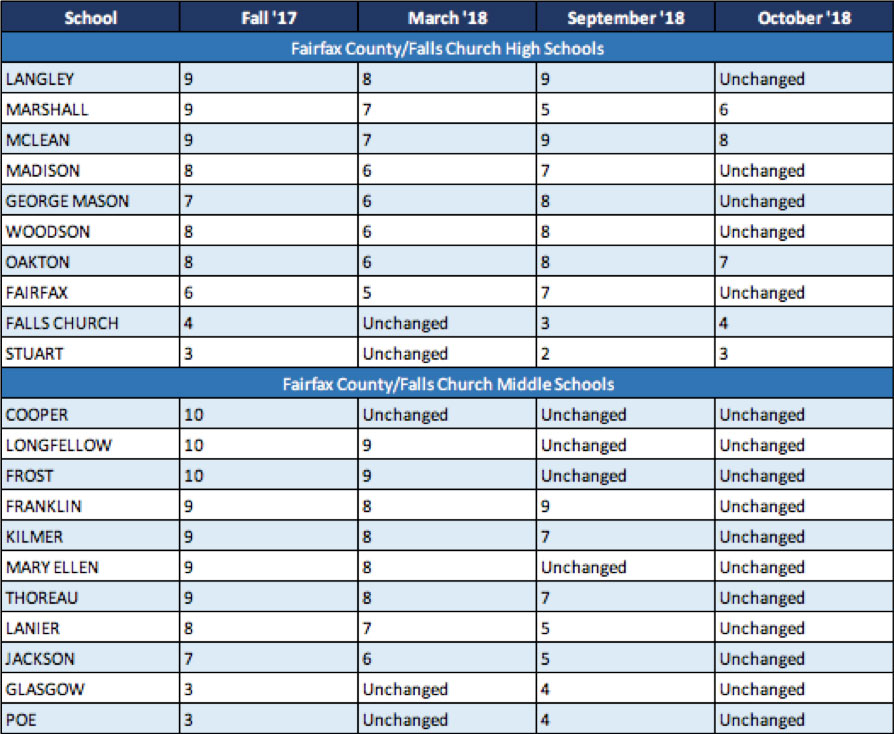
Answer: This summer, the popular school rating website GreatSchools.org made major changes to their ratings for most schools in Northern Virginia for the second time in less than a year. The changes resulted in a drop of 1-2 points for nearly every school.
According to GreatSchools.org changes in ratings are based on student progress (or “growth”) and college readiness data (SAT/ACT participation and/or performance and/or graduation rates).
Their school profiles now include factors such as how much a school helps students improve academically, how well a school supports students from different socioeconomic, racial, and ethnic groups, and whether or not some groups of students are disproportionately affected by the school’s discipline and attendance policies.
Many of these important themes now have their own rating, and these themed ratings are incorporated into the school’s overall GreatSchools Summary Rating.
School Ratings Influence Home Prices
Many property search websites such as Zillow and Trulia include GreatSchools information at the bottom of each listing. The ratings issued by GreatSchools.org heavily influence where people buy and how much they’re willing to spend. You can debate the merits of these ratings systems all you want, but the fact is that they play a significant role in real estate.
While Niche.com generates the most traffic, I find that GreatSchools.org is much more popular locally and I think it’s due to the fact that they grade harder than Niche (Niche gives out a ton of A-, A, and A+ ratings).
What Changed?
GreatSchools does not provide historical ratings, so I compared scores I had recorded for clients from Fall ’17, March ’18, and September ’18 to the current scores.
The Decision Is Yours
Looking only at test scores won’t tell you what the real-life environment is like. That’s why so many people rely on reviews. GreatSchools’ reviews can be written by anybody (parents, teachers, students, and even people not familiar with the school).
To make a decision based on a reliable rating, you can go directly to the Virginia Department of Education, where you can find detailed spreadsheets on pass/fail rates for every school, every grade, every subject, and every demographic.
If you’re considering moving to a new school district, I advise you to take the time to visit the school and take a tour; talk with the principal if possible. Talk to neighbors and join online forums. Take in as much information as you can and dismiss what’s not particularly informative.
I’d love to hear from readers in the comment section who purchased or are in the process of buying a home in Fairfax County, who placed a lot of weight in the GreatSchools rankings — how would these changes have impacted your decision when you bought or how are these changes impacting your current purchase strategy?
If you would like to discuss how the new GreatSchool rankings impact your upcoming plans to purchase or sell a home in Northern Virginia, reach out to me at [email protected] to set-up some time to meet.
If you’d like a question answered in my weekly column, please send an email to [email protected].
Val Sotillo is a licensed Realtor in Virginia, Washington DC, and Maryland with Real Living At Home, 2420 Wilson Blvd #101 Arlington, VA 22201, 703-390-9460.
This regularly-scheduled sponsored Q&A column is written by Val Sotillo, Northern Virginia-based Realtor and Falls Church resident. Please submit your questions to her via email for response in future columns. Enjoy!
Question: Are there any residential properties for sale at The Boro?
Answer: Verse, a 25 story luxury condominium building that will be finished by late fall of 2019. I visited the construction site to preview their model and meet with their Sales Manager, Jennifer Harlow who shared all the details with me. I’m excited to tell you all about it.
But first, what is The Boro?
If you have visited Tysons lately, chances are you have noticed the massive construction of The Boro. Located between Route 7 and Greensboro Dr, it’s the first walkable community with mixed use residential, retail, entertainment and office environment. Coming in 2019, The Boro (you guessed it, short for Greensboro) will be a whole new downtown.
Verse Condos
Verse is the first condominium built within the last decade in the Tysons area. It offers 23 different floor plans ranging from one bedroom to three bedroom with a den units. It is 40% sold out and sales prices range from $500,000 to $2.8 million. The 25th level has three Penthouse units, each with a private terrace, and they all have sold out.
What I Like About Verse
- Modern convenience of having everything at your fingertips
It is located steps away from Greensboro Metro. That is a 20 minute commute to Dulles Airport, and 30 minutes to D.C. on the Silver Line. Properties include garage parking (additional parking can be rented for $95 a month) but the goal is for residents to enjoy the local businesses without even leaving their community.
Residents are walking distance to approximately 17 restaurants (one of them is a sister restaurant of True Food!), high-end shops, state of the art movie theaters, Bluestone Lane coffee, dry cleaners, a nail salon, fitness studios, the biggest Whole Foods in the east coast and even a pet spa for Fido!
Click here for the latest update on businesses opening in The Boro.
- Perfect balance of luxury and function
These condos start on the 10th floor and all units have floor to ceiling windows. That means natural light and amazing views. On top of that, all corner units have a wraparound balcony that allows for some alfresco dining on nice weather days.
A clean and sophisticated floor plan. The chef’s kitchen has a gas stove that vents out to the top, quartz counters, Italian integrated cabinetry (plenty of cabinet space), concealed Bosch appliances and an under-counter wine cooler. Appliances are included in the sales price.
The master suite in the corner two bedroom unit has access to the balcony, a walk-in closet, marbleized floors in the bathrooms, architectural lighting and a spa shower with integrated bench. All cabinets are spacious and soft close.
There’s generous space throughout, plenty of storage closets and additional storage available for purchase.
- Amenities
Other than the 24-hour concierge service and the entry lobby lounge with a fireplace, there’s a club room available for rent for private parties with double height ceilings, fireplaces, billiard tables, TVs, kitchens and terrace access. Residents can also rent a hospitality suite for their visitors.
The building has a 3,000 sq. ft. fitness studio with top of the line equipment connecting to a Zen terrace and a rooftop pool.
The outdoor space includes access to Sky Park, an impeccable landscaped rooftop park where residents can lounge, grill, play bocce ball and enjoy the inviting green space.
Condo fees go for $0.65 per sq. ft. and include water and gas.
An Ideal Place to Live, Work And Play
The Boro will be a vibrant community with many walkable amenities, including pedestrian-friendly roadways, bike lanes and open greenspaces designed to bring people outside.
If you’d like to schedule a tour or discuss Verse Condominium as a primary residence, secondary residence or investment please reach out to me at [email protected]
For part two of this video, click here.
If you’d like a question answered in my weekly column, please send an email to [email protected]. I hope to hear from you soon.
Val Sotillo is a licensed Realtor in Virginia, Washington DC, and Maryland with Real Living At Home, 2420 Wilson Blvd #101 Arlington, VA 22201, 703-390-9460.
