

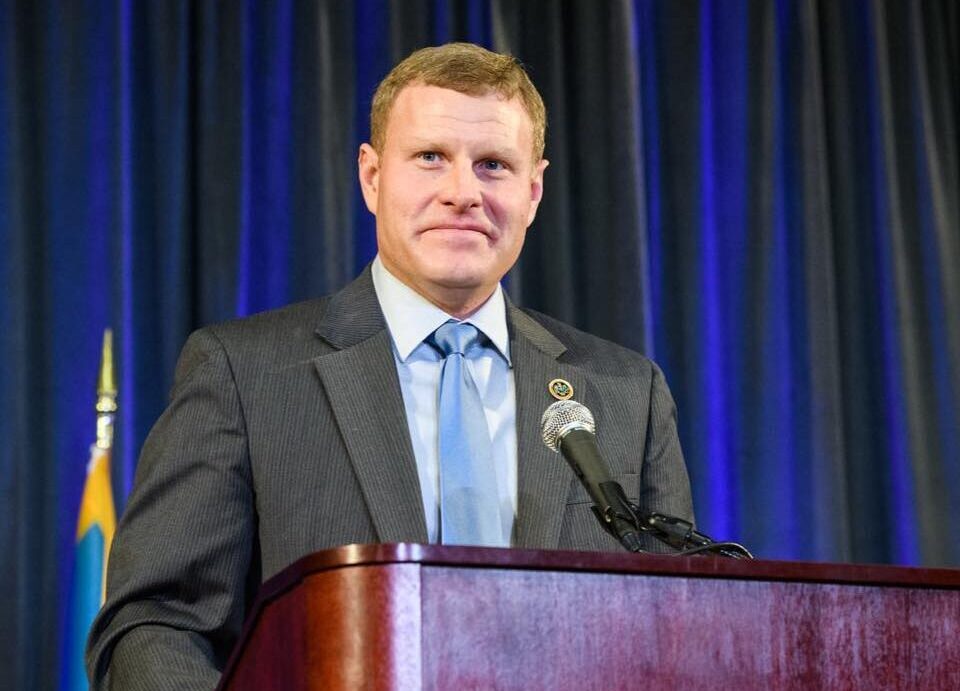
Fairfax County deserves more local authority, Board of Supervisors Chairman Jeff McKay says, calling Virginia’s Dillon Rule “increasingly more intrusive” in day-to-day operations.
The Dillon Rule dictates that localities only have the authority to create laws, set guidelines, and wield power if the state expressly grants it to them.
However, McKay argues this system treats counties as so “unsophisticated” that they need the state to make decisions for them — an assumption that seems particularly outdated for a locality like Fairfax County, which is home to nearly 1.2 million people and an annual budget of $4.7 billion.
“It’s a…broken, inconsistent, and non-responsive system for our constituents that needs modernization,” McKay told FFXnow. “Every time we need something, we’ve got to go to Richmond and beg because most [Virginia] localities don’t need or want that authority. And that’s a problem.”
McKay told Axios D.C. last month that he wanted the county to have more control over its destiny, including the option to levy personal income taxes.
He calculated that Fairfax County only gets 23 cents for each dollar it pays in state taxes. While some disputed that exact calculation, McKay says the county sends enough revenue to the state that it should have more authority to determine how it’s generated.
“I think the county should have the authority to levy any tax that they want and let their voters hold them accountable,” he said. “The state should not be telling them, ‘You can’t raise revenue this way or that way or any other way.’”
If allowed to do this, he would consider a personal income tax as a means to lower — or, even, eliminate — the real estate tax, which provides over $3 billion, or roughly 68% of the county’s annual revenue. He says it would be a fairer, more equitable, and less risky way of raising revenue.
The Dillon Rule’s restrictions on local authority go beyond taxes, hampering day-to-day operations of the county, McKay says, arguing that the “one-size-fits-all” mentality of governing no longer works in a state where counties are diverse in size, population, and budgets.
For instance, rewinding to 2020, McKay says he and other Northern Virginia leaders had to “compel” then-governor Ralph Northam to delay rolling back Covid restrictions in the region.
At the time, Fairfax County’s infection numbers were a lot closer to those in D.C. and Montgomery County than to Roanoke or smaller Virginia localities. Yet, while D.C. and suburban Maryland could keep their covid restrictions in place, Northern Virginia was initially on the same timeline as the rest of the Commonwealth.
“I didn’t have the same authority that they had to do what they were doing,” McKay said. “I was beholden to negotiating, in essence, with the governor about what was in the best interest of Fairfax County.”
McKay says the Dillon Rule is also a factor in the case of the Glasgow Middle School counselor who was arrested last year for a sex crime but stayed employed by Fairfax County Public Schools for months after.
“Another example of a challenge in my community that…fell through the cracks because of a lack of detail, lack of aggressiveness, and lack of awareness of what the Virginia standard or requirements are for localities reporting these incidents,” he said.
In addition to advocating for a centralized, statewide notification system, county and school leaders are looking into the FBI’s Rap Back program, which notifies employers if a worker’s fingerprints are added to its database in connection with criminal activity. However, FCPS can’t join unless the entire state enrolls.
As reported last week, McKay also cited the conflict between FCPS’ policies on the treatment of transgender and other gender-nonconforming students and those proposed by Gov. Glenn Youngkin’s administration as another example of local authority being usurped by state lawmakers.
Even on less contentious matters, the Dillon Rule has slowed down the county’s ability to act, McKay says. It took at least five years for the General Assembly to allow the installation of solar panels on a county-owned closed landfill in Lorton.
“The idea that we couldn’t be greener sooner because the state didn’t give us express permission to do that was terribly frustrating to me,” McKay said. “We literally could not use the property that we own for what we want to do with it, that benefits Virginia, without getting General Assembly approval.”
If the county decides to address ongoing trash service issues by franchising haulers, that again would require a change in Virginia state code and another visit to the General Assembly.
When he tells residents that even some of the most basic county functions have to be approved by state officials, they often find it “maddening.”
“This is a problem of a part-time legislature in Richmond who likes the authority that they have to create one size fits all answers,” he said. “And we’re left holding the pieces.”
But a reevaluation of how the Dillion Rule is used in Virginia appears unlikely to happen anytime soon.
Del. Paul Krizek (D-44) told Axios D.C. last month that ceding the power as McKay suggested is a “non-starter” that he doesn’t envision coming up in the General Assembly anytime soon. McKay said he’s not surprised by state lawmakers’ reluctance to change.
“They love their lever of control, and in essence, for it to go away, you’d be asking people who think they have control to cede that control,” he said.
McKay conceded that there are smaller towns, cities, and counties in Virginia that don’t want or need the type of authority that Fairfax County is seeking.
He proposes that maybe localities over a certain size or budget could have more decision-making powers — or, over time, there will be perhaps an “annual erosion” of the Dillon Rule.
“The members of the Board of Supervisors and the 12 members of the school board…have a much better pulse on what’s going on and the day-to-day lives of our residents than people at the state level who may have never even visited Fairfax County,” McKay said. “I think [local authority] is important for effectiveness, efficiency, and direct representation.”
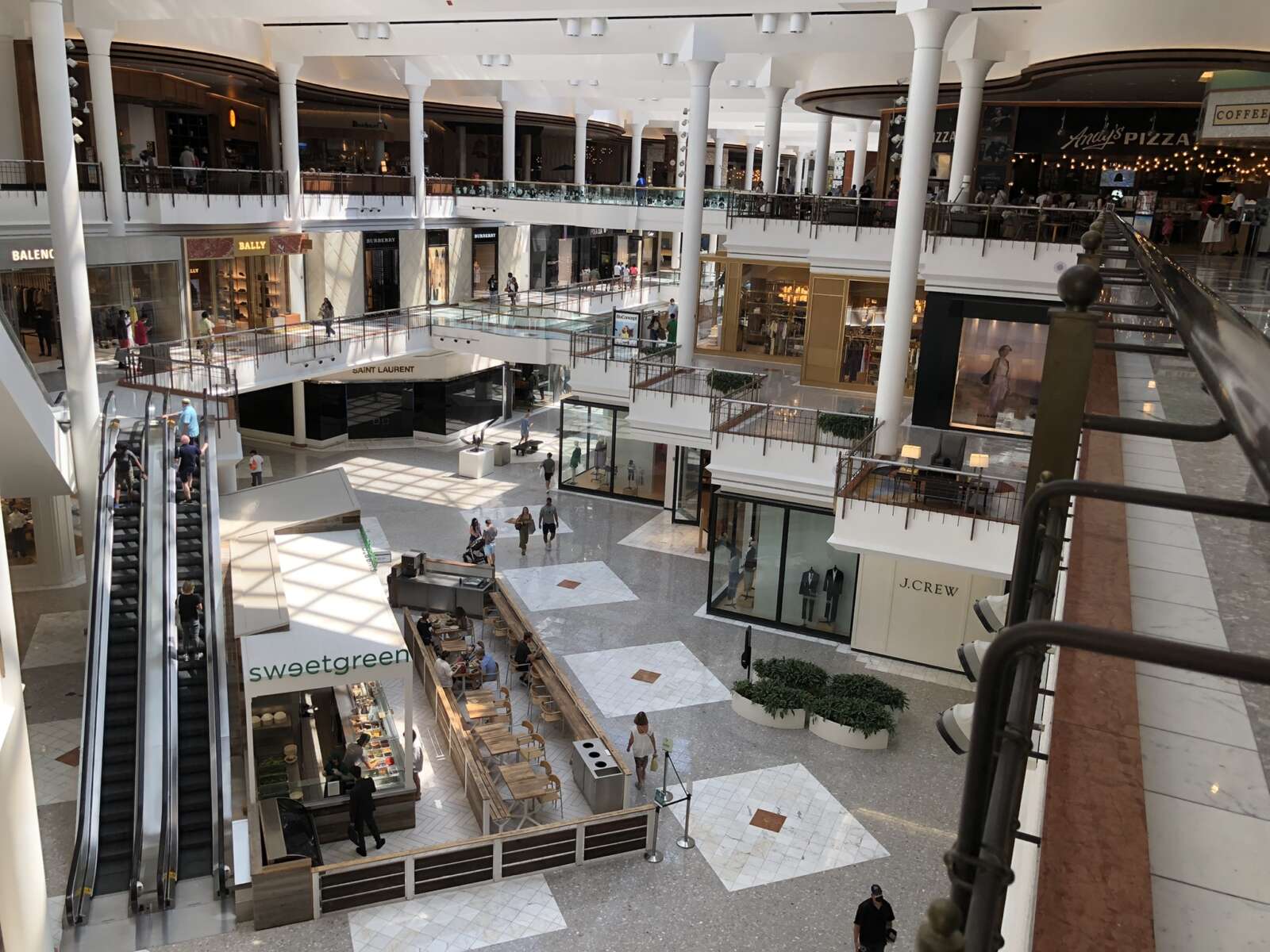
The high-end gowns of Dior will soon grace the halls of Tysons Galleria.
The Parisian fashion house will open a clothing boutique at the mall, its first in Virginia, Tysons Galleria recently announced on Instagram. The store is currently expected to open in June 2023.
Brookfield Properties, the property owner, says it views Dior as a complement to the mall’s existing roster of luxury clothing stores, including Versace, Chanel and Saint Laurent. The latter two are set for future expansions.
“It continues to be an exciting time at Tysons Galleria,” said Kirsten Lee, Brookfield’s executive vice president of luxury leasing. “The Brookfield Properties’ leasing team curates the shopping center to ensure it remains the best luxury shopping destination in the region.”
Founded in Paris in 1946 by designer Christian Dior, Dior has 47 boutiques in the U.S., though its only location in the D.C. area right now is at CityCenterDC. The company didn’t return FFXnow’s request for comment by press time.
An electrical work permit issued by Fairfax County on Sept. 29 indicates that the Tysons Galleria store will be located on the mall’s second floor in suite 2218.
Fashion and accessories have been the primary focus of recent newcomers to Tysons Galleria, including Balenciaga, Van Cleef & Arpels, Jacadi Paris, Montblanc, Ralph Lauren, and Omega. Earlier this year, the mall reopened its Urbanspace food hall.
In addition to Dior, tenants coming to the mall will include watchmakers Panerai, Breitling and IWC Schaffhausen, along with Azzuri Kitchen and Bath, according to Lee.
Also on the way are the Singaporean restaurant Jiwa Singapura, sports bar Yard House, and CMX CinéBistro, though the movie theater-restaurant hybrid no longer has a set opening date.
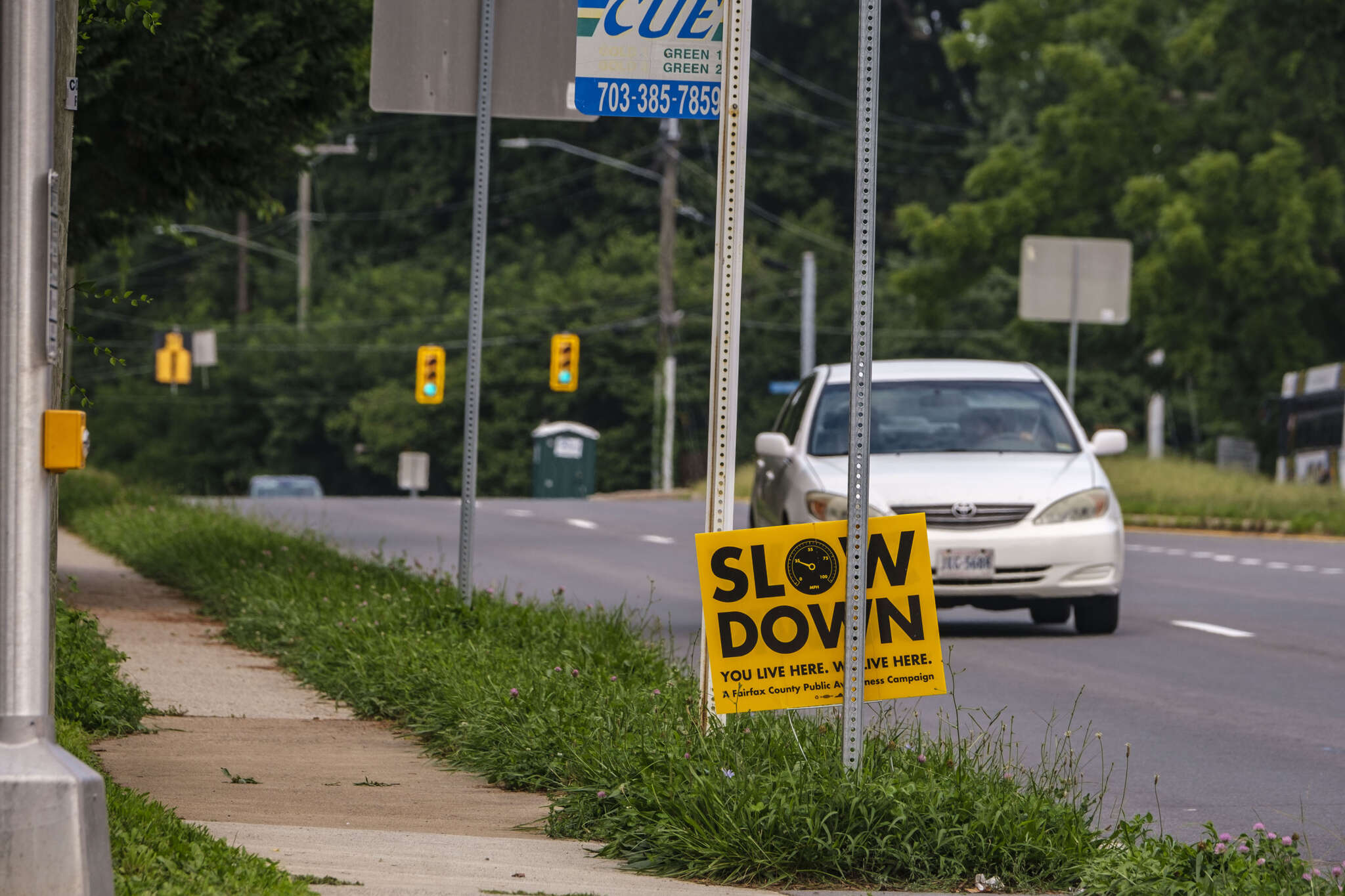
The Fairfax County Police Department could begin using cameras to catch speeders in nine school crossing zones and one highway work zone as soon as early 2023.
The proposed photo speed enforcement pilot program was presented to the Board of Supervisors at a public safety committee meeting Tuesday (Oct. 4).
The work zone included in the pilot would be on Route 28, while the school placements have not been finalized, FCPD Capt. Alan L. Hanson, the police department’s traffic division commander, said.
Drivers caught going at least 10 mph over the speed limit would receive civil penalties, according to the presentation. A maximum penalty of $100 could be incurred for exceeding the limit by at least 20 mph.
A working group including several county departments recommended a six-month pilot program, Hanson said. Their work came after a 2020 state law passed permitting jurisdictions to use speed cameras in school and construction zones.
The draft ordinance authorizes FCPD use of the devices and outlines the fine structure. Photo speed enforcement would aim to reduce the number of people speeding and bring down the number of crashes in and around school areas, Hanson said.
“We’re not trying to entrap people, what we’re trying to do is maintain or gain voluntary compliance,” he said.
Multiple supervisors emphasized that the initiative is not designed to bring in revenue. Dranesville District Supervisor John Foust said he doesn’t believe residents will see the program as a money grab, but the board could also avoid this perception by making a plan for what to do with any excess revenue.
“I say plow them back into pedestrian and bicycle safety in and around our schools,” he said.
The state law only enables cameras in designated school crossing and highway work zones. This limits the county’s ability to use them around Blake Lane, where safety concerns have been particularly urgent after an allegedly speeding driver struck and killed two Oakton High School students in June.
The county has already increased fines for speeding and routed school buses off of Blake Lane in the wake of the fatal crash.
“Blake Lane is a corridor that the school board is working to establish as a school zone, and so that’s one of the places that we would like to select for the photo speed enforcement as soon as it can be designated as a school zone,” Hanson said.
Springfield District Supervisor Pat Herrity asked about FCPD’s ability to staff the program after it declared a personnel emergency in August.
Options could include drawing on officers who are on “light duty,” Hanson said, though having “at least one designated staff to maintain and kind of run it would be certainly beneficial.”
Braddock District Supervisor James R. Walkinshaw, who vice chairs the public safety committee, said it’s “obvious” this effort would decrease pressure on officers by reducing the need for them to be stationed outside a school for traffic enforcement.
“They’re going to be able to be out doing proactive policing in other parts of the county,” Walkinshaw said.
Following the pilot, the program could expand to include 50 cameras between July and September of 2023, and then grow again to better cover school zones starting in July 2024, according to the presentation.
In the presentation, Hanson estimated cameras will cost $3,000 per month.
An administrative item will be submitted at the board’s Nov. 1 meeting so that the county clerk’s office can advertise the ordinance, according to a timeline in the presentation. The board will vote on the ordinance after a public hearing at its Dec. 6 meeting.
“I’m fully on board with the pilot,” said Franconia District Supervisor Rodney L. Lusk, who chairs the public safety committee. “This is a great program, a great start for us and I think it’s going to definitely help.”
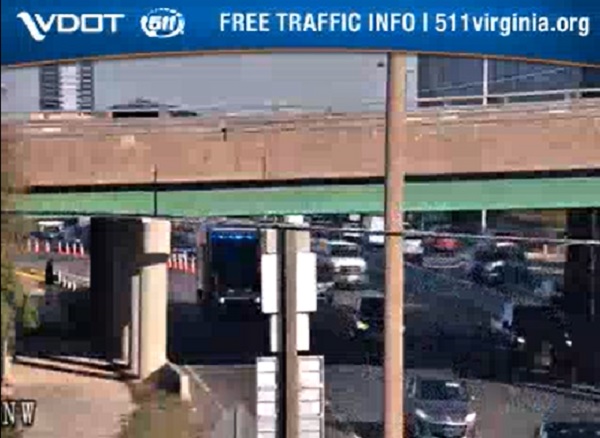
Three more people were killed on Fairfax County roads this morning, police reported.
Eastbound Route 7 (Leesburg Pike) remains partly shut down in Tysons after two people died in a single-vehicle crash at Chain Bridge Road, the Fairfax County Police Department said shortly before 5:30 a.m.
Speed is believed to be a factor in the crash, according to police. Crash Reconstruction Unit detectives remain on the scene to investigate.
Further south, a pedestrian was struck and killed on Richmond Highway (Route 1) at Backlick Road in the Fort Belvoir area.
“Crash Reconstruction Unit detectives are enroute to investigate,” the FCPD said at 7:36 a.m. “Officers from our Motors Unit are arriving to assist diverting traffic.”
According to the Virginia Department of Transportation’s traffic cameras, the north left lane, left center lane, right center lane, and right lane of Route 1 are still closed, as of 8:25 a.m. Drivers should expect delays.
Two lanes are now open on EB Rt7 Leesburg Pike. Crash Reconstruction Unit detectives continue to investigate this crash. Follow our blog, https://t.co/lhGv3NDvYs, for updates when available. #FCPD https://t.co/4vX4ISjVeM
— Fairfax County Police (@FairfaxCountyPD) October 6, 2022
Crash Reconstruction Unit detectives are enroute to investigate. Officers from our Motors Unit are arriving to assist diverting traffic. Avoid the area. Expect delays.
— Fairfax County Police (@FairfaxCountyPD) October 6, 2022
Last Day to Apply for Free and Reduced-Price School Meals — “Apply for Free and Reduced-Price Meals by the deadline of Thursday, October 6. Any family interested in free or reduced-price meals MUST submit a new application, even if your child has received free meals in the past.” [FCPS/Twitter]
IT Issues Slow Voter Registration Processing — The Virginia Department of Elections warned local officials on Friday (Sept. 30) that “unspecified technical issues” had created a backlog of voter registration applications. Fairfax County, “where 10 staffers routinely work on voter registrations,” received a surge of about 11,000 applications overnight. [The Washington Post]
Reston Arts Center Would Be Funded With Bond — “Residents of Small Tax District #5 in Reston would not be solely responsible for funding the performing arts center being considered for Reston Town Center’s Block J property. Joseph Lahait, a debt coordinator with the Fairfax County Department of Management and Budget, told a group of about 50 people at a town hall meeting Tuesday night that all county taxpayers would be responsible if such a project were approved by the Board of Supervisors.” [Patch]
School Board Sees Need for Better Communication With Special Education Families — “Researchers found the school system could do a better job communicating with parents while developing, implementing, and then tracking a student’s individualized education program, or IEP. Hayes said doing so ‘can help proactively reduce conflict between families and schools’…School board members agreed that improving communication between parents and schools would be helpful.” [WTOP]
Man Arrested for Sexual Assault and Robbery in Fairfax — “Detectives said a 37-year-old man was arrested and charged for his alleged involvement in a sexual assault turned robbery in Fairfax on Monday. Officers responded to the 13200 block of Leafcrest Lane around noon for a report of a robbery and sexual assault. Police claim Nolberto Sanchez Hernandez assaulted the victim before taking off with her property.” [WUSA9]
ATM Burglary Attempts Continue — “The latest incident occurred between 4:00 and 4:10 a.m. on, Saturday, October 1. In this incident, two men arrived in a white Ford truck at the NextMark Credit Union at 6506 Loisdale Road in Springfield. The men placed a tow strap around the ATM machine and attempted to steal it, but were unsuccessful.” [FCPD]
Herndon Candidates’ Forum Tonight — “Dulles Regional Chamber of Commerce is hosting a Herndon Candidates Forum Thursday at 7 p.m., in the Herndon Fortnightly Library at 68 Center St. This will be a chance for town residents to meet candidates on the Nov. 8 ballot” [Patch]
McLean Pet Fest Returns This Month — The McLean Community Center’s annual celebration of all things pets will be held at McLean Central Park from 11 a.m. to 4 p.m. on Sunday, Oct. 16. The event will include a pet parade, a photo booth, “pet demonstrations, pet-related information and a variety of exhibitors.” [Sun Gazette]
It’s Thursday — Partly cloudy throughout the day. High of 72 and low of 51. Sunrise at 7:10 am and sunset at 6:45 pm. [Weather.gov]

Fairfax County is moving forward with an update to its affordable housing policy that could ensure a one-for-one replacement of affordable housing units in areas under redevelopment — signaling a major push to bind development to affordable housing preservation.
Open for public feedback until 4:30 p.m. on Oct. 28, the proposal would amend the county’s comprehensive plan to require developers to replace affordable housing on sites where it’s being eliminated in order to get their project approved.
The proposed policy leads with the first goal of ensuring “no net loss of affordable housing units within redevelopment to the extent practicable.”
There are a few policy changes listed beneath that, but one of the more practical and relevant ones for new development is Policy E:
For any proposed Comprehensive Plan amendment or zoning application review that proposes redevelopment of existing multifamily residential units, conduct an affordability analysis through the Department of Housing and Community Development to 1) identify existing affordable housing onsite and 2) understand the potential impacts of the proposed redevelopment on the existing affordable housing, such as a reduction in the number of affordable units or modification to the income tiers served.
This policy seemingly extends not just to committed affordable units — those contractually set to be available at certain levels of income — but to market-rate affordable housing units too — units that are at levels considered affordable without being set as such by a regulatory agency.
While some of Fairfax County’s neighbors like Alexandria have one-to-one replacement requirements for committed affordable units, requiring the replacement of market-rate units is a fairly bold new step.
“Absent any long-term affordability commitments, market-affordable developments can be lost to redevelopment or repositioning of the asset, leading to the displacement of existing residents and to community fragmentation,” the policy proposal said. “The County has committed to a goal of no net loss of these market affordable units, and should preserve the affordability of market-affordable multifamily rental housing units to the extent practicable.”
The changes within the proposal could also ripple out beyond just affordable housing preservation. Like in Alexandria, the county could allow greater density in exchange for affordable housing units.
“Additional residential densities or intensities above the Plan recommendation may be considered in development proposals that commit to long-term preservation (30 or more years), as an incentive to preserve or replace existing affordable multifamily rental housing units,” the proposal said.
The policy proposal noted that levels of density granted could involve other factors, like transit accessibility or financial feasibility around affordable units.
“The potential benefit of the preservation relative to the number and type of units preserved, the income levels served, and/or the strategic importance of the units relative to other factors, such as transit accessibility or financial feasibility of the preservation should be considered as part of any proposed development seeking additional density or intensity,” the proposal said.
The change wouldn’t give developers carte blanche for added density, however, and any proposal would have to weigh the impacts to the environment, schools, parks and other public facilities.
The Board of Supervisors reviewed the proposal at a Housing Committee meeting on Sept. 30. The meeting raised some questions about its feasibility, but the committee seemed generally in favor of the changes to the plan amendment.
“I do acknowledge that in some areas we might have difficulties being able to actualize that one-for-one replacement,” Lee District Supervisor Rodney Lusk said. “Thinking about my own district, I’m thinking about flood plain issues and other environmental aspects. That creates an issue.”
In areas where there can’t be a one-to-one replacement on site, Lusk said the county should consider requiring housing built elsewhere, but for the sake of keeping communities together, he said off-site housing should be the last resort.
Supervisor Dan Storck said around 80% of the units that would be preserved would be along the Richmond Highway in his Mount Vernon District.
“We do not want to go the route of Alexandria,” Storck said. “Frankly, they’ve lost about 90% of their affordable housing over the last 20 years, and that’s exactly why we’re doing what we’re doing. I think the board gets that we can’t just sit idly by and hope for the best…That challenge means we have to sit up our game and work more. The next steps are all ones that I fully support and think are essential to preserving housing, and frankly, I think more is going to have to be done even than that.”
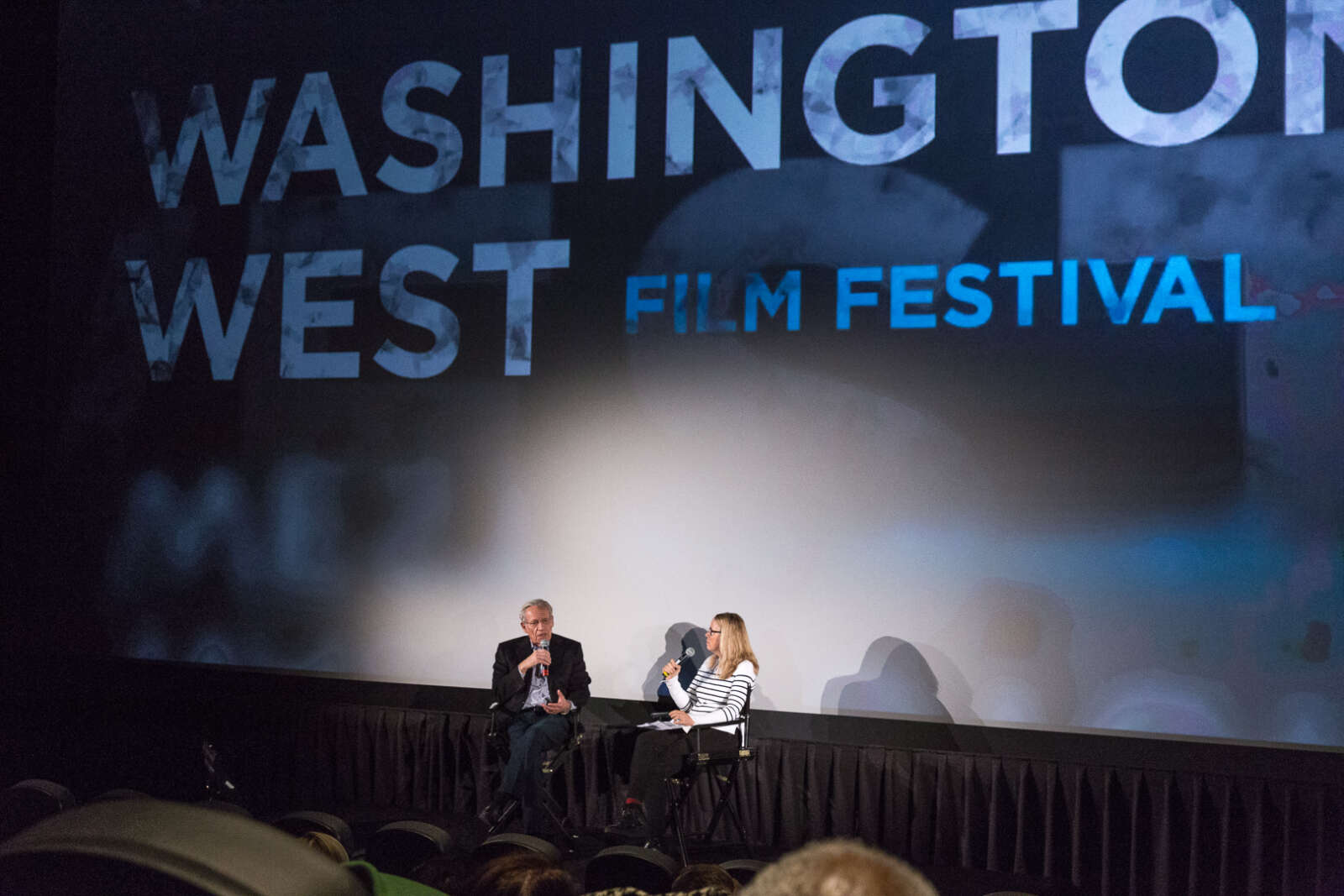
The movie world’s annual parade of fall festivals will make a pit stop in Fairfax County next week, with the launch of the Washington West Film Festival.
After celebrating its 10th anniversary virtually in 2020 due to COVID-19, the festival returned in person last year and is now preparing for its 11th season, which will bring a variety of films to Tysons and Reston from Oct. 13-17.
While it likely won’t generate the Oscar buzz of Toronto or the gossip of Venice, Washington West has a more unique mission. Founded in 2011, the festival was designed as a “laboratory” to promote both cinema and philanthropy, according to its website.
The festival says it donates all of its box office proceeds to nonprofits that assist “struggling communities.” Since 2019, the beneficiaries have been the Henry & William Evans Home For Children, Virginia’s Kids Belong, Blu_Print, and The Children’s Inn at the National Institutes of Health.
This year’s edition will kick off at 7 p.m. on Oct. 13 with an opening night screening of “Refuge” at Tysons’ Capital One Hall (7750 Capital One Tower Road).
The documentary follows a friendship between a Muslim heart doctor and an ex-Ku Klux Klan member in Clarkston, Georgia, “the most diverse square mile in America,” per the festival website. There will be a Q&A with the movie’s subjects as well as co-director and producer Din Blankenship.
The schedule for the four-day event includes feature-length and short films — both fictional and documentary — along with a virtual workshop on crowdfunding a movie and showcases for local filmmakers and George Mason University students.
Steven Spielberg’s classic “E.T. the Extra-Terrestrial” will get a 40th anniversary celebration on Oct. 15 at ShowPlace ICON in The Boro, which will host the majority of events. That day will also have a free, outdoor screening of “Hocus Pocus” at Reston Town Square Park.
The festival’s closing night film will be the HBO documentary “The Slow Hustle,” screening at 7:30 p.m. on Oct. 17 at Reston Community Center’s CenterStage.
The full schedule and links to buy tickets can be found on the festival website.

Thinking about taking the next step in your career?
The Arlington-based Schar School of Policy and Government at George Mason University offers flexible part-time or full-time options for graduate certificate and master’s degree programs designed to teach applicable, real-world knowledge for in-demand careers.
Learn more at the upcoming virtual open house!
Master’s and Certificate Open House
Virtual Event
Wednesday, October 19
7-8 p.m. Eastern
During this online session, you will have the opportunity to hear from our Director of Graduate Admissions about the Schar School and applying to graduate and certificate programs, as well as from program faculty about our graduate programs. Prospective master’s and graduate certificate students who attend this event will be provided with an application fee waiver for the spring 2023 or fall 2023 graduate applications.
Master’s Degree Programs
Part-time, full-time, and online options available
- Biodefense, MS
- Global Commerce and Policy, MA
- International Security, MA
- Organization Development and Knowledge Management, MS
- Political Science, MA
- Public Administration, MPA
- Public Policy, MPP
To learn more about graduate programs at the Schar School, register for the open house or fill out our inquiry form.
The preceding sponsored post was also published on FFXnow.com
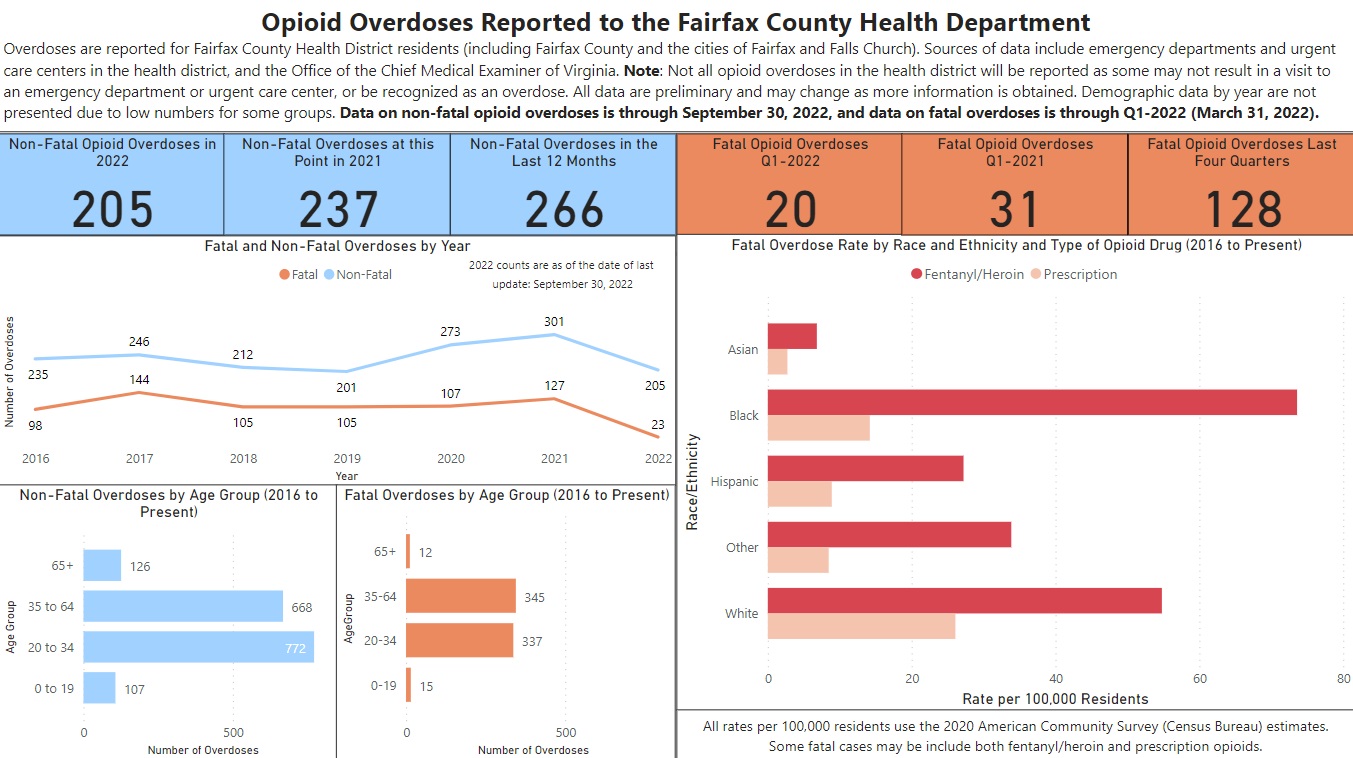
With opioids topping the list of causes of non-natural death in Fairfax County, local health officials have launched a new resource to give residents a better understanding of the situation.
A public-facing dashboard went live Monday (Oct. 3) with data about opioid overdoses and overdose deaths in the Fairfax Health District, which includes Fairfax County and the cities of Fairfax and Falls Church.
The Fairfax County Health Department worked with the county’s Opioid and Substance Use Task Force to put the dashboard together, according to the announcement.
“The goal of the dashboard is to ensure that Fairfax County residents understand the threat that opioid drugs pose in our community and recognize that overdoses and overdose deaths affect a wide range of ages, people of both sexes, and all racial and ethnic groups,” Dr. Benjamin Schwartz, the county’s director of epidemiology and population health, said in the release.
The dashboard provides information about overdoses broken down by age, race and ethnicity. It will be updated in the first week of every month, according to the announcement.
As of press time, the dashboard counted 205 non-fatal opioid overdoses from Jan. 1 through Sept. 30 in the Fairfax Health District. There were 237 non-fatal overdoses at this point in 2021.
The dashboard also noted that the first quarter of 2022 saw 20 fatal opioid overdoses, compared to 31 during the first quarter of 2021.
“We want the public to be aware of overdose trends, which reflect the impacts of social factors, the types and availability of drugs, and the effect of mitigation measures including law enforcement, treatment and harm reduction measures,” Schwartz said.
The data comes from two main places: A system managed by the state health department that keeps track of emergency room and urgent care visits for overdoses, and the Virginia Office of the Chief Medical Examiner.
Earlier this year, county medical officials worked to step up their response to the opioid epidemic after emergency care statistics showed an increase in overdoses, particularly cases involving teenagers.
The county provides services to assist people struggling with opioid use, including the Fairfax-Falls Church Community Services Board Peer Outreach Response Team and the Fairfax Detoxification Center.

A cell tower by the Capital Beltway in McLean must be removed before the end of this year to make way for the road’s widening, leaving Fairfax County and state transportation leaders scrambling to prevent future service disruptions.
The 135-foot-tall monopole stands right next to I-495 at the Old Dominion Drive bridge, which will be replaced by a new two-lane bridge with a shared-use path as part of the Virginia Department of Transportation’s I-495 Northern Extension (495 NEXT) project.
VDOT determined that the tower needs to be relocated “well over a year ago,” but no progress has been made to identify a temporary or permanent new site, Megaprojects Director Susan Shaw told the Fairfax County Board of Supervisors on Friday (Sept. 30).
“The providers to date have said that there is no temporary location that’s acceptable to them,” she said. “…We’re all working very hard to try to resolve it, and I think we’ve tried to provide a lot of ideas for where they might find acceptable locations on VDOT right of way, but again, we’re not experts. It’s very specific technically in terms of what would work for them and maintaining the kind of service that they have.”
Construction on 495 NEXT is underway, but work hasn’t started yet on the Old Dominion bridge.
American Cell Towers, which owns the monopole, initially faced a Sept. 30 deadline for the removal, but that has been extended to Dec. 31. The tower has to be decommissioned in November so that the utilities can be taken off and the structure dismantled, according to Shaw.
In conversations with AT&T and T-Mobile, the providers that use the pole, VDOT was told that service along the Beltway won’t be affected, but service for the surrounding communities “would be degraded,” particularly during periods of peak demand, Shaw said.
AT&T confirmed that some of its customers “may experience intermittent wireless service disruptions near Old Dominion Drive and the Capital Beltway.”
“We, like other carriers, are being forced to remove our antennas so that they can widen the Beltway,” an AT&T spokesperson said. “We apologize for the inconvenience, and we are working with state and Fairfax County officials to identify an alternative site for our equipment. In the meantime, we have optimized other nearby sites to try and extend coverage until this is resolved.”
The provider added that people who experience disruptions can utilize its Wi-Fi Calling service instead.
While the availability of other cell carriers in the area suggests 911 calls won’t be affected, Shaw said the providers told VDOT they “couldn’t guarantee” that there would be no impact. American Towers didn’t immediately respond to FFXnow’s requests for comment.
The lack of clarity around how the tower’s removal will affect service “has been particularly frustrating,” Dranesville District Supervisior John Foust told FFXnow.
Foust says American Tower representatives reported this spring that they were looking for an alternative site, but his office didn’t learn about the initial Sept. 30 deadline until August. The county convinced VDOT to extend the deadline, and since then, VDOT officials, county staff, American Towers and the carriers have been meeting every two weeks to try to find a solution.
“It seems obvious that with advanced planning, this issue could have been resolved without impact to cell service,” Foust said. “It is not clear at this time that impacts can be avoided. My position is that any loss of cell service to residents and travelers on I-495 is unacceptable, particularly any impact to 911 service.”
Hunter Mill District Supervisor Walter Alcorn likened the situation to the outages that residents of Reston’s Lake Anne neighborhood experienced this summer, where “frankly, the carriers are not necessarily exhibiting any sense of urgency.”
She noted that the zoning process that the county requires for all new cell towers can take a long time, so even if a temporary replacement site is found, a new pole won’t be built before the existing one has to be taken down.
Shaw also said the county’s zoning staff “doesn’t believe this is an emergency, and it wouldn’t require any relaxation of that zoning,” prompting Board of Supervisors Chairman Jeff McKay to question how staff came to that conclusion.
Promising to “do everything I can to expedite” the zoning process, Foust suggested the issue is not a lack of urgency from staff — “Everybody recognizes this is an emergency,” he said — but rather, limitations on their ability to approve a temporary measure.
“The carrier has not even suggested a temporary location to date, so there’s no pending application of any kind,” County Attorney Elizabeth Teare said. “We don’t know where they want to put it. Until we have that, it’s hard to even think about how do we move forward.”
Foust says he will introduce a board matter on Tuesday (Oct. 11) directing the county to send a letter to VDOT and the carriers “asking them to describe their plan for ensuring that cell service will not be adversely impacted, and to describe what they are doing to mitigate impacts if they cannot be avoided.”
Photo via Google Maps
