


The Delta variant-fueled rise in coronavirus cases that roiled Fairfax County during the latter half of the summer appears to have eased a little over the first week of September.
With 135 new cases reported today (Tuesday), the Fairfax Health District, including the cities of Fairfax and Falls Church has recorded a total of 85,151 COVID-19 cases, 4,262 hospitalizations, and 1,167 deaths.
The county is now averaging 158.4 new cases per day over the past week, down from the weekly average of 183.9 cases on Aug. 30 that has so far represented the summer’s peak. That is shy of the high mark for the spring, when the county averaged 195.1 cases on April 13.
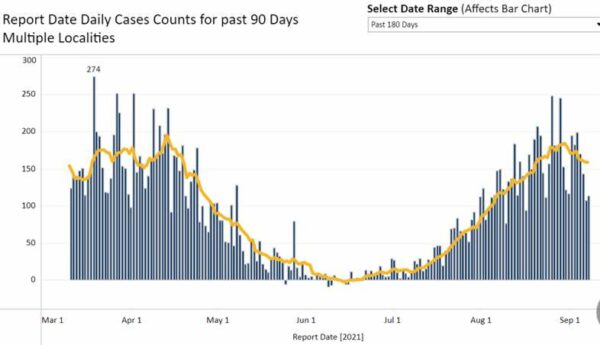
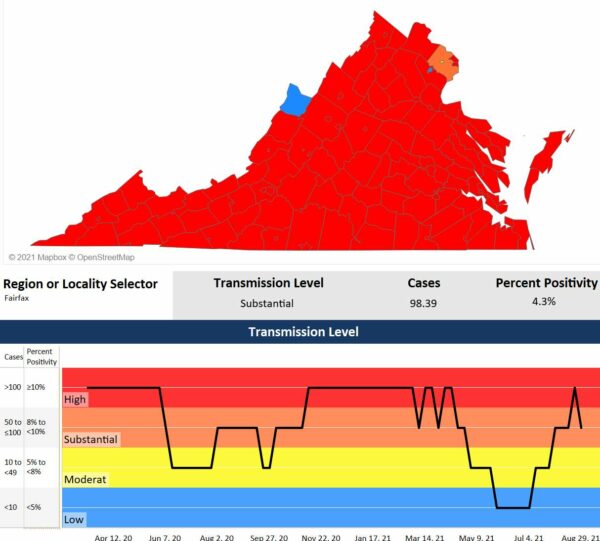
That slight decline in cases has been enough to bring Fairfax County back down to a substantial level of community spread after entering the “high” category at the end of August.
The Centers for Disease Control and Prevention and Virginia Department of Health determine the level of COVID-19 community transmission within a locality based on the number of new cases per 100,000 people and the percentage of positive tests over the past week.
Fairfax County recorded 98.4 new cases per 100,000 people for the week of Aug. 29 to Sept. 4, dropping below the 100-case threshold for “high” transmission. 4.3% of administered tests came back positive for COVID-19 in that time frame.
However, Fairfax County also saw fewer people seek out a COVID-19 vaccination in the past week — perhaps a product of residents leaving town for Labor Day weekend.
According to the Fairfax County Health Department’s dashboard, 791,935 Fairfax Health District residents have received at least one vaccine dose. That constitutes 79.1% of residents 18 and older and 66.9% of the total population.
However, it’s just 4,527 more people than Aug. 30, when more than 6,000 additional people had gotten their first shot in the preceding week.
717,743 residents — 60.6% of the district’s population — are now fully vaccinated, including 72.1% of all adults.
The need to get the remaining 30% of adults vaccinated will become increasingly urgent as the weather starts to cool, pushing activities like dining and exercise back indoors.
The CDC is currently projecting Virginia to surpass 25,000 COVID-19 cases per week by the end of the month. The Commonwealth totaled 21,693 cases over the week of Sept. 1.
The Fairfax County Health Department says community members should remain vigilant in following not only COVID protocols, such as wearing a mask indoors and getting vaccinated for those who haven’t done so already, but also more general health guidelines.
“As the weather cools, and people are typically inside more often, it is even more important to adhere to commonsense health and wellness strategies such as getting enough rest, a balanced diet, and regular exercise,” the department said in a statement. “This is also the time of year when everyone should investigate getting their flu shots — either from their medical provider, pharmacy or community clinics.”
Photo via CDC/Unsplash
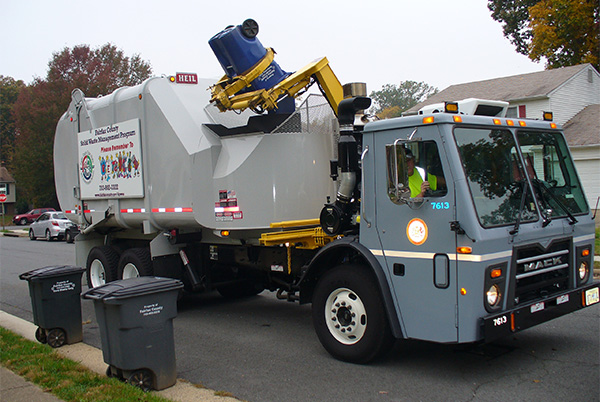
Yard waste is piling up in Fairfax County, as a nationwide labor shortage in the hauling services industry has triggered collection delays that could potentially last weeks.
The Fairfax County Department of Public Works and Environmental Services has made some temporary changes to its practices after recently warning customers, who make up about 10% of residents and businesses, to expect delays for the next several weeks.
“There is a tremendous amount of competition for drivers, which has an impact on our ability to recruit and retain,” DPWES spokesperson Sharon North said in an email. “Since COVID-19, the home delivery business has skyrocketed, often providing more attractive and lucrative trucking jobs in the private sector.”
Now, the county says it will allow solid waste service providers — both public and private — to collect trash and yard waste together if they are experiencing labor shortages that prevent them from completing routes in a timely manner.
“This temporary allowance can be used by both private haulers and county collective service providers if they choose based on their staff resources,” the county said in an announcement on Wednesday (Sept. 1).
The changes took effect last Tuesday (Aug. 31). The county also said it will review a requirement in mid-October that prevents combining recycling and yard waste hauling.
“[The] staffing shortages in the Solid Waste industry are happening in many municipalities across the country, not just in Fairfax County,” North wrote. “Even private solid waste/recycling haulers are struggling during these times.”
As of Friday (Sept. 3), the county had 13 vacancies for maintenance workers, heavy and motor equipment operators, and lead refuse operators. Hourly pay for positions with regular benefits ranges from $18.10 on average for regular maintenance workers to $29.95 on average for lead refuse operators.
North said in an Aug. 30 email that the county’s trash and recycling services have not been affected by the delays.
County collection customers are primarily located along the eastern border of Fairfax County. Most other residents and businesses receive hauling services from private companies.
Yard waste and trash will still end up in their same, separate downstream destinations.
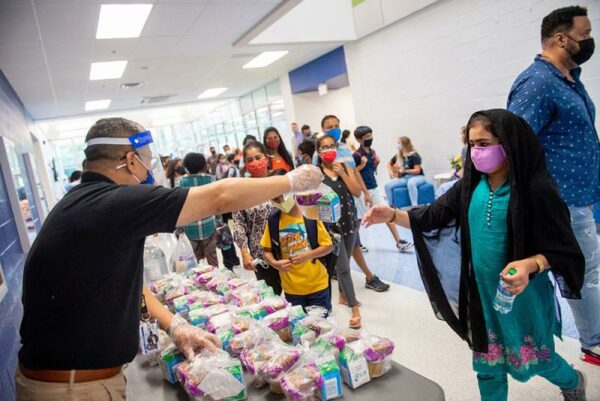
As COVID-19 cases rise in Fairfax County Public Schools, so have concerns from parents, students, and staff, particularly when it comes to the cafeteria.
More than 205,000 students and staff in Fairfax County went back to school on Aug. 23 after 18 months of mostly remote learning. Excitement about seeing friends and having in-person classes mingled with frustration over transportation issues and pandemic-related anxieties.
After more than a week of classes, some community members have expressed increasing alarm at the sight of crowded cafeterias during lunch, jam-packed school hallways, and what they feel is a lack of oversight by FCPS administrators.
FCPS has seen a clear uptick in COVID-19 cases since classes began, according to its dashboard, which displays cases that are self-reported by students and staff and shared with the Fairfax County Health Department.
As of yesterday (Wednesday), the school system had recorded 351 new cases in August, including 266 cases involving students and 84 among staff. 252 cases have come in since schools reopened on Aug. 23.
While this remains a small percentage compared to the division’s overall population, which is the largest of any Virginia school district, the numbers still have many worried.
An online petition urging FCPS to offer a virtual option for more students has now garnered close to 5,000 signatures, almost double what it had in mid-August.
FCPS has a virtual program, but enrollment for this year was limited to students who personally have a documented medical need. Eligibility wasn’t extended to students based on health concerns in their family or household.
“FCPS believes that students learn best in-person,” an FCPS spokesperson said. “We are focused on providing a safe and positive learning experience for all students.”
Lunch time has emerged as a particular concern, since students have to remove the face masks that are otherwise required inside school buildings. The Centers for Disease Control and Prevention characterize mealtime at schools as a “high-risk situation.”
In particular, elementary school students are at risk.
While about 80% of middle and high school aged students in Fairfax County have gotten at least one vaccine dose, children under the age of 12 are not yet eligible. At this point, it’s not expected that vaccines will be available for those children until this winter if not early next year.
A parent of a student at Westbriar Elementary School in Vienna told FFXnow that, during the first week, she saw students “elbow-to-elbow” inside the small cafeteria, eating and talking without masks on. The school has an outdoor space with a tent, the parent says, but it isn’t being used enough.
The student said they “don’t feel safe” during lunch and snack time in school.
The parent doesn’t fault the young students, but rather, the administrators for not adequately monitoring or providing better options.
When these concerns are brought up to administrators, the parent feels like they’re ignored or given unsatisfying explanations, such as that it was raining, even though the outdoor space is under cover, or that letting one class go outside and not another wouldn’t be “equitable.”
The Westbriar parent takes their student out of school for lunch every day due to their health concerns, but admits many other families don’t have the time or ability to do that.
In an email to FFXnow, an individual who identified themselves as an FCPS staff member expressed concern that there has been “no social distancing” during lunch periods, singling out Fairfax High School in particular.
When staff members approached the school administration with their concerns, they were told that the school is “doing what is required of us by the county,” the tipster said.
FCPS officials have stressed that maintaining six or even three feet of social distancing in cafeterias would be impossible with 99.5% of the student body back in school buildings.
However, beyond having general guidelines about mask-wearing and directing elementary schools to establish seating charts, the division has mostly left the logistics of meals up to the discretion of individual schools.
“The size of every school cafeteria is different and the number of students at each school is different,” FCPS says on its website. “The physical layout of each cafeteria varies from school to school depending on size and student enrollment. Some schools (but not all) will have outdoor cafeteria spaces or options. These may be used on days when the weather is good.”
In a statement, an FCPS spokesperson confirmed that individual “administrators are tasked with making decisions on their individual school lunch set-ups,” though outdoor eating is encouraged when possible:
Where possible, students will eat outside and 186 tents have been installed to serve this purpose. Schools are also using additional spaces to space out students during lunch. Plexiglass, forward-facing seating and additional spacing between students is also being used to create a safe environment for students during lunch. Finally, some schools are extending lunch so students can be more spaced out in cafeterias. The situation is being reviewed in every school to make sure they are doing everything possible to create a safe and healthy environment.
Melanie Meren, who represents Hunter Mill District on the Fairfax County School Board, says she has seen different schools use a variety of methods to try create distance between students based on each building’s layout, seating, availability of outdoor space, and population.
School board members shared concerns that they had received about crowded cafeterias with FCPS Superintendent Scott Brabrand during a work session on Aug. 24. The board then approved a federal relief spending plan last Thursday (Aug. 26) that included $10 million to hire monitors for cafeterias, classrooms, and outdoor spaces.
“The School Board has given clear direction to the Superintendent that students should be using outdoor areas — whether that’s at picnic tables, under tents, on yoga mats, etc.,” Meren wrote in an email. “The Board approved use of funds to hire in-person monitors to supervise students in smaller groups during meals. This direction reflects input I’ve heard from some families who want more social distance in place when masks are off while eating.”
However, the onus remains on administrators at each of the county’s nearly 200 public schools to figure out how to implement tools like outdoor tents and cafeteria monitors, which the Westbriar parent finds less-than-ideal.
“Our principal is not a public health expert. This is totally out of her realm,” the parent said. “[Create] a health and doctor committee that can then go to these schools and give them wise words of wisdom and best practices.”
FCPS officials said during the Aug. 24 work session that they are working with an outside vendor to set up safety teams to monitor COVID-19 health practices at each school, like the ones that were deployed last year, but the hiring process was still underway at that point.
Dr. Amira Roess, a professor of epidemiology at George Mason University, says lunchtime in crowded, loud cafeterias is a huge concern for her, particularly for elementary school-aged children who aren’t yet eligible for the vaccine.
“We know from a lot of outbreak investigations that eating, projecting your voice, singing, shouting, does carry a significant probability of infection,” she said.
She recommends eating in shifts, moving outdoors, and setting a good example.
“If the adults around [younger students] are modeling good mask-wearing behavior and are reminding them to wear masks, they tend to follow these rules and they wear their masks,” Roess said, adding that regular and frequent testing would also be a good strategy to identify potential sources of outbreaks.
FCPS has mandated that all employees get vaccinated against COVID-19 by late October or submit to regular testing, and the school system announced earlier this week that high school students must be vaccinated to participate in winter and spring sports this year.
However, there remains fewer protections for younger students. FCPS’s lunch time procedures and guidelines remain the same for high schools as they are for elementary schools, save for a required seating chart.
Roess acknowledged that the cost and logistics of these measures can be a challenge for schools that are often already overcrowded and under-resourced, but they could prevent what public health experts fear will be a nationwide surge in COVID-19 cases among children.
“The problem with a lot of children getting infected at once is that it’s just a numbers game,” Roess said. “We’re going to have a larger number of kids who end up with more severe cases and will need to be hospitalized.”
Photo via FCPS
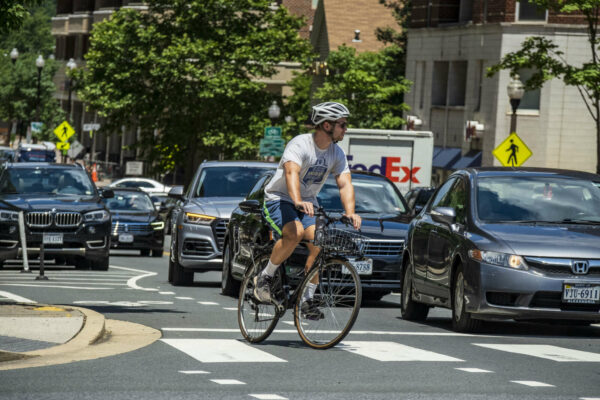
Around noon on June 12, a pedestrian trying to reach a pathway by Dogwood Pool on Green Range Drive in Reston was nearly hit by a vehicle, because the trail was blocked by parked cars.
Three days earlier, another driver failed to yield and sped through a left turn at the Westpark and Galleria Drive intersection in Tysons, almost colliding with a person who was using the crosswalk.
Those are two of more than 350 “near miss” traffic incidents that community members have reported to Northern Virginia Families for Safe Streets (NoVA FSS) since the advocacy group launched a survey on June 17 to collect data on dangerous roadways across the region.
Developed with the help of Virginia Tech graduate students, the Near Miss Survey allows walkers, bicyclists, drivers, and other road users to report instances where they came close to getting into a crash or accident but were fortunate enough to avoid it.
The resulting map highlights specific incidents as well as hotspots that are especially accident-prone, with the goal of helping local transportation and public safety officials see what areas need their attention and how they can improve policies and infrastructure to make streets safer.
“It gives people an opportunity to report on areas that might be dangerous,” Phil Kemelor, the Mason District board member for Fairfax Families for Safe Streets, said. “Just because it doesn’t result in a specific accident like with someone getting hit or killed, it’s still something people should know about.”
While the survey is still new, some trends have already emerged. Unsurprisingly, there tend to be more incidents at times with more traffic, such as the afternoon rush hour, and failure to yield to pedestrians in crosswalks is the most frequently reported issue.
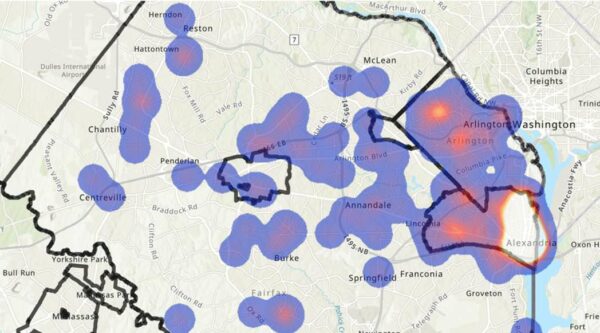
Kemelor notes that the reported incidents haven’t been weather-related, since they’ve all occurred during clear conditions, and they are rarely one-time issues.
“Those reporting the incidents cite multiple occurrences at the locations mentioned,” he said.
The Near Miss Survey project grew out of conversations between NoVA FSS founder Mike Doyle and Tom Sanchez, who teaches urban affairs and planning at Virginia Tech.
As a capstone requirement for the master’s program, graduate students take a year-long studio class where they work on a project with a client from the community.
For the 10 students who took the class during the 2020-2021 academic year, that client was Families for Safe Streets, which began in the City of Alexandria in 2017 and has since added Arlington and Fairfax chapters.
Sanchez says the idea of collecting near-miss data appealed to the class, because there was no existing source for that kind of information, even though a split second could be the only difference between a close call and a tragic collision.
“Even though [a crash] didn’t happen, it could’ve easily,” Sanchez said. “So, it’s a very good indicator of where there may be, say, bad street design or poor visibility or bad signage or lots of other potential problems.”
Limited to Zoom meetings due to the ongoing COVID-19 pandemic, the students built the mobile platform that collects, analyzes, and maps the near-miss data over the course of two semesters.
Now that the platform is online, the focus has shifted to giving NoVA FSS the resources maintain it indefinitely and raising awareness about the tool. One of the biggest challenges for NoVA FSS so far has been figuring out ways to incentivize people to report an incident, Sanchez says.
“You’re on your bike or you’re walking and you almost get hit by a car. You’re not thinking, hey, I need to get on my phone and I need to record that information. You’re thinking…I’m glad I didn’t get hurt,” he said. “So, part of their campaign to increase the visibility of [the survey] is really to get the word out about…this benefits us all if we can gather this information and map it and highlight where some of these dangerous places are so we can go out and fix it.”
In addition to encouraging community members to share the survey link, NoVA FSS has reached out to local officials to discuss the project. The Fairfax chapter, for instance, recently had a call with the Fairfax County Police Department to let them know about the collected data.
The FCPD says its traffic safety division uses record management systems and “a variety of open sources” like the near-miss survey to monitor traffic incidents and crashes. That data gives police a better understanding of existing trends and helps them develop enforcement strategies.
“We are fortunate to have great relationships with our community partners,” the department said in a statement. “One of our second lieutenants from our traffic safety division attends monthly meetings with the Northern Virginia Families for Safe Streets to share our data and hear their concerns. We would encourage community members to reach out to their district station for any traffic enforcement requests.”
The Virginia Department of Transportation’s Bicycle and Pedestrian Program coordinator has also been in touch with NoVA FSS and “looks forward to continued information and data sharing,” VDOT spokesperson Kathleen Leonard says.
She noted that VDOT has a form where people can report roads and sidewalks that are blocked or in need of repair and a Pedestrian Safety Action Plan Map that identifies “priority corridors” based on crash data.
“Safety is always our top priority and balancing the needs of all modes is a key consideration at each stage of the project development process,” Leonard said. “Data makes our projects and programs better and crash data is a key factor in the overall project development process.”
NoVA FSS says the data collected by its near-miss survey will help inform its advocacy efforts around infrastructure improvements, traffic laws and regulations, and other aspects of road safety, with the ultimate goal of achieving Vision Zero and eliminating all traffic fatalities and injuries.
“The survey, it’s open,” Kemelor said. “We just want as many people to know about it to put their information into it.”
The post Street safety advocates map reported close calls on Fairfax County roads first appeared on FFXnow.
